Vayu Deva Meaning: Wind, Prana, and the Strength to Serve
Discover Vayu Deva as the divine presence of wind, his relationship with prana, and why Hanuman and Bhima embody two distinct expressions of his power.
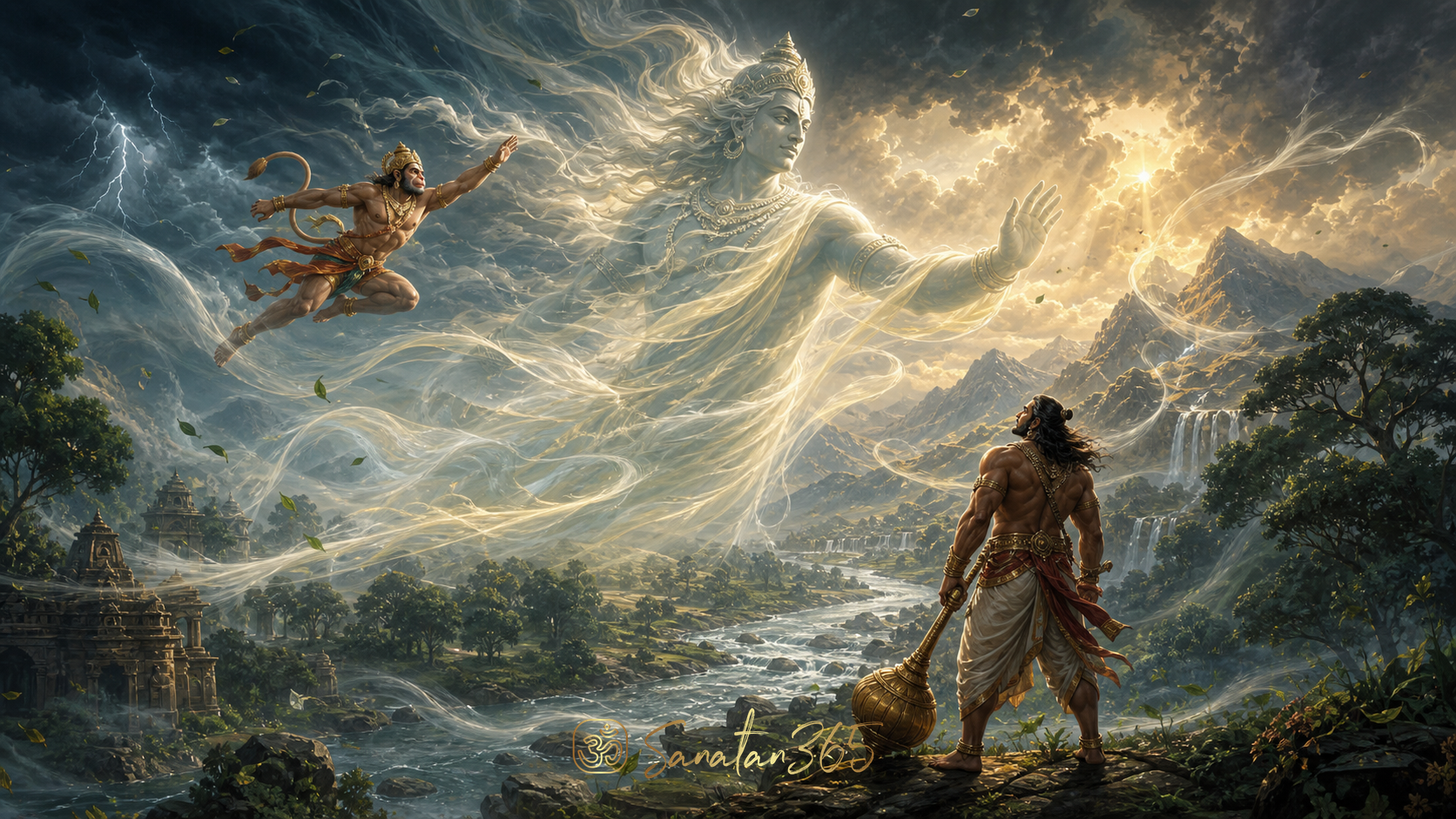
Wind cannot be held in the hand, yet every leaf, flame, cloud, and breath reveals that it is present. This is the heart of Vayu Deva meaning in Hindu tradition: Vayu is the divine power of wind and movement, while also pointing toward the life-sustaining force experienced through breath. Vedic hymns honor him as swift and life-giving; later sacred narratives recognize Hanuman and Bhima as sons of Vayu, each expressing immense strength in a different moral form. Vayu therefore represents far more than weather. He helps readers see power as movement guided by purpose, restraint, courage, and service.
Who is Vayu Deva and what does he represent?
Vayu (वायु, vāyu, wind or air) is a Vedic deity associated with the moving atmosphere. The Sanskrit word comes from a verbal root connected with blowing or moving. In the Rig Veda, Vayu is addressed as a swift divine presence who travels in a radiant chariot and is invited to the sacred offering. Hymns 1.134 and 1.135 praise his speed and ask him to arrive with his teams of horses, language that turns the movement of wind into a vivid sacred arrival. Readers can consult the Rig Veda in translation while remembering that translations of Vedic poetry often differ.
The image is not simply poetic decoration. Wind is known through its effects. It carries rain clouds, bends trees, feeds fire, cools the body, and makes sound possible. Vayu thus gives sacred form to a power that is invisible but unmistakably active.
Hindu iconography and later descriptions may portray Vayu as a dignified deity riding through the sky, sometimes carrying a banner. Details vary across periods and regions, so no single artistic representation should be treated as the only correct one. What remains consistent is movement: Vayu crosses boundaries, animates space, and makes still things respond.
This identity also explains why Vayu is sometimes linked with the northwest direction in later directional-deity systems. Yet his significance is not limited to one place on a diagram. Air surrounds every direction and enters every living body.
Key takeaway: Vayu Deva personifies the unseen but active power of wind, revealing divine presence through movement and effect.
How is Vayu described in the Vedas and Upanishads?
The Vedic hymns present Vayu as a deity worthy of direct invocation. Rig Veda 1.134 calls upon his powerful teams, while 1.135 invites him to the ritual drink before other deities. Such passages belong to a liturgical world in which wind is neither a lifeless mechanism nor merely a metaphor. It participates in a sacred cosmos where natural powers, ritual action, and divine relationship are interwoven.
The Upanishads deepen the reflection. They frequently use breath and wind to ask what sustains life and coordinates the senses. In the Prashna Upanishad, prana (प्राण, prāṇa, vital breath or life-force) is described as having a governing role among the powers of the person. A well-known teaching depicts the senses disputing about their importance; when prana prepares to depart, the others are disturbed, like bees following their queen. The point is not anatomy in a modern scientific sense. It is a contemplative account of dependence: sight, hearing, speech, and thought require living vitality.
The Brihadaranyaka Upanishad similarly explores breath as a sustaining power that is not defeated when the other faculties are tested. These teachings helped make the language of wind and breath central to later yoga and Vedanta reflection.
It is important, however, to respect the layers of the tradition. The Vedic deity Vayu, the physical wind, the breath moving through the body, and metaphysical teachings about prana are related, but they are not always interchangeable. A hymn addressing Vayu as a deity has a different purpose from an Upanishadic dialogue about the vital functions of a living person.
This layered understanding keeps the tradition rich. It allows worship, philosophy, ritual, and bodily practice to speak to one another without forcing them into one definition.
Key takeaway: Vedic texts praise Vayu as divine wind, while Upanishadic teachings use breath and vitality to examine what sustains embodied life.
What is the relationship between Vayu and prana?
In everyday speech, Vayu may mean air or wind, while prana means the vital breath or animating force of life. The two meet most clearly in breathing: air moves from the surrounding world into the body, and the living body receives and uses that movement. Yet prana in yoga and Upanishadic thought is broader than oxygen or the mechanical act of inhalation.
Traditional models often speak of five major functions of vital energy:
- Prana in the narrower sense is associated with inward-moving breath and the chest.
- Apana (अपान, apāna, downward-moving vital function) is associated with elimination and release.
- Samana (समान, samāna, balancing vital function) is associated with digestion and assimilation.
- Udana (उदान, udāna, upward-moving vital function) is associated with speech and upward movement.
- Vyana (व्यान, vyāna, pervasive vital function) is associated with circulation throughout the body.
These are traditional contemplative categories, not substitutes for medical physiology. They should not be used to diagnose illness or promise cures. Anyone with breathing difficulty should seek qualified medical care rather than treating spiritual breathing language as treatment.
The distinction also matters in pranayama practice. Pranayama (प्राणायाम, prāṇāyāma, disciplined regulation or expansion of breath) works with breathing as a doorway to attention and steadiness. It does not imply that a practitioner controls Vayu Deva or manipulates a supernatural substance. Responsible practice begins gently, respects health limitations, and learns from qualified instruction.
One useful reflection is simple: breath is received before it is controlled. A person can shape a breath for a short time, but no one authors the vast atmosphere that makes breathing possible. Vayu therefore invites gratitude before technique.
Key takeaway: Vayu is divine wind and movement; prana is the vital principle expressed through several life functions. Breath connects them without making them identical.
Why are Hanuman and Bhima called sons of Vayu?
The two great epics give Vayu's power a human and devotional dimension. Hanuman in the Ramayana and Bhima in the Mahabharata are both widely known as sons of Vayu, but their stories express the inheritance differently.
Hanuman: strength made weightless by devotion
Hanuman's birth traditions identify the wind deity as instrumental in his divine conception, which gives rise to names such as Pavanaputra (पवनपुत्र, pavanaputra, son of the wind) and Vayuputra (वायुपुत्र, vāyuputra, son of Vayu). As a child, Hanuman's restless energy reaches toward the sun. In the Ramayana's mature devotional arc, that energy becomes disciplined service to Lord Rama.
His leap across the ocean is an especially clear image of Vayu-like power. Hanuman crosses an immense distance, adapts his form, reads danger, resists distraction, and reaches Lanka for a defined purpose. Speed alone would not make the act sacred. His strength is governed by seva (सेवा, sevā, selfless service) and remembrance of Rama.
This is why the Hanuman Chalisa's teaching on strength and surrender remains so resonant. Hanuman does not become small by serving. Service gives his force direction.
Bhima: strength tested by appetite, anger, and duty
In the Mahabharata, Kunti invokes Vayu and gives birth to Bhima. His extraordinary physical power appears from childhood and later protects the Pandavas through repeated dangers. Bhima's directness, fierce loyalty, appetite, and anger make him a more turbulent expression of wind-like force than Hanuman.
The Mahabharata does not present strength as automatically virtuous. Bhima's power becomes meaningful when it serves dharma (धर्म, dharma, sustaining moral order and rightful duty). At other moments, his intensity must be counselled and restrained. This moral complexity is essential: force can rescue, but force without discernment can also injure.
One later episode beautifully joins the two sons of Vayu. Bhima encounters an aged monkey whose tail blocks his path. Unable to move it, he discovers that the monkey is Hanuman. The meeting humbles Bhima and places physical strength within a larger lineage of devotion, wisdom, and self-knowledge. The Mahabharata's forest narratives preserve this encounter within Bhima's journey.
Hanuman and Bhima are therefore not duplicates. Hanuman shows power becoming transparent through devotion; Bhima shows power being educated through trial, loyalty, correction, and duty.
Key takeaway: The sons of Vayu reveal two moral forms of strength: Hanuman's disciplined service and Bhima's formidable energy refined by responsibility.
What can Vayu's symbolism teach in daily life?
Vayu's symbolism becomes practical when it is translated into qualities rather than superstition.
First, movement needs direction. Wind can carry fragrance, fill a sail, scatter seeds, or intensify a fire. In the same way, energy is not enough. A busy day can produce service or agitation depending on the intention guiding it.
Second, strength should remain responsive. Wind moves around obstacles rather than meeting everything with blunt force. Hanuman's mission in Lanka succeeds through intelligence, proportion, concealment, courage, and speech as much as muscular power. Flexibility is not weakness; it is strength that can listen.
Third, every force has limits. A storm reminds human beings that movement can exceed control. Bhima's encounter with Hanuman offers the ethical equivalent: even a powerful person needs humility, elders, counsel, and situations that reveal what effort alone cannot accomplish.
Fourth, breath can become a cue for responsibility. Before a difficult reply, one natural unforced breath creates a small space between impulse and action. This is not a guaranteed cure for anger or anxiety. It is simply a practical reminder that attention can accompany movement.
A short Vayu-inspired reflection may follow four steps:
- Notice one natural breath without changing it.
- Recognize that breath depends upon a world beyond the individual.
- Name the purpose that should guide the next action.
- Choose one form of service that gives energy a worthy direction.
Vayu also widens ecological awareness. Clean air is not merely a private resource. It is shared across homes, species, cities, forests, and borders. Reverence for wind should encourage responsible care for the atmosphere, without turning devotional language into a simplistic environmental claim.
The image of Garuda's freedom disciplined by service offers a useful companion. Both sky-moving figures challenge the assumption that freedom means aimlessness. In Hindu thought, the highest mobility often becomes meaningful through devotion and dharma.
Key takeaway: Vayu's power becomes wisdom when movement serves a clear purpose, strength remains adaptable, and breath awakens gratitude and responsibility.
The deepest Vayu Deva meaning is found where invisible power becomes visible through right action. The wind moves without possession, breath sustains without announcing itself, Hanuman serves without vanity, and Bhima learns that might must answer to dharma. Together, these teachings invite a form of strength that is alive, mobile, humble, and useful.
Key takeaway: True strength is not merely the ability to move the world; it is the discipline to move in service of what is right.
FAQ
Is Vayu Deva the Hindu god of wind?
Yes. Vayu is the Vedic deity associated with wind and the moving atmosphere. His meaning later develops alongside teachings about breath and vital energy, though wind, breath, Vayu, and prana should not always be treated as identical terms.
Are Vayu and prana the same?
They are closely related but not simply the same. Vayu can mean wind or air and is also the name of the wind deity. Prana refers to vital breath or the animating life-force, with several traditional functions in the body.
Why is Hanuman called Pavanaputra?
Pavanaputra means “son of the wind.” Hanuman's birth traditions connect him with Vayu or Pavana, and his speed, leap, vitality, and extraordinary strength express that relationship. His defining virtue, however, is the devotion that directs his power toward Lord Rama's service.
Why is Bhima called Vayuputra?
In the Mahabharata, Kunti invokes Vayu and gives birth to Bhima. His immense physical strength and forceful temperament reflect this divine parentage, while his life repeatedly teaches that power must be governed by dharma and wise counsel.
Can reflecting on Vayu replace medical breathing care?
No. Devotional reflection and gentle awareness of natural breath may support spiritual practice, but they do not diagnose or treat breathing conditions. Persistent or severe symptoms require qualified medical care.
About the author
Sanatan365 Editorial
Bringing Sanatan Dharma to modern seekers through authentic, scripture-grounded content.
Related in Deities
 Deities
Savitr Deva Meaning: Golden Hands and the Rhythm of Life
Meet Savitr, the Vedic divine impeller whose golden hands set life in motion and whose hymns honour rest as well as activity.
 Deities
Indra Deva Meaning: The Vajra, Rain, and Responsible Power
Indra links the thunderbolt and released waters with a demanding question: what is strength for? Read his Vedic imagery and later lessons w…
 Deities
Agni Deva Meaning: Sacred Fire and the Divine Messenger
Meet Agni as the Vedic priest and messenger, read the first Rig Veda hymn, and understand sacred fire without reducing a living deity to a…

