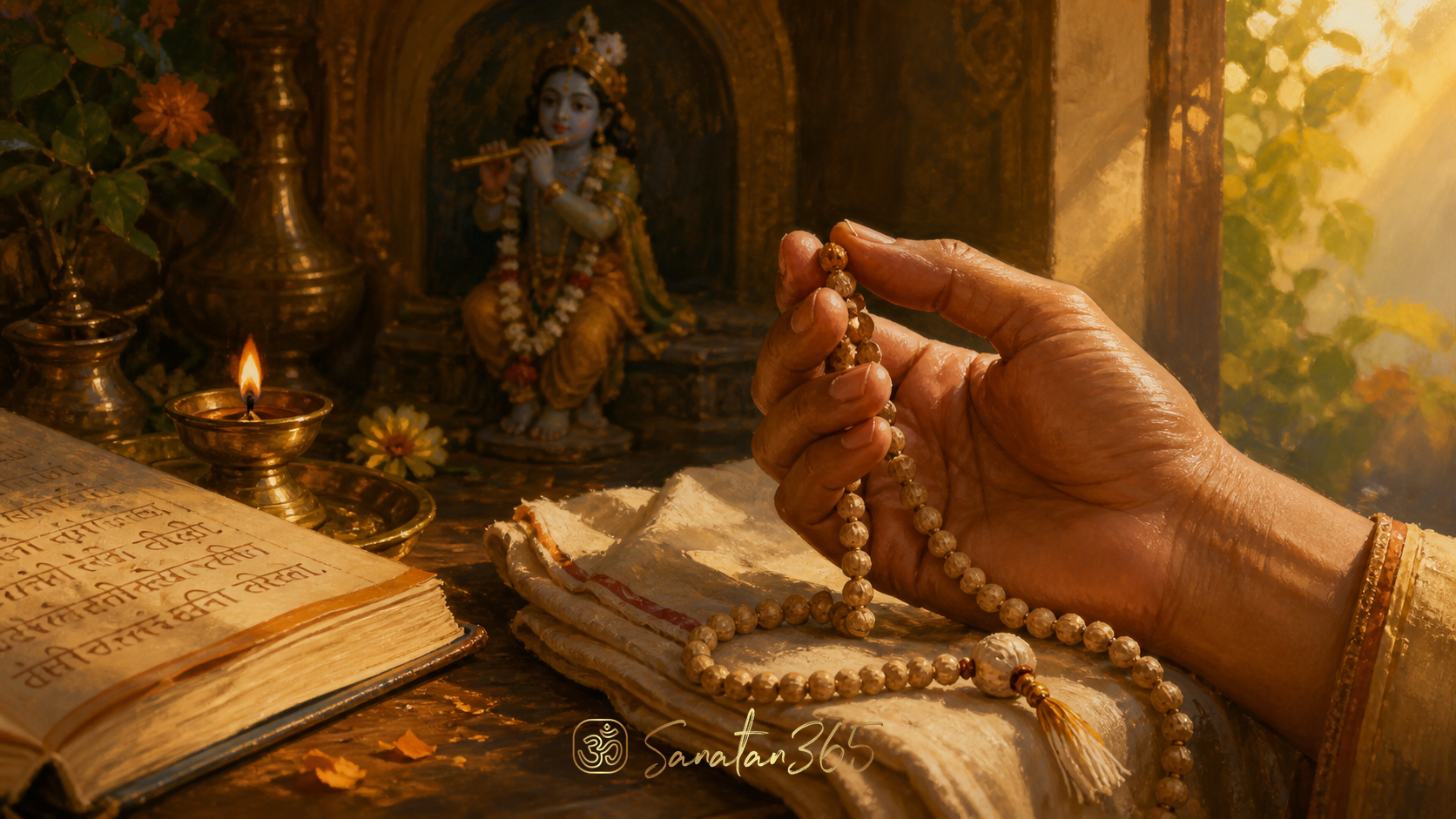
Japa Mala Meaning: Why 108 Beads Support Mantra Practice
A japa mala is a strand used to count mantra repetitions while steadying attention and devotion. Its 108 beads give practice a clear rhythm without turning prayer into a race.
A japa mala turns an invisible practice into a rhythm the fingers can feel. Japa mala meaning begins with japa (जप, repeated recitation of a sacred name or mantra) and mala (माला, garland): it is a garland of beads used to count repetitions while the mind returns, bead by bead, to remembrance.
Most Hindu japa malas contain 108 counting beads and one larger meru bead (मेरु, summit or guiding bead). The number gives a practice a definite form, but the mala is not a spiritual scorecard. Its purpose is to free attention from mental arithmetic, support steadiness, and help prayer become regular without becoming mechanical.
What Is the Japa Mala Meaning in Hindu Practice?
Japa may be voiced clearly, whispered, or repeated mentally, depending on the mantra, lineage, and instruction received. The Bhagavad Gita 10.25 presents japa-yajna (जपयज्ञ, the offering or sacrifice of sacred repetition) as a distinguished form of worship. Patanjali's Yoga Sutra 1.28 similarly joins repetition with contemplation of meaning: the sacred syllable is repeated while its significance is remembered. The Gita Supersite text of Bhagavad Gita 10.25 and Yoga Sutra 1.28 preserve these textual anchors.
The mala serves this practice in three ways. First, it counts without forcing the practitioner to keep numbers in working memory. Second, the repeated touch creates a gentle sensory cue: when attention wanders, the next bead invites a return. Third, completing one circuit gives the session a clear beginning and end.
Different traditions use tulsi wood, rudraksha seeds, sandalwood, lotus seeds, crystal, or other materials. These are not interchangeable fashion choices in every lineage. Tulsi malas are strongly associated with Vaishnava devotion, while rudraksha is closely associated with Shiva. A teacher or family tradition may recommend a material suited to a particular mantra. The earlier guide to rudraksha and steady japa practice explains one such sacred association.
The strand should therefore be understood as a practice tool treated with reverence, not as a magical object that guarantees results. The mantra, attention, ethical life, devotion, and consistency remain central.
Key takeaway: A japa mala is a tactile companion to sacred repetition, helping the practitioner count while keeping the heart of the practice on remembrance.
Why Are There 108 Beads in a Japa Mala?
The short answer is that 108 is a sacred whole used across several Indian religious and contemplative traditions. Yet there is no single universally binding explanation for why every mala must contain exactly 108 beads. Hindu teachers and communities preserve several complementary interpretations.
One explanation points to lists of 108 divine names, recited as a namavali (नामावली, garland or sequence of names). Another relates 108 to cosmological and calendrical patterns, including traditional enumerations that multiply significant numbers. Some yogic explanations connect it with a symbolic map of the human being and cosmos. The Oxford Centre for Hindu Studies overview of japa describes repetition as a major devotional and meditative discipline, while the diversity of Hindu practice cautions against reducing 108 to one clever equation.
What can be said with confidence is practical: 108 is long enough to require sustained attention, yet finite enough to complete in an ordinary sitting. It turns a vague intention such as “I will chant for a while” into a bounded vow. Many practitioners also use shorter malas of 54 or 27 beads, completing two or four circuits respectively to reach 108. A wrist mala may contain an even smaller count.
The larger meru bead is not normally included among the 108. It marks the point where a round begins and ends. Rather than crossing over it, practitioners commonly reverse direction and continue back through the beads. This small act prevents the circle from becoming mindless; the boundary asks the practitioner to notice that a round has been completed.
Numbers should support devotion rather than anxiety. A missed count is not a spiritual catastrophe, and speed is not proof of depth. If counting makes a person tense, a smaller, sustainable commitment may be wiser than forcing a full round.
Key takeaway: The 108 beads create a traditional, complete rhythm; their value lies in supporting sustained practice, not in turning prayer into arithmetic.
How Do You Use a Japa Mala Respectfully?
Customs differ, so instructions from one's guru, sampradaya (सम्प्रदाय, living spiritual lineage), temple, or family practice take priority. In a common method, the mala is held in the right hand and draped over the middle finger. The thumb draws one bead at a time; the index finger does not manipulate the beads. Some traditions use a cloth bead bag to protect the mala and preserve inwardness.
A simple general sequence is:
- Sit in a clean, settled place and choose the mantra before beginning.
- Hold the bead next to the meru bead without counting the meru itself.
- Recite the mantra once, audibly, softly, or mentally as appropriate.
- Use the thumb to move to the next bead, without rushing.
- Continue until the meru is reached again.
- To begin another round, turn the mala and reverse direction instead of crossing the meru.
- End with a brief pause, allowing the sound and meaning to settle.
The mantra should be pronounced as accurately as possible. Some mantras are widely used in household devotion; others are traditionally received through diksha (दीक्षा, formal initiation). When a mantra belongs to an initiated practice, public instructions should not replace guidance from the initiating teacher. The article on diksha and the teacher-student bond gives helpful context.
Care for the mala follows the same spirit. Many practitioners keep it in a clean pouch, avoid placing it directly on the floor, and reserve a practice mala for japa rather than casual decoration. Regional and lineage conventions vary, and respectful variation is part of Hindu tradition.
Key takeaway: Use one bead for one repetition, honor the meru boundary, and follow the living customs of the tradition from which the mantra comes.
How Does a Mala Help Attention Without Making Japa Mechanical?
Repetition can deepen attention, but repetition can also become automatic. The mala cannot solve that tension by itself. It works best when touch, sound, meaning, and intention are gently reunited.
The fingers provide an anchor. If the mind wanders into planning or memory, the sensation of the bead makes distraction easier to notice. The practitioner does not need to judge the wandering; the next repetition is already an invitation to return. This resembles the disciplined return cultivated in dhyana and meditation practice, though japa retains its own devotional and sonic character.
Meaning matters as much as count. If repeating a divine name, one can remember the quality, presence, or relationship invoked by that name. If repeating a Vedic or yogic mantra, contemplation should remain within the understanding provided by trustworthy teaching. Patanjali's pairing of repetition and reflection guards against empty sound on one side and abstract analysis on the other.
Several habits keep japa alive:
- begin with a clear sankalpa (संकल्प, sincere intention), such as one round offered with steadiness;
- keep a pace at which each repetition remains recognizable;
- return to pronunciation when the sound blurs;
- periodically recall the mantra's meaning rather than racing through the count;
- sit for a short silence after the final bead;
- let the qualities honored in the mantra influence speech and conduct afterward.
The last point is crucial. A thousand repetitions do not excuse harshness, dishonesty, or neglect. Japa is meant to gather a scattered person around sacred remembrance. Its fruit should appear, however gradually, as patience, humility, clarity, and service.
Key takeaway: The mala prevents counting from occupying the mind, but conscious pronunciation, meaning, and ethical follow-through prevent repetition from becoming empty.
How Can a Beginner Build a Sustainable Mantra Practice?
Consistency grows more reliably from a modest promise than an heroic first day. A beginner might start with 11 or 27 repetitions at the same time each morning or evening. After that rhythm becomes natural, the count can expand toward one full mala.
Choose one established mantra rather than collecting many. Learn its pronunciation and meaning from a credible source. Pair the practice with a stable cue: after bathing, before breakfast, beside the home shrine, or before evening rest. The surrounding ritual can remain simple; a clean seat and attentive mind matter more than elaborate equipment.
It is also wise to separate spiritual practice from guaranteed claims. Japa may support calm, devotion, and concentration for many people, but it is not a substitute for medical or mental-health care. Someone experiencing severe distress should seek qualified professional support and trusted human help alongside any spiritual practice.
On difficult days, protect continuity by reducing the count instead of abandoning the practice. Eleven attentive repetitions may preserve the relationship better than 108 hurried ones. On easier days, complete a full round without using increased quantity as a reason for pride.
A useful weekly reflection is not “How many rounds did I achieve?” but:
- Did attention return more gently?
- Did the mantra's meaning become clearer?
- Did practice make speech and action more considerate?
- Is the commitment sustainable within family and work responsibilities?
This approach complements tapas as disciplined inner fire: discipline is valuable when it creates clarity and steadiness, not strain or display.
Key takeaway: Begin small, learn one mantra well, attach it to a stable daily cue, and measure progress through steadiness and character rather than quantity alone.
Conclusion
The deepest japa mala meaning is not hidden in the beads themselves. The strand gives sacred repetition a body: one bead, one mantra, one return. Its 108 beads preserve a traditional sense of completeness, the meru marks a conscious boundary, and the fingers relieve the mind of counting.
Used reverently, the mala makes discipline gentle and devotion concrete. It does not guarantee a result or replace the guidance appropriate to initiated mantras. It simply helps a practitioner keep returning until repetition becomes remembrance and remembrance begins to shape daily life.
Key takeaway: The mala counts repetitions so the practitioner can attend to what truly matters: sacred sound, meaning, devotion, and the character formed through steady return.
FAQ
What does japa mala mean?
Japa mala means a “garland for sacred repetition.” It is a strand of beads used to count repetitions of a mantra or divine name while supporting attention and devotional rhythm.
Why does a japa mala have 108 beads?
The number 108 is treated as a sacred whole in Hindu traditions and appears in sequences such as 108 divine names. It also provides a practical, finite count for sustained recitation. Traditions offer several symbolic explanations rather than one exclusive formula.
What is the extra bead on a mala?
The larger bead is commonly called the meru or guru bead. It marks the beginning and end of a round and is not counted among the 108. Practitioners generally reverse direction instead of crossing over it.
Can a beginner chant fewer than 108 times?
Yes. Eleven, 27, or 54 repetitions can form a sincere beginning. A smaller attentive practice is often more sustainable than a full round performed hurriedly.
Can any mantra be used with a japa mala?
Many widely known names and mantras are used in household practice, but some mantras are traditionally received through initiation. When a mantra belongs to a specific lineage, guidance from that tradition should take priority over general online instructions.
About the author
Sanatan365 Editorial
Bringing Sanatan Dharma to modern seekers through authentic, scripture-grounded content.
Related in Mantras
 Mantras
Kanakadhara Stotram Meaning: Lakshmi, Compassion, and Prosperity
Kanakadhara Stotram praises Lakshmi through the image of her compassionate glance. Explore its Sanskrit meaning, traditional story, and res…
 Mantras
Om Namo Narayanaya Meaning: Surrender, Reverence, and the Eight-Syllable Mantra
Om Namo Narayanaya is the Ashtakshara, or eight-syllable mantra, of the Vaishnava tradition. It expresses reverent surrender to Narayana, t…
 Mantras
Sarve Bhavantu Sukhinah Meaning: A Prayer for Universal Well-Being
Sarve Bhavantu Sukhinah asks that all beings be happy, healthy, secure in what is good, and free from suffering. Explore its line-by-line m…