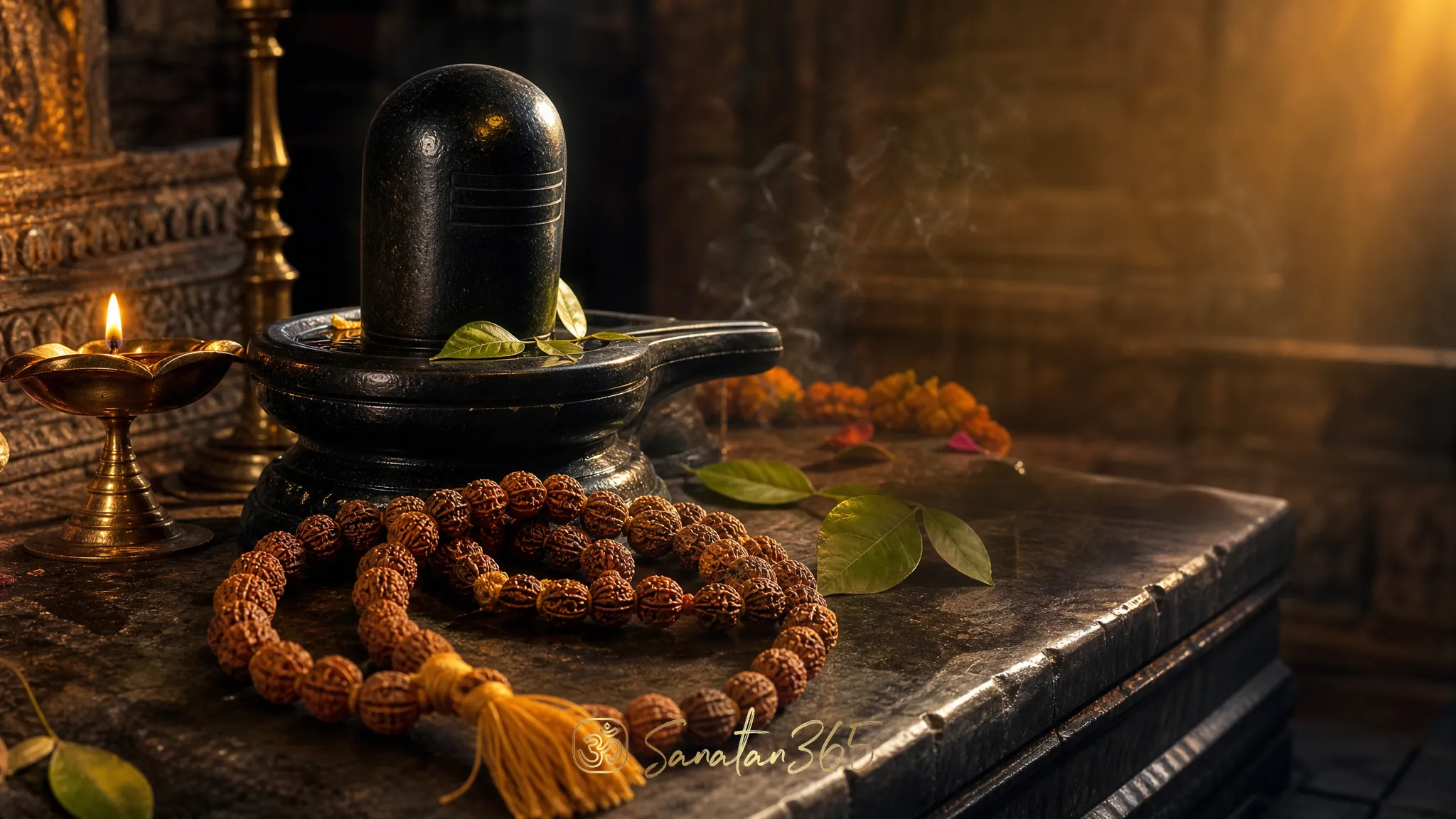
Rudraksha Meaning: Shiva's Sacred Beads for Japa and Steady Practice
Rudraksha meaning explained through Shiva devotion, japa mala practice, mukhi beads, and a grounded way to wear or use sacred beads with reverence.
A small seed can become a discipline when the hand meets it with reverence.
Rudraksha meaning begins with Shiva, japa (जप, repeated sacred recitation), and the humble bead that helps a seeker count mantra without turning prayer into arithmetic. A rudraksha is traditionally understood as a sacred seed associated with Rudra-Shiva; in practice, it is worn or used in a mala (माला, garland or rosary) for remembrance, mantra, and steadiness. Its deepest value is not decoration or superstition. It is the way a physical bead can train attention toward sacred sound, ethical living, and daily devotion.
Key takeaway: Rudraksha is best understood as a sacred aid to practice, not as an object that replaces sincerity, discipline, or dharma.
What Is Rudraksha Meaning in Shiva Practice?
Rudraksha meaning is often explained through the Sanskrit roots Rudra and aksha. Rudra is an ancient Vedic name closely associated with Shiva; Britannica notes that Rudra later becomes deeply connected with Shiva in Hindu tradition Britannica. Aksha is commonly understood as eye, tear, or seed in devotional explanations. Together, rudraksha is remembered in living tradition as "the eye of Rudra" or "the tear of Shiva."
This etymology should be handled with reverence rather than sensationalism. The point is not to reduce the bead to a dramatic myth. The point is to understand the devotional relationship: Shiva is the great yogi, the ascetic, the compassionate Lord who receives the sincere heart. Britannica's article on Shiva describes Shiva's wide Hindu significance as ascetic, yogi, destroyer, and auspicious Lord. Rudraksha belongs naturally to that Shaiva imagination of meditation, mantra, vairagya (वैराग्य, detachment), and inner steadiness.
In many households and ashrams, rudraksha beads are used for japa, especially with mantras such as Om Namah Shivaya. The bead helps the hand move through repetition while the mind returns to sound. Each bead becomes a small reminder: come back, chant again, listen again, soften again.
Key takeaway: Rudraksha points toward Shiva not merely as a symbol, but as a practice of returning the mind to sacred remembrance.
What Are Rudraksha Beads Made From?
Rudraksha beads are seeds, not stones. Botanical references identify the bead with the dried seed of Elaeocarpus ganitrus. A pharmacognostic study in the Indian Journal of Pharmaceutical Sciences describes rudraksha as the dried bead obtained from the ripe fruit of Elaeocarpus ganitrus PMC. In devotional use, the dried seed is cleaned, pierced, strung, and often worn as a mala or bracelet.
The visible grooves on a rudraksha bead are called mukhi (मुखी, faces or natural lines). A five-mukhi bead is among the most common in everyday use, while other mukhi counts are treated differently in various traditions. Serious practitioners usually avoid turning this into a status game. A rare bead may attract attention, but spiritual maturity is not measured by rarity.
This matters because modern markets can make rudraksha feel like a spiritual luxury product. The older spirit is simpler. A bead should support japa, humility, restraint, and remembrance. If it inflates pride, the object has been misunderstood.
A seeker can remember three layers:
- Botanical layer: a natural seed from a living tree.
- Devotional layer: a sacred object associated with Shiva.
- Practice layer: a tactile aid for mantra, attention, and sankalpa (संकल्प, sacred intention).
Each layer protects the others. The bead is physical, so it should be treated practically. It is sacred, so it should be treated respectfully. It is a practice aid, so it should be used rather than merely displayed.
Key takeaway: Rudraksha is a natural seed made sacred through tradition, mantra, and disciplined use.
How Does A Shiva Japa Mala Help Daily Practice?
A Shiva japa mala helps daily practice by giving the body a steady rhythm for mantra. The hand touches one bead, the mantra is repeated, and the hand moves to the next bead. This simple rhythm can reduce restlessness because attention has a place to return.
Japa is not only repetition. It is remembrance. In Sanatan Dharma, sacred sound is not treated as casual language. Mantra is received, honored, repeated, and internalized. A rudraksha mala can support this by slowing the mind down. Instead of chanting while half-distracted, the seeker feels each bead and notices whether the mantra is alive or mechanical.
For beginners, the practice can be simple:
- Sit with a clean body and a respectful mind.
- Hold the mala gently, not as an object of display.
- Set a sankalpa for clarity, devotion, or steadier conduct.
- Repeat the chosen mantra bead by bead.
- End with gratitude and carry one calmer action into the day.
Many practitioners use 108 beads, a number widely found in Indian spiritual practice. The number should not become the only focus. Eleven sincere repetitions with attention may shape the heart more than 108 rushed repetitions done only to finish a count.
The mala also teaches return. The mind wanders. The bead remains. The mantra brings the mind back. In that sense, rudraksha practice is close to other daily disciplines such as Dhyana Meaning: Hindu Meditation as Steady Awareness, Not Empty Escape and Sankalpa Meaning: Why Hindu Puja Begins with Sacred Intention. It trains the seeker to begin again without drama.
Key takeaway: A rudraksha mala helps because it joins hand, breath, mantra, and intention into one steady rhythm.
What Does Mukhi Rudraksha Mean?
Mukhi rudraksha refers to the natural lines or faces visible on the bead. Different traditions associate different mukhi counts with different deities, qualities, or forms of practice. Five-mukhi rudraksha is especially common and is often connected with Shiva practice in everyday devotional life.
A careful reader should keep two cautions in mind. First, not every online claim about mukhi beads is reliable. Some claims promise guaranteed wealth, health, success, or instant spiritual powers. That is not a responsible Sanatan Dharma framing. Sacred practice may support discipline and inner steadiness, but it should never be sold as a guaranteed result.
Second, the bead should not become a substitute for conduct. A person can wear rudraksha and still speak harshly, act dishonestly, or live carelessly. The bead does not do the ethical work for the wearer. It reminds the wearer to do that work.
A healthier approach is to ask:
- Does this bead deepen my remembrance of Shiva?
- Does it make me more careful with speech?
- Does it support regular japa?
- Does it encourage humility rather than display?
- Does it fit my family and community tradition respectfully?
If the answer is yes, the bead is serving its purpose. If the bead becomes anxiety, competition, or vanity, the practice needs to be simplified.
Key takeaway: Mukhi counts matter within tradition, but the highest test is whether the bead supports devotion, humility, and better daily conduct.
How Should Rudraksha Be Worn or Used Respectfully?
Rudraksha should be worn or used respectfully, with cleanliness, sincerity, and awareness of one's tradition. Customs vary by family, guru-parampara (गुरु-परम्परा, teacher lineage), region, and community. Some people wear rudraksha daily. Some use it only for japa. Some avoid wearing it during certain activities. A seeker should follow the guidance of trusted elders or qualified teachers where available.
The basic principle is simple: do not treat a sacred object casually. Keep the mala clean. Do not throw it around. Do not wear it only as fashion while ignoring its meaning. If it is used for japa, store it in a clean pouch or sacred space. If it breaks, repair or retire it respectfully according to local custom.
Regional variation is natural. Shaiva sadhus may wear rudraksha prominently. Householders may wear one bead, a bracelet, or a simple mala. Diaspora families may keep a mala near the home altar and use it before work or school. None of these needs to become a contest. The dharmic question is not "Who looks more spiritual?" It is "Who remembers with sincerity?"
Rudraksha can also sit within a wider practice rhythm:
- Morning japa before daily duties.
- A short mantra pause before a difficult conversation.
- Evening prayer near the altar.
- A weekly longer practice on Monday, traditionally associated with Shiva.
- Temple darshan, aarti, or study when possible.
For related practice context, readers can also explore Aarti Meaning: Why Hindus Offer Light in Worship and Pradakshina Meaning: Why Hindus Walk Clockwise Around the Sacred. The bead is one doorway among many; it does not need to carry the whole burden of spiritual life.
Key takeaway: Respectful rudraksha use is clean, sincere, tradition-aware, and connected to actual practice.
Why Does Rudraksha Matter for Modern Seekers?
Rudraksha matters for modern seekers because attention is easily scattered. A phone can pull the mind in ten directions before sunrise. A mala in the hand does the opposite. It asks the seeker to repeat one sacred sound, touch one bead, breathe one breath, and return.
This is especially useful for people who feel disconnected from temple life or inherited practice. A person in Mumbai, Varanasi, Bengaluru, London, New Jersey, or Singapore may not always have time for long rituals. But a rudraksha mala can make five minutes of japa feel anchored. It gives daily practice a form.
At the same time, the bead should not be burdened with exaggerated promises. Rudraksha is not a medical treatment, financial tool, or guaranteed protection device. It belongs to devotional and contemplative life. The real transformation comes through repeated practice, ethical conduct, grace, and the slow purification of attention.
For families, rudraksha can also become a teaching object. A parent can explain that Shiva is not only worshipped in temples but remembered through discipline, silence, mantra, and compassion. A child can learn that sacred things are handled gently. A young adult can learn that identity is not only cultural display; it can become lived practice.
The bead is small, but the lesson is large: spiritual life becomes real through repetition. One mantra, one breath, one act of restraint, one honest word, one return to the Divine. That is how a symbol becomes sadhana (साधना, disciplined spiritual practice).
Key takeaway: Rudraksha helps modern seekers by giving devotion a simple physical rhythm in a distracted world.
FAQ
What is Rudraksha meaning?
Rudraksha meaning is commonly explained as "the eye of Rudra" or "the tear of Shiva." In practice, it refers to sacred seeds associated with Shiva devotion, japa, and steady remembrance.
Is rudraksha a seed or a stone?
Rudraksha is a seed, not a stone. It is traditionally identified with the dried seed of Elaeocarpus ganitrus, then cleaned, pierced, and strung for devotional use.
Can anyone use a rudraksha mala?
Many seekers use rudraksha for mantra and devotion, but customs vary. It is best to use it respectfully, keep it clean, avoid treating it as fashion alone, and follow trusted family or teacher guidance where available.
What mantra is commonly used with rudraksha?
Many Shiva devotees use rudraksha with Om Namah Shivaya. The mantra should be repeated with reverence, not rushed only to complete a number.
Does rudraksha guarantee success or protection?
No. Rudraksha should not be presented as a guaranteed source of wealth, health, success, or protection. It is a sacred aid for devotion, discipline, and remembrance; the seeker still must live with dharma and responsibility.
Rudraksha meaning finally returns to the hand and heart. A bead can count mantra, but only the seeker can bring sincerity. Shiva practice is not proved by what is worn. It is revealed through steadier speech, humbler action, cleaner intention, and the quiet willingness to return to the Divine again and again.
Key takeaway: Rudraksha is most powerful when it becomes a daily reminder to chant, remember, and live with greater dharma.
About the author
Sanatan365 Editorial
Bringing Sanatan Dharma to modern seekers through authentic, scripture-grounded content.
Related in Practices
 Practices
Shaucha Meaning in Yoga: Cleanliness Without Harsh Purity Rules
Explore shaucha as a yogic observance: its scriptural setting, outer and inner dimensions, daily practice, and why cleanliness must never b…
 Practices
Kusha Grass Meaning: Why Darbha Has a Place in Hindu Rituals
Understand kusha or darbha grass, its traditional place in worship and ancestral rites, and how to approach varied customs with care.
 Practices
Bhuta Shuddhi Meaning: Purifying the Five Elements Within
Bhuta Shuddhi means the purification of the five elements: earth, water, fire, air, and space. In Hindu yogic and Tantric traditions, it is…

