Kanwar Yatra Meaning: Shiva, Gangajal, and Walking Devotion
A clear guide to Kanwar Yatra meaning, why devotees carry Gangajal for Lord Shiva, key routes, safe practice, and the inner discipline of Shravan pilgrimage.
Some pilgrimages are measured in miles. Kanwar Yatra is measured in how carefully a devotee carries water.
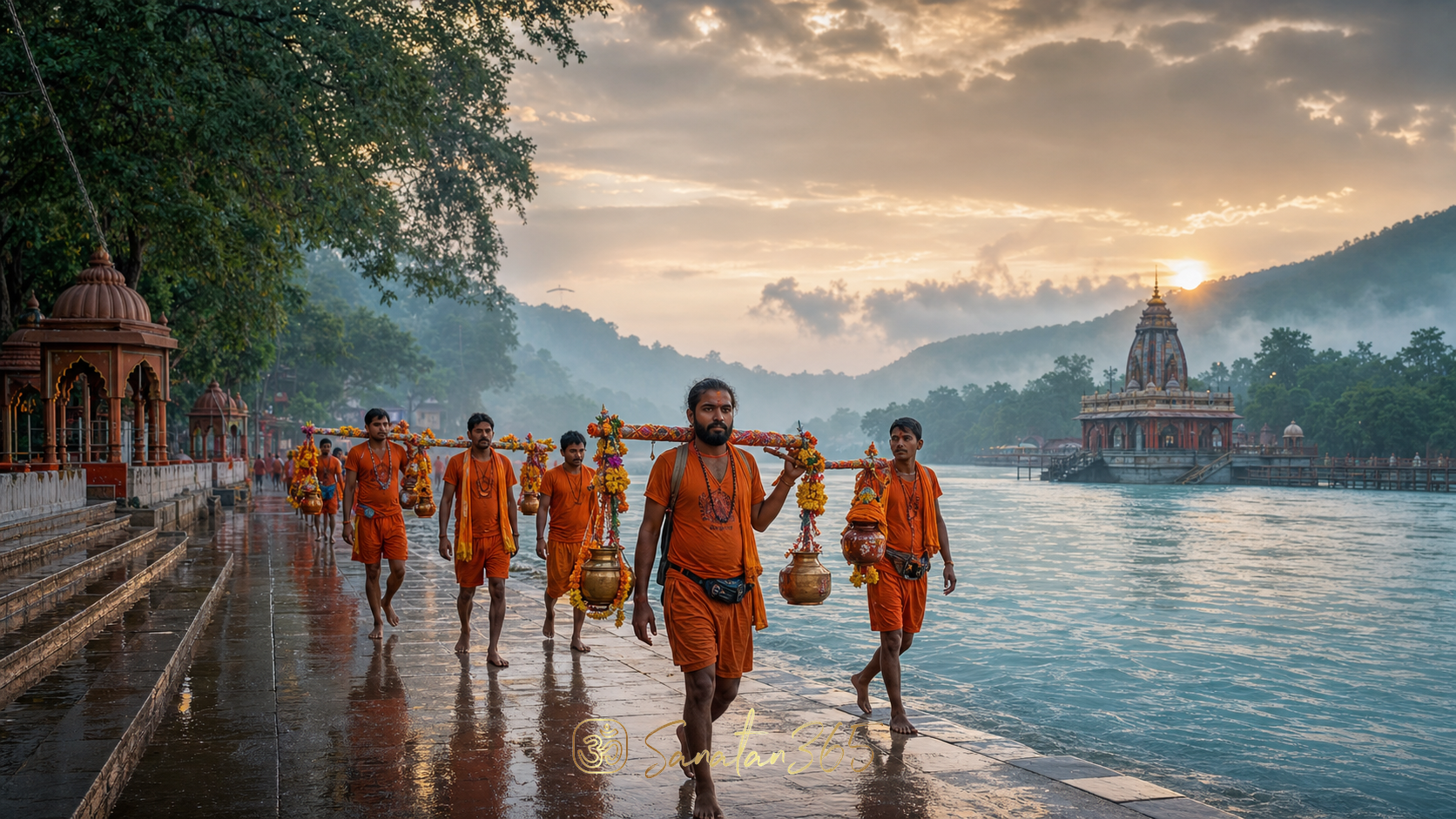
Kanwar Yatra meaning begins with a simple act: devotees of Lord Shiva carry sacred Ganga water, or Gangajal (गंगाजल, water from the Ganga), in a decorated kanwar (कांवड़, shoulder-carried water frame) and offer it as jalabhishek (जलाभिषेक, sacred water offering) to a Shiva linga. The annual pilgrimage is observed during Shravan or Sawan, the monsoon month especially associated with Shiva. Its outer form is walking, but its inner discipline is restraint, service, humility, and remembrance.
Official Haridwar district guidance describes Kanwar Yatra as an annual pilgrimage of Shiva devotees to Haridwar, Gaumukh, and Gangotri to fetch Ganga water during Shraawan Haridwar district. Uttarakhand Tourism also lists Haridwar, Gaumukh, and Gangotri as major Kanwar Yatra sources Uttarakhand Tourism.
Key takeaway: Kanwar Yatra is not only a large public pilgrimage; it is a moving vow of Shiva bhakti, carried drop by drop.
What Is Kanwar Yatra Meaning in Hindu Pilgrimage?
Kanwar Yatra meaning comes from the word kanwar, the balanced pole or frame used to carry pots of sacred water. The pilgrim, often called a Kanwariya, carries the water with care and brings it to a Shiva temple for offering. In many regions the pilgrimage is marked by saffron clothing, group walking, chants of "Bol Bam" and "Har Har Mahadev," vegetarian discipline, and a vow to treat the water as sacred until it reaches the linga.
This makes the yatra (यात्रा, sacred travel) different from ordinary travel. A tourist moves from one location to another. A pilgrim moves with an offering, a vow, and a changed sense of the body. The shoulders become an altar. The road becomes a discipline. The group becomes a temporary satsanga (सत्संग, company of truth or noble association).
The water is central. In Hindu worship, water is never merely physical. It cools, cleanses, consecrates, and carries memory. When Gangajal is brought to Shiva, the devotee is not giving Shiva something He lacks. The devotee is offering effort, time, sweat, restraint, and love through water.
This is also why the kanwar is handled with such attention. The decorated frame is not a prop for spectacle; it is the pilgrim's visible sankalpa (संकल्प, sacred intention). To carry it carefully is to keep the vow awake from the riverbank to the temple.
Key takeaway: Kanwar Yatra turns movement into worship by joining sacred water, bodily discipline, and Shiva remembrance.
Why Do Devotees Offer Gangajal to Lord Shiva?
Lord Shiva is closely connected with the Ganga in Hindu imagination. In the Bhagiratha story, Shiva receives the descending Ganga in His matted locks so that her force does not shatter the earth. In temple practice, devotees pour water, milk, or other offerings over the Shiva linga as abhishek (अभिषेक, ritual bathing), a sign of reverence, surrender, and cooling devotion.
During Shravan, this symbolism becomes especially powerful. The monsoon cools the land after heat. The devotee cools the restless mind through restraint. The water offered to Shiva becomes a visible prayer: may inner heat, anger, pride, and exhaustion be calmed.
There is also a social meaning. Kanwar Yatra requires patience with others. Pilgrims walk in groups, receive food or water from roadside sevaks, and often depend on strangers. The route teaches that devotion is not isolated. It lives through shared care, cleanliness, traffic discipline, and respect for towns and villages on the path.
This is why the offering should not be reduced to a wish-fulfillment formula. A devotee may certainly pray for health, family, work, or relief from difficulty. But the deeper offering is the self trained by tapas (तपस्, disciplined effort). Gangajal reaches the linga; the pilgrim should return with a softer voice and steadier conduct.
Key takeaway: Gangajal offered to Shiva represents cooling, purification, gratitude, and the surrender of ego through disciplined effort.
Where Does Kanwar Yatra Take Place?
Kanwar Yatra has several important regional routes. In North India, Haridwar is one of the most visible gathering points. The official Haridwar page names Haridwar, Gaumukh, and Gangotri in Uttarakhand as sacred places where devotees fetch Ganga water Haridwar district. These routes draw devotees from Delhi, Uttar Pradesh, Haryana, Rajasthan, Punjab, and other nearby regions.
Eastern India has its own strong pattern. Deoghar district's Shrawani Mela reference describes devotees walking long distances, often from Sultanganj to Babadham, carrying water in kanwars while chanting "Bol Bam" Deoghar district. For many families in Bihar, Jharkhand, and eastern Uttar Pradesh, this Sultanganj-Deoghar route is a living part of Shravan memory.
Other pilgrims may offer the water at local Shiva temples rather than a major jyotirlinga or famous shrine. This does not make the devotion lesser. Sanatan Dharma has always held both the great tirtha (तीर्थ, sacred crossing place) and the home-near temple. The sacred geography expands through intention.
For diaspora families, the practice may become symbolic. A household in London, New Jersey, Dubai, Singapore, or Melbourne may not be able to walk a traditional route, but it can still mark Shravan through Shiva puja, clean water offering, mantra, charity, and learning about the pilgrimage with reverence.
Key takeaway: Kanwar Yatra is strongest in North and eastern India, but its core principle can be honored wherever Shiva is worshipped with discipline and respect.
When Is Kanwar Yatra 2026 Connected With Shravan?
Kanwar Yatra follows the Shravan or Sawan season, but dates can vary by regional calendar system and local panchang. Drik Panchang's 2026 Hindu calendar lists Devshayani Ekadashi on July 25 and Guru Purnima on July 29, placing late July inside the larger sacred rhythm of Ashadha turning toward Shravan Drik Panchang Hindu calendar. Public Shravan listings for New Delhi show Shravan Somwar observances in August 2026 Drik Panchang Sawan Somwar.
Because Hindu observance depends on tithi (तिथि, lunar day), local sunrise, and regional month systems, devotees should not copy a date from a generic post without checking their city and family tradition. North Indian Purnimanta calendars, Amanta calendars, and some solar calendars can place Shravan differently.
For a pilgrim, this calendar care is part of the discipline. The correct question is not only "When does the crowd begin?" It is also "What does my local panchang, temple, family tradition, and health condition allow me to observe properly?"
Key takeaway: Kanwar Yatra 2026 should be planned with local panchang confirmation because Shravan dates can differ by region and calendar system.
How Should First-Time Pilgrims Approach the Yatra Safely?
Kanwar Yatra is devotional, but it is also physically demanding. A first-time pilgrim should avoid romanticizing hardship. Shiva bhakti does not require recklessness. It asks for sincerity joined with discipline.
Useful preparation includes:
- Confirm the route, dates, and local administration guidance.
- Walk only with trusted companions or a known group.
- Keep the body hydrated and avoid extreme fasting during long walking.
- Follow vegetarian and substance-free discipline during the vow.
- Use official routes, medical camps, and rest points where available.
- Keep the kanwar and water clean.
- Avoid loudness, littering, road obstruction, or disrespect to residents.
- Do not treat social media recording as the center of the pilgrimage.
The Deoghar Shrawani Mela page notes the long walking distance from Sultanganj to Babadham Deoghar district. That one detail should make beginners humble. Walking with sacred water requires training, footwear decisions according to tradition and health, weather awareness, and respect for police and volunteer instructions.
Families should be especially careful with children, elderly devotees, pregnant people, and anyone with medical conditions. A gentler local Shiva abhishek may be more dharmic than forcing a difficult route beyond capacity. Dharma is not proven by injury.
Key takeaway: A safe Kanwar Yatra is not weaker devotion; it is devotion protected by viveka (विवेक, discernment).
What Can Modern Families Learn From Kanwar Yatra?
Kanwar Yatra teaches that devotion becomes real when it changes behavior. The pilgrim cannot carry sacred water casually. Every step asks for attention. This is a lesson modern families need: the sacred is preserved through small repeated acts of care.
Children can learn three simple ideas from the yatra. First, worship is not only words; it can involve the body, time, and effort. Second, water is sacred and should never be wasted or polluted. Third, a vow should make a person kinder, cleaner, and more responsible.
Adults can learn even more. A kanwar on the shoulder is a reminder that burdens can become offerings when carried with the right bhava (भाव, devotional feeling). A long road is a reminder that spiritual life is not instant. Group walking is a reminder that personal devotion must still respect public order.
The same lesson connects with other Hindu practices such as Upavas Meaning: Hindu Fasting as Nearness, Discipline, and Devotion, where restraint becomes nearness to the Divine, and Amarnath Yatra 2026 Meaning: Shiva, the Ice Lingam, and the Inner Pilgrimage, where Shiva pilgrimage asks the body to participate in reverence. The forms differ, but the training is similar: purify intention, respect the path, and return changed.
Key takeaway: Kanwar Yatra gives modern families a practical model of devotion as discipline, ecology, service, and reverence.
Conclusion
Kanwar Yatra meaning is simple enough for a child and deep enough for a lifelong seeker. A devotee carries Gangajal for Lord Shiva, but the water also carries the devotee's vow. The pilgrimage asks the body to walk, the speech to chant, the senses to restrain themselves, and the heart to remember.
The single key takeaway: Kanwar Yatra is Shiva bhakti in motion, and its true success is seen not only when the water reaches the linga, but when the pilgrim returns with humility, discipline, and cleaner conduct.
FAQ
What is Kanwar Yatra meaning?
Kanwar Yatra meaning is the annual Shiva pilgrimage in which devotees carry sacred Ganga water in a kanwar and offer it as jalabhishek to a Shiva linga, especially during Shravan or Sawan.
Why do Kanwariyas carry Gangajal?
Kanwariyas carry Gangajal because water from the Ganga is treated as sacred. Offering it to Lord Shiva expresses purification, cooling devotion, gratitude, and the devotee's disciplined effort.
Where do Kanwar Yatra pilgrims collect water?
Many pilgrims collect water from Haridwar, Gaumukh, and Gangotri in Uttarakhand. In eastern India, many devotees follow the Sultanganj to Deoghar route for Babadham worship.
Is Kanwar Yatra only for people who can walk long distances?
No. Traditional Kanwar Yatra involves walking, but devotees who cannot safely make the route can honor Shravan through local Shiva abhishek, mantra, charity, study, and respectful symbolic practice.
What should a beginner remember before Kanwar Yatra?
A beginner should confirm local dates, follow official route guidance, travel with trusted companions, stay hydrated, avoid intoxicants and careless behavior, keep the water clean, and treat the vow with humility.
About the author
Sanatan365 Editorial
Bringing Sanatan Dharma to modern seekers through authentic, scripture-grounded content.
Related in Pilgrimage
 Pilgrimage
Panch Prayag: Five Sacred Confluences of the Alaknanda
Learn the five Panch Prayag river pairs, their downstream order, the naming of the Ganga at Devprayag, and a respectful way to visit.
 Pilgrimage
Tiruvannamalai Girivalam: Meaning of the Sacred Arunachala Walk
A grounded guide to the meaning, route, traditions, and respectful practice of Girivalam around Arunachala in Tiruvannamalai.
 Pilgrimage
Narmada Parikrama Meaning: Walking with a Sacred River
Narmada Parikrama is the devotional circumambulation of the Narmada, traditionally following one bank to the river mouth and returning alon…