Tiruvannamalai Girivalam: Meaning of the Sacred Arunachala Walk
A grounded guide to the meaning, route, traditions, and respectful practice of Girivalam around Arunachala in Tiruvannamalai.
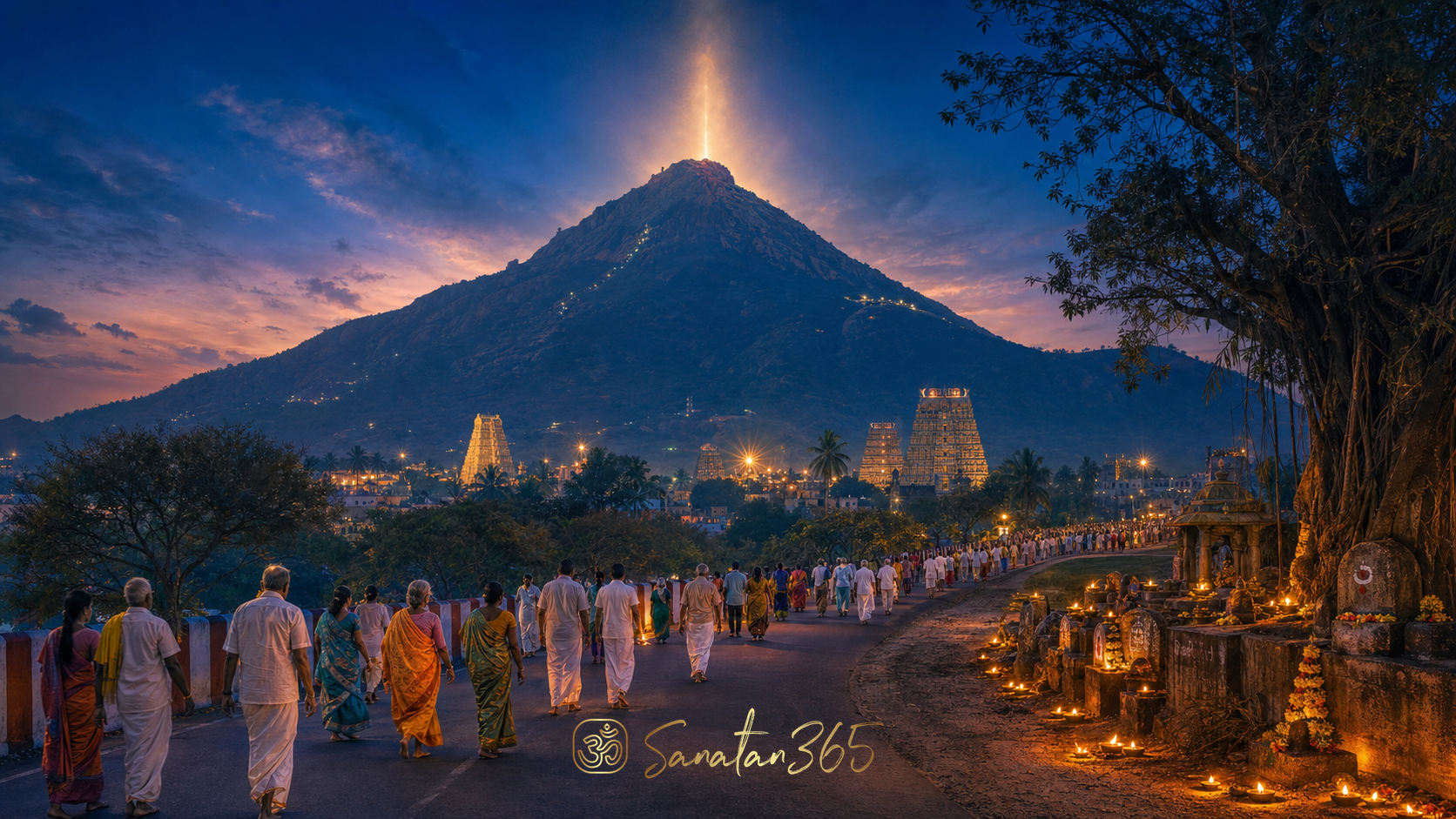
Arunachala is not merely the backdrop to Tiruvannamalai Girivalam. For devotees, the hill itself is a form of Lord Shiva, and walking around it is an act of prayer performed with the whole body. Tiruvannamalai Girivalam is the approximately 14-kilometre clockwise circumambulation of Arunachala in Tamil Nadu, undertaken quietly or with sacred remembrance, especially on the full moon.
The practice is called giri valam (கிரிவலம், “going around the hill”) in Tamil and giri pradakshina (गिरि प्रदक्षिणा, “reverential circumambulation of the mountain”) in Sanskrit usage. Its meaning is deeper than completing a route. The walker repeatedly places the sacred centre to the right, allowing effort, attention, landscape, and devotion to become one disciplined offering.
What Is Tiruvannamalai Girivalam?
Tiruvannamalai Girivalam is a clockwise pilgrimage around Arunachala, the hill rising beside the great Arunachaleswarar Temple. The established road circuit is commonly described as about 14 kilometres, though a pilgrim’s exact distance varies with starting point, temple visits, and detours. Many begin near the temple, bow toward Arunachala, and proceed with a mantra such as “Om Namah Shivaya,” while others walk in silence.
The Sanskrit word pradakshina joins pra (with reverence), dakshina (right or south), and the sense of movement. In temple practice, the deity or sanctum remains on the devotee’s right. Girivalam expands that principle to an entire sacred landscape: Arunachala becomes the still centre, while the pilgrim moves around it.
This distinction matters. A fitness walk measures pace and distance; a sacred circumambulation also measures the quality of attention. Devotees may pause at shrines, offer a simple prayer, notice the changing face of the hill, or serve fellow pilgrims. The road is public and physically demanding, yet the inner practice is one of humility rather than achievement.
Sri Ramanasramam preserves teachings associated with Sri Ramana Maharshi, whose life was inseparable from Arunachala and who commended giri pradakshina as a spiritually fruitful practice. His presence drew seekers from India and abroad, helping many encounter the hill not as scenery but as a silent teacher. The older sacred standing of Arunachala, however, belongs to the temple, Tamil Shaiva devotion, and the Arunachala Mahatmya tradition long before modern spiritual travel.
Key takeaway: Girivalam is a moving act of worship in which Arunachala remains the sacred centre.
Why Is Arunachala Regarded as Shiva in the Form of Fire?
Arunachala is traditionally linked with Agni (अग्नि, fire) and the tejo linga (तेजोलिङ्ग, linga of radiance) among the elemental expressions of Shiva. The Arunachaleswarar Temple presents Shiva through the fire element, while the hill is revered as Shiva’s own form. This is why devotees do not treat the mountain merely as a symbol pointing elsewhere: within the living tradition, the place itself carries sacred presence.
The best-known narrative tells of Brahma and Vishnu seeking the beginning and end of an immeasurable column of light. Shiva’s radiance exceeds the reach of pride and ordinary measurement. The story does not invite a competition between deities; it teaches the limits of ego before the boundless Divine. Arunachala, the tradition says, is that fiery revelation made approachable as a mountain.
Karthigai Deepam makes this theology visible. A great flame is kindled atop Arunachala while lamps shine across Tiruvannamalai. Fire here suggests illumination, purification, and the light of awareness. Yet the pilgrim should resist turning a sacred narrative into a geological claim. The tradition speaks in theological and devotional language, while the physical hill can also be understood through earth science. Reverence does not require confusing the two kinds of description.
The mountain changes as the walker moves: sharp ridges become rounded slopes; temple towers appear and disappear; morning heat becomes evening shadow. The same hill looks different from each point, while remaining one. For many pilgrims, that experience becomes a quiet teaching about perspective. Human views shift, but the sacred centre does not need to move.
Key takeaway: Arunachala’s fire symbolism teaches humility before a reality that cannot be contained by one viewpoint.
What Does the Girivalam Route Teach?
The route is known for the Ashta Lingams (अष्ट लिङ्ग, eight Shiva lingas) positioned around the hill and associated with the eight directions. They are commonly named Indra, Agni, Yama, Nirriti, Varuna, Vayu, Kubera, and Ishanya Lingam. Pilgrims may stop at each shrine, but Girivalam is not invalidated by an inability to visit every point. Age, mobility, crowding, weather, and health all shape what is responsible.
The circuit also passes ashrams, tanks, smaller shrines, neighbourhoods, shops, resting places, and stretches where the hill commands attention. This mixture is important. Sacred geography is not separated from ordinary life. Temple bells, traffic, vendors, families, mendicants, animals, and volunteers share the road. Patience toward this complexity is part of the pilgrimage.
Three disciplines can give the walk a clear inner form:
- Remembrance: Repeat a chosen name of Shiva, listen inwardly, or maintain attentive silence.
- Restraint: Walk without pushing, littering, loud performance, or treating shrines as photo props.
- Service: Offer water or practical help only through safe, respectful channels; make space for elders, children, and people with disabilities.
Walking barefoot is customary for many, but it is not a test of spiritual worth. Road heat, sharp debris, diabetes, injury, or other health conditions can make footwear necessary. A sincere pilgrim does not earn holiness by ignoring safety. Likewise, fasting is not required for everyone. Spiritual discipline should be adapted responsibly, and anyone with health concerns should follow appropriate professional guidance.
The clockwise direction gives the walk continuity, but the deeper orientation is ethical. The hill remains to the right while self-importance is gradually set down. Each step becomes a small consent to move without demanding that the sacred centre move around the individual.
Key takeaway: The route teaches remembrance, restraint, and service more clearly than it rewards physical display.
How Can Pilgrims Walk Girivalam Respectfully?
Preparation protects both devotion and the community. Full-moon nights can draw very large crowds, and Tamil Nadu’s heat can be severe. Conditions, road diversions, temple access, and local instructions can change, so pilgrims should verify current guidance from official district, police, or temple sources before setting out.
A practical preparation list includes:
- Carry drinking water in a reusable bottle and refill where safe.
- Wear modest, weather-appropriate clothing and suitable footwear when needed.
- Avoid single-use plastic and carry personal waste until a proper bin is available.
- Keep valuables minimal and agree on a meeting point if walking with a group.
- Use reflective elements or a small light after dark without shining it into shrines or faces.
- Respect queues, traffic controls, residents, animals, and posted photography rules.
- Begin only if the body is ready for a long walk; stop if there is dizziness, pain, or distress.
Pilgrims should also distinguish generosity from impulsive action. Supporting verified local service organizations, buying fairly from small vendors, and sharing water safely can be helpful. Feeding animals beside heavy traffic, leaving food waste, or obstructing the route can create harm despite good intention.
Silence is valuable, but complete silence is not always practical in a crowded public space. The aim is not to police other devotees. It is to keep one’s own voice, music, and phone use from dominating the shared pilgrimage. Sacred names can be chanted with warmth without turning the road into a contest of volume.
Those unable to walk the full circuit can still honour Arunachala through temple darshan, a shorter accessible segment, quiet meditation facing the hill, reading sacred teachings, or supporting pilgrims. Sanatan Dharma holds many forms of devotion; no one should be excluded because of age, disability, finances, or distance.
Key takeaway: Respectful Girivalam protects the pilgrim, the local community, and the sacred landscape together.
When Do Devotees Undertake Tiruvannamalai Girivalam?
Girivalam is undertaken throughout the year, but Pournami (पूर्णिमा, the full-moon observance) is especially popular. Many begin in the evening and walk through the night, when the moon, lamps, and cooler air shape the atmosphere. Full-moon crowds can also be intense, so quieter days may better support elderly walkers, families, first-time visitors, or those seeking contemplation.
Karthigai Deepam, usually observed in the Tamil month of Karthigai, is Tiruvannamalai’s great festival of light. The beacon on Arunachala draws immense devotion and requires careful planning. Festival dates follow a lunisolar calendar and must be checked for the relevant year and location through reliable current sources.
Weather should guide judgment. The hot season may make daytime walking unsafe, while monsoon conditions can produce slippery surfaces and traffic difficulty. Starting before sunrise or later in the evening may reduce heat, but night walking demands visibility and group awareness. There is no spiritual virtue in disregarding local alerts.
Pilgrims often visit Arunachaleswarar Temple before or after the circuit and may consult Sri Ramanasramam for its visitor information and teachings connected with Arunachala. These sources complement, rather than replace, real-time local instructions.
For readers exploring the wider meaning of sacred walking, the Hindu idea of tirtha explains pilgrimage as a “crossing place,” while pradakshina in temple worship offers the ritual foundation for keeping the sacred centre to one’s right.
Key takeaway: The best time is not simply the busiest sacred date; it is the time when devotion, safety, and responsible preparation can remain together.
What Girivalam Leaves With the Pilgrim
At the end of the circuit, Arunachala looks both familiar and newly seen. The pilgrim has not conquered the hill. The hill has quietly reorganized the pilgrim’s attention. Feet may ache, plans may have changed, and many distractions may have appeared, yet the sacred centre remained present through them all.
That is Girivalam’s enduring lesson. Spiritual life is not always an escape from roads, crowds, bodies, and obligations. It can be the art of moving through them without losing the centre. The circumambulation gives this truth a physical grammar: return, remember, adjust, continue.
Key takeaway: Tiruvannamalai Girivalam turns sacred geography into a disciplined practice of attention, humility, and care.
FAQ
How long is Tiruvannamalai Girivalam?
The established road circuit around Arunachala is commonly described as approximately 14 kilometres. Exact walking distance and time vary with the starting point, shrine stops, crowd levels, weather, and individual pace.
Must Girivalam be walked barefoot?
Many devotees walk barefoot as an expression of reverence, but safety and health matter. Footwear may be appropriate because of heat, debris, injury, disability, or a medical condition. Devotion should not be measured by avoidable harm.
Is Girivalam only performed on a full moon?
No. Girivalam can be undertaken throughout the year. Pournami is especially popular, while quieter days may offer a more manageable experience. Current local conditions should always be checked.
What mantra can be repeated during Girivalam?
“Om Namah Shivaya” is widely repeated. A pilgrim may also walk in silence or use a prayer received within their own tradition. Sincerity and attentive conduct matter more than volume or display.
Can someone honour Arunachala without completing the full walk?
Yes. Temple darshan, an accessible partial walk, meditation, prayer, sacred reading, and service are meaningful forms of devotion. Physical completion is not the only measure of spiritual participation.
The single key takeaway is simple: Tiruvannamalai Girivalam is sacred not because the pilgrim covers a distance, but because every careful step restores Arunachala—and the Divine—to the centre.
About the author
Sanatan365 Editorial
Bringing Sanatan Dharma to modern seekers through authentic, scripture-grounded content.
Related in Pilgrimage
 Pilgrimage
Panch Prayag: Five Sacred Confluences of the Alaknanda
Learn the five Panch Prayag river pairs, their downstream order, the naming of the Ganga at Devprayag, and a respectful way to visit.
 Pilgrimage
Narmada Parikrama Meaning: Walking with a Sacred River
Narmada Parikrama is the devotional circumambulation of the Narmada, traditionally following one bank to the river mouth and returning alon…
 Pilgrimage
Tirtha Meaning: Why Hindu Pilgrimage Is a Sacred Crossing
Tirtha means a sacred crossing place: a riverbank, temple, mountain, or landscape where pilgrimage invites devotion, humility, remembrance,…