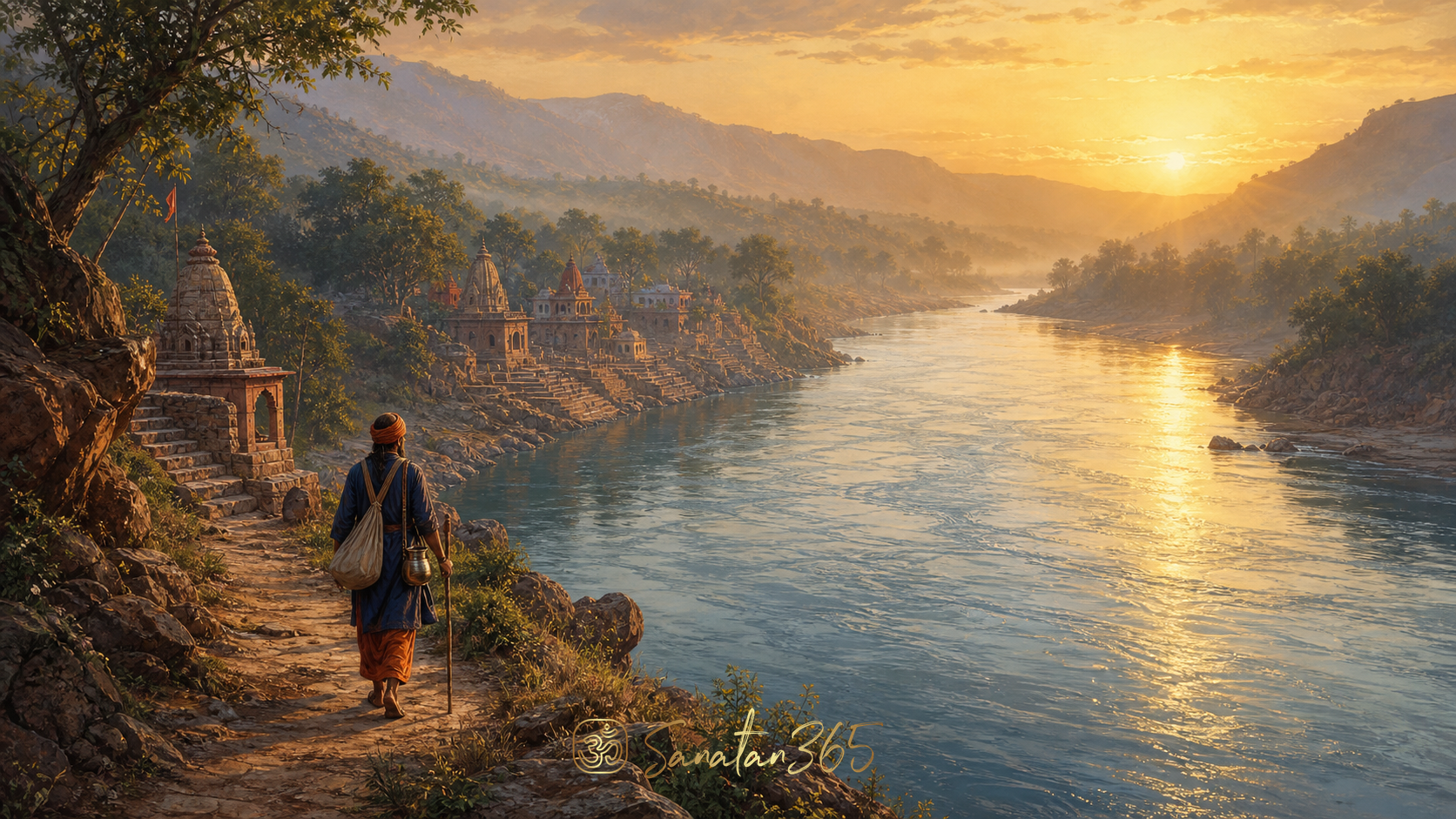
Narmada Parikrama Meaning: Walking with a Sacred River
Narmada Parikrama is the devotional circumambulation of the Narmada, traditionally following one bank to the river mouth and returning along the other. More than a route, it is a discipline of reverence, restraint, hospitality, and attention to a living sacred landscape.
A river is usually crossed to reach somewhere else. In Narmada Parikrama, the river becomes the centre: the pilgrim follows her long course, keeps her in reverent awareness, and returns changed by the act of walking beside her.
Narmada Parikrama meaning is the devotional circumambulation of the Narmada River. Parikrama (परिक्रमा, reverential movement around a sacred centre) ordinarily circles a shrine, deity, or holy place. Here, the sacred centre extends across an entire river landscape. Traditional pilgrims, known as parikramavasis (परिक्रमावासी, those dwelling in the discipline of circumambulation), follow one bank toward the Arabian Sea, cross near the river's mouth, and return along the opposite bank. The undertaking is not simply a long trek. It is a vow-shaped practice of humility, restraint, hospitality, and sustained attention.
What is Narmada Parikrama meaning in Hindu tradition?
In Hindu worship, circumambulation places the sacred at the centre and the self in motion around it. The familiar temple practice of pradakshina expresses this relationship on a human scale. Narmada Parikrama expands the same grammar across forests, farming settlements, ghats, temple towns, rocky ravines, and the tidal meeting of river and sea.
The Narmada is also called Reva in sacred literature. Traditions associated with the Reva Khanda of the Skanda Purana praise the river and the tirthas (तीर्थ, sacred crossings or pilgrimage places) along her banks. The Vana Parva of the Mahabharata likewise presents the Narmada valley as a landscape of pilgrimage. These texts do not turn geography into a decorative backdrop. They teach that place, practice, memory, and moral discipline can meet in one sacred field.
That is why the parikrama is better understood as a relationship than as an itinerary. The pilgrim repeatedly sees the river in different moods: narrow near her source, powerful through stone, broad beside cultivated plains, and tidal near the sea. To continue beside that changing presence is to learn constancy without demanding sameness.
Key takeaway: Narmada Parikrama places the sacred river at the centre and asks the pilgrim to reorganize time, movement, and desire around reverence.
Why is the Narmada approached as a living sacred presence?
Hindu tradition does not limit a river to water flowing between banks. Narmada is honoured as Devi Narmada (देवी नर्मदा, the goddess Narmada), a sacred presence who nourishes communities, carries memory, and connects places of worship across central and western India. Devotees often greet her with “Narmade Har,” a salutation that recognizes the river as worthy of remembrance and respect.
This reverence is not a licence to collapse every local tradition into one fixed story. Accounts of Narmada's origin and sanctity vary across Puranic, regional, and oral sources. Shiva is especially important in many Narmada traditions, and Omkareshwar is one of the best-known Shiva tirthas along the river. Yet the parikrama also belongs to the households, ashrams, farmers, boat communities, temple caretakers, and village hosts whose daily lives make the route possible.
The University of Minnesota's Open Rivers account of Narmada Parikrama places the pilgrimage within both sacred literature and the changing ecological life of the valley. That wider view matters. To call a river sacred while ignoring pollution, unsafe extraction, damaged habitats, or the dignity of riverbank communities would make devotion incomplete. Sacred regard should deepen care, not replace it with romantic language.
The river therefore teaches at several levels at once. She is a deity in devotional imagination, a physical waterway with ecological limits, a source of livelihood, and a path connecting many distinct communities. Reverence becomes mature when it can hold all these truths together.
Key takeaway: Seeing Narmada as a living sacred presence joins devotion to ecological responsibility and respect for the people of the river valley.
How does the traditional Narmada Parikrama route work?
There is no single modern itinerary followed identically by every pilgrim. A common traditional pattern begins from a chosen sacred point, proceeds along one bank to the estuary near Bharuch, crosses near the river's meeting with the sea, and returns along the other bank to the starting place. Amarkantak, the river's source region, and Omkareshwar are widely recognized starting points.
The Madhya Pradesh Tourism overview describes a route passing through places such as Amarkantak, Mandla, Jabalpur, Narmadapuram, Omkareshwar, Maheshwar, Barwani, and Bharuch. Exact paths change with seasonal water, bridges, local access, health, safety, and the guidance of experienced people. Published distances and durations also vary because a fully traditional foot pilgrimage is not the same as a shorter vehicle-assisted circuit.
A simplified geographical picture is:
- Begin with sankalpa (संकल्प, a clearly stated sacred intention) at the chosen starting tirtha.
- Follow one bank downstream, visiting river shrines and accepting the discipline of the route.
- Cross only at the traditionally accepted turning area near the estuary, according to the lineage or guide being followed.
- Return upstream along the opposite bank.
- Complete the circle at the starting place with gratitude and, where customary, concluding worship.
Popular accounts often cite a demanding traditional duration of three years, three months, and thirteen days, while many contemporary walkers complete the route in several months. Such numbers should describe forms of practice, not rank devotees. Speed is not spiritual superiority, and a road circuit should not be presented as identical to a full walking vow.
Anyone considering the journey should seek current local guidance. River levels, extreme heat, monsoon conditions, forest stretches, road construction, ferry availability, and medical needs can materially change the route. The devotional ideal never requires reckless disregard for life or health.
Key takeaway: The route forms a complete circle around the Narmada, but its responsible practice depends on season, safety, local knowledge, and the pilgrim's actual vow.
What disciplines guide a parikramavasi?
The outer route becomes spiritual practice through niyama (नियम, observance or disciplined commitment). Customs vary by teacher, community, physical ability, and the form of parikrama undertaken. Some pilgrims walk barefoot, carry few possessions, accept simple food, avoid unnecessary river crossings, and remain close to the banks. Others adopt a more limited discipline because of age, disability, family obligations, or safety.
Several principles recur across accounts of the pilgrimage:
- Keep the river central. The path is not a checklist of famous temples but a sustained relationship with Narmada.
- Travel lightly. Fewer possessions expose habits of dependence and make gratitude more immediate.
- Receive hospitality without entitlement. Food and shelter offered by local people are gifts, never services owed to a pilgrim.
- Practice non-harm. Care for animals, plants, water, shared spaces, and vulnerable people is part of the vow.
- Accept changing conditions. Heat, fatigue, delay, and uncertainty reveal the distance between preference and necessity.
- Avoid performance. The pilgrimage should not turn residents, ascetics, or sacred rituals into content props.
These disciplines make the parikramavasi dependent on a web of grace: the river, the path, unknown hosts, fellow walkers, and the body's honest limits. That dependence can soften the illusion of complete self-sufficiency.
It can also expose unequal burdens. A visitor should not romanticize hardship that local communities endure every day. Ethical pilgrimage means paying fairly when payment is appropriate, asking permission before photographs, reducing waste, listening to local instruction, and refusing to treat poverty as spiritual scenery.
Key takeaway: A parikramavasi's discipline is measured less by spectacle than by humility, restraint, non-harm, and gratitude toward hosts and landscape.
Which tirthas and communities shape the pilgrimage?
The Narmada valley contains many tirthas understood as sacred crossings, but the full parikrama cannot be reduced to its most famous stops. Amarkantak holds the source region and the Narmada Kund. Bhedaghat reveals the river moving through marble formations. Omkareshwar joins river geography with Shiva devotion. Maheshwar's ghats carry memories of Ahilyabai Holkar and living worship. Bharuch stands near the estuarine turn where freshwater approaches the Arabian Sea.
Between such names lie countless smaller shrines, river landings, farms, tribal regions, towns, and household spaces. Their importance is not secondary. A pilgrimage survives because people maintain paths, share warnings, provide water, offer food, preserve oral knowledge, and welcome strangers.
The Sanskrit word tirtha originally carries the sense of a ford or crossing. A sacred crossing is therefore not only where one changes sides of a river. It can also be where the pilgrim crosses from anonymity into relationship, from consumption into reciprocity, or from certainty into attentive listening.
This is why route research should include more than maps. A respectful pilgrim learns how a village prefers visitors to behave, whether a shrine has particular customs, where photography is unwelcome, and which stretches require a local companion. The river's sacred geography is social as well as physical.
Key takeaway: Famous tirthas orient the parikrama, but local communities and everyday acts of hospitality sustain its living sacred geography.
What can those who cannot walk the full route learn from the tradition?
Most people will never complete a months-long Narmada Parikrama. The tradition does not become irrelevant because its full physical form is inaccessible. It can still teach how to place something sacred at the centre rather than treating it as one more item in a crowded schedule.
A smaller practice might include:
- Studying the Narmada's geography and sacred traditions before visiting.
- Spending unhurried time at one ghat without trying to collect many destinations.
- Supporting a credible river-conservation or community initiative.
- Walking a locally appropriate short stretch with permission and guidance.
- Reducing waste and refusing offerings packaged in materials that may pollute the river.
- Practising daily remembrance through prayer, reading, or quiet gratitude.
These acts are not substitutes to be falsely labelled a complete parikrama. They are ways of receiving its ethical insight. The broader meaning of tirtha yatra is that pilgrimage changes the pilgrim's manner of seeing. One need not claim an achievement to learn reverence, patience, and responsibility.
For diaspora readers, the lesson may travel even farther. A sacred relationship with water can begin by learning the river basin where one lives, respecting Indigenous and local histories, conserving water, and approaching nature as more than a resource. This does not make every river “the Narmada.” It lets Narmada's example sharpen attention to the particular place one actually inhabits.
Key takeaway: Those unable to walk the full parikrama can honour its teaching through careful study, local responsibility, modest practice, and truthful language about what they have undertaken.
FAQ
What does Narmada Parikrama mean?
Narmada Parikrama means the reverential circumambulation of the Narmada River. Traditionally, a pilgrim follows one bank toward the river mouth, crosses near the estuary, and returns along the opposite bank to complete the sacred circle.
Where does Narmada Parikrama begin?
Pilgrims begin from different sacred places, with Amarkantak and Omkareshwar among the best known. The correct starting point depends on the tradition, guide, and vow being followed.
How long does Narmada Parikrama take?
Duration varies greatly. Traditional accounts describe an extended vow of three years, three months, and thirteen days, while many contemporary walking pilgrimages take several months. Shorter vehicle circuits are different forms and should be described honestly.
Can everyone undertake the full pilgrimage?
No single form is suitable for everyone. Health, disability, age, caregiving duties, weather, and route safety matter. Devotion does not require ignoring medical advice or physical limits; a shorter, locally guided practice may be more responsible.
What is the most important rule of the pilgrimage?
Customs vary, but the deepest principle is to keep Devi Narmada at the centre through reverence, non-harm, humility, and respect for the communities that sustain the route.
Narmada Parikrama turns a line on a map into a circle of relationship. The pilgrim moves, the river changes, and the sacred centre remains present through every landscape.
Key takeaway: The pilgrimage's deepest achievement is not distance covered, but a more truthful relationship with sacred place, human dependence, and the living river.
About the author
Sanatan365 Editorial
Bringing Sanatan Dharma to modern seekers through authentic, scripture-grounded content.
Related in Pilgrimage
 Pilgrimage
Panch Prayag: Five Sacred Confluences of the Alaknanda
Learn the five Panch Prayag river pairs, their downstream order, the naming of the Ganga at Devprayag, and a respectful way to visit.
 Pilgrimage
Tiruvannamalai Girivalam: Meaning of the Sacred Arunachala Walk
A grounded guide to the meaning, route, traditions, and respectful practice of Girivalam around Arunachala in Tiruvannamalai.
 Pilgrimage
Tirtha Meaning: Why Hindu Pilgrimage Is a Sacred Crossing
Tirtha means a sacred crossing place: a riverbank, temple, mountain, or landscape where pilgrimage invites devotion, humility, remembrance,…

