Kirtan Meaning: Devotional Singing in Hindu Bhakti
Kirtan is Hindu devotional singing that turns sacred names, stories, and remembrance into a shared practice of bhakti.
A single repeated divine name can do what long arguments often cannot: gather scattered minds into one shared act of remembrance.
Kirtan meaning begins with kirtana (कीर्तन, praising, reciting, or glorifying): a Hindu devotional practice where sacred names, mantras, and stories are sung aloud, often in a call-and-response form. In bhakti (भक्ति, loving devotion), kirtan is not performance alone. It is remembrance through voice, rhythm, listening, and community. The Hindu American Foundation describes kirtan as praise or glorification of divinity, commonly through call-and-response singing focused on names such as Radha, Krishna, Sita, and Rama HAF.
What Is Kirtan Meaning in Hindu Devotional Singing?
Kirtan is devotional singing that praises, remembers, and invokes the Divine through sound. The Sanskrit root behind kirtana carries the sense of calling, praising, describing, or celebrating. That is why kirtan can include a simple mantra, a poetic name of Bhagavan, a saint's verse, or a sung story from sacred tradition.
In the most familiar form, a lead singer offers a line and the gathered group repeats it. This call-and-response pattern is not merely musical convenience. It makes the practice participatory. A person does not need classical training, a perfect voice, or scholarly confidence. Listening, repeating, clapping, and sitting with attention all become part of the sadhana (साधना, disciplined spiritual practice).
Kirtan is closely related to bhajan (भजन, devotional song), but the two are not always identical. A bhajan may be sung as a composed devotional song by one person or a group. Kirtan often emphasizes shared repetition, divine names, and congregational response. Many communities use the words fluidly, and the lived practice matters more than rigid labeling. For a related devotional lens, see Bhajan Meaning.
Key takeaway: Kirtan means devotional praise made audible, communal, and repeatable through sacred singing.
Why Does Kirtan Matter in Bhakti?
Bhakti treats remembrance as relationship. One remembers not an abstract concept alone, but a living presence: Krishna, Rama, Shiva, Devi, Vishnu, Hanuman, or the chosen form of the Divine held by the devotee. Britannica describes bhakti-marga as the path of devotion centered on love for a personal God, alongside other Hindu paths of spiritual realization Britannica. Kirtan gives that remembrance a body through breath and sound.
The Bhagavata Purana famously lists nine forms of devotion, including shravanam (श्रवणम्, listening), kirtanam (कीर्तनम्, chanting or praising), and smaranam (स्मरणम्, remembrance). In this sequence, kirtan is linked to hearing and remembering rather than separated from them. The devotee hears the name, sings the name, and lets the name return through memory. The practice becomes circular in the best sense: voice deepens listening, and listening steadies voice.
This is why kirtan can be simple without being shallow. A short refrain such as "Hare Krishna," "Sri Ram Jai Ram," "Om Namah Shivaya," or "Jai Mata Di" may repeat for several minutes. The repetition is not a lack of content. It is the method. Repeated names gradually move attention away from restless self-concern and toward bhava (भाव, devotional feeling or inner mood).
Kirtan also protects bhakti from becoming only private emotion. The gathered voice matters. In a temple, home satsang, ashram, or diaspora community hall, kirtan lets devotion become shared without requiring everyone to speak about their inner life. A child can clap, an elder can hum, a newcomer can listen quietly, and a trained singer can lead without owning the practice.
Key takeaway: Kirtan matters because it joins praise, listening, remembrance, and community into one devotional act.
How Is Kirtan Different From Mantra Japa and Aarti?
Kirtan, mantra japa, and aarti are related practices, but each has a distinct center.
Mantra japa (जप, repeated recitation) is usually quieter, more counted, and more inward. A practitioner may repeat a mantra on a mala, with attention held steadily on the sound and its meaning. Kirtan is usually more public and musical. It may use the same divine names, but the energy is congregational and responsive.
Aarti (आरती, offering of light) centers on the ritual act of offering flame before the deity. It often includes singing, bells, and clapping, but the lamp offering is the ritual heart. Kirtan may happen before or after aarti, or as a separate gathering entirely. See Aarti Meaning for the meaning of offering light in worship.
Bhajan sits between these categories. It can be a composed devotional song, sometimes narrative, sometimes reflective, sometimes sung in a group. Kirtan leans more strongly toward repeated divine names and shared response. The boundaries are porous because Hindu practice is lived through regional inheritance, family tradition, guru-parampara (गुरु-परम्परा, teacher lineage), and local temple culture.
A simple comparison helps:
- Kirtan: shared devotional singing, often call-and-response.
- Japa: repeated mantra recitation, often inward and counted.
- Aarti: ritual offering of light, often accompanied by song.
- Bhajan: devotional song, often lyrical and reflective.
None of these practices needs to compete with the others. A household may begin with japa, attend temple aarti, and end the evening with kirtan. Each turns attention toward the sacred through a different doorway.
Key takeaway: Kirtan is the communal singing doorway into devotion, while japa, aarti, and bhajan emphasize repetition, light offering, and devotional poetry in different ways.
What Happens in a Traditional Kirtan Gathering?
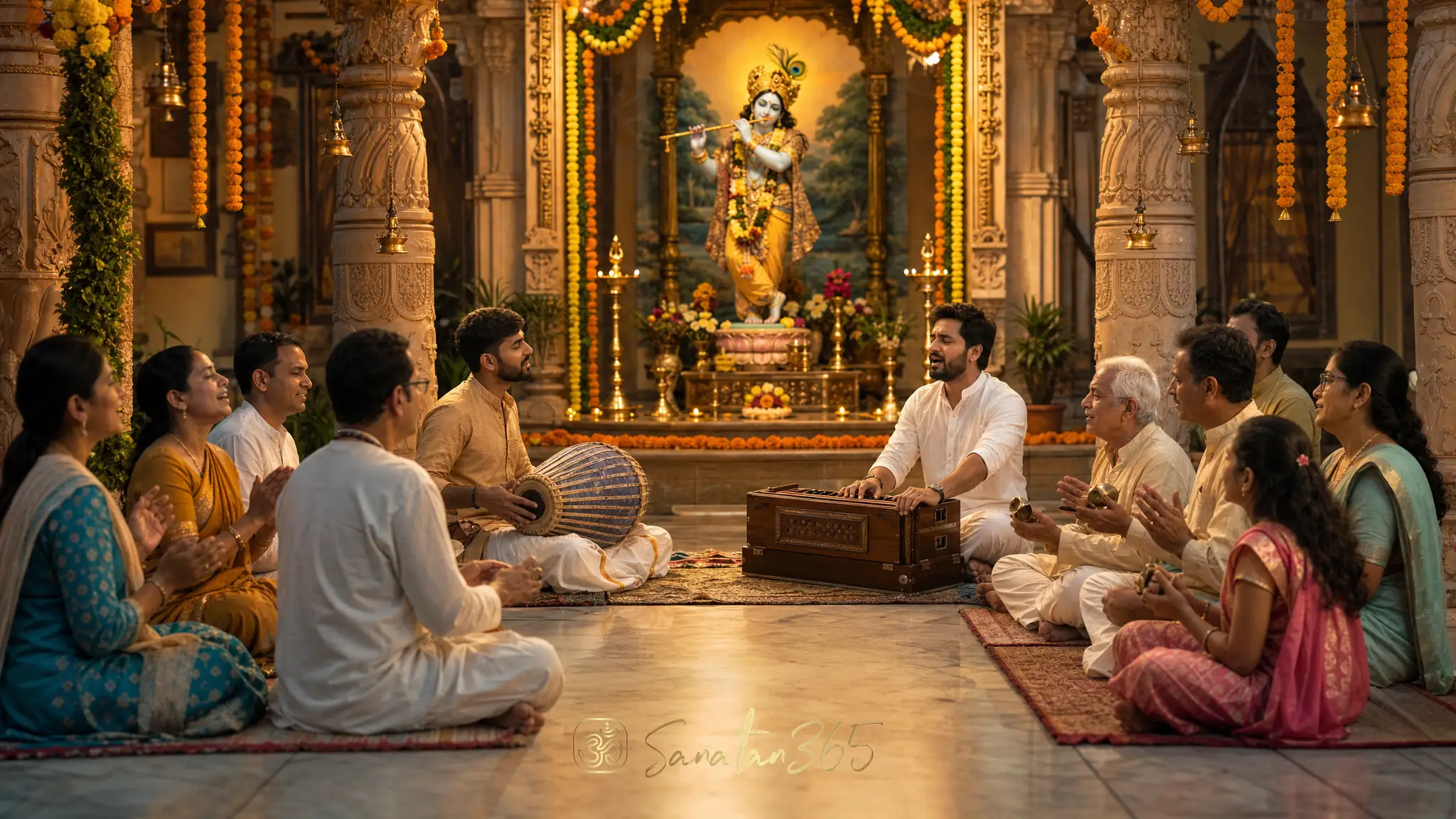
A traditional kirtan gathering begins with orientation, even when no one formally announces it. The space itself teaches: shoes outside, lamps lit, images or murtis arranged with care, instruments tuned, people seated on the floor or in rows, and the first sound offered with respect.
The lead singer may start with a short invocation to Ganesha, Guru, Krishna, Rama, Shiva, Devi, or the community's chosen deity. The line is sung slowly first, allowing everyone to hear the melody and words. Then the group responds. Over time the tempo may rise, percussion may enter, clapping may grow stronger, and the call-and-response becomes natural.
Common instruments include harmonium, mridanga, tabla, kartal, manjira, or hand claps. But instruments are supportive, not the essence. A small home kirtan with only voices can be complete. A temple kirtan with skilled musicians can be powerful, but it remains devotional only when the music serves remembrance rather than display.
Many kirtans close gently. After energetic singing, silence may follow. This is not an empty pause. It lets the sound settle. Some communities then offer prasad (प्रसाद, sanctified offering), read a short teaching, or move into aarti. Others end with pranam (प्रणाम, respectful bowing) and quiet departure.
Regional forms vary widely. Maharashtra has strong kirtan traditions connected with saints such as Namdev, Tukaram, and the Varkari movement. Bengal and Gaudiya Vaishnava communities emphasize sankirtana (संकीर्तन, collective chanting) of Krishna's names. Assam's Vaishnava namghar culture, North Indian satsangs, South Indian bhajana sampradaya, and diaspora kirtan circles each carry distinct musical and devotional flavors.
Key takeaway: A kirtan gathering is not just music in a sacred room; it is a structured devotional environment where sound, participation, and reverence work together.
How Can Beginners Practice Kirtan Respectfully?
Beginners can approach kirtan with humility and attention. The practice is welcoming, but not casual in the sense of being careless. The divine names and sacred verses deserve clean intention, accurate pronunciation when possible, and respect for the community that carries them.
Start with listening. Notice how the leader pronounces each name, where the group breathes, and when the response begins. If the words are unfamiliar, repeat softly or listen until the refrain becomes clear. Devotion does not require forcing volume.
Learn the meaning of one chant at a time. If the kirtan uses "Om Namah Shivaya," understand it as a reverent salutation to Shiva; for more depth, see Om Namah Shivaya Meaning. If the gathering sings the Gayatri Mantra, treat it as a Vedic prayer with its own sanctity and discipline; see Gayatri Mantra Meaning for context.
Respect the space. Avoid treating kirtan as background entertainment, social media content, or performance sampling without permission. In many gatherings, photography or recording may be inappropriate. If there is a murti, altar, or guru seat, follow local etiquette before sitting, touching items, or moving close.
A beginner can practice at home with a short and steady format:
- Light a clean lamp if that is part of one's tradition.
- Sit comfortably with the spine alert.
- Choose one simple divine name or mantra.
- Sing slowly for five to ten minutes.
- End with one minute of silence.
- Offer gratitude without rushing into the next activity.
This small practice is enough. Kirtan grows through regularity, not theatrical intensity.
Key takeaway: Beginners practice kirtan well by listening first, learning meanings, honoring the sacred setting, and keeping the first home practice simple.
Why Does Call-and-Response Singing Feel So Powerful?
Call-and-response singing changes the way attention is held. The leader carries the line, but the group must listen in order to answer. This creates a gentle discipline: receive, remember, respond. The pattern itself trains presence.
The shared rhythm also lowers the pressure of individual performance. A shy participant can join because the group voice carries them. A confident singer learns restraint because the response belongs to everyone. Kirtan therefore has an ethical quality hidden inside its musical form. It teaches listening, humility, timing, and shared joy.
Theologically, the repeated name is not treated as ordinary sound. In many bhakti traditions, nama (नाम, the divine name) is honored as a direct doorway to the named presence. The name of Krishna, Rama, Shiva, Devi, or Hari is not merely a label. It is a sacred sound that turns attention toward the Divine again and again.
This is why kirtan can move people across language barriers. A person may not understand every Sanskrit, Braj, Hindi, Tamil, Bengali, Marathi, Gujarati, or Assamese phrase on first hearing. But repetition, melody, and visible devotion help the heart enter before the intellect catches up. Understanding should still be cultivated, but kirtan often begins with participation.
Key takeaway: Call-and-response kirtan is powerful because it trains people to listen, answer, and remember together.
FAQ
What is the simple meaning of kirtan?
Kirtan means devotional praise through singing or chanting. In Hindu practice, it often refers to call-and-response singing of divine names, mantras, or sacred stories as an expression of bhakti.
Is kirtan only for trained singers?
No. Trained singers may lead, but kirtan is participatory. Listening, repeating, clapping, and sitting reverently are all valid ways to join. The aim is remembrance, not vocal display.
What is the difference between kirtan and bhajan?
A bhajan is usually a devotional song, while kirtan often emphasizes repeated divine names and group response. In many communities the terms overlap, so local tradition decides how they are used.
Can kirtan be practiced at home?
Yes. A home practice can be as simple as singing one divine name or mantra for five to ten minutes, followed by silence. It should be done respectfully, with attention to meaning and cleanliness of intention.
Is kirtan connected to Krishna only?
Kirtan is strongly associated with Krishna bhakti in many traditions, especially Vaishnava sankirtana, but it is not limited to Krishna. Devotees also sing kirtan for Rama, Shiva, Devi, Hanuman, Vishnu, and other revered forms of the Divine.
Kirtan's single key takeaway is this: devotional singing becomes transformative when sound is offered with attention, humility, and love.
About the author
Sanatan365 Editorial
Bringing Sanatan Dharma to modern seekers through authentic, scripture-grounded content.
Related in Aarti
 Aarti
Durge Durghat Bhari Aarti Meaning: A Marathi Prayer for Refuge
Read the Marathi Durga aarti through its appeal for compassion, the limits of description, and its closing image of devotion at the Mother’…
 Aarti
Aarti Kunj Bihari Ki Meaning: Seeing Krishna Through Song
Read the names and poetic images of Aarti Kunj Bihari Ki, from Krishna's flute and forest grove to Radha, Ganga and attentive devotional si…
 Aarti
Jai Ganesh Deva Aarti Meaning: Reading the Song With Reverence
Understand the familiar Hindi Ganesh aarti through its refrain, sacred imagery, offerings and language of refuge, without turning devotiona…

