Kundali Meaning: How a Vedic Birth Chart Maps Karma, Dharma, and Time
A clear guide to Kundali meaning, the Vedic birth chart, and how lagna, graha, bhava, rashi, and dasha help seekers reflect on life with responsibility.
A Kundali is not meant to frighten a person with fate. It is meant to make time visible.
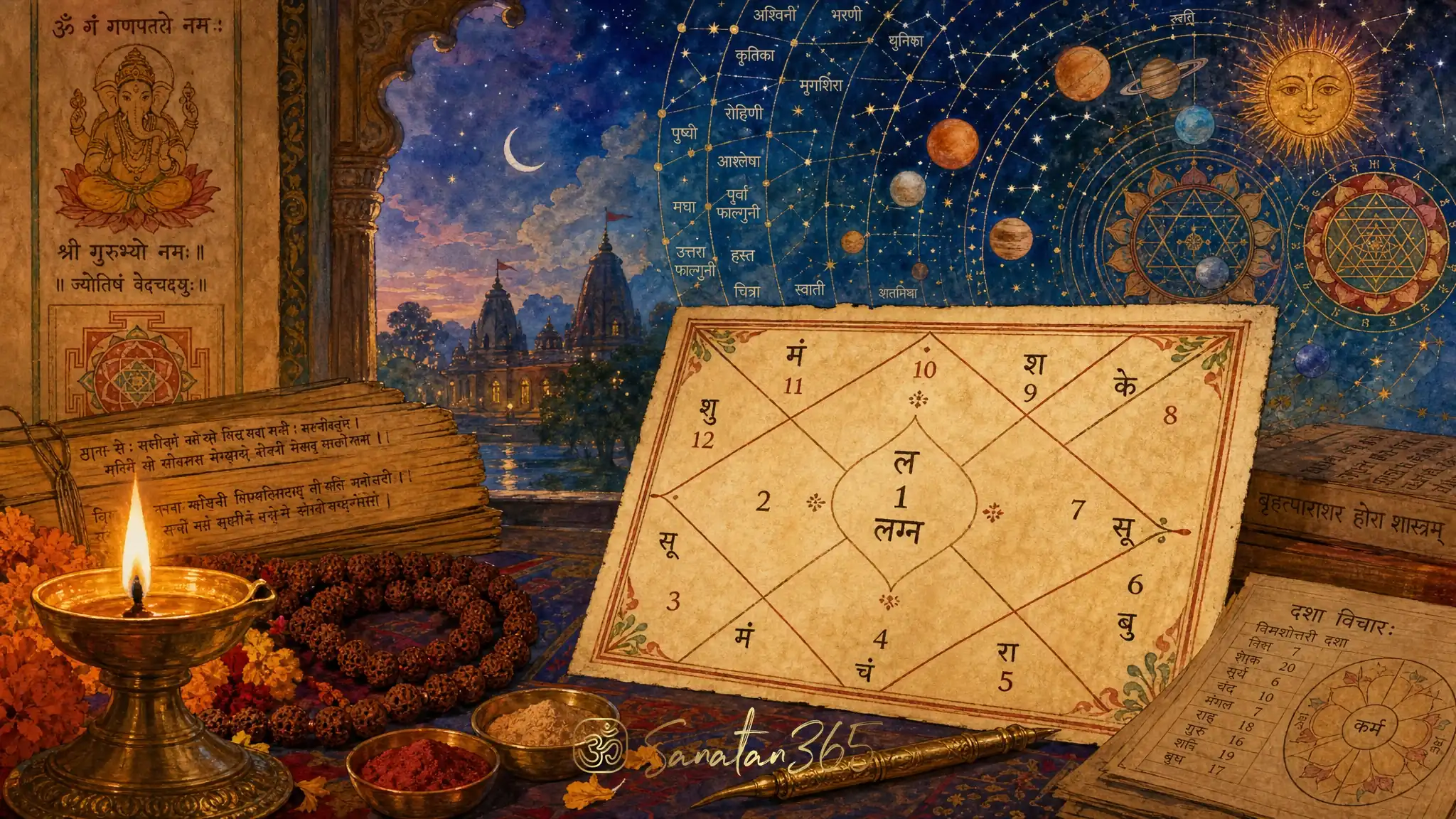
Kundali meaning begins with Janam Kundali (जन्म कुण्डली, birth chart): a Vedic astrological chart prepared from the date, time, and place of birth. In Jyotisha (ज्योतिष, the traditional discipline of celestial light), the chart places graha (ग्रह, planetary factors), rashi (राशि, zodiac signs), and bhava (भाव, houses of life) around the lagna (लग्न, ascendant). For a seeker, the chart is best understood as a symbolic map for self-reflection, timing, responsibility, and dharma, not as a substitute for wisdom, effort, or moral choice.
Key takeaway: A Kundali shows patterns and timing; it does not remove personal responsibility.
What Is Kundali Meaning in Vedic Astrology?
The practical Kundali meaning is “a birth chart that maps the sky at the moment of birth according to the Jyotisha tradition.” The word is commonly used for Janam Kundali or Janma Kundali, the natal horoscope. It records how the zodiac signs, planetary factors, ascendant, and lunar markers are arranged for one person’s birth.
Jyotisha is traditionally counted among the Vedangas (वेदाङ्ग, limbs of Vedic learning), especially because calendars, ritual timing, and auspicious observances depend on celestial reckoning. Modern readers should hold two truths together with maturity: Jyotisha has deep cultural and scriptural roots in Hindu life, and its interpretations should be approached with humility rather than blind fear. Britannica’s overview of astrology notes that Indian astrology developed with technical systems comparable in sophistication to other ancient astrological traditions, while Hindu practice also connects timing with ritual life and panchanga observance.
A Kundali usually helps answer questions such as:
- What is the rising sign, or lagna?
- Where are the grahas placed?
- Which bhavas are emphasized?
- What does the Moon sign suggest about temperament?
- Which dasha, or planetary period, is active?
- Which areas of life require patience, discipline, devotion, or service?
The healthy reading of a Kundali is not, “This chart controls me.” It is closer to, “This chart may show tendencies; how can dharma guide my response?”
Key takeaway: Kundali reading is strongest when it encourages awareness, not helplessness.
Why Does the Lagna Matter in Kundali Meaning?
The lagna is central to Kundali meaning because it becomes the starting point of the chart. Lagna, often translated as ascendant, is the zodiac sign rising on the eastern horizon at the time and location of birth. From this point, the chart’s houses are organized.
If the Kundali is a sacred map, the lagna is the door through which the map is entered. It helps frame the body, temperament, orientation to life, and the way experiences are received. Two people born on the same date can have different lagna placements if they are born at different times or places; this is one reason birth time accuracy matters in traditional readings.
A beginner can understand lagna in three layers:
- Outer orientation: How life is approached, especially in visible behavior.
- Chart anchor: The point from which the twelve houses are counted.
- Dharma lens: The practical field where effort, discipline, and self-knowledge begin.
Traditional texts such as the Brihat Parashara Hora Shastra are associated with systematic treatment of graha, rashi, bhava, and related chart principles. Many current summaries of the text describe its broad concern with planets, signs, houses, divisional charts, and dashas. The point for modern readers is not to reduce a profound tradition into quick predictions. The point is to respect the chart as a layered symbolic system.
When a person hears, “Your lagna is this,” the wise response is not anxiety. It is curiosity: What qualities should be refined? What tendencies should be purified? What form of seva, sadhana, restraint, or courage does this life ask for?
Key takeaway: Lagna is not a label for identity; it is the entry point for disciplined self-understanding.
What Are Graha, Rashi, and Bhava in a Vedic Birth Chart?
A Vedic birth chart becomes easier to read when its three basic building blocks are clear: graha, rashi, and bhava.
Graha literally carries the sense of “that which grasps” or influences. In Jyotisha practice, the nine grahas are commonly listed as Surya, Chandra, Mangala, Budha, Guru, Shukra, Shani, Rahu, and Ketu. They are not treated merely as physical planets in a modern astronomy sense. They are symbolic forces used in interpretation.
Rashi means zodiac sign. The twelve rashis provide the field through which graha qualities are expressed. A graha in one rashi may be interpreted differently from the same graha in another rashi.
Bhava means house. The twelve bhavas describe life areas such as self, family, learning, home, creativity, service, partnership, transformation, dharma, work, community, and liberation. A simple beginner’s guide may say “house equals life area,” but serious interpretation depends on many interlinked factors.
Here is a beginner-friendly way to think about the relationship:
- Graha shows the active principle.
- Rashi colors how that principle expresses itself.
- Bhava shows the field of life where it becomes visible.
- Lagna sets the whole structure in motion.
- Dasha suggests timing and sequence.
For example, a chart reading should not isolate one placement and make dramatic claims. A responsible astrologer studies patterns, strengths, aspects, dashas, divisional charts, and the broader life context. In Sanatan thought, karma is subtle. No single chart line should be treated as a final sentence on a human life.
Key takeaway: Kundali interpretation is relational; graha, rashi, and bhava must be read together.
How Does a Kundali Relate to Karma and Dharma?
A mature understanding of Kundali meaning avoids two extremes. One extreme dismisses the tradition without understanding its place in Hindu life. The other turns every difficulty into fatalism. Sanatan wisdom points to a more balanced view.
Karma (कर्म, action and its consequences) is not merely punishment or reward. It is the subtle continuity of action, tendency, and result. Dharma (धर्म, sustaining order and right conduct) is the way a person responds with integrity. A Kundali may suggest tendencies, timings, and areas of life that need attention. Dharma decides what is done with that knowledge.
This is why a thoughtful chart reading should lead to practical refinement:
- If the chart suggests restlessness, cultivate steadiness.
- If speech is a theme, practice truthful and gentle words.
- If family duties are emphasized, serve without resentment.
- If career timing feels slow, combine patience with skill-building.
- If spiritual inclination appears strong, build daily sadhana.
The Bhagavad Gita repeatedly brings the seeker back to right action, clarity, devotion, and steadiness. Even when one consults timing, the heart of dharma remains effort aligned with wisdom. A Kundali can become spiritually useful when it moves a person away from panic and toward responsibility.
Sanatan365’s Kundali Reports by Jaimini Rishi are designed in this spirit: not as fear-based fortune-telling, but as a reflective way to understand traditional chart patterns with reverence and clarity.
Key takeaway: The highest use of a Kundali is not prediction alone; it is wiser participation in one’s own dharma.
How Should Beginners Read a Kundali Without Fear?
Beginners often meet Kundali reading through marriage matching, career questions, health anxiety, or family pressure. That can make the subject feel intimidating. A calmer approach begins with the right expectations.
First, a Kundali should never be used to shame a person. No chart makes someone spiritually inferior. No placement removes dignity. No dosha should be discussed in a way that creates panic or social stigma. The Atman, the innermost Self, is not reduced to a horoscope.
Second, timing is not the same as certainty. A dasha or transit may suggest a season of emphasis, but real life includes effort, prayer, character, relationships, health, education, and grace. Astrology should not replace medical, legal, financial, or mental health advice. For serious decisions in those areas, qualified professionals and trusted elders matter.
Third, remedies should be sattvic and ethical. Sattva (सत्त्व, clarity and harmony) means practices that calm and uplift: prayer, mantra, charity, service, disciplined habits, respect for parents and teachers, care for the vulnerable, and honest living. Any remedy that exploits fear, demands unaffordable payment, or encourages harm is outside the spirit of dharma.
A safe beginner checklist:
- Confirm birth date, time, and place carefully.
- Learn lagna, Moon sign, and key bhavas before advanced combinations.
- Ask what virtue each challenge is inviting.
- Avoid making one placement the whole story.
- Treat remedies as devotional discipline, not magical shortcuts.
- Keep free will, effort, and grace at the center.
Key takeaway: A Kundali should increase steadiness, humility, and better choices—not fear.
What Is the Difference Between Panchanga and Kundali?
Many seekers confuse panchanga and Kundali because both use celestial calculation. They are related, but not identical.
Panchanga (पञ्चाङ्ग, five limbs of time) is the traditional Hindu calendar framework. Its five limbs are commonly given as tithi (तिथि, lunar day), vara (वार, weekday), nakshatra (नक्षत्र, lunar mansion), yoga (योग, a calculated sun-moon relationship), and karana (करण, half-tithi). Panchanga helps communities observe festivals, vratas, temple timings, and auspicious days. Public panchang references such as Drik Panchang show how tithi, nakshatra, and regional location affect festival observance.
A Kundali, by contrast, is personal. It applies the sky’s arrangement to a specific birth. Panchanga asks, “What is the quality of this day?” Kundali asks, “What was the arrangement of time at this person’s birth, and how might it be interpreted?”
For Hindu families, both can serve spiritual rhythm. Panchanga helps the household remember sacred days. Kundali can help the individual reflect on tendencies, timing, and duties. Neither should be used to avoid compassion, effort, or common sense.
Key takeaway: Panchanga guides sacred time for the community; Kundali maps birth time for the individual.
How Can a Kundali Become a Spiritual Practice?
The finest use of a Kundali is not obsession with the future. It is self-study. In the language of Yoga, svadhyaya (स्वाध्याय, self-study and sacred study) asks the seeker to look honestly at patterns. A Kundali can support that inquiry when handled with reverence.
A seeker might ask:
- What strengths should be offered in service?
- Which habits need purification?
- Where does fear distort judgment?
- What duties are being avoided?
- Which devotional practice brings steadiness?
- How can this season of life become more dharmic?
This turns the chart from a prediction device into a mirror. The mirror does not walk for the person. It simply shows where attention may be needed.
A simple monthly practice can help:
- Review one chart theme without panic.
- Choose one dharmic habit connected to that theme.
- Practice it daily for thirty days.
- Offer the effort through prayer or mantra.
- Notice whether conduct has become clearer.
If the chart points toward speech, practice truthful kindness. If it points toward discipline, keep a small vow. If it points toward devotion, light a diya and chant with attention. If it points toward service, help someone without seeking credit.
Key takeaway: A Kundali becomes meaningful when it leads to better conduct.
Conclusion: Kundali Meaning Is a Map, Not a Prison
The deepest Kundali meaning is not that life is fixed. It is that time, karma, temperament, and duty can be contemplated with care. A Janam Kundali may show symbolic patterns through lagna, graha, rashi, bhava, and dasha, but the seeker still has the sacred responsibility to act with dharma.
A good reading should leave a person steadier, not smaller. It should encourage humility without fear, discipline without rigidity, and devotion without superstition. The birth chart may show the field. The life is still cultivated through action, grace, and conscious choice.
Key takeaway: Read the Kundali as a sacred mirror; live the dharma through daily action.
FAQ
What is Kundali meaning in simple words?
Kundali meaning, in simple words, is a Vedic birth chart made from a person’s date, time, and place of birth. It maps lagna, graha, rashi, bhava, and other factors to help interpret life patterns and timing.
Is a Kundali the same as a horoscope?
A Kundali is often translated as a horoscope, but in Hindu Jyotisha it has a specific birth-chart structure and interpretive tradition. It is usually more detailed than a casual daily horoscope.
Does a Kundali decide my future completely?
No. A Kundali may suggest tendencies, timings, and areas of emphasis, but Sanatan wisdom gives great importance to karma, dharma, effort, devotion, and wise choices. It should not be treated as a prison.
What details are needed to prepare a Janam Kundali?
A Janam Kundali generally needs accurate birth date, birth time, and birth place. The birth time is especially important because the lagna can change during the day.
How should beginners use Kundali reading responsibly?
Beginners should use Kundali reading for self-reflection, not fear. Learn the basics, avoid dramatic one-placement conclusions, choose sattvic remedies, and seek professional help for medical, legal, financial, or mental health matters.
About the author
Sanatan365 Editorial
Bringing Sanatan Dharma to modern seekers through authentic, scripture-grounded content.
Related in Kundali
 Kundali
Atmakaraka Meaning: The Soul Significator in Jaimini Astrology
Atmakaraka means the significator of the self or soul in Jaimini astrology. It is identified through a planet's relative degree within its…
 Kundali
Ashtakavarga Meaning: How Bindus Help Read Planetary Support
Ashtakavarga is a classical Jyotisha method that maps planetary support across the twelve signs through bindus. Learn what the scores mean,…
 Kundali
Vimshottari Dasha Meaning: Mahadasha, Antardasha, and the 120-Year Cycle
A grounded guide to Vimshottari Dasha: how the birth nakshatra starts the sequence, how Mahadasha and Antardasha work, and how to read plan…