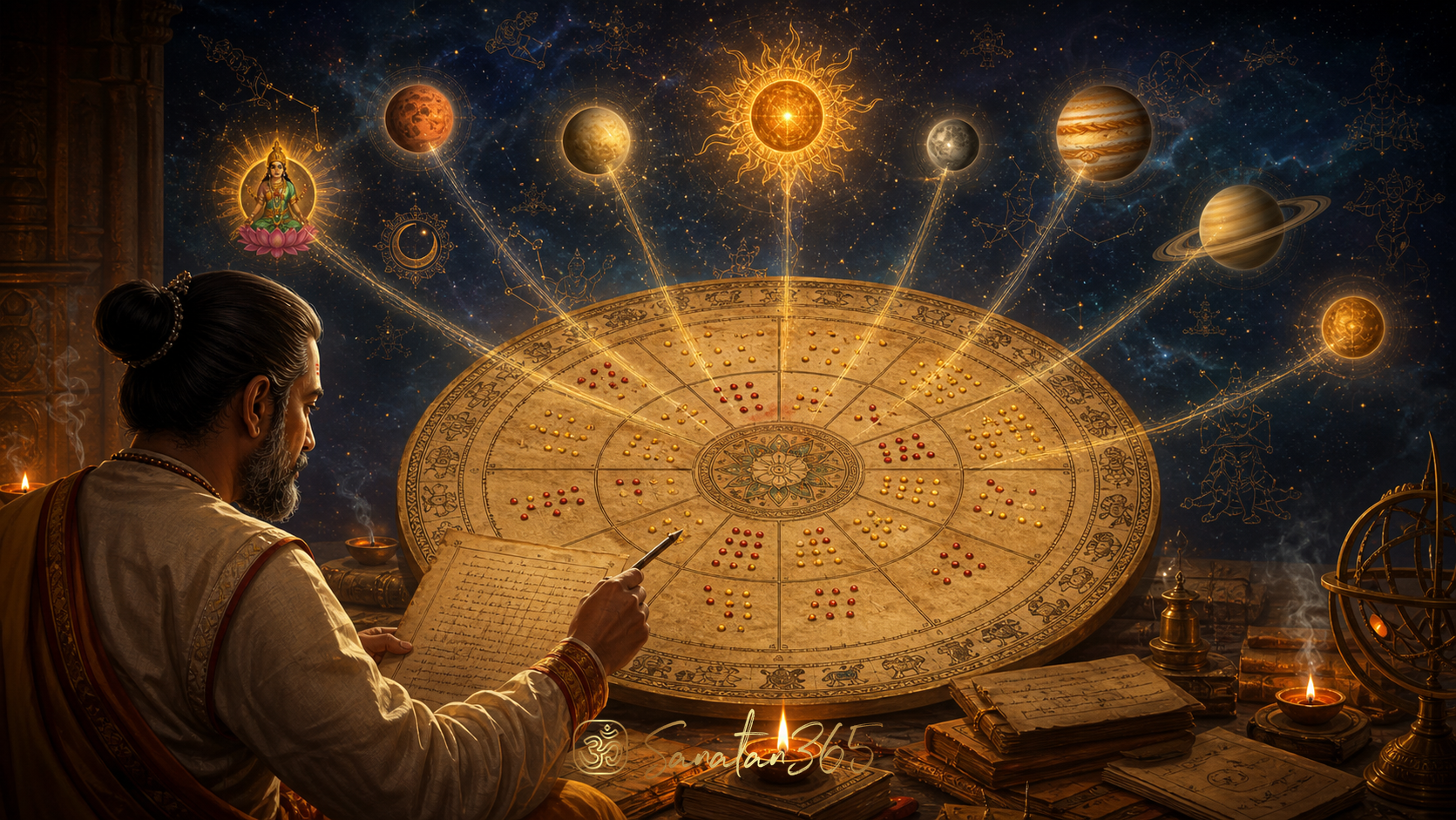
Ashtakavarga Meaning: How Bindus Help Read Planetary Support
Ashtakavarga is a classical Jyotisha method that maps planetary support across the twelve signs through bindus. Learn what the scores mean, how the main charts differ, and why no number should be read alone.
A Kundali may look like a fixed picture of the sky, but Ashtakavarga asks a more specific question: where does each classical planet find support as it moves through the zodiac?
Ashtakavarga meaning begins with its Sanskrit name: ashta (अष्ट, eight) and varga (वर्ग, group or division). It is a classical Jyotisha (ज्योतिष, the Hindu tradition of astral knowledge) method that assigns bindus, or point-marks, across the twelve signs using eight reference points. The resulting patterns help an astrologer compare relative support for planets, signs, houses, and transits. They do not replace the birth chart, promise an event, or reduce a life to one total.
Key takeaway: Ashtakavarga is a contextual map of relative planetary support, not a stand-alone verdict about fate.
What Is the Meaning of Ashtakavarga in a Kundali?
The basic Kundali records the zodiacal positions of the grahas (ग्रह, planets or influential celestial factors) at birth. Ashtakavarga reorganizes part of that information into a point-based pattern. Instead of looking only at where a planet sits, it examines how a set of eight references supports or withholds support from that planet across all twelve signs.
The classical system is discussed at length in the Brihat Parashara Hora Shastra, whose Ashtakavarga material spans several chapters on the base system, reductions, results, and the collective chart. A published chapter listing is available through Wisdom Library's edition overview. This breadth matters: Ashtakavarga was not designed as a one-number shortcut. It belongs to a larger interpretive discipline.
In a modern chart, the marks may appear as dots, numbers, or rows in a table. The Sanskrit term bindu (बिन्दु, point or dot) is commonly used for a supportive contribution. Some lineages and software use rekha (रेखा, line) differently, and older explanatory conventions are not perfectly uniform. A careful reader should therefore confirm the legend used by the particular chart instead of assuming that every symbol means the same thing everywhere.
What remains consistent is the comparative logic. A sign receiving more supportive contributions in a relevant chart is generally treated as having greater capacity for the planet or transit being studied. A sign receiving fewer is approached with more caution. Yet “more” does not automatically mean “good in every area,” and “less” does not mean disaster. The relevant house, planet, rulership, natal condition, dasha, and life question still matter.
This is similar to reading a map of roads. A wide road may make movement easier, but it does not decide why someone travels, whether the destination is wise, or what happens upon arrival.
Key takeaway: Ashtakavarga converts selected relationships in a Kundali into a comparative support map while preserving the need for full-chart judgment.
Why Does Ashtakavarga Use Eight Reference Points?
The “eight” in Ashtakavarga refers to the seven visible classical grahas used in this calculation plus the Lagna (लग्न, ascendant or rising sign):
- Surya, the Sun
- Chandra, the Moon
- Mangala, Mars
- Budha, Mercury
- Guru or Brihaspati, Jupiter
- Shukra, Venus
- Shani, Saturn
- Lagna, the ascendant
Rahu and Ketu, the lunar nodes, are central to many forms of Jyotisha interpretation, but they are not among the eight contributors in the standard Ashtakavarga calculation. That does not make them unimportant. It simply reflects the architecture of this particular classical method.
For each planet's individual Ashtakavarga, traditional rules identify which sign positions receive a supportive contribution from each of the eight references. The calculation is relational. A point is not assigned because a sign is universally fortunate; it is assigned because a specified relationship meets the rule for that planet and contributor.
This distinction prevents a common misunderstanding. Ashtakavarga is sometimes described as if planets were handing out generic “lucky points.” The traditional logic is more disciplined. Each planet has its own contribution pattern, and the same sign may look different in the individual charts of the Sun, Moon, Mars, or Saturn.
The ascendant's inclusion is also significant. The Lagna anchors the houses to the local eastern horizon at birth and gives the chart its lived orientation. Including it among the eight reference points joins planetary relationships to the embodied, house-based experience of the person.
Key takeaway: The eight contributors are seven classical planets plus the ascendant, and each contributes according to planet-specific rules rather than a generic luck scale.
What Is the Difference Between Bhinnashtakavarga and Sarvashtakavarga?
Two names appear repeatedly when people first encounter an Ashtakavarga chart.
Bhinnashtakavarga (bhinna, भिन्न, separate or individual) is the separate Ashtakavarga of one planet. It shows how many supportive contributions that planet receives in each of the twelve signs. There are individual charts for the seven classical planets. When studying Saturn's transit, for example, an astrologer may examine Saturn's Bhinnashtakavarga rather than treating every planetary table as interchangeable.
Sarvashtakavarga (sarva, सर्व, all or collective) combines the seven planetary Bhinnashtakavarga totals sign by sign. It offers a broader view of how much cumulative support gathers in each sign. Because the ascendant contributes within the individual calculations but does not have a separate planetary row added to the collective total, the usual Sarvashtakavarga total across all twelve signs is 337.
Some sources use the name Samudaya Ashtakavarga (samudaya, समुदाय, aggregate or collection) for the collective chart. A contemporary overview of the method and its relation to the twelve houses appears in Prokerala's Ashtakavarga introduction. Terminology can vary, but the practical distinction remains:
- Bhinnashtakavarga asks about one planet's pattern.
- Sarvashtakavarga shows the cumulative pattern across the seven planetary charts.
- Neither should be interpreted without the natal chart and the question being asked.
The collective chart is attractive because it seems easy to compare. A reader can see that one sign has more points than another. But a total cannot explain everything carried by the twelve bhavas, or houses. The same number may operate differently when connected with education, health, relationships, livelihood, spiritual practice, or shared resources.
Key takeaway: Bhinnashtakavarga is planet-specific; Sarvashtakavarga is collective. The first gives detail, while the second gives a wider pattern.
How Are Bindus Read Across the Twelve Signs?
The safest way to read Ashtakavarga points is comparatively and in layers.
First, identify the chart being viewed. Is it a planet's Bhinnashtakavarga or the collective Sarvashtakavarga? A score without its chart type is incomplete information.
Second, identify the sign and the house it occupies from the natal Lagna. Signs and houses are related but not identical. Aries is always Aries, yet it does not become the first house for every person. A point total belongs to a sign in the calculation and gains house meaning only when placed within the person's chart.
Third, compare rather than label. In an individual planetary chart, a higher bindu count in one sign suggests relatively stronger support for that planet there than in a sign with fewer points. In the collective chart, a higher total suggests more accumulated support. Traditional practitioners often use broad reference ranges, but rigid universal cut-offs can mislead. Distribution matters, and the same total must be judged with the house and natal condition.
Fourth, return to the planet's condition in the main Kundali. Is the planet strong or strained by sign, house, conjunction, aspect, combustion, or other factors recognized by the lineage? What houses does it govern? A supportive Ashtakavarga pattern can strengthen a constructive possibility, but it does not erase the rest of the chart.
Fifth, distinguish capacity from guaranteed outcome. A well-supported house may offer scope for growth, responsibility, or productive activity. That does not guarantee effortless results. Likewise, a lower score may call for patience and realism without condemning the area of life.
A beginner can use this four-question check:
- Which Ashtakavarga chart is this?
- Which sign and natal house does the score describe?
- Is the score high or low relative to the rest of this same chart?
- What do the natal planet, dasha, and current transit add?
This prevents the most common error: isolating one number and turning it into a prediction.
Key takeaway: Bindus become meaningful only after chart type, sign, house, planetary condition, and relative distribution are considered together.
How Is Ashtakavarga Used with Planetary Transits?
One important use of Ashtakavarga is gochara (गोचर, planetary transit). As a planet moves through a sign, its Bhinnashtakavarga can help an astrologer assess whether that sign carries relatively more or less support for that planet in the natal pattern.
Suppose Jupiter is transiting a sign that receives comparatively strong support in Jupiter's Bhinnashtakavarga. A practitioner may read that as one supportive factor. Yet Jupiter's natal role, the house being activated, aspects, the collective score, and the current dasha still shape the interpretation. The point pattern refines the reading; it does not authorize a guaranteed promise.
This is especially important when Ashtakavarga is combined with a timing system such as Vimshottari Dasha. Dasha and transit answer different parts of the timing question. A dasha indicates which planetary period is active within that tradition, while a transit describes current movement. Ashtakavarga adds a structured measure of relative support across signs. Used together, they create context. Used carelessly, they can create false precision.
Astrology should never be used to frighten someone into urgent remedies, financial decisions, medical choices, or relationship ultimatums. A chart reading can support reflection, but it cannot replace qualified professional advice or personal responsibility. Traditional wisdom is best served by humility about what any technique can establish.
Key takeaway: In transit work, Ashtakavarga is one interpretive layer beside the natal chart, house activation, planetary periods, and responsible judgment.
What Can Ashtakavarga Not Predict on Its Own?
Ashtakavarga cannot tell a complete life story from one score. It cannot ethically guarantee wealth, marriage, health, career success, spiritual attainment, or the timing of a specific event by itself. It also cannot explain a house without considering its lord, occupants, aspects, relevant divisional charts, and operating periods.
Three limits are especially useful for beginners:
- A high score is not a universal blessing. It may show capacity or support, but the area and planetary role determine how that support is expressed.
- A low score is not a sentence. It may describe a field requiring effort, restraint, maturity, or careful timing.
- Numbers do not remove interpretation. They organize information, but the quality of the reading depends on context, lineage, and ethical restraint.
There is also a spiritual limit. Jyotisha traditionally invites attention to time, karma, and dharma; it does not cancel purushartha (पुरुषार्थ, purposeful human effort). A chart may describe tendencies and seasons, but choices, character, service, study, and devotion remain meaningful.
For anyone receiving an Ashtakavarga table in software or a report, the wisest next step is not to search for one frightening threshold. Ask what chart is shown, which calculation convention is being used, what the relevant planet and house signify, and how the conclusion was integrated with the full Kundali.
Ashtakavarga is most valuable when it makes interpretation more disciplined. Its bindus encourage comparison, its separate charts preserve planetary specificity, and its collective chart reveals broader distribution. The method becomes less useful when precision is mistaken for certainty.
Key takeaway: Ashtakavarga can refine a reading, but it cannot replace the full chart, ethical interpretation, purposeful effort, or professional judgment.
FAQ
What does Ashtakavarga mean?
Ashtakavarga means an “eightfold group” or “group of eight.” In Jyotisha, it is a classical method that uses contributions from seven traditional planets and the ascendant to distribute supportive bindus across the twelve zodiac signs.
What is a bindu in Ashtakavarga?
A bindu (बिन्दु, point or dot) is commonly used to mark a supportive contribution in an Ashtakavarga table. Symbol conventions can differ between lineages and software, so the chart's own legend should always be checked.
What is the difference between Bhinnashtakavarga and Sarvashtakavarga?
Bhinnashtakavarga is the separate point pattern for one planet. Sarvashtakavarga combines the seven planetary patterns to show cumulative support across the twelve signs. One is planet-specific; the other is collective.
Is a high Ashtakavarga score always good?
No. A higher score generally indicates relatively greater support within the relevant Ashtakavarga chart, but its meaning depends on the sign, natal house, planet, rulership, dasha, transit, and the rest of the Kundali. It is not a guaranteed positive outcome.
Can Ashtakavarga predict exact events?
Not on its own. Ashtakavarga is used as one layer in a wider Jyotisha assessment. Exact-event claims based only on a point total ignore the natal chart, planetary periods, transits, divisional charts, and the limits of responsible interpretation.
About the author
Sanatan365 Editorial
Bringing Sanatan Dharma to modern seekers through authentic, scripture-grounded content.
Related in Kundali
 Kundali
Atmakaraka Meaning: The Soul Significator in Jaimini Astrology
Atmakaraka means the significator of the self or soul in Jaimini astrology. It is identified through a planet's relative degree within its…
 Kundali
Vimshottari Dasha Meaning: Mahadasha, Antardasha, and the 120-Year Cycle
A grounded guide to Vimshottari Dasha: how the birth nakshatra starts the sequence, how Mahadasha and Antardasha work, and how to read plan…
 Kundali
 Matching Meaning: Guna Milan, Compatibility, and Dharma
A clear guide to Kundali matching, Guna Milan, Ashtakoota, Manglik checks, and how families can read compatibility with maturity and faith.

