Vimshottari Dasha Meaning: Mahadasha, Antardasha, and the 120-Year Cycle
A grounded guide to Vimshottari Dasha: how the birth nakshatra starts the sequence, how Mahadasha and Antardasha work, and how to read planetary periods responsibly.
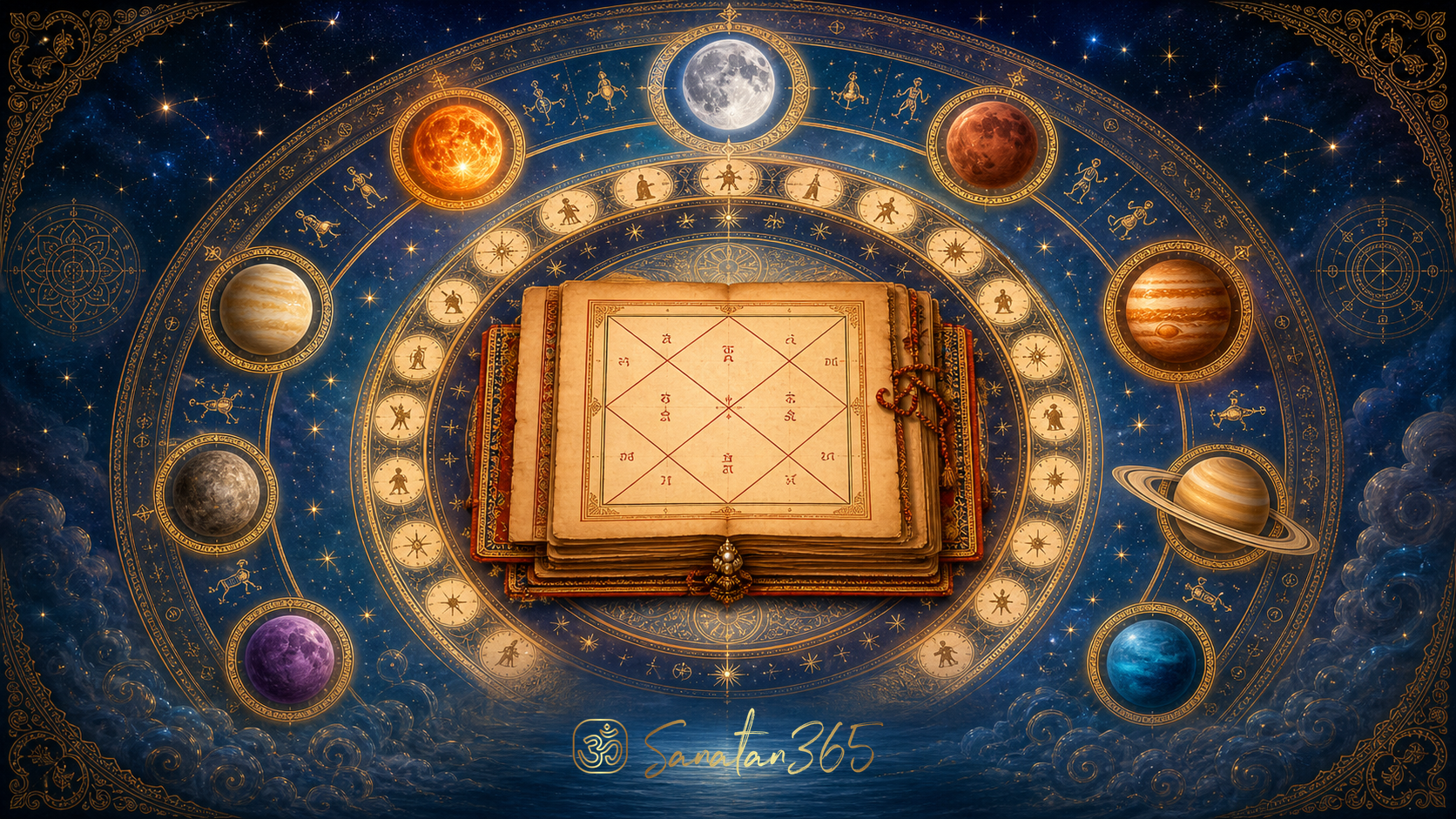
A Kundali is not read only as a fixed picture of birth. In Jyotisha, it is also read through changing periods of time. Vimshottari Dasha meaning begins here: it is a traditional system that divides a 120-year cycle among nine grahas, starting from the ruler of the Moon's nakshatra at birth. A Mahadasha gives the larger period; an Antardasha gives a smaller period within it. Neither should be treated as an automatic promise of success, danger, marriage, illness, or any other event.
The Sanskrit word dasha (दशा, daśā, condition or period) describes a phase in which one graha becomes especially relevant to interpretation. Vimshottari (विंशोत्तरी, viṃśottarī, one hundred and twenty) names the complete 120-year sequence. The system is widely used in Parashari Jyotisha and is traditionally associated with the Brihat Parashara Hora Shastra, particularly its discussion of planetary periods.
This article explains the framework, its arithmetic, its relationship to the birth nakshatra, and the limits that make responsible interpretation possible.
What Is the Vimshottari Dasha Meaning in a Kundali?
Vimshottari Dasha is a nakshatra-based planetary-period system used to ask when particular potentials in a birth chart may become more prominent. A natal chart describes placements at birth; the dasha sequence supplies a traditional clock for reading how those placements may unfold through time.
A graha (ग्रह, graha, a celestial influence that “seizes” or holds) is not interpreted in isolation. During its period, an astrologer still examines:
- the houses the graha rules;
- the house and sign it occupies;
- conjunctions and aspects;
- strength, dignity, and relevant yogas;
- the chart's ascendant and Moon;
- the running sub-period;
- major transits and the person's real circumstances.
This is why “Saturn period is bad” or “Venus period guarantees marriage” are poor readings. The same graha can signify different responsibilities, relationships, opportunities, or tests in different charts. The meaning of Lagna in Kundali helps explain why house rulership changes from one ascendant to another.
The broader practice belongs to Jyotisha (ज्योतिष, jyotiṣa, the traditional discipline of celestial indicators and sacred time). Modern academic references, including the Encyclopaedia Britannica overview of astrology, classify astrology as divination rather than modern empirical science. A careful reader can therefore approach dasha as a traditional interpretive framework, not as a scientifically guaranteed forecasting mechanism.
Key takeaway: Vimshottari Dasha provides a timing framework, but the whole chart and lived context determine how a period is interpreted.
How Does the 120-Year Vimshottari Dasha Cycle Work?
The complete cycle assigns fixed durations to nine grahas, including the lunar nodes Rahu and Ketu. The standard sequence is:
- Ketu — 7 years
- Venus — 20 years
- Sun — 6 years
- Moon — 10 years
- Mars — 7 years
- Rahu — 18 years
- Jupiter — 16 years
- Saturn — 19 years
- Mercury — 17 years
Together these periods total 120 years. The durations and order are summarized in traditional Vimshottari tables such as the Prokerala dasha reference. After Mercury, the sequence returns to Ketu.
The 120 years are not a prediction that every person will live for exactly that span. They form a complete mathematical cycle from which an individual's running periods are calculated. Most people are born partway through the Mahadasha indicated by the Moon's birth nakshatra, so they do not begin life with the full Ketu period merely because Ketu appears first in the conventional list.
Each of the 27 nakshatras belongs to one of the nine dasha rulers, repeating the same planetary order three times across the zodiac. A nakshatra (नक्षत्र, nakṣatra, lunar mansion) is one of the 27 divisions used to locate the Moon and other grahas. Readers unfamiliar with that foundation may first review the 27 nakshatras in Hindu astrology.
Why does the Moon's nakshatra matter?
The Moon's precise position at birth identifies the nakshatra and therefore the Mahadasha ruler active at birth. The portion of that nakshatra still left for the Moon to traverse determines the balance of the Mahadasha remaining.
Suppose, only as a simple illustration, that half of the relevant birth nakshatra remained when a child was born. If that nakshatra belonged to a graha whose full Mahadasha lasts 16 years, roughly half of that 16-year period would remain. Real calculation uses exact astronomical longitude and should not be estimated from a broad Sun sign or a casual horoscope.
This starting balance is one reason an accurate birth time and place matter. Even when the Moon does not change nakshatra near the recorded time, precise data helps establish the ascendant, houses, and other factors used to interpret the resulting period. The birth chart is the map; the dasha is one timing layer placed upon it.
Key takeaway: The sequence is universal, but each person's entry point and remaining balance arise from the Moon's exact birth nakshatra.
What Are Mahadasha and Antardasha?
Mahadasha (महादशा, mahādaśā, great or major period) is the broadest commonly discussed period in the Vimshottari system. It establishes the long chapter. Antardasha (अन्तर्दशा, antardaśā, inner or sub-period), sometimes called bhukti in South Indian practice, divides that chapter into nine smaller phases.
Every Mahadasha contains an Antardasha of each of the nine grahas. The sub-periods follow the Vimshottari order beginning with the Mahadasha lord. Thus a Jupiter Mahadasha begins with Jupiter Antardasha, then proceeds to Saturn, Mercury, Ketu, Venus, Sun, Moon, Mars, and Rahu.
The length of an Antardasha is proportional to the fixed years of its ruler. The traditional calculation is:
Antardasha duration = Mahadasha years × Antardasha ruler's years ÷ 120
For example, a Jupiter Mahadasha lasts 16 years. Jupiter Antardasha within it lasts 16 × 16 ÷ 120 years, while Saturn Antardasha lasts 16 × 19 ÷ 120 years. Software usually performs these conversions into calendar dates, but seeing the ratio prevents the table from feeling arbitrary.
How should two period lords be read together?
The Mahadasha lord sets the larger field; the Antardasha lord modifies and activates a more specific part of it. A responsible interpretation asks how the two grahas relate in the natal chart:
- Do they rule supportive, demanding, or mixed houses?
- Where are they placed from the ascendant and from each other?
- Do they form a recognized yoga or receive important aspects?
- What themes do their houses naturally bring forward?
- Are current transits reinforcing or restraining those themes?
- What choices, duties, resources, and constraints exist in the person's life?
Smaller divisions called Pratyantardasha (प्रत्यन्तर्दशा, pratyantardaśā, sub-sub-period) and further levels can narrow the timeline. More precision, however, does not automatically create more certainty. If the birth time is inaccurate or the foundational chart reading is weak, adding smaller periods may only produce false confidence.
Key takeaway: Mahadasha and Antardasha work as nested periods; neither can be judged responsibly by the planet's popular reputation alone.
How Is a Dasha in Kundali Interpreted Responsibly?
A useful dasha reading describes themes, conditions, and decision points. It does not frighten a person with unavoidable outcomes. Traditional symbolism can support reflection, but it should never replace practical judgment, professional advice, or personal responsibility.
1. Begin with natal promise, not period stereotypes
A period cannot reliably produce what the chart does not meaningfully support. The dasha lord's house rulership, placement, condition, and relationships come first. Even then, interpretation remains a reading of symbolic indications, not a contract with fate.
2. Distinguish activation from causation
Astrologers often describe a dasha as “activating” houses or significations. This language is safer than claiming that a planet mechanically causes every event. A career theme may become more visible, for example, but its expression can range from training and responsibility to a role change, depending on the chart and real-world choices.
3. Check the Antardasha and major transits
A long Mahadasha can contain contrasting sub-periods. An Antardasha may highlight a different relationship, house, or obligation within the larger chapter. Gochara (गोचर, gocara, planetary transit) is then used as a separate timing layer. The Panchang's five limbs of Hindu time provide related calendar context, though a Panchang and a natal dasha serve different purposes.
4. Use probabilistic, ethical language
Good phrasing sounds like “this period may emphasize disciplined work” or “this combination can bring relationship decisions into focus.” Poor phrasing sounds like “this will certainly happen” or “this planet will ruin the next seven years.” Fear-based claims make people easier to exploit and are inconsistent with careful spiritual counsel.
5. Keep remedies proportionate and voluntary
Some Jyotisha traditions recommend prayer, mantra, charity, vrata, temple worship, or service during particular periods. Such practices should be devotional and ethical, never sold as guaranteed control over fate. They should not involve unsafe fasting, unaffordable purchases, fear, or the abandonment of medical, legal, financial, or mental-health support.
For readers using a generated Kundali or consulting a practitioner, three questions improve the conversation:
- Which exact chart factors support this interpretation?
- What alternative expressions of the same period are possible?
- What practical actions remain within the person's control?
Key takeaway: Responsible dasha interpretation joins technical chart context with humility, choice, and freedom from fear.
What Can the Vimshottari Dasha Cycle Teach Beyond Prediction?
The deepest value of a time-cycle framework may be its reminder that no phase is the whole life. A long Mahadasha still contains changing Antardashas. A demanding period contains internal seasons; an easy period still asks for wise conduct. Time moves, conditions change, and human response matters.
This view can encourage four forms of reflection:
- Stewardship: What responsibilities deserve attention in this chapter?
- Discernment: Which impulses should be acted upon, examined, or released?
- Preparation: What skills, savings, relationships, or disciplines need strengthening?
- Perspective: How can a temporary condition be met without turning it into a permanent identity?
Jyotisha literally carries the imagery of light. At its best, its timing systems should bring greater clarity to action, not surrender judgment to a calendar. The point is not to become passive before a planetary period. It is to notice patterns while living dharma through truthful, compassionate, and responsible choices.
Key takeaway: The cycle is most constructive when it deepens perspective and responsibility rather than fatalism.
Conclusion
Vimshottari Dasha organizes 120 years among nine planetary rulers and begins each individual sequence from the Moon's nakshatra at birth. Mahadasha describes the larger chapter; Antardasha reveals a nested phase within it. Their meaning depends on the natal chart, their relationship, other timing factors, and real life.
Key takeaway: A dasha is a traditional lens on time, not a fixed verdict; read it with technical care, ethical restraint, and room for human agency.
FAQ
What is the simple meaning of Vimshottari Dasha?
Vimshottari Dasha is a traditional Jyotisha system that divides a 120-year cycle among nine grahas. It uses the Moon's nakshatra at birth to determine which Mahadasha is running and how much of it remains.
What is the difference between Mahadasha and Antardasha?
Mahadasha is the major planetary period that sets the larger theme. Antardasha is a shorter planetary sub-period within that Mahadasha. The two rulers are interpreted together with the full birth chart.
Does everyone begin with Ketu Mahadasha?
No. Ketu begins the conventional list, but a person's first running Mahadasha depends on the ruler of the Moon's birth nakshatra. Most people are also born partway through that period rather than at its first day.
Is Vimshottari Dasha scientifically proven?
No. It belongs to the traditional interpretive practice of Jyotisha and is not established as a predictive method by modern empirical science. It should not be used as a guaranteed forecast or as a substitute for professional advice.
Can a Mahadasha be called entirely good or bad?
Not responsibly. Results are traditionally judged from house rulership, placement, strength, aspects, yogas, the running Antardasha, transits, and personal circumstances. Every long period can contain varied phases and expressions.
About the author
Sanatan365 Editorial
Bringing Sanatan Dharma to modern seekers through authentic, scripture-grounded content.
Related in Kundali
 Kundali
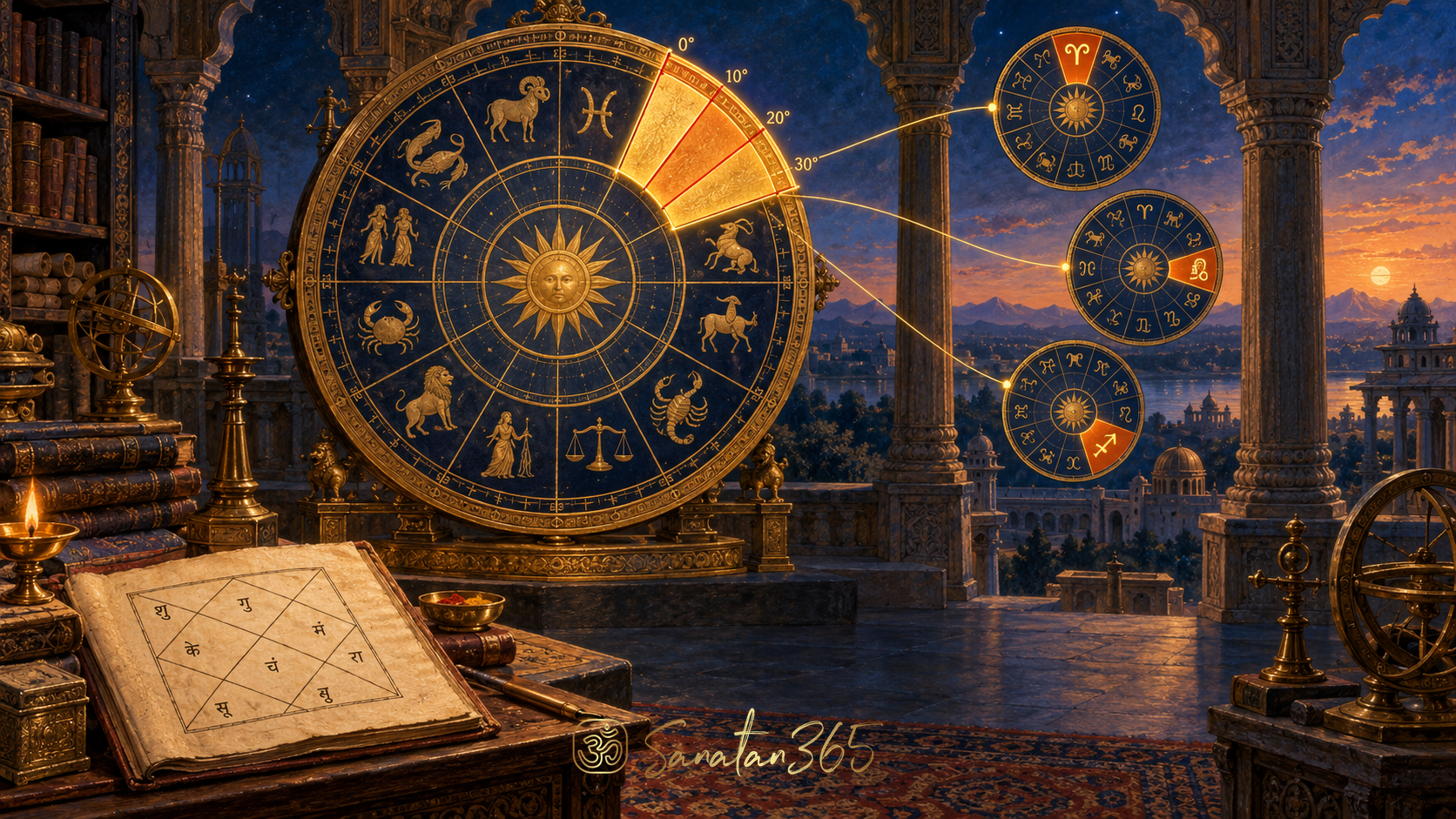
Drekkana Chart Meaning: How the D3 Divides a Birth Chart
Understand the Drekkana D3 chart through ten-degree divisions, worked examples, its traditional focus on siblings, and clear limits on inte…
 Kundali
Bhava Chalit Chart Meaning: Why Houses Change but Signs Do Not
Read a Bhava Chalit chart without confusing a planet’s zodiac sign with its calculated house. Understand midpoint conventions, a worked exa…
 Kundali
Vargottama Meaning: When D1 and D9 Repeat a Zodiac Sign
Understand the same-sign relationship between a birth chart and its Navamsa, how to identify it, and why it is not a stand-alone promise of…