Lavthavati Vikrala Aarti Meaning: Shiva in a Marathi Song of Light
A close reading of a Marathi Shiva aarti, from fierce fire and flowing water to Parvati, the blue throat, and the quiet work of remembrance.
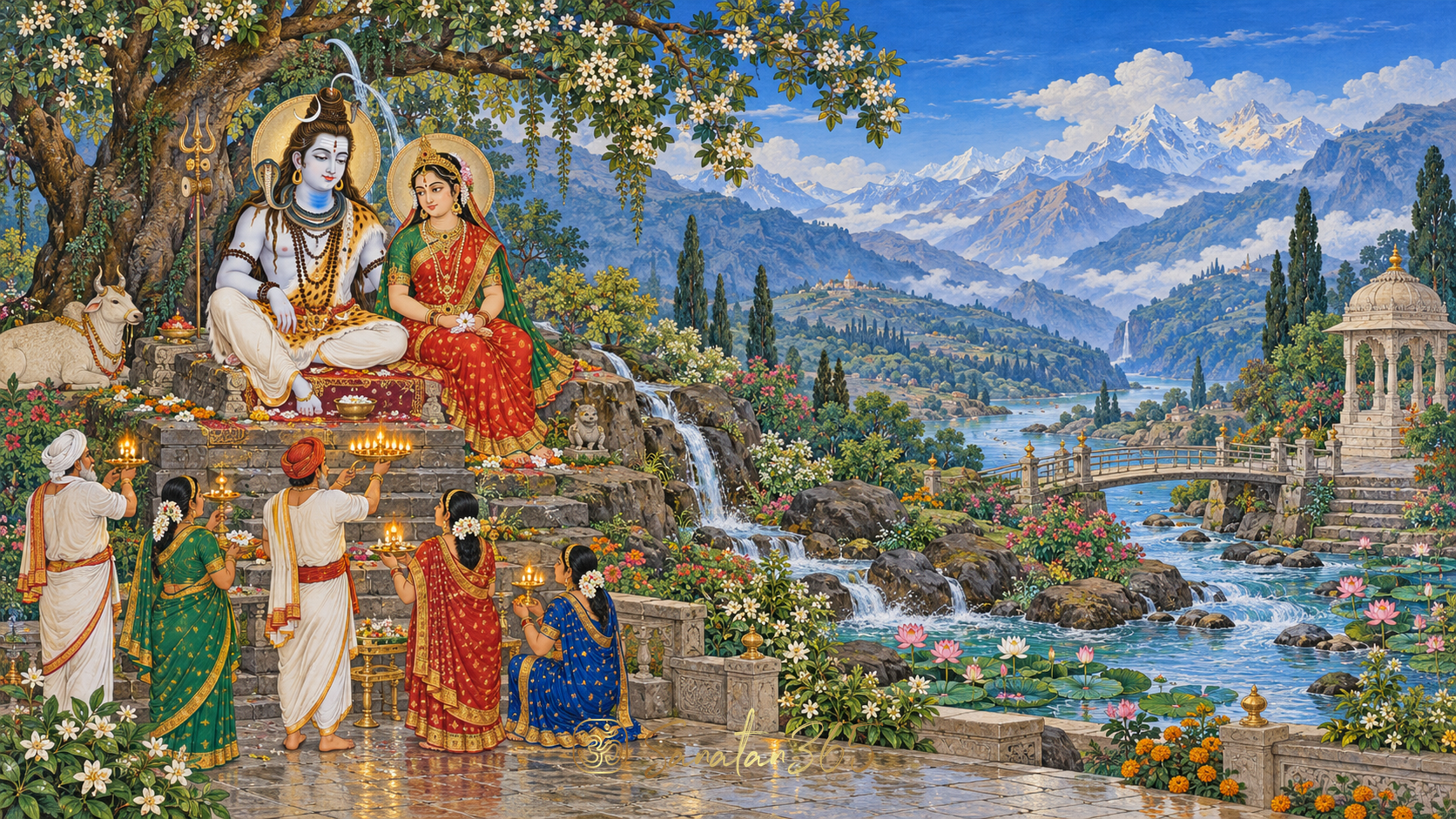
A darkened throat, a fiery third eye, and a stream of clear water appear within the opening four lines. The song does not ask the listener to choose between Shiva's awe-inspiring power and his tenderness.
Lavthavati Vikrala aarti meaning centres on praising Shiva through contrasting images: fierce radiance and beauty, sacred ash and flowers, cosmic danger and protective compassion. This Marathi aarti (आरती, an offering of light accompanied by praise) moves through four stanzas, each returning to a refrain addressed to Shri Shankara, an auspicious name of Shiva. Understanding that movement makes a familiar song easier to sing with attention rather than simply from memory.
What is the Lavthavati Vikrala aarti meaning?
The Marathi text printed by Drik Panchang provides the basis for this reading. English spellings vary: Lavthavati, Lavathavati, and Lavthavti can identify the same opening. Such variation reflects transliteration, not necessarily a different song. The four-stanza sequence matters more than insisting on one English spelling.
Its refrain is the devotional anchor:
जय देव जय देव जय श्रीशंकरा। आरती ओवाळू तुज कर्पुरगौरा॥
In a simple sense, the singers praise Shri Shankara and offer the circling light to the camphor-fair Lord. Karpurgaura (कर्पूरगौर, fair or luminous like camphor) is a poetic epithet. It should not become a judgment about human complexion. The line concerns the sacred appearance of Shiva within the song's devotional imagery.
The Marathi verb associated with the offering describes the act of waving or circling the light before the worshipped presence. The song is therefore not merely a list of attributes. It repeatedly brings the worshipper back to an act: praise becomes offering. After each stanza has opened a different aspect of Shiva, the refrain gathers the attention again.
A useful way to follow the whole composition is to notice its progression:
- The opening places powerful and beautiful images side by side.
- The second stanza brings Parvati, flowers, ash, and affection into view.
- The third remembers the dangerous poison from the ocean churning.
- The final stanza turns toward sacred names, speech, and inward remembrance.
This outline is an interpretive aid, not a replacement for the Marathi words. Readers unfamiliar with the offering itself may first explore why light is offered in aarti. The ritual and the particular song illuminate one another, but they are not identical subjects.
Key takeaway: The refrain turns each changing image of Shiva into the same attentive offering of light.
Why does the first stanza join fierce fire and flowing water?
The first stanza begins with a tremendous vision. Its language evokes fierceness and cosmic scale, then names the darkened throat and the flame of the third eye. Before that intensity settles into a single mood, beauty and clear flowing water enter the scene. The listener is not left with an image of destruction alone.
The word trinetri (त्रिनेत्री, three-eyed) points to Shiva's third eye. In this close reading, the flame can invite reflection on a power that exceeds ordinary sight. That is a devotional interpretation of the image, not a claim that the stanza supplies a complete philosophical explanation of every form of Shiva.
Likewise, the flowing water recalls Shiva's familiar association with Ganga (गंगा, the sacred river personified as a goddess). The song's compact wording does not retell the full descent of the river. A listener may recognise the association without inserting a lengthy narrative into a line that mainly asks the imagination to see and hear clear water flowing.
There is a useful caution about translation here. Marathi words, poetic compression, and local explanation do not always map neatly onto one English sentence. A second Marathi text with an English rendering offers a more expanded account of Ganga in the opening stanza. That rendering is helpful as an interpretation, but its added explanation should not be mistaken for a literal word-for-word equivalent of every phrase.
For a singer, the important contrast remains accessible even without solving every lexical question: fire is present, but so is water; awe is present, but so is beauty. The sacred image has more than one emotional register. Singing the stanza slowly allows those registers to remain together.
This can change how a household introduces the song to children. Instead of saying only that Shiva is frightening, an adult can ask which details seem powerful and which seem gentle. The discussion then stays rooted in the actual images. It need not turn into invented promises about what singing will cause to happen.
Key takeaway: The opening holds intensity and tenderness together, rather than reducing Shiva to a frightening figure.
How do Parvati and sacred ash change the portrait?
The second stanza calls Shiva bhola (भोळा, simple-hearted or guileless) and describes his wide eyes. It brings Parvati beside him, along with flower garlands and sacred ash. The vastness of the opening is not cancelled; it is made approachable through relationship and affection.
Ardhangi (अर्धांगी, the one who shares half the body or the inseparable partner) describes Parvati in the Marathi line. It can call to mind the unity expressed in Ardhanarishvara (अर्धनारीश्वर, the form uniting Shiva and Parvati in one body), as the cited English rendering explains. Yet the song does not require every image used during worship to depict that particular form. A household may sing before Shiva and Parvati together or before its established Shiva shrine according to its own practice.
Vibhuti (विभूती, sacred ash) and flowers offer another contrast. Ash is not a luxury ornament; flowers are fresh, fragrant, and delicate. Held together in the stanza, they make the appearance of Shiva unlike ordinary ideas of display. Devotional beauty is not simply the accumulation of expensive things.
One possible reflection is that reverence can include simplicity without becoming careless. A clean place, thoughtfully offered flowers where customary, and careful attention to the song can carry meaning. The stanza itself does not set a budget, prescribe shopping, or announce that one household's materials make its devotion greater than another's.
Parvati's presence also keeps the reading relational. Shiva is not presented only as a remote force to be managed through correct performance. The affectionate closing description of this stanza places him in relation to Uma, another name of Parvati. The worshipper encounters tenderness within the same figure whose third eye has just been remembered.
For Marathi-speaking families outside India, explaining two or three of these words may be more useful than interrupting every sung line. The words can be discussed before the offering, leaving the actual singing unhurried and continuous. Meaning supports participation without turning worship into an examination.
Key takeaway: Parvati, flowers, and ash bring affection and simplicity into the song's powerful sacred portrait.
What does the blue throat reveal about the churning story?
The third stanza briefly recalls the churning of the ocean by divine and opposing beings. From it emerges halahala (हलाहल, the dangerous poison of the churning narrative). Shiva drinks the poison and becomes known as Nilakantha (नीलकण्ठ, the blue-throated one). These are the core narrative elements named in the song.
The stanza is short, but its placement matters. The darkened throat appeared at the beginning as part of Shiva's form. Now the song gives that feature a remembered action. The visible sign is connected to the response to a danger that has emerged during a collective undertaking.
The cited English translation interprets this act through compassion for living beings. That is a helpful devotional reading: the blue throat bears the memory of protection. It is not a sign that the danger never existed. The image preserves both the crisis and the response to it.
Readers wanting the larger narrative can turn to the story and meaning of Samudra Manthan. Samudra Manthan (समुद्र मन्थन, churning of the ocean) contains many episodes; this aarti selects the poison-bearing moment rather than recounting them all. Keeping that distinction avoids attributing an entire retelling to four compact lines.
The episode must never be treated as a literal instruction to ingest anything harmful. Nor does compassionate endurance mean accepting abuse, concealing danger, or refusing practical help. A sacred narrative can encourage responsibility without making preventable suffering a measure of devotion.
An ordinary ethical reflection might be much smaller: when a shared task produces anger or confusion, someone can pause the escalation, identify the problem, and seek a constructive response. That is an analogy drawn by the reader, not an equivalence between a human action and Shiva's cosmic deed. The distinction preserves both reverence and sensible judgment.
It also changes the tone of singing. The blue throat is not merely a decorative colour detail to rush past. It can become the point at which the gathering remembers that power, in this devotional image, answers danger through care rather than indifference.
Key takeaway: The third stanza explains the blue throat through a remembered act of protection, not a promise of immunity from harm.
How does the final stanza turn vision into remembrance?
The last stanza returns to Shiva's distinctive attributes. Vyaghrambara (व्याघ्रांबर, wearing a tiger-skin garment) and phanivaradhara (फणिवरधर, bearer of a great serpent) evoke familiar iconography. Madanari (मदनारी, opponent or destroyer of Madana, the deity of desire) and panchanana (पंचानन, five-faced) add further names and associations. These are poetic descriptions, not instructions to obtain animal materials or reproduce every attribute at home.
The effect is cumulative. After fire, water, ash, flowers, and poison, the singer meets further images that resist a single ordinary portrait. Yet the verse does not end with a visual inventory. It moves toward utterance and the heart, with references to sacred seed, speech, Rama, and Ramdasa.
Bija (बीज, seed) can carry a sacred verbal sense in devotional language. A beginner need not infer an undisclosed technical mantra practice from that word. The song itself remains available to sing reverently without claiming initiation, secret authority, or mastery of a specialised discipline.
The closing reference to Ramdasa is a reason the aarti is commonly associated with the devotional voice of Ramdas. The printed lyric establishes that name within the verse; by itself, it does not establish a manuscript history or an exact composition date. Those historical questions require evidence beyond a modern lyric page.
Rama's appearance at the close of a Shiva song need not be treated as a competition between deities. Within this devotional reading, remembrance can be expansive rather than exclusive. Readers can compare the distinct approach of Om Jai Shiv Omkara, while allowing each song its own words and progression.
Key takeaway: The final stanza brings the richly pictured form back to sacred speech and inward remembrance.
How can a household sing this Marathi aarti attentively?
Begin with the family's established practice rather than an invented universal rule. Some gatherings sing several aartis in sequence; others sing one. Language, melody, repetition, and the placement of the refrain can differ. A printed four-stanza text is a useful reference, not proof that every recording must perform exactly the same musical arrangement.
A simple preparation can help:
- Read the refrain's meaning before singing.
- Choose one image to notice in each stanza.
- Let a confident singer guide unfamiliar pronunciation gently.
- Keep flames stable and away from clothing, curtains, and children.
- Follow local guidance about the offering and any temple restrictions.
People who do not know Marathi can listen respectfully and learn gradually. There is no need to pretend that repetition has already produced full understanding. Returning to one word each week may deepen familiarity more naturally than memorising a rushed English paraphrase.
The song's central gift is its refusal to separate awe from tenderness. Light circles before a presence imagined through fire and water, ash and flowers, power and affection. The single concluding takeaway is simple: attentive praise remembers the relationships and actions within the image, not only its outward splendour.
Key takeaway: A small amount of preparation can make familiar singing more attentive without making participation burdensome.
FAQ
What does Lavthavati Vikrala mean in English?
The opening evokes Shiva's fierce, tremendous appearance. The full aarti places that intensity beside beauty, flowing water, Parvati, and compassion, so an English explanation should not reduce the song to fierceness alone.
Is Lavthavati Vikrala a Marathi or Sanskrit aarti?
The song is Marathi, with Sanskrit-derived devotional names and terms. English spellings of its opening vary because transliteration is not completely standardised across lyric collections and recordings.
What does Karpurgaura mean in the refrain?
It means fair or luminous like camphor and is addressed to Shiva. It is devotional imagery about the sacred form, not a statement that human worth depends on skin colour.
Why is Shiva called Nilakantha in this aarti?
The third stanza connects the name, meaning blue-throated, with Shiva drinking the poison that emerged from the ocean churning. The devotional story must not be imitated through harmful physical acts.
Can someone who does not speak Marathi join the singing?
Yes. A learner can listen, follow a reliable text, and learn the refrain and meanings gradually. Respectful attention matters more than pretending to have perfect pronunciation or complete understanding at the outset.
About the author
Sanatan365 Editorial
Bringing Sanatan Dharma to modern seekers through authentic, scripture-grounded content.
Related in Aarti
 Aarti
Yuge Atthavis Aarti Meaning: Vitthal, the Brick, and the River
Read the Marathi Vitthal aarti through its standing deity, welcoming refrain, sacred river and gathering pilgrims, with clear limits on lit…
 Aarti
Durge Durghat Bhari Aarti Meaning: A Marathi Prayer for Refuge
Read the Marathi Durga aarti through its appeal for compassion, the limits of description, and its closing image of devotion at the Mother’…
 Aarti
Aarti Kunj Bihari Ki Meaning: Seeing Krishna Through Song
Read the names and poetic images of Aarti Kunj Bihari Ki, from Krishna's flute and forest grove to Radha, Ganga and attentive devotional si…

