Samudra Manthan Story: Meaning, Symbols, and Lessons from the Ocean Churning
A clear guide to the Samudra Manthan story, its meaning, major symbols, and spiritual lessons from the churning of the ocean.
A single ocean can reveal both poison and nectar.
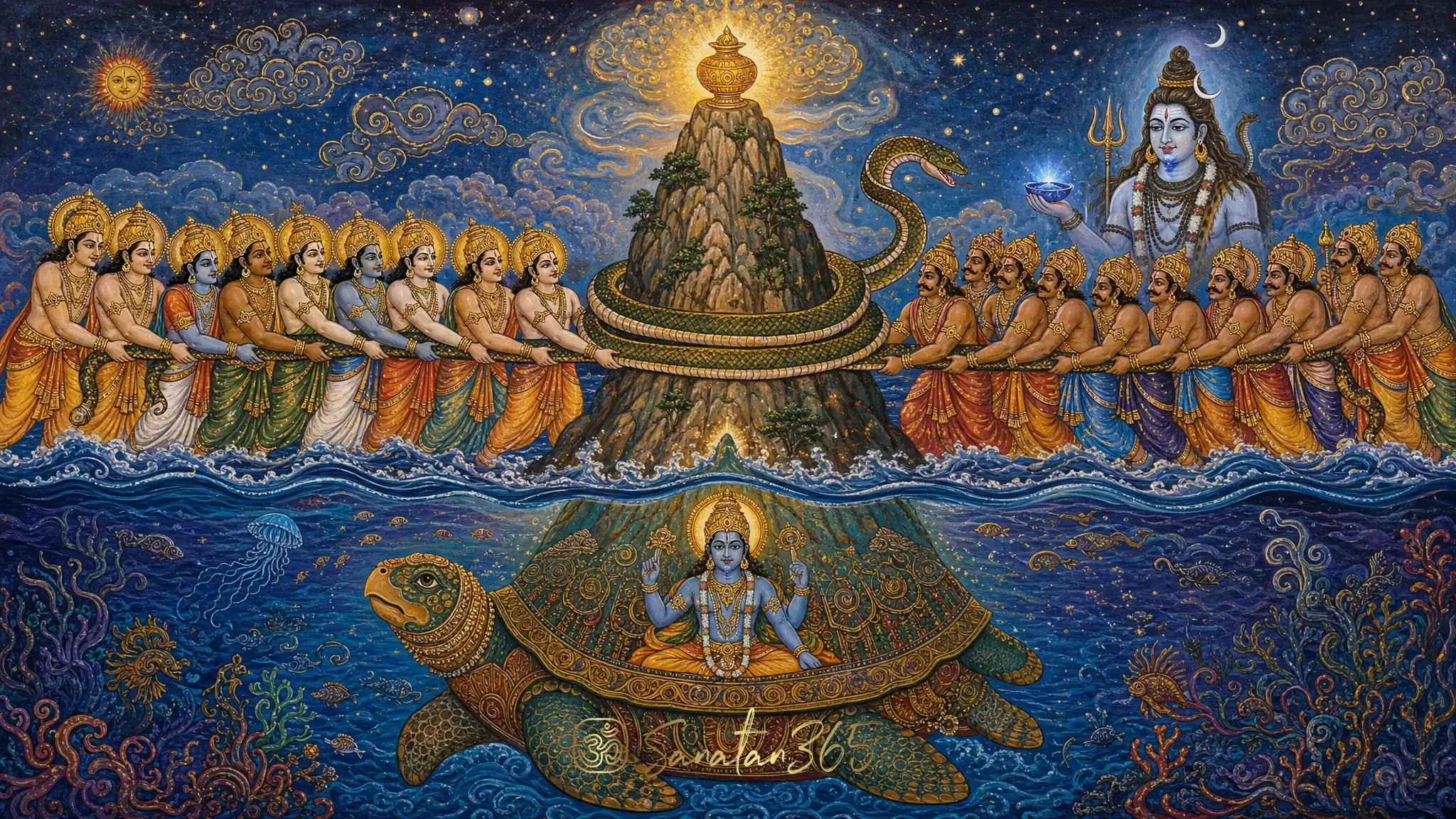
The Samudra Manthan story is the Hindu account of the devas and asuras churning the cosmic ocean to obtain amrita (अमृत, nectar of immortality). In this sacred story, Mount Mandara becomes the churning rod, Vasuki becomes the rope, Lord Vishnu supports the mountain as Kurma (कूर्म, the tortoise avatar), and Lord Shiva protects creation by holding the deadly halahala (हलाहल, poison). Its meaning is simple but deep: spiritual growth requires effort, cooperation, patience, and the courage to face what rises before wisdom appears.
This article explains the story, its symbols, and the practical lessons it offers for families, seekers, and anyone trying to live with steadiness.
Key takeaway: The Samudra Manthan teaches that nectar comes after disciplined churning, not before it.
What Is the Samudra Manthan Story?
The Samudra Manthan story means the churning of the ocean. Samudra (समुद्र) means ocean, and manthan (मन्थन) means churning or deep stirring. In the traditional account, the devas lose their strength and seek Lord Vishnu's guidance. Vishnu advises them to work with the asuras to churn the Kshira Sagara (क्षीरसागर, Ocean of Milk) so that amrita, the nectar of immortality, may arise.
The story is told in Purana and epic traditions, including the Bhagavata Purana, Vishnu Purana, and Mahabharata-linked retellings. Britannica describes Samudra Manthana as the Churning of the Ocean of Milk, a central Hindu myth involving devas, asuras, Mount Mandara, and the serpent Vasuki. The details vary across tellings, but the core pattern remains steady: weakness leads to counsel, counsel leads to effort, effort brings both danger and blessing.
The devas and asuras choose Mount Mandara as the churning rod. Vasuki, the great serpent, becomes the rope. They pull from opposite sides, and the mountain begins to sink. At that moment, Lord Vishnu takes the form of Kurma, the divine tortoise, and supports the mountain from below. The churning continues only because the foundation is steady.
Then the ocean begins to reveal its hidden contents. Some are beautiful gifts. Some are dangerous. Before amrita appears, the terrible poison halahala rises and threatens all beings. Lord Shiva receives it and holds it in his throat, becoming Neelkanth (नीलकण्ठ, the blue-throated one), a symbol of compassion and restraint.
Key takeaway: The story begins with loss, but it does not end in despair; it turns weakness into disciplined effort.
Why Does the Samudra Manthan Meaning Matter?
The Samudra Manthan meaning matters because it gives a complete map of inner life. Most people want wisdom, peace, or strength, but they discover that effort first brings up confusion, pride, fear, old habits, and unresolved emotion. The story does not hide this. It says that when the ocean is churned, poison may arise before nectar.
This is why the story feels psychologically precise. A family trying to rebuild trust may first meet old pain. A student trying to develop discipline may first meet restlessness. A seeker beginning japa (जप, sacred repetition) may first notice distraction. A person trying to speak truth may first discover how often they avoid difficult honesty.
The churning is not a punishment. It is purification.
A simple way to read the symbolism is:
- The ocean represents the depth of existence and the hidden mind.
- Mount Mandara represents effort, focus, and the axis of practice.
- Vasuki represents energy, desire, and the force that can pull in either direction.
- Kurma represents steadiness beneath effort.
- Halahala represents the painful material that appears when life is stirred deeply.
- Amrita represents wisdom, renewal, and spiritual clarity.
The devas and asuras are not merely external groups in the story. They can also be read as tendencies within the human being. One part seeks truth, restraint, and devotion. Another part seeks control, reward, and recognition. The churning of life involves both. Sanatan wisdom often teaches not by flattening human nature, but by showing how even mixed forces can be brought into a larger dharmic order.
Key takeaway: The story shows that inner work becomes fruitful when difficult material is faced with steadiness.
Who Are the Main Figures in the Churning of the Ocean?
The churning of the ocean includes several sacred figures, each carrying a teaching.
Lord Vishnu is the guide and preserver. His Kurma avatar gives the whole event a foundation. Without the tortoise below Mount Mandara, the mountain cannot stand. This suggests that great effort needs a stable base: daily practice, humility, patience, and divine support.
Lord Shiva receives the halahala. He does not swallow it into the stomach, where it would harm the body, and he does not release it into the world, where it would harm creation. He holds it. This image is one of the most powerful lessons in the story: spiritual maturity includes the ability to contain poison without spreading it.
Vasuki is the serpent rope. Serpents in Hindu symbolism often carry power, danger, protection, and transformation. In this story, energy itself is not rejected. It is harnessed. The same force that could frighten becomes part of the sacred effort.
The devas and asuras represent cooperation under divine direction. The story does not romanticize the asuras or deny conflict. It simply shows that vast tasks may require disciplined engagement with opposing forces. In personal life, this can mean learning to work with ambition, fear, competitiveness, and desire instead of pretending they do not exist.
Dhanvantari appears with amrita in many retellings. He is associated with Ayurveda and healing wisdom. His emergence suggests that the ocean yields not only immortality imagery but also the principle of restoration.
Some tellings also list treasures or ratnas (रत्न, jewels) that arise from the ocean, such as Lakshmi, the divine goddess of prosperity, and other celestial gifts. These details vary by source and tradition. General references to Samudra Manthana preserve the broad list of beings and treasures connected with the episode, though practitioners usually learn the story through family, temple, Purana, and regional storytelling traditions.
Key takeaway: Each figure teaches a different part of spiritual effort: guidance, steadiness, power, restraint, and healing.
What Does Shiva Drinking Halahala Teach?
Shiva's response to halahala is one of the most remembered moments in the Samudra Manthan story. The poison appears before the nectar. It threatens devas, asuras, and the worlds. Shiva receives it for the protection of creation and holds it in his throat, which is why he is honored as Neelkanth.
This does not mean people should silently accept harm or endure abuse. The spiritual lesson is not passive suffering. The lesson is containment with wisdom. Shiva does not spread the poison. He also does not allow it to destroy him. He transforms a cosmic danger into a mark of compassion.
In daily life, halahala can appear as anger, jealousy, insult, grief, or fear. A person may not be able to stop the first arising of emotion. But dharma asks: what happens next? Is the poison thrown at others through speech? Is it swallowed into the heart as bitterness? Or is it held with awareness until it loses its power?
Families can teach this gently to children:
- Notice the feeling.
- Pause before speaking.
- Name the feeling honestly.
- Ask what action will reduce harm.
- Repair quickly if harm has already happened.
This is not only moral teaching. It is practical emotional discipline. Shiva's blue throat becomes an image for sacred self-control.
Key takeaway: Shiva's halahala teaches that not every painful feeling must become a painful action.
What Practical Lessons Can Modern Seekers Learn?
The Samudra Manthan story remains useful because it turns cosmic imagery into everyday guidance. It is not only a grand myth; it is a pattern for work, family, sadhana (साधना, disciplined spiritual practice), and character.
Here are five practical lessons:
1. Begin with guidance. The devas seek Vishnu's counsel before acting. In daily life, guidance may come from scripture, a teacher, prayer, elders, or sincere reflection. Unfocused effort often wastes energy.
2. Build a steady base. Kurma supports the mountain from below. Every major change needs a foundation: sleep, routine, honest speech, daily prayer, and patience. Without a base, intensity collapses.
3. Expect resistance. The ocean does not reveal amrita immediately. When someone begins a good habit, resistance may rise first. That does not mean the practice is failing.
4. Handle poison carefully. Halahala is part of the churning. Difficult emotions and old patterns should be neither denied nor carelessly expressed. They need wise containment and, when needed, help from trusted people.
5. Remember that blessings arrive in stages. The ocean produces many gifts before the final nectar. Small improvements matter: a calmer home, steadier speech, more regular prayer, more honest self-awareness.
For readers who want a family-friendly companion story, Sanatan365's children's story library includes traditional narratives such as "The Tale of Samudra Manthan," designed to help children meet these lessons in a gentler form. The deeper point remains the same for adults and children: great transformation is churned slowly.
Key takeaway: The story turns patience, discipline, and emotional restraint into memorable sacred images.
How Can Families Explain the Samudra Manthan Story to Children?
Families can explain the Samudra Manthan story without frightening children. The key is to emphasize effort, teamwork, and responsibility rather than danger.
A simple child-friendly version is:
The devas and asuras churned a great ocean to find nectar. They used a mountain and a serpent, and Lord Vishnu helped by becoming a tortoise beneath the mountain. Before the nectar appeared, a dangerous poison came out. Lord Shiva protected everyone by holding it safely. The story teaches that when we work hard, difficult things may come first, but patience and goodness help us reach better results.
Parents can then ask reflective questions:
- What is one good habit that feels hard at first?
- What is one "poison" feeling, like anger or jealousy, that we can learn to hold carefully?
- Who helps us stay steady like Kurma?
- What kind of nectar appears when we keep practicing?
This keeps the story alive without turning it into fear-based teaching. Children do not need every symbolic layer at once. They need a story that grows with them. At age six, it may teach patience. At age twelve, it may teach emotional restraint. In adulthood, it may reveal the deeper churning between ego and dharma.
For related family reflections, readers can pair this story with Karma Meaning for Kids: A Gentle Hindu Lesson on Actions and Choices on action and responsibility, and Bhakti Meaning: Devotion as a Daily Practice of Love and Surrender on devotion as daily practice.
Key takeaway: For children, the story should be taught as hopeful discipline: hard effort can bring good fruit.
Conclusion: Why the Samudra Manthan Story Still Guides Daily Life
The Samudra Manthan story endures because it tells the truth about transformation: when life is churned deeply, both poison and nectar may rise, and dharma is the wisdom to handle each one correctly.
Key takeaway: Real spiritual maturity means staying steady enough to face the poison and patient enough to receive the nectar.
FAQ
What is the Samudra Manthan story in simple words?
The Samudra Manthan story is the Hindu story of the devas and asuras churning the cosmic ocean to obtain amrita, the nectar of immortality. Lord Vishnu supports the churning as Kurma, and Lord Shiva protects creation by holding the poison halahala.
What does Samudra Manthan mean?
Samudra means ocean, and manthan means churning. Together, Samudra Manthan means the churning of the ocean. Spiritually, it also means deep inner effort that brings hidden poison and hidden wisdom to the surface.
Why did Shiva drink the poison in Samudra Manthan?
Shiva received the halahala poison to protect creation. Traditional tellings honor him as Neelkanth because he held the poison in his throat. The lesson is compassionate restraint: harmful energy should be contained wisely, not spread.
What is the role of Vishnu's Kurma avatar?
Vishnu's Kurma avatar supports Mount Mandara when it begins to sink during the churning. Symbolically, Kurma teaches that intense effort needs a steady foundation.
What lesson should children learn from Samudra Manthan?
Children can learn that good results often require patience, teamwork, and self-control. The story teaches that difficult feelings may arise first, but with guidance and steadiness, better choices can appear.
About the author
Sanatan365 Editorial
Bringing Sanatan Dharma to modern seekers through authentic, scripture-grounded content.
Related in Stories
 Stories
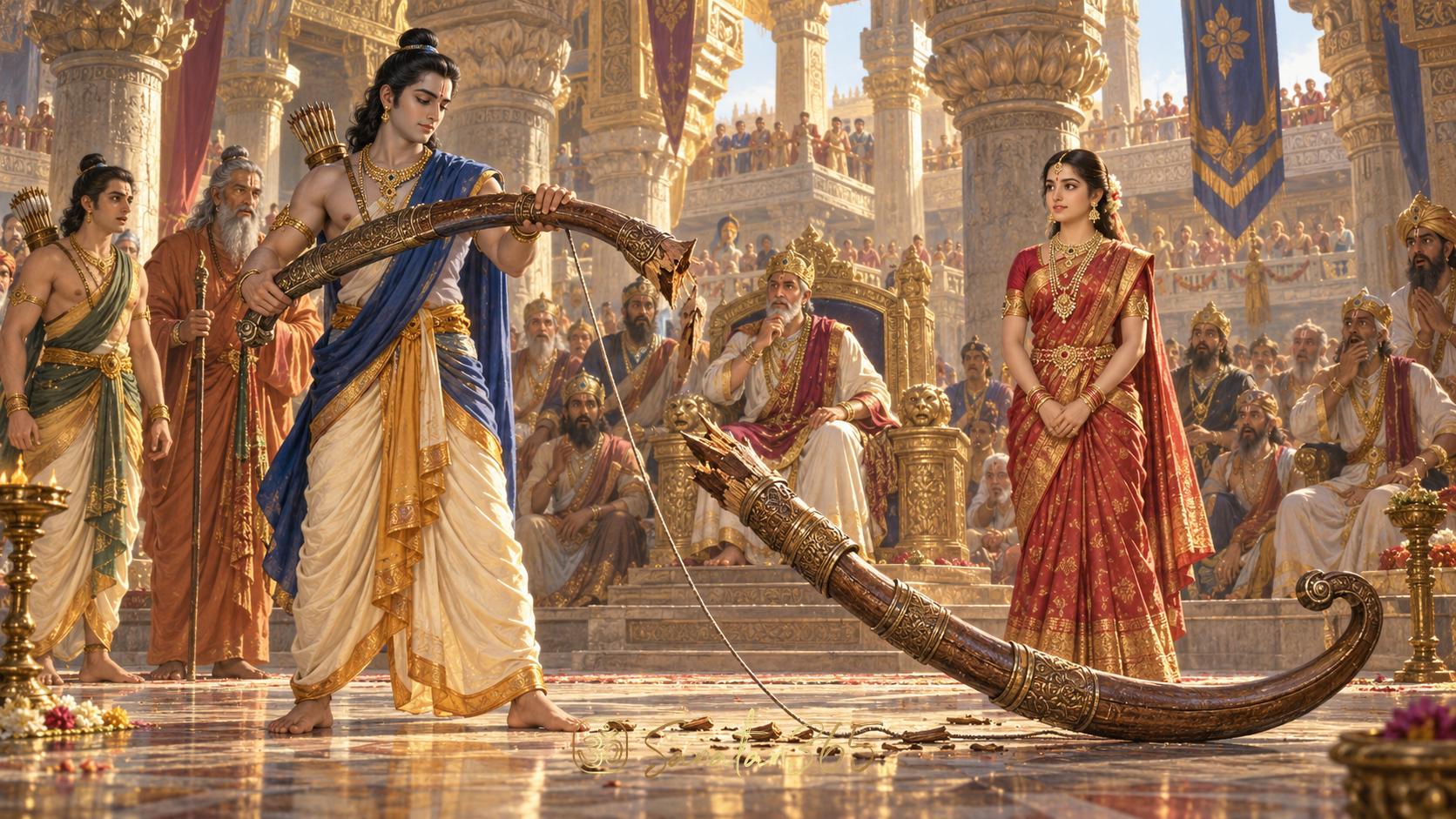
Sita Swayamvara in the Ramayana: Shiva's Bow and the Meaning of the Marriage
Read the Bala Kanda account of Rama, Sita, Janaka and Shiva's bow, and separate the text's sequence from later devotional retellings.
 Stories
King Chitraketu Story: Grief, Wisdom, and Humility in the Bhagavata
The Bhagavata Purana tells how King Chitraketu met devastating loss, listened to Narada and Angira, and learned a difficult humility. Read…
 Stories
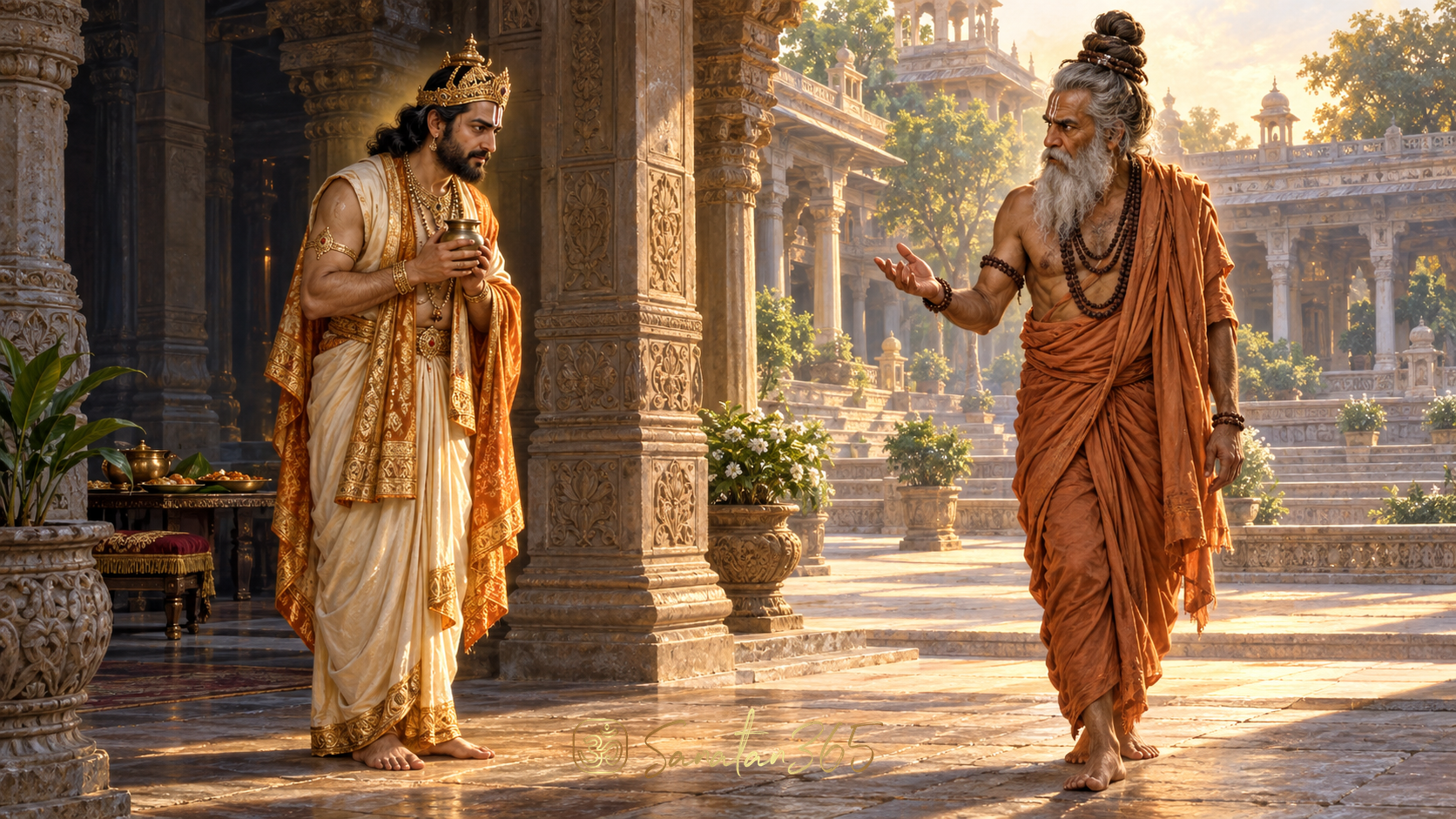
King Ambarisha and Durvasa: A Story of Devotion and Humility
The Bhagavata Purana story of King Ambarisha and Sage Durvasa explores a difficult fast, an angry visitor, and the restraint behind devotio…

