Lingaraj Temple: Shiva, Harihara, and Kalinga Architecture
Lingaraj Temple in Bhubaneswar joins Shiva devotion, Harihara theology, Kalinga architecture, sacred water, and living worship in one historic temple.
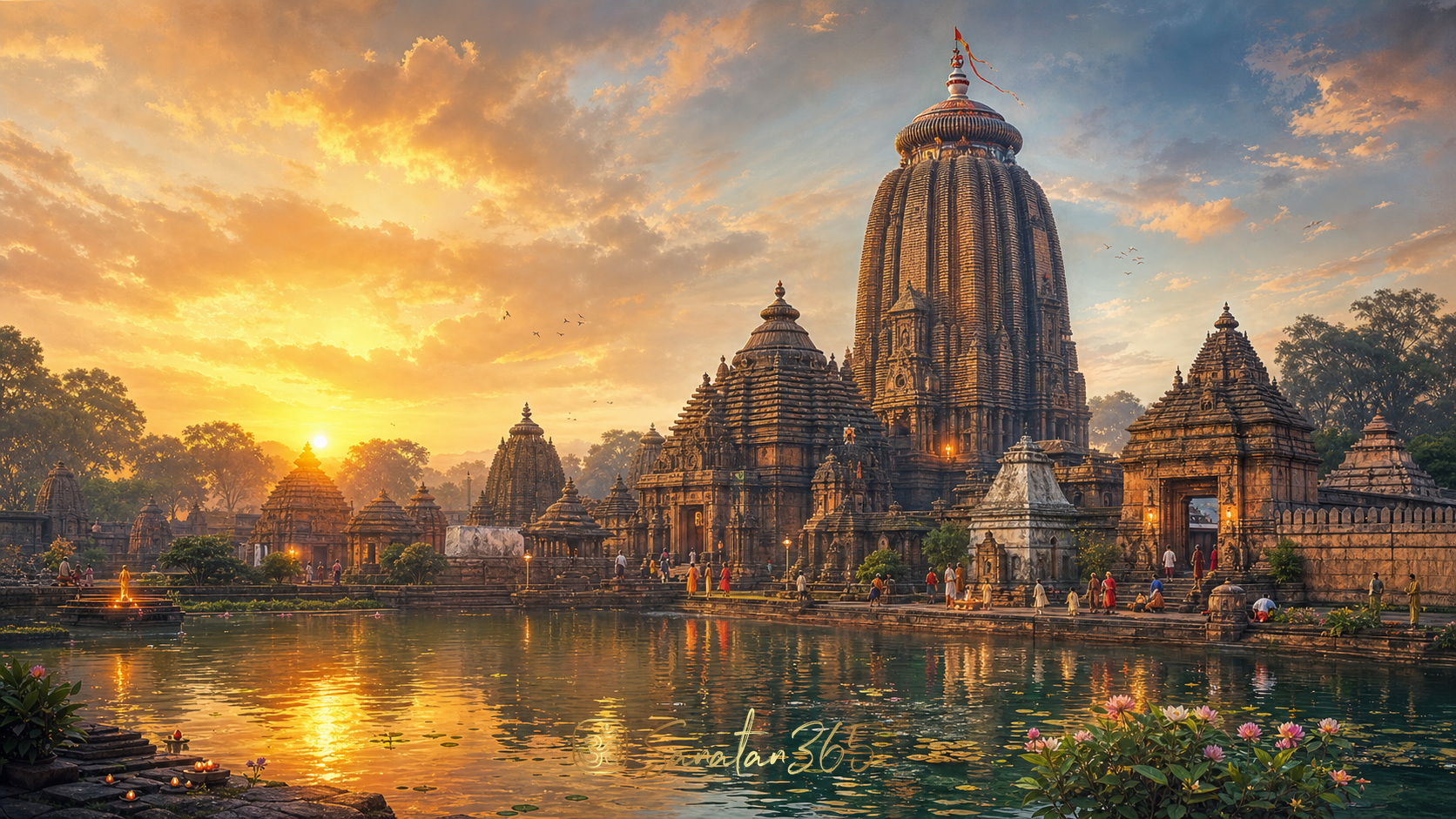
One skyline can explain why Bhubaneswar is called India’s Temple City. At its heart rises Lingaraj Temple, where a great stone tower, a living rhythm of worship, and the sacred geography of Bindu Sagar gather around Lord Shiva.
Lingaraj Temple is important because it is both a major centre of Shiva devotion and one of the most complete expressions of mature Kalinga temple architecture. The presiding form, Lingaraja, is also associated with Harihara (हरिहर, Harihara, “Vishnu and Shiva united”), making the temple a powerful reminder that distinct devotional traditions can meet without losing their integrity. Its meaning lives not only in stone, but in darshan, festival processions, water, flowers, food offerings, and the discipline of entering a sacred place with humility.
Why Is Lingaraj Temple Important?
Lingaraj Temple stands in Bhubaneswar, Odisha, within the old sacred landscape traditionally known as Ekamra Kshetra (एकाम्र क्षेत्र, Ekāmra Kṣetra, “the sacred field of the mango tree”). The present monumental complex is generally associated with the medieval period, although the site and its traditions are understood to be older. Rather than forcing a single construction date onto a place shaped across generations, it is more accurate to see the temple as the result of continuous patronage, worship, repair, and ritual memory.
The temple is dedicated to Lingaraja, “the king of lingas.” A linga (लिङ्ग, liṅga, “sign or mark”) is the aniconic form through which Shiva is worshipped. It is not merely a stone object. In Shaiva theology, it directs attention toward the divine reality that exceeds ordinary form while remaining approachable through consecrated presence.
The temple’s importance operates on several levels:
- It is an active place of worship, not an abandoned monument.
- It is a defining landmark of Bhubaneswar’s sacred urban identity.
- Its architecture demonstrates the developed Kalinga style of Odisha.
- Its Harihara association expresses a meeting of Shaiva and Vaishnava devotion.
- Its festivals connect the sanctum to the wider city through procession and shared time.
The Archaeological Survey of India documents and protects many of India’s historic sacred structures, while Odisha Tourism presents Bhubaneswar’s temples as part of a living cultural landscape. Yet heritage language alone cannot contain Lingaraj. For a devotee, the central act remains darshan (दर्शन, darśana, “sacred seeing and being seen by the Divine”).
Key takeaway: Lingaraj Temple matters because architectural achievement, sacred geography, and continuous Shiva worship remain joined in one living place.
Who Is Lingaraja, and Why Is Harihara Central to the Temple?
Lingaraja is worshipped primarily as Shiva, but the temple tradition also understands the deity through Harihara. Hari is a name of Vishnu; Hara is a name of Shiva. Harihara therefore represents their unity, not a contest in which one deity defeats or absorbs the other.
This theological meeting suits Odisha’s religious history. The region carries deep Shaiva, Vaishnava, Shakta, Buddhist, and Jain inheritances. Sacred places often preserve the memory of encounter rather than a neat modern category. At Lingaraj, Harihara offers a disciplined way to hold difference: Shiva remains Shiva, Vishnu remains Vishnu, and the worshipper is invited to recognise an underlying divine wholeness.
That insight is especially valuable when Hindu traditions are mistakenly presented as competing camps. Sanatan Dharma has long made room for varied ishta-devata (इष्टदेवता, iṣṭa-devatā, “personally cherished form of the Divine”) traditions. A devotee may love Shiva intimately without disrespecting Vishnu, Devi, Ganesha, Surya, or another sacred form.
The name Lingaraja also brings together transcendence and locality. Shiva as the limitless Divine is approached here as the Lord of this temple, this city, this water, and this community. The universal does not erase place; it shines through place.
Visitors should resist turning Harihara into a simplistic claim that every Hindu deity is interchangeable. Hindu theology is subtler. Forms, stories, mantras, and ritual traditions have real distinctions. Unity becomes meaningful precisely because difference is treated with reverence.
Key takeaway: Harihara at Lingaraj Temple expresses sacred unity without flattening the distinct devotional beauty of Shiva and Vishnu.
How Does Kalinga Architecture Shape Lingaraj Temple?
Kalinga architecture is the temple-building tradition associated especially with Odisha. At Lingaraj, it is experienced as a progression of spaces rather than as one isolated tower. The complex includes the principal sanctuary and halls commonly identified by their ritual functions: the deul or sanctum tower, the jagamohana or assembly hall, the nata mandira or dance hall, and the bhoga mandapa or offering hall.
The soaring sanctuary belongs to the rekha deul form, recognised by its tall, curving vertical profile. In front, the hall roofs use stepped, pyramidal forms often described as pidha deul. Their contrast creates a visual rhythm: ascent and gathering, height and procession, mystery and community.
The architecture guides the body before it explains anything in words:
- The outer complex separates sacred attention from ordinary movement.
- Successive halls prepare the devotee through gathering, music, offering, and waiting.
- The tower draws the eye upward while concealing the deepest sanctum.
- Sculpted surfaces turn the walls into a field of divine, human, vegetal, and celestial life.
- The sanctum concentrates that abundance into focused presence.
This movement is one reason temple architecture cannot be understood from a façade alone. A Hindu temple is not simply a building that houses worship. Its sequence of thresholds actively shapes worship. Sound changes. Light narrows. Crowds slow. Fragrance intensifies. The devotee becomes aware that approach itself is part of prayer.
The sculptural programme should also be read with care. Temple walls may hold deities, guardians, dancers, musicians, animals, foliage, mythic beings, and scenes of life. Sacred architecture does not always divide the spiritual from the worldly. It can gather the fullness of existence around the sanctum while still preserving clear ritual boundaries.
Readers interested in how another temple turns philosophy into space can explore Chidambaram Nataraja Temple and the meaning of Akasha. The comparison is useful: both temples honour Shiva, yet Odisha’s Kalinga forms and Tamil Chidambaram’s ritual-architectural world remain distinct.
Key takeaway: Lingaraj Temple’s architecture leads from public space toward concentrated sacred presence through a carefully ordered sequence of towers and halls.
What Does Bindu Sagar Add to Bhubaneswar’s Sacred Geography?
Near Lingaraj Temple lies Bindu Sagar, the large sacred tank central to old Bhubaneswar’s ritual landscape. Its name is commonly understood as the “ocean of drops,” linked by tradition to waters gathered from many holy rivers and tirthas. A tirtha (तीर्थ, tīrtha, “crossing place”) is a place where ordinary and sacred worlds are experienced as drawing close.
Whether approached through theology, ecology, or urban history, the tank teaches that a temple does not stand alone. Water, shrines, streets, gardens, processional routes, kitchens, markets, and neighbourhoods form a sacred ecosystem. The built tower may dominate photographs, but the larger kshetra gives worship its geography.
Water carries several meanings in Hindu practice:
- purification before entering a sacred space;
- memory of rivers and pilgrimage sites;
- nourishment and dependence on the natural world;
- reflection, both literal and inward;
- continuity between temple ritual and civic life.
This symbolism must be paired with responsibility. Sacred water should never become an excuse for pollution or careless offerings. Reverence includes restraint: avoiding plastic, following local regulations, and treating tanks and rivers as living ecological bodies rather than backdrops.
Bindu Sagar is also connected with festival movement. During major observances, the deity’s relationship with the wider sacred landscape becomes visible through processions. The sanctum is stable, but divine presence is not imagined as trapped inside it. The deity moves outward, meets the community, and marks the city as sacred space.
Key takeaway: Bindu Sagar reveals Lingaraj Temple as the centre of a wider sacred ecology shaped by water, pilgrimage, procession, and civic responsibility.
How Is Lingaraj Still a Living Shiva Temple?
The clearest answer is ritual continuity. Lamps are lit, offerings are prepared, mantras are recited, darshan is sought, and the calendar turns through daily and annual observances. The temple’s stones carry history, but worship keeps that history from becoming inert.
Maha Shivaratri is among the most visible observances associated with the temple. Devotees keep vigil, pray, and wait for the ceremonial raising of the great lamp. The night’s discipline is not merely about staying awake. Jagaran (जागरण, jāgaraṇa, “sacred wakefulness”) can symbolise attention that refuses to sink into carelessness.
Ashokashtami brings the Rukuna Ratha festival, when the deity’s representative moves in procession. A ratha (रथ, ratha, “chariot”) makes theology public: roads become ritual routes, waiting becomes participation, and the temple’s relationship with the city is renewed.
Daily worship can appear less dramatic, but it is equally essential. Repetition protects memory. The same acts of bathing, dressing, offering, singing, and resting the deity form a sacred rhythm. Devotees learn that love is not sustained by rare intensity alone; it becomes durable through regular attention.
Living worship also means that visitor access and conduct follow temple authority, inherited custom, and current security rules. Not every part of a living temple functions like a museum. Some spaces may restrict entry. Such restrictions should be checked through current official guidance before travel and approached without confrontation.
Key takeaway: Lingaraj remains alive through daily seva and festivals that repeatedly connect deity, devotee, temple, water, and city.
How Can Visitors Approach Lingaraj Temple Respectfully?
A respectful visit begins before arrival. Check current timings, entry rules, festival crowds, photography restrictions, and access conditions through official Odisha sources. Rules can change, and an old travel post is not reliable authority.
Practical etiquette includes:
- Dress modestly and choose clothing suitable for a sacred place and warm climate.
- Leave footwear only in designated areas.
- Do not photograph worshippers, priests, or restricted spaces without permission.
- Keep phones quiet and avoid blocking queues for pictures.
- Follow instructions about offerings rather than improvising.
- Do not touch sculptures or historic stone surfaces.
- Avoid plastic and dispose of flowers or packaging only where directed.
- Make space for local devotees whose visit is prayer, not sightseeing.
Those unable to enter every area can still approach the wider Ekamra Kshetra with reverence. The surrounding temples, Bindu Sagar, streets, and skyline offer meaningful ways to understand Bhubaneswar’s sacred urban form. Respect does not depend on forcing access; it depends on attention.
The best visitor question is not “How much can I see?” but “How carefully can I receive what this place is?” Architecture rewards observation. Devotion asks for humility. Heritage requires protection. At Lingaraj, all three responsibilities meet.
Key takeaway: Responsible pilgrimage honours current rules, living worship, local devotees, historic stone, and the sacred ecology of old Bhubaneswar.
FAQ
Where is Lingaraj Temple located?
Lingaraj Temple is in the old city of Bhubaneswar, Odisha, near the sacred tank Bindu Sagar. It stands within the traditional Ekamra Kshetra temple landscape.
Which deity is worshipped at Lingaraj Temple?
The presiding deity is Lingaraja, a form of Lord Shiva worshipped through the linga. Temple tradition also associates the deity with Harihara, the unity of Shiva and Vishnu.
What style of architecture does Lingaraj Temple use?
It is a major example of Kalinga temple architecture. Its complex combines the tall curving sanctuary tower with successively ordered halls for assembly, dance, and offerings.
Why is Bindu Sagar important?
Bindu Sagar is a sacred tank near the temple and an important part of Bhubaneswar’s ritual geography. It connects water, purification, pilgrimage memory, festival procession, and ecological responsibility.
What should visitors check before going?
Visitors should check current official guidance for opening times, entry eligibility, dress, photography, security, and festival-day arrangements. Living-temple rules may change and should be followed respectfully.
The single key takeaway: Lingaraj Temple shows how Shiva devotion, Harihara unity, Kalinga architecture, sacred water, and daily ritual can shape an entire city into a living field of reverence.
About the author
Sanatan365 Editorial
Bringing Sanatan Dharma to modern seekers through authentic, scripture-grounded content.
Related in Temples
 Temples
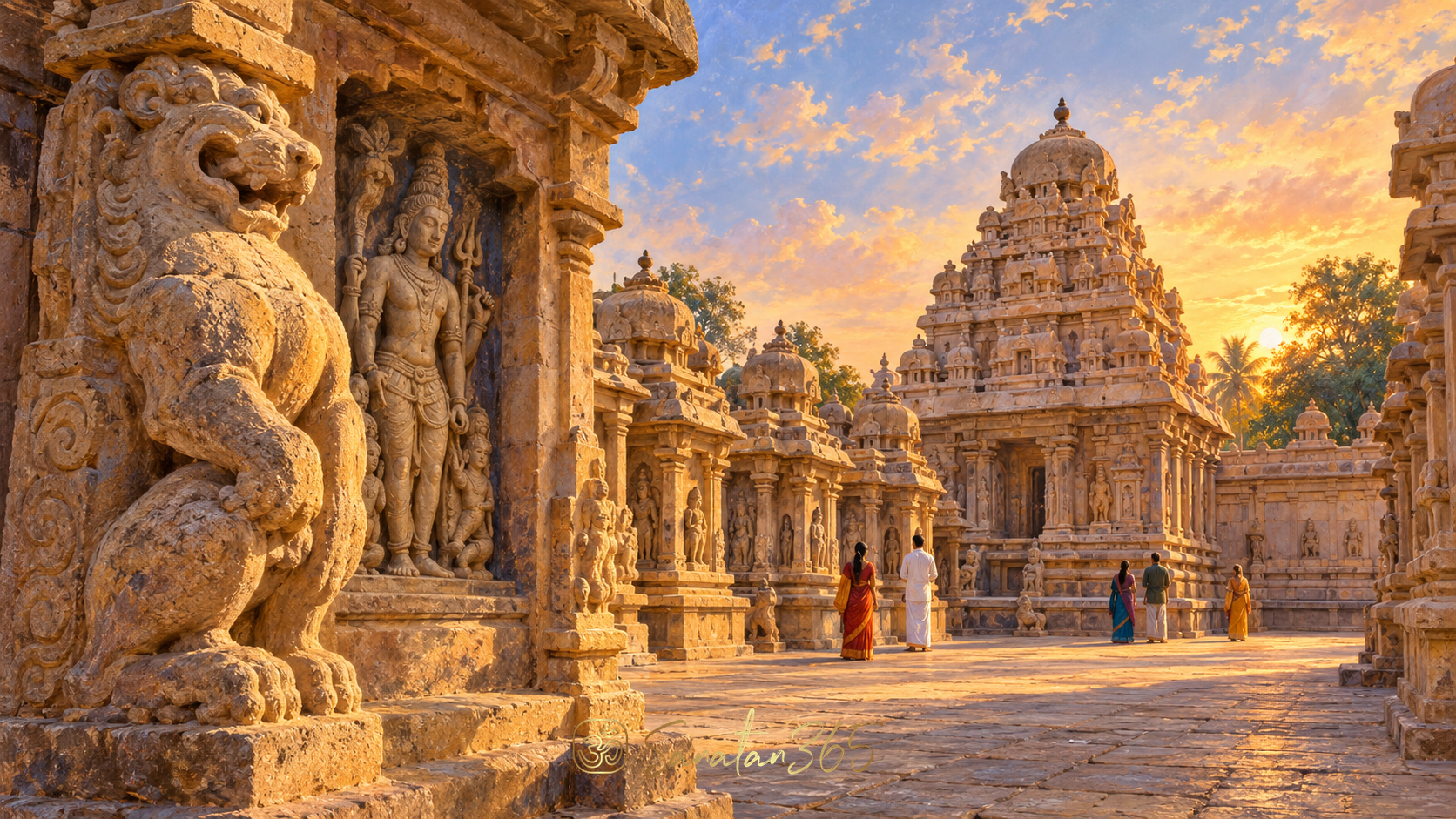
Kailasanathar Temple Kanchipuram: Learning to Read Shiva in Stone
Read Kanchipuram’s Pallava Shiva temple through its sandstone, sanctum tower, sculpted shrines and the care that sacred heritage asks of vi…
 Temples
Vittala Temple Hampi: Reading the Stone Chariot and Sacred Courtyard
Understand Hampi’s Vittala Temple through its Garuda stone chariot, pillared halls, Vishnu devotion, and careful heritage visiting.
 Temples
Kirtimukha Meaning: The Face of Glory Above the Temple Door
The fierce face above a temple doorway is not a warning to turn away. Learn to recognize Kirtimukha, read its sacred story, and notice how…