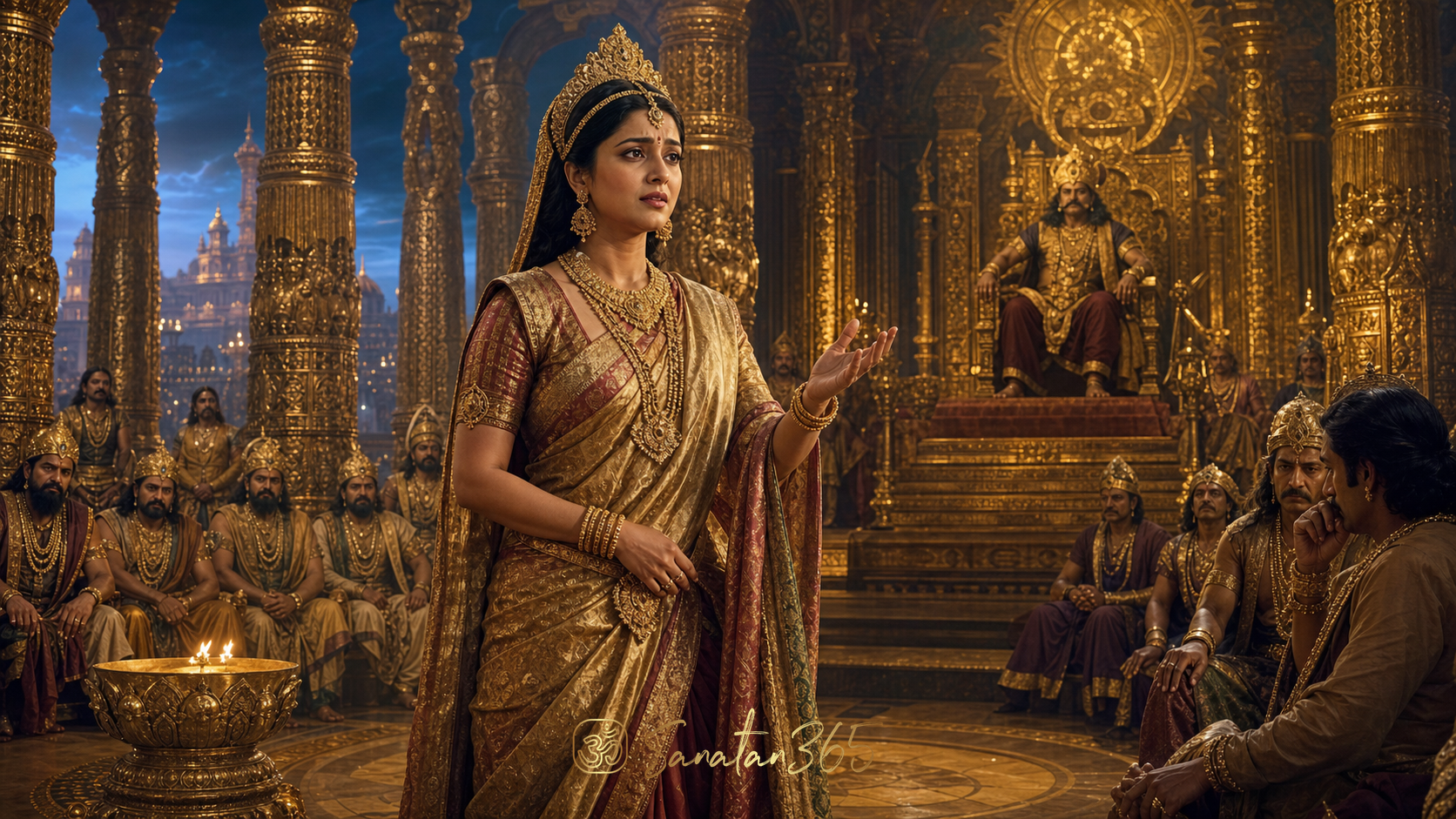
Mandodari in the Ramayana: Wise Counsel in Ravana's Court
Mandodari's story reveals the courage to speak dharma inside a powerful household, the limits of ignored counsel, and dignity amid grief.
Mandodari sees the danger in Ravana's court before pride allows Ravana to see it himself.
Mandodari in Ramayana tradition is the chief queen of Lanka and one of the clearest voices urging Ravana to return Sita, restrain desire, and avert destruction. She remains loyal to her household without calling wrongdoing right. Her story is therefore not simply about a king's wife or a grieving widow. It is about dharma (धर्म, ethical and sacred responsibility) spoken from inside a powerful family when truth is unwelcome.
The Valmiki Ramayana, especially the Yuddha Kanda, presents Mandodari through counsel, perception, and lament. Later tellings add details about her birth and life, but the ethical center remains remarkably steady: she recognizes Rama's strength, Sita's dignity, and Ravana's fatal refusal to govern himself.
Key takeaway: Mandodari shows that loyalty can require truthful resistance rather than silent agreement.
Who Was Mandodari in the Ramayana?
Mandodari is Ravana's principal queen and the mother of Indrajit, also called Meghanada. She lives at the center of Lanka's wealth and authority, yet the epic does not reduce her to royal privilege. Her importance comes from discernment. She understands what Ravana's ministers and flatterers often fail to say plainly: abducting Sita has placed Lanka in moral and mortal danger.
The name Mandodari is commonly understood through later traditional accounts that connect her with Maya, the celebrated architect of the asuras, and the apsara Hema. Different regional Ramayanas develop her background in different ways. A careful reading should distinguish those later narrative layers from the episodes emphasized in Valmiki's text. What matters across traditions is that Mandodari is portrayed as intelligent, dignified, and capable of seeing beyond the intoxication of power.
She is also remembered in a traditional verse naming five exemplary women, or panchakanya (पञ्चकन्या, five revered women): Ahalya, Draupadi, Kunti, Tara, and Mandodari. The word kanya in this devotional remembrance should not be flattened into a modern biographical label. The verse recalls women whose complicated lives invite moral reflection, resilience, and remembrance. Their stories are not simple tales of protected innocence; they unfold amid war, exile, public judgment, and difficult choices.
Mandodari's position makes her counsel especially costly. She is not an outsider criticizing Lanka from safety. Ravana is her husband, Indrajit is her son, and the threatened kingdom is her home. Speaking against Ravana's course therefore risks emotional loss whichever way events turn. Silence might preserve temporary comfort, but it would abandon truth.
The epic's treatment of her also prevents an easy division between a wholly corrupt city and wholly righteous outsiders. Lanka contains valor, learning, family affection, and voices of conscience. Vibhishana speaks one such warning in public and eventually leaves Ravana. Mandodari speaks another from within the intimate space of the royal household.
Key takeaway: Mandodari matters because she combines closeness to power with the clarity to judge power by dharma.
What Counsel Did Mandodari Give Ravana?
Mandodari's counsel is built on moral recognition and practical realism. She understands that Sita is not an object Ravana can possess by force. She also recognizes that Rama is no ordinary opponent whose resolve can be dismissed. Her advice repeatedly points toward the one action that can still prevent catastrophe: return Sita honorably.
In the Yuddha Kanda, the women of Ravana's household lament after his death, and Mandodari's speech looks backward over the ignored warnings. English translations of the Valmiki Ramayana at IIT Kanpur and the public-domain translation at Wisdom Library allow readers to compare the relevant passages and translation choices. Her lament makes clear that Ravana's end was not an inexplicable turn of fate. It followed repeated acts of refusal.
Her reasoning can be understood in four movements:
- See Sita truthfully. Sita's fidelity, courage, and refusal cannot be overturned by threat or luxury.
- See Rama truthfully. Ravana's pride mistakes restraint for weakness and human form for ordinary limitation.
- See desire truthfully. Unruled desire has become destructive, not only for Ravana but for people who never chose his act.
- Choose the remaining remedy. Returning Sita is not humiliation; it is the last available act of responsible kingship.
This is niti (नीति, wise conduct or statecraft) joined to dharma. Mandodari does not merely say that Ravana's action is wrong. She shows how private vice becomes public disaster when the person acting is a ruler. A king's lack of self-command does not stay private. It reaches soldiers, families, cities, and future generations.
The lesson parallels the danger explored in Vidura Niti and truthful counsel, although the relationships differ. Vidura advises a king and court that repeatedly resist him. Mandodari advises her husband from inside the household most exposed to the consequences. Both stories ask whether truth will still be spoken when power prefers reassurance.
Mandodari's words are not successful in the narrow sense: Ravana does not reverse course. Yet failed persuasion is not failed dharma. A counsellor cannot control whether another person listens. She can control whether warning is honest, proportionate, timely, and free from flattery.
Key takeaway: Mandodari's counsel joins moral truth with practical foresight: return what was taken, restrain desire, and protect the kingdom from a ruler's private error.
Why Is Mandodari's Loyalty Not Silent Agreement?
Loyalty is often confused with defending every act of the person one loves. Mandodari offers a harder definition. She does not abandon concern for Ravana, but neither does she rename adharma (अधर्म, conduct opposed to dharma) as virtue. Her speech is loyal precisely because she wants him to stop before the consequences become irreversible.
This distinction matters in families, institutions, and communities. Agreement can be comfortable while loyalty can be demanding. A friend who encourages self-deception may protect the mood of the moment but not the person. A family member who speaks with respect against harmful conduct may risk anger in order to protect life, dignity, or character.
Mandodari's example suggests several tests for ethical counsel:
- Is the warning grounded in truth rather than rivalry?
- Does it recognize the dignity of those harmed?
- Does it identify a real corrective action?
- Is it spoken before disaster, not only after it?
- Does the speaker accept that love cannot control another person's choice?
Her stance should not be romanticized as limitless endurance. Hindu narratives contain many forms of moral response. Vibhishana ultimately leaves Ravana after counsel fails; Sita refuses coercion; Hanuman speaks as a messenger; Rama acts as a warrior and ruler. Mandodari's particular dharma is shaped by her position, knowledge, and moment. Her story is not a command that every person must remain in a dangerous situation. Modern readers facing abuse or threat should prioritize safety and appropriate professional or community support.
Nor should her loyalty be read as weakness. Ravana's court rewards displays of strength, but Mandodari demonstrates viveka (विवेक, discernment between what is sound and unsound). She separates love for a person from approval of the person's conduct. That separation is emotionally difficult because it refuses two easy extremes: blind defense and dehumanizing rejection.
The story of King Shibi explores competing duties through a ruler asked to protect both refuge and life. Mandodari's dilemma is different, yet similarly layered. She must care for her husband, Sita's dignity, her son, and Lanka while recognizing that these goods can no longer be preserved by pretending Ravana is right.
Key takeaway: Mandodari's loyalty is morally serious because it seeks Ravana's correction, not his comfort.
What Does Mandodari's Lament Reveal After Ravana's Death?
Mandodari's lament after Ravana falls is among the epic's most human examinations of consequence. She does not speak as though Ravana possessed no greatness. She remembers his power, learning, rank, and the awe he inspired. This makes the lament sharper: extraordinary capacity did not save a person who would not govern his desire.
The Sanskrit tradition uses shoka (शोक, grief or sorrow) for the anguish that follows loss. Mandodari's shoka contains love, bewilderment, recognition, and accusation. She grieves the man she knew and the destruction his choices brought. Her sorrow does not require a false verdict about his conduct.
This complexity protects the Ramayana from becoming a flat victory tale. Ravana's death ends a grave injustice and enables Sita's release, but the battlefield still contains widows, bereaved parents, and a shattered city. Dharma may require force against persistent violence, yet the epic does not ask readers to become delighted by suffering.
Mandodari also recognizes a pattern familiar far beyond royal courts: capability can conceal inner disorder for a long time. Ravana has knowledge, tapas, authority, and strategic power. None of these automatically produces self-mastery. When intelligence serves appetite rather than wisdom, it can make wrongdoing more effective.
Her lament therefore becomes a final form of counsel, now addressed to the audience. It says in effect: do not wait until consequence makes truth undeniable. Listen while repair remains possible.
There is dignity in the way Mandodari is allowed to mourn. The victorious side does not erase the grief of Lanka's women. This invites readers to hold moral clarity and compassion together:
- Wrongdoing must be named.
- Those harmed must be protected.
- Consequences cannot always be avoided.
- Grief remains real even when the fallen person caused the crisis.
- Compassion does not require confusion about right and wrong.
Key takeaway: Mandodari's lament mourns Ravana without excusing him, showing that grief and moral clarity can occupy the same heart.
What Can Modern Readers Learn from Mandodari's Ethical Courage?
Mandodari's world is epic and royal, but the pattern of ignored counsel is ordinary. It appears whenever status makes honest feedback dangerous: in a family business, a workplace, a community committee, a friendship, or a public institution.
Her story offers a practical discipline for speaking truth responsibly.
1. Name the act, not the person's entire worth
Mandodari can recognize Ravana's gifts while condemning the choice that endangers everyone. This prevents counsel from becoming either flattery or total contempt.
2. Center the person harmed
The issue is not merely whether Ravana will lose a war. Sita has been abducted and pressured. Ethical counsel begins by refusing to make the harmed person's dignity secondary to the powerful person's reputation.
3. Offer a corrective path
"Return Sita" is concrete. Good counsel does more than express disapproval; it identifies the next truthful action when one exists.
4. Refuse the illusion of control
Mandodari can advise Ravana, but she cannot choose for him. This limit is painful and essential. People who offer counsel need humility about what belongs to them and what does not.
5. Record the lesson before crisis
Teams and families can create conditions where warning is heard early: invite dissent, protect respectful disagreement, and ask what evidence would change a decision. Ethical culture is easier to build before pride hardens.
For personal reflection, a short evening practice can help:
- Recall one situation in which agreement felt easier than honesty.
- Ask whether silence protected peace or merely postponed harm.
- Identify the most respectful truthful sentence available.
- Consider safety, timing, and the right support before speaking.
- Release the demand to control the response.
Mandodari's courage is sober rather than spectacular. She does not win a debate, command an army, or escape grief. She preserves something equally important: the integrity of having seen clearly and spoken while action was still possible.
Key takeaway: Ethical courage means giving truthful, humane counsel without making another person's acceptance the measure of one's duty.
FAQ
Who was Mandodari in the Ramayana?
Mandodari was Ravana's chief queen and the mother of Indrajit. Ramayana traditions remember her as intelligent, dignified, and morally perceptive, especially in her warnings about the consequences of abducting Sita.
What advice did Mandodari give Ravana?
Mandodari urged Ravana to recognize Rama's strength, respect Sita's fidelity, restrain destructive desire, and return Sita. Her counsel presented correction as the way to protect both Ravana and Lanka.
Did Mandodari support Ravana's actions?
No. She remained connected to Ravana and grieved him, but she did not treat his abduction of Sita as right. Her story distinguishes loyalty to a person from approval of harmful conduct.
Why is Mandodari remembered among the panchakanya?
Mandodari appears in a traditional remembrance verse naming Ahalya, Draupadi, Kunti, Tara, and Mandodari. These complex women are remembered for lives marked by trial, resilience, and moral reflection; the verse should not be reduced to a simplistic biographical category.
What is the main lesson of Mandodari's story?
Mandodari teaches that wise counsel must remain truthful even when power resists it. She also shows that grief can acknowledge a person's gifts and humanity without excusing the choices that caused harm.
Mandodari's presence in the Ramayana is quiet beside the epic's battles, but it is not small. She sees the moral shape of the crisis, speaks from within the household most bound to Ravana, and grieves without surrendering truth. Her life leaves a demanding standard for every age: love a person enough to refuse the lie that their worst choice is harmless.
Key takeaway: Mandodari's wisdom lies in holding loyalty, truth, compassion, and consequence together when power tries to tear them apart.
About the author
Sanatan365 Editorial
Bringing Sanatan Dharma to modern seekers through authentic, scripture-grounded content.
Related in Stories
 Stories
Upamanyu’s Story: Discipline, Discernment, and the Ashvins’ Grace
Upamanyu’s early Mahabharata story follows a hungry student tested by his teacher, blinded after eating harmful leaves, and restored by the…
 Stories
King Parikshit and Shukadeva: Seven Days of Sacred Listening
When King Parikshit learned that only seven days remained, the Bhagavata Purana says he turned from power toward one urgent question: what…
 Stories
Arundhati Vashistha Star Meaning: A Hindu Wedding Guide
The Arundhati–Vashistha star pair joins an ancient story of companionship with a living Hindu wedding custom. Learn who they are, why the s…