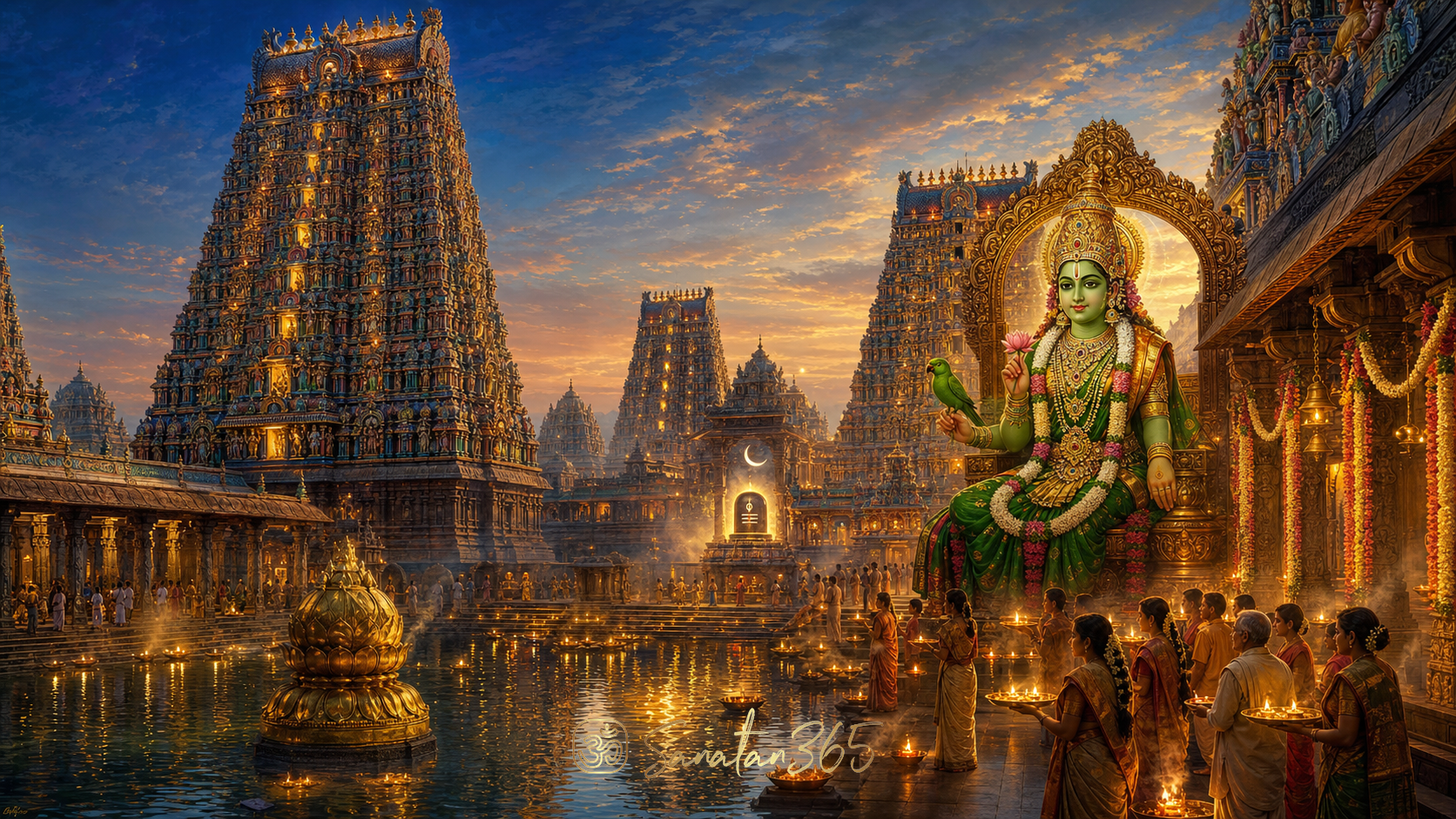
Meenakshi Amman Temple Meaning: Madurai's Sacred City of the Goddess
Explore the meaning of Madurai's Meenakshi Amman Temple through Goddess Meenakshi, Sundareswarar, Dravidian architecture, sacred marriage, and living Tamil devotion.
Madurai does not simply contain a temple; its historic heart appears to unfold from one. The Meenakshi Amman Temple meaning lies in this union of Goddess, city, architecture, and daily devotion: the complex honours Meenakshi, a sovereign form of Parvati, alongside Sundareswarar, the “Beautiful Lord” form of Shiva. Its towers, courtyards, shrines, festivals, and rituals make divine relationship visible at the scale of an entire city.
That is why the temple is more than an architectural landmark. It presents shakti (शक्ति, divine power) as active sovereignty, celebrates marriage as a harmony of complementary sacred principles, and turns movement through space into a devotional education. To understand Madurai's most famous shrine is to see how Tamil Hindu tradition joins beauty with discipline, intimacy with grandeur, and local identity with universal spiritual questions.
What Is the Meenakshi Amman Temple Meaning?
The simplest answer is that Meenakshi Amman Temple expresses divine presence as the living centre of civic and spiritual life. Meenakshi is not treated as a secondary figure beside Shiva. Her shrine, mythology, royal bearing, and relationship with Madurai establish the Goddess as ruler, protector, and source of auspicious order.
The temple is formally known as the Meenakshi Sundareswarar Temple. It is dedicated to Meenakshi, understood as a form of Parvati, and Sundareswarar, a form of Shiva. Encyclopaedia Britannica describes the complex as devoted to their union and notes that much of its present monumental form arose in the sixteenth and seventeenth centuries, even though tradition and earlier references reach much further back (Britannica).
Three meanings meet here:
- Divine sovereignty: Meenakshi embodies power that protects, governs, and nurtures.
- Sacred relationship: Her union with Sundareswarar represents balance without erasing distinct identities.
- A centred life: The city arranged around the temple suggests that spiritual orientation can give shape to commerce, art, family, learning, and public celebration.
The name Meenakshi is commonly explained through mīna (fish) and akshi (eye): “the fish-eyed one.” In Indian poetic language, the comparison evokes long, beautiful, watchful eyes. Devotional interpretation also sees a gaze of unbroken care, like a mother whose attention remains with her children.
Key takeaway: Meenakshi Amman Temple means that divine feminine power can stand at the centre of both inner life and a flourishing city.
Who Is Goddess Meenakshi, the Sovereign of Madurai?
Goddess Meenakshi is worshipped as a distinct and deeply local form of Parvati. Her story does not begin with passivity. Tamil temple tradition remembers her as a Pandya princess born to rule, trained in statecraft and warfare, and marked by extraordinary destiny. She conquers widely before meeting Shiva, who appears as Sundareswarar. Recognition, not defeat, transforms the encounter.
This narrative gives Meenakshi's iconography unusual force. She may appear with an emerald-green complexion, a parrot, a crown, and the upright bearing of a queen. The parrot can suggest refined speech, beauty, fertility, and living intelligence. Her royal form communicates that compassion is not weakness and power need not abandon grace.
The story also corrects a narrow assumption that Hindu sacred femininity is only domestic. Meenakshi is daughter, warrior, ruler, bride, and Goddess without being reduced to any single role. Her marriage matters, but so does the sovereignty she already possesses. The temple's ritual world preserves both truths.
This balance can become a practical reflection:
- Strength can remain tender without becoming timid.
- Leadership can protect rather than dominate.
- Partnership need not erase vocation or identity.
- Beauty can reveal order when joined to responsibility.
In a public sacred complex of extraordinary scale, the centrality of Meenakshi also carries cultural significance. National Geographic has described the site as one of India's great temple complexes and noted its distinctive dedication to a female deity (National Geographic). The important point is not competition with other temples, but the clarity with which Madurai celebrates the Goddess as its presiding power.
Key takeaway: Goddess Meenakshi embodies a feminine divinity in which rulership, courage, beauty, and maternal care reinforce one another.
Why Are Meenakshi and Sundareswarar Worshipped Together?
Sundareswarar means the beautiful Lord. In Madurai's sacred story, Shiva comes to marry Meenakshi, and their wedding becomes a cosmic and civic event. Vishnu, honoured as Meenakshi's brother in the festival tradition, participates in the marriage narrative. The annual Thirukalyanam (திருக்கல்யாணம், sacred wedding) celebrates this union publicly.
Sacred marriage here should not be flattened into a modern romantic metaphor. It works on several levels at once:
- the joining of shakti, dynamic divine power, with Shiva, pure consciousness;
- the harmony of sovereignty and stillness;
- the integration of household life with spiritual aspiration;
- the relationship between a local Goddess, her city, and the wider sacred universe.
The two principal shrines preserve distinction within union. Devotees do not encounter an abstract idea of sameness; they encounter two divine presences related through ritual, story, procession, and affection. This is a useful Hindu pattern: unity does not always require uniformity.
Their relationship also shapes the rhythm of the temple day. Ritual movement and ceremonial meetings make theology experiential. The devotee learns not only through explanation but through sight, sound, waiting, walking, lamps, bells, fragrance, and darshan (दर्शन, the sacred act of seeing and being seen by the Divine).
This complements the symbolism of other Shiva temples without duplicating it. At Chidambaram's Nataraja Temple, Shiva's dance and sacred space become central. In Madurai, the relationship of Meenakshi and Sundareswarar gives the city its distinctive sacred grammar.
Key takeaway: The divine couple represents a unity spacious enough to preserve strength, beauty, consciousness, and relationship in their full dignity.
How Does Dravidian Temple Architecture Teach Through Space?
The Madurai Meenakshi Temple is a major expression of Dravidian temple architecture, the South Indian architectural tradition recognised by monumental gateway towers, enclosed precincts, pillared halls, sacred tanks, and increasingly intimate inner zones. Smarthistory identifies the complex as a prime example of this architecture and explains how its dense visual programme guides the visitor into a layered sacred environment (Smarthistory).
The most visible forms are the gopurams (गोपुरम्, monumental gateway towers). Covered with painted sculptural figures, they announce sacred narrative before a visitor crosses the threshold. Deities, attendants, guardians, animals, and mythic beings turn the outer architecture into a visual cosmos. National Geographic notes fourteen towers across the complex, with thousands of colourful figures across their surfaces (National Geographic).
Yet height is only the beginning. Moving inward matters:
Gateways mark a change of attention
A gateway does more than permit entry. It asks the visitor to leave scattered awareness behind. Shoes are removed, behaviour becomes quieter, and the body learns reverence through changed conduct.
Enclosures create progressive inwardness
The prakara (प्राकार, sacred enclosure or circumambulatory precinct) turns walking into orientation. Each passage brings the devotee closer to the sanctum while allowing time for the mind to settle.
Pillared halls make sacred life communal
The famed hall popularly called the Thousand Pillared Hall demonstrates how sculpture, engineering, gathering, and memory can inhabit the same space. The temple is not designed only for solitary contemplation; it supports festivals, music, movement, teaching, and shared identity.
The Golden Lotus Tank opens a field of reflection
The Porthamarai Kulam, or Golden Lotus Tank, creates visual and symbolic pause amid architectural density. Water suggests purification, receptivity, and reflection. Around it, the upward energy of the towers meets the stillness of the surface.
The architecture therefore teaches through a sequence: approach, cross, circle, pause, behold. Its complexity is not decorative excess. It reflects the Hindu intuition that the sacred can be approached through many forms while the deepest centre remains concentrated and intimate.
Key takeaway: Madurai's architecture converts a physical visit into a movement from sensory abundance toward focused divine presence.
Why Is the Temple the Heart of Madurai Rather Than Just a Monument?
Many historic religious buildings are encountered mainly as preserved heritage. Meenakshi Amman Temple remains a living kshetra (क्षेत्र, sacred field or place): worship continues, festivals reorganise public time, and the surrounding city participates in its rhythms.
Madurai's historic streets developed concentrically around the temple complex. This urban relationship makes a philosophical claim without a written slogan: what a society places at its centre influences how the rest of life is arranged. Markets, crafts, food, music, processions, and family observances gather around sacred geography.
The temple's present architecture also records layers of patronage and reconstruction. Britannica places much of the current complex in the Nayaka-era sixteenth and seventeenth centuries (Britannica). Careful wording matters because sacred sites often contain histories longer and more complicated than a single construction date. The temple is both inherited and continually renewed.
Its annual festivals reveal that renewal in public form. Chithirai celebrations, including Meenakshi's coronation and sacred marriage, connect temple ritual with the streets and communities of Madurai. The Goddess does not remain conceptually confined to the sanctum; procession allows divine presence to meet the city.
For Tamil communities beyond India, Madurai can also function as remembered sacred geography. A photograph of the gopurams, a recitation of Meenakshi's names, or participation in a local temple festival can connect diaspora families to language, art, and inherited devotion without pretending that a remote practice replaces pilgrimage itself.
Key takeaway: The temple remains alive because worship, memory, economy, art, and civic identity continue to meet around it.
How Can a First-Time Visitor Approach Madurai Meenakshi Temple Respectfully?
A temple visit becomes more meaningful when it is approached as worship first and sightseeing second. Rules and timings can change, so visitors should consult current official or local temple guidance before arriving. A few enduring principles remain useful:
- Dress modestly and follow entry instructions. Sacred spaces have boundaries; accepting them is part of respectful presence.
- Travel light. Photography and electronic-device rules may be restricted in parts of the complex.
- Allow unhurried time. The temple rewards patient attention more than a checklist of famous features.
- Observe before imitating. Regional ritual customs vary. When unsure, ask a temple official or follow the quiet conduct of local devotees.
- Remember both principal deities. The complex is dedicated to Meenakshi and Sundareswarar; its meaning emerges through both sovereignty and relationship.
- Treat sculpture as sacred narrative. Figures on gopurams and halls are not merely colourful backgrounds for photographs.
- Respect queues and worshippers. For many visitors, this is a place of intimate prayer, vows, grief, gratitude, and family memory.
A person unable to visit can still reflect responsibly. They might learn one name of Meenakshi, contemplate the relationship between strength and care, or light a lamp before a clearly identified image of the Goddess at home. Digital images can support remembrance, but they should not be described as identical to physical pilgrimage or temple darshan.
The most portable lesson of Madurai is centring. A devotee can ask: What occupies the inner centre of daily life? Do work, relationships, speech, and use of attention radiate from a worthy principle, or compete without orientation?
Key takeaway: Respectful visiting begins by recognising a living house of worship and ends by carrying its discipline of sacred centring into ordinary life.
What Does Meenakshi Amman Temple Teach Modern Seekers?
The temple offers no simplistic promise that beauty removes difficulty. Instead, it shows how a civilisation can repeatedly organise beauty, labour, ritual, and community around devotion. Its endurance comes not from stone alone but from generations choosing to return.
Meenakshi's image teaches integrated strength. The sacred marriage teaches relationship without erasure. The gopurams teach that multiplicity can lead toward a centre. The tank teaches stillness amid splendour. The living city teaches that spirituality is not confined to private feeling; it can shape calendars, arts, architecture, duties, and public memory.
Modern seekers do not need to copy every historical form to receive that challenge. They can create a small but serious centre in daily life: a consistent prayer time, a clean altar focused on a named deity or sacred symbol, ethical restraint before action, and regular study. Like pradakshina, repeated movement around the sacred gradually reveals what the person has chosen as their centre.
Key takeaway: Meenakshi Amman Temple invites a life in which power serves care, beauty serves remembrance, and many activities remain oriented toward the sacred.
Conclusion
Meenakshi Amman Temple is Madurai's sacred centre because it joins theology to lived form. Goddess Meenakshi stands as sovereign power; Sundareswarar reveals the beauty of consciousness and relationship; towers and corridors train attention; festivals let the city participate in divine story. The complex is simultaneously temple, artistic inheritance, civic heart, and active field of worship.
Key takeaway: The deepest Meenakshi Amman Temple meaning is not grandeur for its own sake, but a whole city learning to place divine presence at the centre.
FAQ
What is special about Meenakshi Amman Temple?
The temple is special for its central worship of Goddess Meenakshi with Sundareswarar, its monumental Dravidian gopurams, sacred tank, pillared halls, living ritual cycle, and deep relationship with Madurai's urban and cultural identity.
Is Meenakshi a form of Parvati?
Yes. Meenakshi is revered as a distinct Tamil form of Goddess Parvati. Her Madurai tradition especially emphasises sovereignty, courage, beauty, and compassionate protection.
What does the name Meenakshi mean?
Meenakshi is commonly interpreted as “fish-eyed,” from words associated with fish and eye. In poetic and devotional usage, it conveys beautiful, elongated, ever-watchful eyes and a gaze of caring attention.
Who is Sundareswarar in the Madurai temple?
Sundareswarar, “the Beautiful Lord,” is the form of Shiva worshipped with Meenakshi. Their sacred marriage is central to the temple's theology and annual festival life.
Can non-Hindus visit Meenakshi Amman Temple?
Access rules can vary by area and may change. Visitors of every background should check current temple guidance, respect restricted sacred zones, dress modestly, and approach the complex as an active place of worship rather than only a tourist attraction.
About the author
Sanatan365 Editorial
Bringing Sanatan Dharma to modern seekers through authentic, scripture-grounded content.
Related in Temples
 Temples
Vittala Temple Hampi: Reading the Stone Chariot and Sacred Courtyard
Understand Hampi’s Vittala Temple through its Garuda stone chariot, pillared halls, Vishnu devotion, and careful heritage visiting.
 Temples
Kirtimukha Meaning: The Face of Glory Above the Temple Door
The fierce face above a temple doorway is not a warning to turn away. Learn to recognize Kirtimukha, read its sacred story, and notice how…
 Temples
Somanathapura Keshava Temple: Three Shrines and the Art of Looking
Read the star-shaped plan, three Vishnu shrines and carved narratives of Somanathapura, with a respectful guide to a protected Hoysala monu…

