Pradakshina Meaning: Why Hindus Walk Clockwise Around the Sacred
A warm, practical guide to pradakshina meaning, the clockwise temple walk, its symbolism, regional variations, and how families can practice it with reverence.
A temple walk can be a prayer even when no words are spoken.
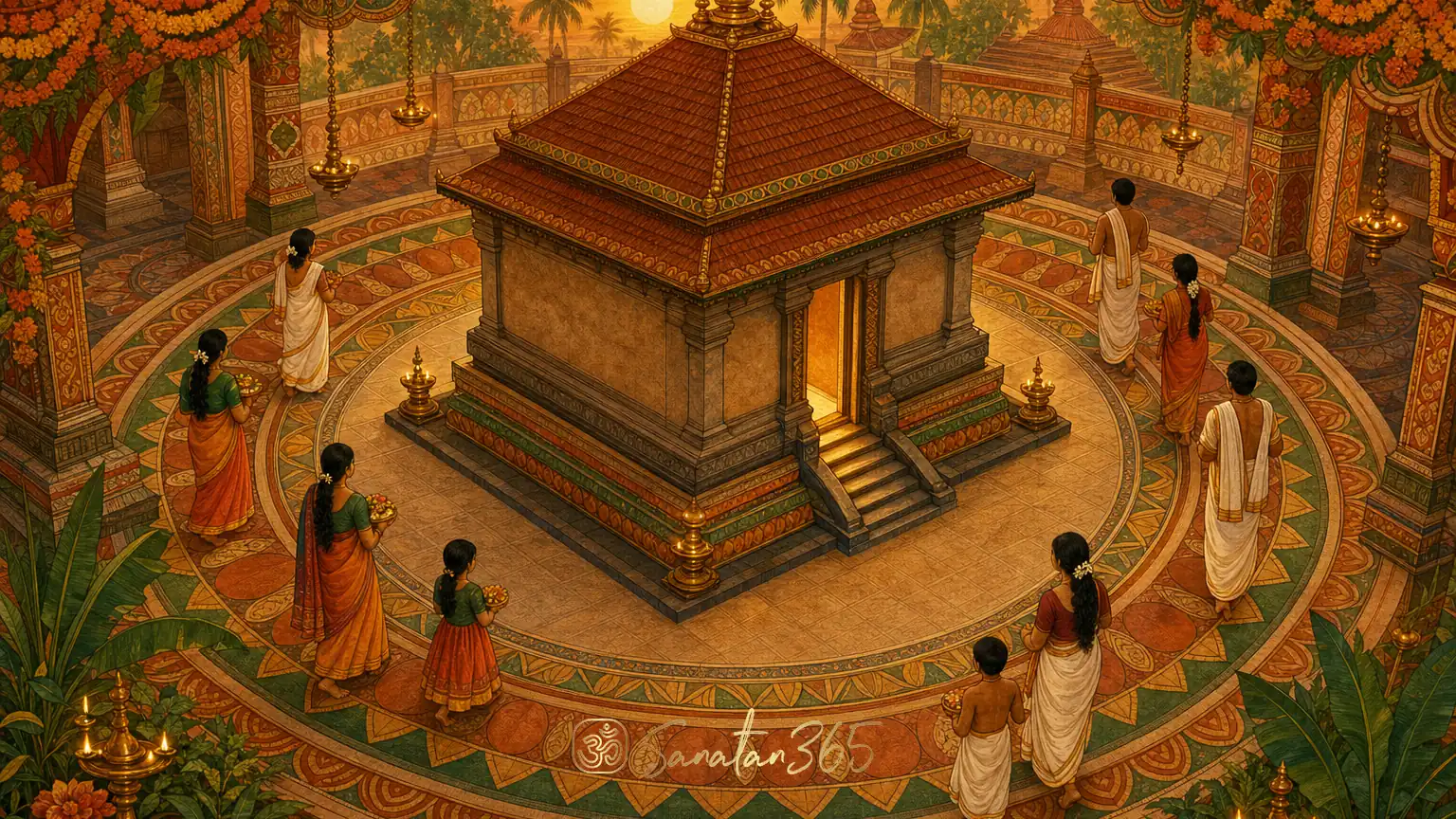
Pradakshina meaning is simple at first: it is the reverent clockwise movement around a deity, shrine, sacred fire, tree, hill, or temple space, usually after puja (पूजा, worship). The Sanskrit word pradakshina (प्रदक्षिणा) carries the sense of keeping the sacred presence to one’s right side, while parikrama (परिक्रमा, circumambulation) is often used for the same circular act. In Hindu worship, this walk turns the body into a quiet offering: the divine becomes the center, and the devotee moves with attention, humility, and gratitude.
Key takeaway: Pradakshina is not just “walking around.” It is a physical way of remembering what belongs at the center of life.
What Is Pradakshina Meaning in Hindu Ritual?
The most practical Pradakshina meaning is “going around with reverence while keeping the sacred on the right.” In many temples, devotees complete darshan, offer prayer, and then walk clockwise around the sanctum or designated path. Encyclopaedia Britannica describes pradakshina as the rite of circumambulating clockwise around an image, relic, shrine, or sacred object, beginning in a way that keeps the sacred object on the worshiper’s right side.
The right side matters because dakshina (दक्षिणा) is associated with the right, the south, and skillful or auspicious orientation in Sanskrit usage. In lived worship, this becomes a gentle rule: the devotee does not place the deity at the margins. The sacred remains close, honored, and central.
This is why pradakshina can be performed around many forms of sacred presence:
- a temple sanctum after darshan
- a Shiva linga, where local temple rules may differ
- a Tulsi plant in home worship
- a sacred Peepal tree in village practice
- a yajna fire during ritual
- a temple tank, hill, river, or pilgrimage path
- the sacred fire during Hindu wedding rites, often called pheras
The act can be small, like three quiet circles around a home altar, or vast, like the parikrama of Govardhan, Arunachala, Narmada, or a sacred city. The size changes. The inner gesture remains: “May my life move around dharma, not around ego.”
Key takeaway: The circular path teaches spiritual orientation through the body, not only through belief.
Why Is Pradakshina Usually Clockwise?
Pradakshina is usually clockwise so that the sacred presence remains on the devotee’s right side. In many Indic traditions, clockwise movement is considered auspicious because it follows a solar pattern of order, light, and continuity. Britannica notes that one explanation connects the movement to the daily course of the sun, while other explanations emphasize sanctifying a space or aligning action with favorable movement.
A simple way to understand it is this: when a person walks clockwise around the shrine, the deity is not merely “visited.” The deity becomes the axis. The devotee’s body makes visible what the heart is trying to learn.
The clockwise walk also creates discipline. A person slows down. The eyes lower. The hands may fold in anjali mudra (अञ्जलि मुद्रा, palms joined in reverence). The feet move without hurry. The mind stops treating the temple as a place to rush through. The ritual asks the seeker to be present.
There are also regional and temple-specific differences. Some Shiva temples follow special rules around the somasutra (सोमसूत्र, the channel through which abhisheka water flows from the Shiva linga), where devotees may avoid crossing the water outlet. Some temples allow full circumambulation; some have limited space; some ask devotees to follow a marked route. Good ritual conduct begins with humility: observe local practice, ask a priest or elder when unsure, and never push against the flow of worshipers.
Key takeaway: Clockwise movement is not mechanical superstition. It is a disciplined way of keeping the sacred close and central.
How Many Times Should Pradakshina Be Done?
There is no single number that applies to every home, temple, deity, and regional tradition. Many families do one, three, five, seven, eleven, or twenty-one rounds depending on the context. Some vrata observances prescribe specific counts. Some temples have their own inherited practice. Some devotees perform only one slow round because age, health, crowding, or space makes more difficult.
The best rule is reverence over arithmetic.
If a family is teaching children, three simple rounds are often enough: first for gratitude, second for guidance, third for steadiness. If an elderly devotee cannot walk, a mental pradakshina offered with folded hands is still meaningful. If the temple is crowded, one respectful round may be better than several distracted rounds that disturb others.
A beginner-friendly practice can look like this:
- Complete darshan or home puja first.
- Fold the hands, lower the pace, and begin clockwise.
- Keep the sacred presence to the right whenever the space allows.
- Walk without gossip, phone use, or haste.
- End with a short prayer, gratitude, or silent bow.
For a home altar, the same principle can be adapted gently. If there is no space to walk, the family may stand, turn slowly in place with folded hands, or simply offer a mental circle of reverence. Sanatan practice has always made room for sincere intention when physical conditions are limited.
Key takeaway: The number of rounds matters less than attention, humility, and non-disruptive conduct.
What Does Parikrama Teach Beyond Temple Etiquette?
Parikrama teaches that human life needs a center. Without a center, attention circles restlessly around desire, fear, comparison, and memory. In ritual, the deity or sacred presence becomes the center. The body moves, but the center does not. This is the teaching hidden in the circle.
A circle also has no sharp beginning or end. It suggests continuity: birth and death, day and night, effort and grace, receiving and offering. Many sacred geography traditions in India use this symbolism. Govardhan Parikrama in Braj, Arunachala Girivalam in Tamil Nadu, Narmada Parikrama across central India, and circumambulation routes around Varanasi all show the same idea at larger scale. The land itself becomes a mandala of remembrance.
For diaspora families, this teaching can be especially valuable. A child may not know every Sanskrit term. A parent may not remember every ritual detail. But walking together around a home altar or temple sanctum gives the body a memory: pause, fold hands, keep the sacred central, move with care. Such embodied learning often stays longer than explanation. Readers exploring related foundations may also enjoy Satya meaning and Isha Upanishad meaning.
This does not mean every family must practice identically. North Indian, South Indian, Maharashtrian, Gujarati, Bengali, Tamil, Kannada, Telugu, and diaspora temples may differ in layout and custom. A mature approach honors the local temple’s discipline while remembering the shared principle beneath it.
Key takeaway: Parikrama is a portable spiritual lesson: place dharma at the center, then let daily life move around it.
How Can Modern Families Practice Pradakshina With Reverence?
Modern families can practice pradakshina by making it slow, clean, and conscious. The ritual loses its power when it becomes a rushed loop before leaving the temple. It regains depth when each round carries a simple intention.
Here are useful intentions for different moments:
- For children: “May I learn with humility.”
- For parents: “May this home stay rooted in dharma.”
- For students: “May knowledge become wisdom.”
- For workers: “May effort become service.”
- For elders: “May memory rest in peace and gratitude.”
- For anyone grieving: “May I be held by strength greater than my own.”
These are not guaranteed outcomes or transactional promises. They are devotional intentions. Sanatan ritual is most dignified when it avoids bargaining and returns to surrender.
A family can also connect pradakshina with related practices. Read a short story after temple visits, chant one simple mantra while walking, or teach children why phones should be put away in sacred spaces. Sanatan365’s daily stories, lessons, and ritual experiences can support this kind of family learning when used as a companion to real-life practice, not as a replacement for temple, elders, or living tradition.
The same reverence applies to accessibility. If someone cannot walk because of illness, disability, pregnancy, age, or crowding, they should not feel spiritually inferior. A seated prayer, mental circumambulation, or one gentle bow can carry devotion fully. Ritual should deepen compassion, not create shame.
Key takeaway: Pradakshina becomes powerful when it is practiced with attention, family learning, and compassion for real human limits.
What Should Devotees Avoid During Pradakshina?
The main things to avoid are haste, display, and disregard for the temple’s rules. A sacred path is not a race track, photo backdrop, or place to prove devotion through intensity. Reverence is often quiet.
Devotees should avoid:
- cutting across other worshipers aggressively
- walking against the indicated flow
- crossing restricted areas or priest-only spaces
- touching sacred objects without permission
- talking loudly or using phones during the round
- treating the number of rounds as spiritual competition
- ignoring special local rules around Shiva lingas, temple tanks, or narrow paths
It is also wise to avoid overconfident explanations. Some practices have multiple regional meanings. Some rules come from Agama traditions, some from local temple custom, some from family learning. When explaining pradakshina to children or new seekers, humility is better than pretending every detail has one universal answer.
One careful sentence is enough: “We walk clockwise to keep the sacred on our right, and to remind ourselves that the divine is the center.” From there, the experience can teach.
Key takeaway: The etiquette of pradakshina protects the inner purpose of the ritual.
Conclusion
Pradakshina begins as a circle around a shrine, but it quietly asks a larger question: what does life revolve around? When the sacred is kept to the right and the heart is kept humble, the body learns what philosophy teaches in words. Walk slowly, honor the temple’s custom, include children gently, and let each round become a return to the center.
Key takeaway: The deepest pradakshina is not only around a temple; it is the daily effort to let dharma become the center of one’s life.
FAQ
What is the meaning of pradakshina?
Pradakshina means reverent clockwise circumambulation around a deity, shrine, sacred object, tree, fire, hill, or temple space. In common Hindu practice, it keeps the sacred presence on the devotee’s right side.
Is pradakshina the same as parikrama?
The words are often used together. Pradakshina usually emphasizes the auspicious clockwise act, while parikrama means circumambulation or going around. In everyday temple language, many devotees use them almost interchangeably.
Why do Hindus walk clockwise around temples?
The usual explanation is that clockwise walking keeps the deity or sacred presence on the right side, which is treated as auspicious. It also symbolizes keeping the divine at the center of life.
How many pradakshina rounds should be done?
The number depends on family, temple, deity, vow, and regional tradition. Many devotees do one, three, five, seven, eleven, or twenty-one rounds. A sincere, respectful round is better than many distracted ones.
Can someone do pradakshina mentally if they cannot walk?
Yes. If age, illness, disability, pregnancy, crowding, or space makes walking difficult, a mental pradakshina with folded hands and sincere prayer is a respectful alternative.
About the author
Sanatan365 Editorial
Bringing Sanatan Dharma to modern seekers through authentic, scripture-grounded content.
Related in Rituals
 Rituals
Chandan Offering in Hindu Puja: The Meaning of Gandha
Why devotees offer sandalwood paste in Hindu worship, what gandha signifies, how the custom varies, and how to practise with care.
 Rituals
Deepa Dana Meaning: Why Devotees Offer Lamps
Deepa Dana is the devotional offering or giving of a lamp. Learn how it differs from aarti, what shared light signifies, and how to observe…
 Rituals
Kanya Puja Meaning: Honouring the Divine Feminine During Navratri
Kanya Puja honours young girls as living symbols of Devi during Navratri. Learn its meaning, timing, regional forms, offerings, and a respe…