Mohini Avatar Meaning: Enchantment, Discernment, and Divine Strategy
Mohini is Vishnu's enchanting form, appearing when force alone cannot restore balance. Her stories explore desire, discernment, illusion, and the ethical use of intelligence.
Some forms of the Divine defeat disorder through strength. Mohini restores balance through perception.
Mohini avatar meaning begins with this unusual insight. Mohini is the enchanting feminine form assumed by Lord Vishnu in several Hindu narratives. Her beauty is important, but it is not the whole meaning. She appears at moments when desire has clouded judgment, promises have been misused, or raw force cannot protect dharma (धर्म, the order that sustains life). Mohini does not simply overpower confusion. She allows its hidden motive to reveal itself and then redirects it.
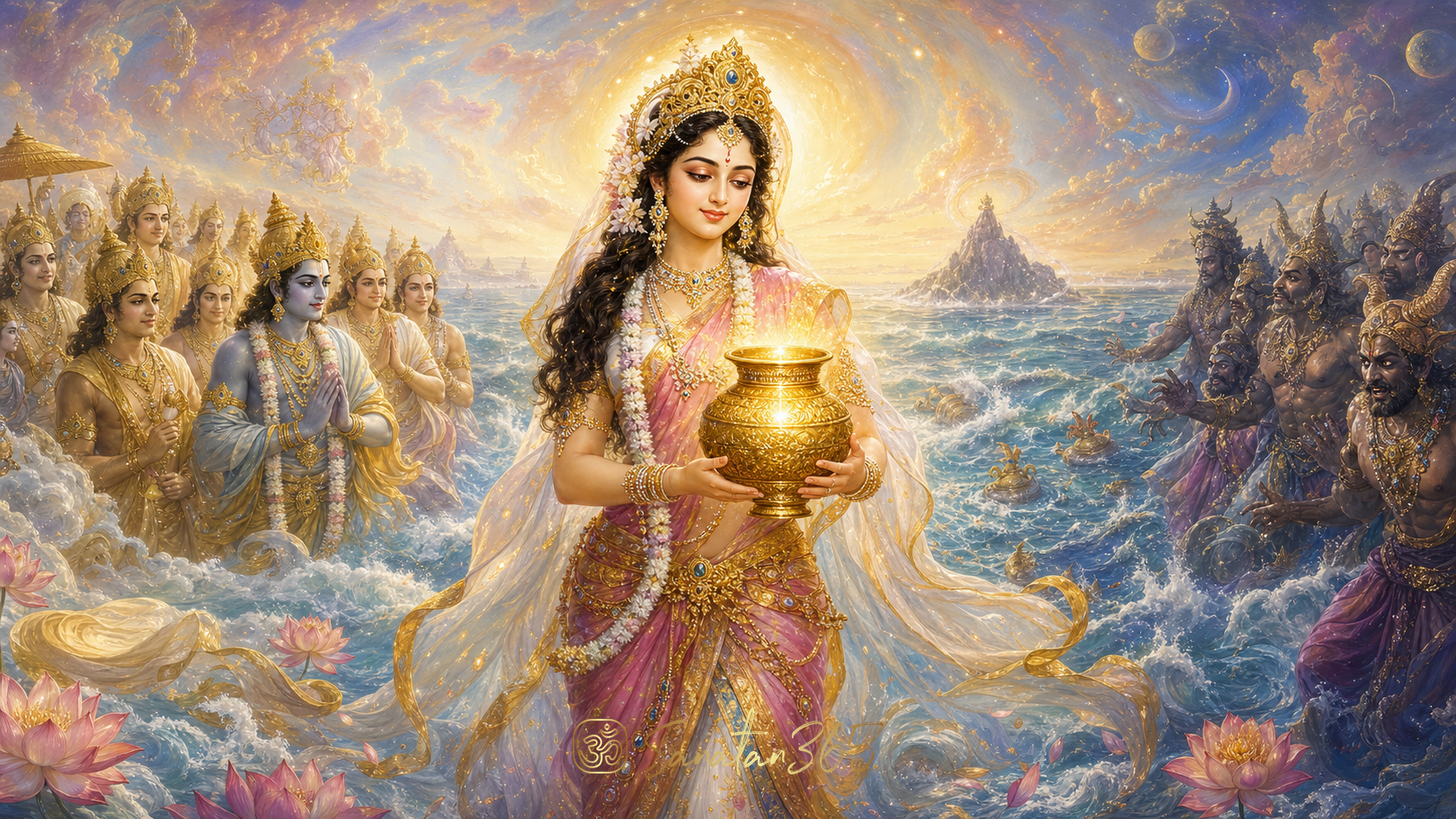
The best-known account places Mohini beside the cosmic ocean with the vessel of amrita, the nectar of immortality. Another widely told tradition joins her to Bhasmasura, whose destructive boon threatens everyone around him. Across these stories, enchantment is not treated as a cheap trick. It becomes a mirror: what a person sees depends on the quality of attention they bring.
Who Is Mohini in Hindu Tradition?
The name Mohini (मोहिनी) comes from the Sanskrit root muh, associated with bewilderment, fascination, or delusion. Mohini may therefore be understood as “the enchantress” or “she who captivates.” In Hindu tradition, she is most often identified as a form of Lord Vishnu, the Divine Preserver who assumes whatever form is needed to restore cosmic balance.
Mohini is not one of the commonly listed ten principal avatars, the Dashavatara. Hindu texts contain many manifestations of Vishnu beyond that familiar sequence. The category of avatara (अवतार, a divine descent or manifestation) describes the Divine becoming present in a particular form for a particular purpose. Mohini's purpose is usually precise and temporary: she enters a crisis, exposes the weakness driving it, and makes a path for order to return.
This form also unsettles rigid assumptions about how divine power must look. Vishnu does not remain limited by human categories of masculine and feminine. Mohini is not a disguise that makes divinity less real. She is a fully effective sacred form whose grace, intelligence, and presence accomplish what another approach could not.
Key takeaway: Mohini is Vishnu's enchanting form, revealing that preservation may require adaptability, beauty, intelligence, and perfect timing.
Why Does Vishnu Take the Form of Mohini?
Vishnu's manifestations respond to the nature of a crisis. Varaha lifts the Earth, Narasimha breaks through a seemingly impossible boon, and Vamana restores balance through three measured steps. Mohini appears when the central problem is not lack of strength but lack of discernment.
Viveka (विवेक) means the capacity to distinguish clearly: enduring from temporary, duty from impulse, and appearance from truth. The Mohini stories repeatedly place characters in situations where viveka has been eclipsed by greed, pride, fear, or appetite. Her presence does not create those impulses. It makes them visible.
This is closely connected with maya (माया), a rich Hindu philosophical term that can refer to the power of manifestation and to the appearance that veils deeper reality. Maya is not simply “everything is fake.” The world is experienced, meaningful, and morally consequential. Yet appearances can be misunderstood when the mind sees only what it wants to possess.
Mohini embodies mastery of appearance rather than captivity to it. She can work through form without forgetting truth. Those who meet her are tested by the same question: can they see beyond immediate attraction and remember their commitments?
Key takeaway: Vishnu becomes Mohini when the restoration of dharma depends on revealing confused desire and guiding events with discernment.
How Does Mohini Distribute the Amrita?
The Samudra Manthana, or churning of the ocean, is one of Hindu tradition's great cosmic narratives. Devas and asuras cooperate to churn the ocean of milk, using Mount Mandara as the churning rod and Vasuki as the rope. Many treasures emerge, along with halahala, a devastating poison that Shiva contains. At last Dhanvantari appears carrying the vessel of amrita (अमृत), the nectar associated with deathlessness.
Cooperation then gives way to conflict. The asuras seize the vessel, and the fragile alliance collapses. According to the Bhagavata Purana account, Vishnu assumes the form of Mohini. Her extraordinary presence arrests the quarrel. She asks the competing groups to sit separately and entrust the distribution to her.
The asuras agree because fascination outruns caution. Mohini serves the amrita to the devas. Rahu, disguising himself, enters the devas' line and tastes the nectar before Surya and Chandra identify him; Vishnu's discus then severs him, giving rise to the Rahu-Ketu tradition in later cosmology.
The episode can be uncomfortable if read only as one side deceiving another. Its theological frame matters. The asuras have seized a shared result and are themselves divided by possession. Mohini's intervention prevents a power associated with immortality from strengthening forces already committed to domination. The story is not a licence for ordinary dishonesty. It presents divine strategy within a cosmic crisis, where power without restraint would deepen disorder.
It also asks a sharp question: why do the asuras surrender control of the very treasure they fought to obtain? Mohini does not compel them by violence. Their own unexamined desire makes the decision for them.
Key takeaway: At the cosmic ocean, Mohini restores the amrita to a dharmic purpose by turning the asuras' possessiveness and fascination into the means of their own defeat.
What Does the Bhasmasura Story Teach?
The Bhasmasura story is famous across later Puranic, regional, dance, and oral traditions, though details and textual placement vary. Its central pattern is consistent. An asura performs severe austerities and receives a boon: anyone whose head he touches will be reduced to ashes. Instead of using this power responsibly, he immediately threatens others and, in many retellings, turns it toward Shiva, the very deity who granted it.
This is a story about power without character. Tapas (तपस्) means disciplined spiritual effort or inner heat. Tapas can cultivate clarity, but effort alone does not guarantee wisdom. Bhasmasura acquires capacity while remaining governed by impulse. His boon magnifies what he already is.
Vishnu appears as Mohini. Rather than fighting a figure whose touch makes direct combat dangerous, she invites him into dance. Bhasmasura imitates her movements, captivated and eager to prove that he can follow. Mohini finally places a hand upon her own head. He copies the gesture and activates the boon against himself.
The ending is not merely a clever escape. Bhasmasura becomes the author of his destruction because imitation has replaced awareness. He watches the beautiful form before him but does not observe his own hand, his own boon, or his own intention.
The lesson is especially relevant wherever people seek influence, technology, authority, or spiritual attainment. A tool amplifies the mind that holds it. Capacity without self-knowledge can become self-consuming.
Key takeaway: The Bhasmasura tradition warns that discipline can win power, but only discernment and ethical maturity can make power safe.
What Does Mohini Symbolize Philosophically?
Mohini's symbolism cannot be reduced to “beauty is deceptive.” That reading unfairly treats feminine beauty as the problem and misses the moral center of the stories. Mohini is conscious, purposeful, and free. The delusion belongs to the gaze that tries to possess without understanding.
Several philosophical themes emerge:
Appearance reveals the observer
The same form can awaken reverence, curiosity, greed, or confusion. Mohini shows that perception is participatory. We do not encounter the world without assumptions; we often project our hunger onto what we see.
Intelligence can be protective
Dharma is not preserved by physical force alone. Strategy, timing, communication, and psychological insight can prevent harm. Mohini's intelligence is active compassion for the larger order.
Desire narrows attention
Moha (मोह) means delusion, attachment, or bewilderment. Under moha, a person sees the desired object but not the consequences of reaching for it. Both the amrita dispute and Bhasmasura's dance dramatize this narrowing.
Divine reality exceeds fixed categories
Mohini demonstrates that the Divine is not bound by the gendered limits human societies create. Vishnu's feminine manifestation is neither secondary nor powerless. It is the exact form through which preservation becomes possible.
Grace may arrive as interruption
We often imagine grace as receiving what we want. Mohini suggests another possibility: grace can interrupt a desire that would harm us. The loss of an impulsive goal may protect a deeper good.
Key takeaway: Mohini symbolizes mastery of maya, flexible intelligence, and the clarity to see how desire shapes perception.
How Is Mohini Remembered in Worship and Art?
Mohini appears in sculpture, painting, storytelling, temple traditions, and classical performance. Artists usually emphasize graceful movement, a composed expression, elaborate ornaments, and the amrita vessel. The intention need not be sensual display. In devotional art, beauty can communicate auspiciousness, divine attraction, and the power that draws the mind away from disorder.
Kerala preserves particularly important Mohini traditions. The name Mohiniyattam is commonly interpreted as “the dance of the enchantress.” The classical dance form's gentle swaying movement and expressive storytelling are culturally distinct from a literal re-enactment of every Mohini narrative, yet its name evokes the captivating feminine presence associated with Mohini. Kerala also holds temple and regional traditions joining Mohini with Shiva and the birth of Hariharaputra, revered as Lord Ayyappa. Accounts differ across texts and communities and should be approached without forcing one version to replace all others.
Some images present Mohini holding the nectar vessel; others emphasize dance or the meeting of Shaiva and Vaishnava traditions. These depictions are best read with local context. Hindu iconography is a language: posture, objects, gesture, and setting help identify the theological moment.
For devotees, respectful engagement may take the form of hearing the stories, studying their meanings, viewing temple art, or reflecting on Vishnu's adaptability. There is no need to invent a universal home ritual where family or lineage tradition does not prescribe one.
Key takeaway: Mohini lives across scripture, visual art, performance, and regional devotion as a dignified form of divine intelligence and grace.
What Can Mohini's Stories Teach Modern Readers?
Mohini's world of nectar, boons, and cosmic conflict may feel distant, but its psychology is immediate. Modern life constantly places attractive surfaces before us: headlines engineered for outrage, products designed to create urgency, authority without accountability, and tools whose power arrives before our wisdom catches up.
A Mohini-inspired practice of discernment can begin with four questions:
- What is attracting me right now? Name the object, promise, status, or feeling without shame.
- What am I failing to notice? Look for cost, consequence, duty, and the people affected.
- Who benefits if I act immediately? Urgency often protects someone else's interest rather than dharma.
- What choice would remain wise after the fascination passes? Create enough space for viveka to return.
This reflection is not a rejection of beauty, pleasure, or ambition. Hindu traditions do not require every householder to flee the world. The question is whether experience is held within dharma or allowed to rule the mind.
Mohini also offers a leadership lesson. When a group is trapped in conflict, repeating the same display of force may intensify the problem. A reframing, a boundary, a different sequence, or a clearer understanding of motivation may open the way forward. Ethical strategy is not manipulation for private gain. It uses insight to reduce harm and restore a fairer order.
Key takeaway: Mohini's stories invite a pause between attraction and action—the space where discernment can protect freedom.
FAQ
Is Mohini a goddess or an avatar of Vishnu?
Mohini is primarily described as the enchanting feminine form of Lord Vishnu. Some devotional and regional contexts may speak of her with the reverence given to a goddess, but her central Puranic identity is Vishnu manifesting in feminine form for a particular purpose.
Is Mohini part of the Dashavatara?
Mohini is not usually included among the ten principal avatars known as the Dashavatara. Vishnu's manifestations are more numerous than that familiar list, and Mohini remains an important divine form in her own right.
Why did Mohini give amrita only to the devas?
Within the cosmic narrative, the asuras had seized the shared nectar and were divided by possessiveness. Mohini's distribution prevents deathlessness from empowering forces committed to domination and restores the balance needed for the worlds to continue.
What is the moral of Mohini and Bhasmasura?
The story teaches that power gained without self-mastery can destroy its holder. Bhasmasura has a formidable boon but lacks the awareness and ethical maturity to use it safely.
Does Mohini mean that beauty is deceptive?
No. The deeper teaching concerns the observer's attachment. Mohini acts with awareness and purpose; the confused characters see only what desire allows them to see. Beauty is not condemned—unexamined craving is exposed.
Is Mohini connected with Lord Ayyappa?
Yes. Several Kerala and Puranic traditions describe Hariharaputra—identified devotionally with Lord Ayyappa—as born through the union of Shiva and Vishnu's Mohini form. Retellings vary, so the connection should be presented respectfully within its regional and textual contexts.
A Form That Makes the Mind Visible
Mohini's power lies in more than enchantment. She reveals the movement of the mind itself.
At the cosmic ocean, grasping causes the asuras to surrender what they seized. In Bhasmasura's dance, imitation causes destructive power to turn back upon its holder. In both cases, Mohini does not plant greed or carelessness. She makes their consequences impossible to avoid.
That is why Mohini remains such a compelling form of Vishnu. She shows that preservation is not always loud, that intelligence can be sacred, and that the most decisive victory may begin with seeing clearly. When fascination narrows the world to a single desire, Mohini restores the forgotten horizon of dharma.
Sanatan365 offers real-time conversations with named AI spiritual guides, including Lord Vishnu, for reflective devotional exploration. Such conversations can support study and contemplation while honouring scripture, family tradition, and qualified teachers as vital sources of guidance.
About the author
Sanatan365 Editorial
Bringing Sanatan Dharma to modern seekers through authentic, scripture-grounded content.
Related in Deities
 Deities
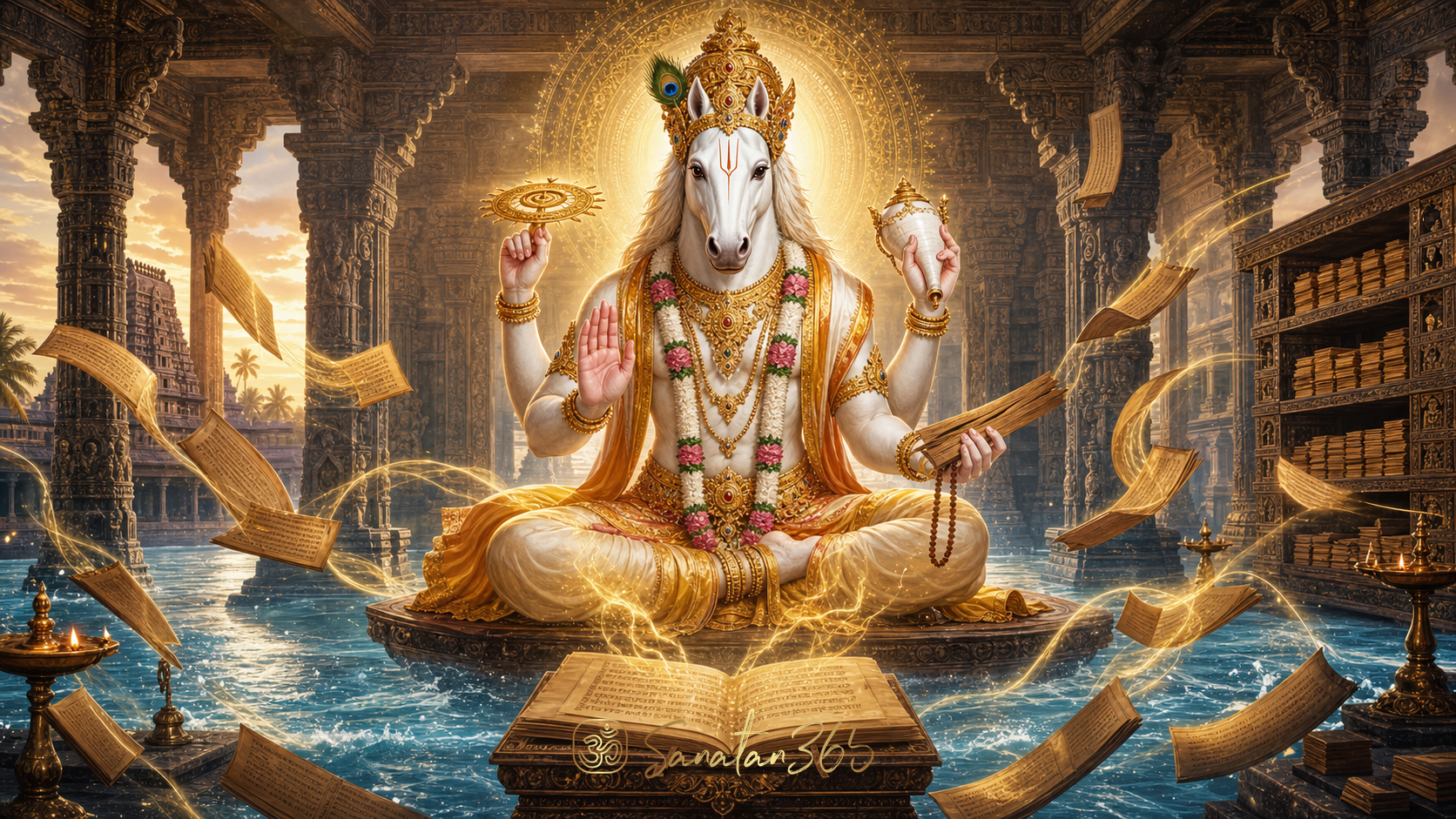
Hayagriva Meaning: Vishnu's Horse-Headed Form of Sacred Knowledge
Hayagriva is a horse-headed form of Lord Vishnu revered as the protector and restorer of sacred knowledge. His imagery joins intellectual c…
 Deities
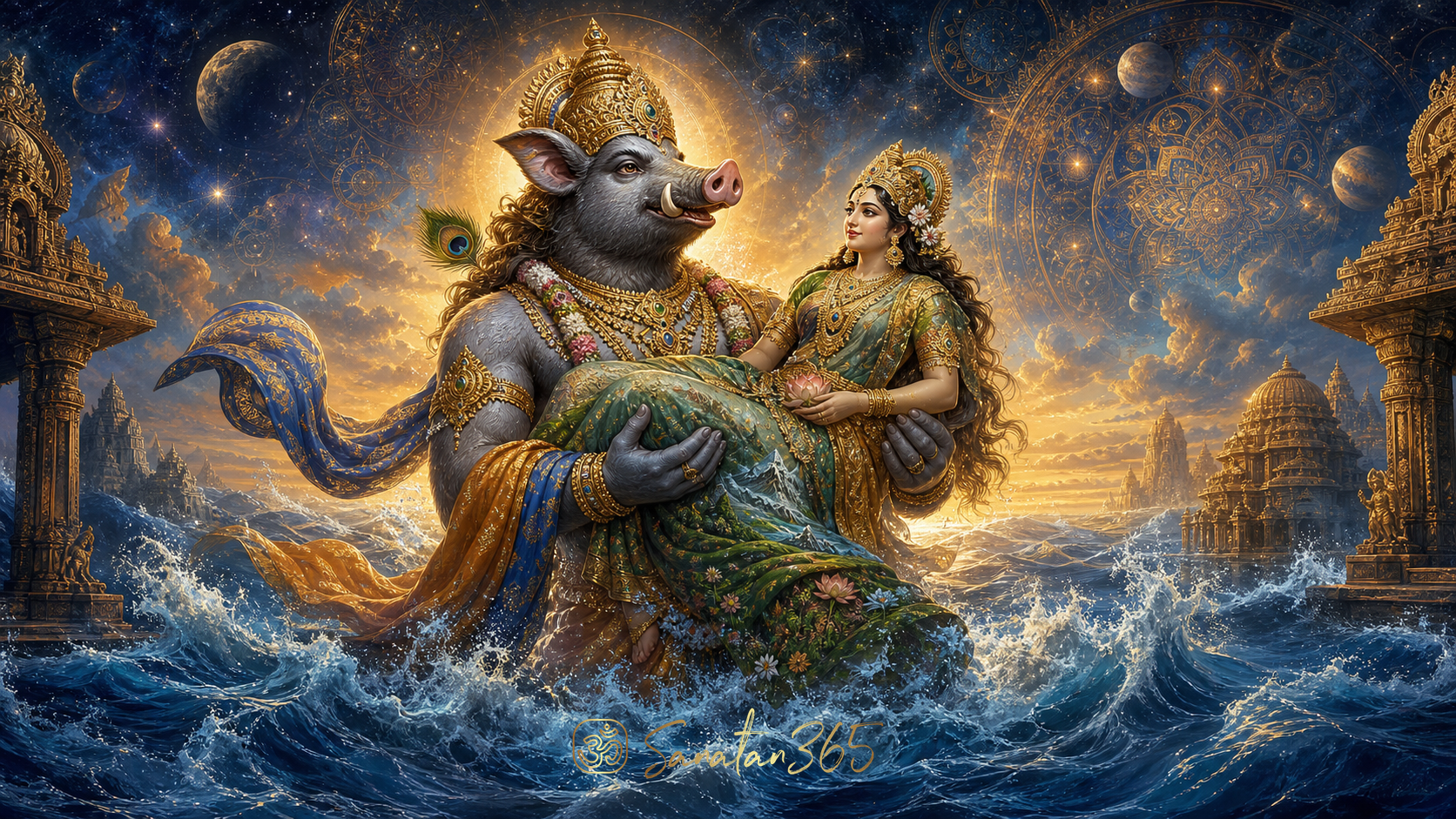
Varaha Avatar Meaning: Vishnu, Earth, and the Restoration of Dharma
Varaha, Vishnu's boar avatar, raises Bhudevi from the cosmic waters. The story joins divine courage, the dignity of Earth, and the restorat…
 Deities
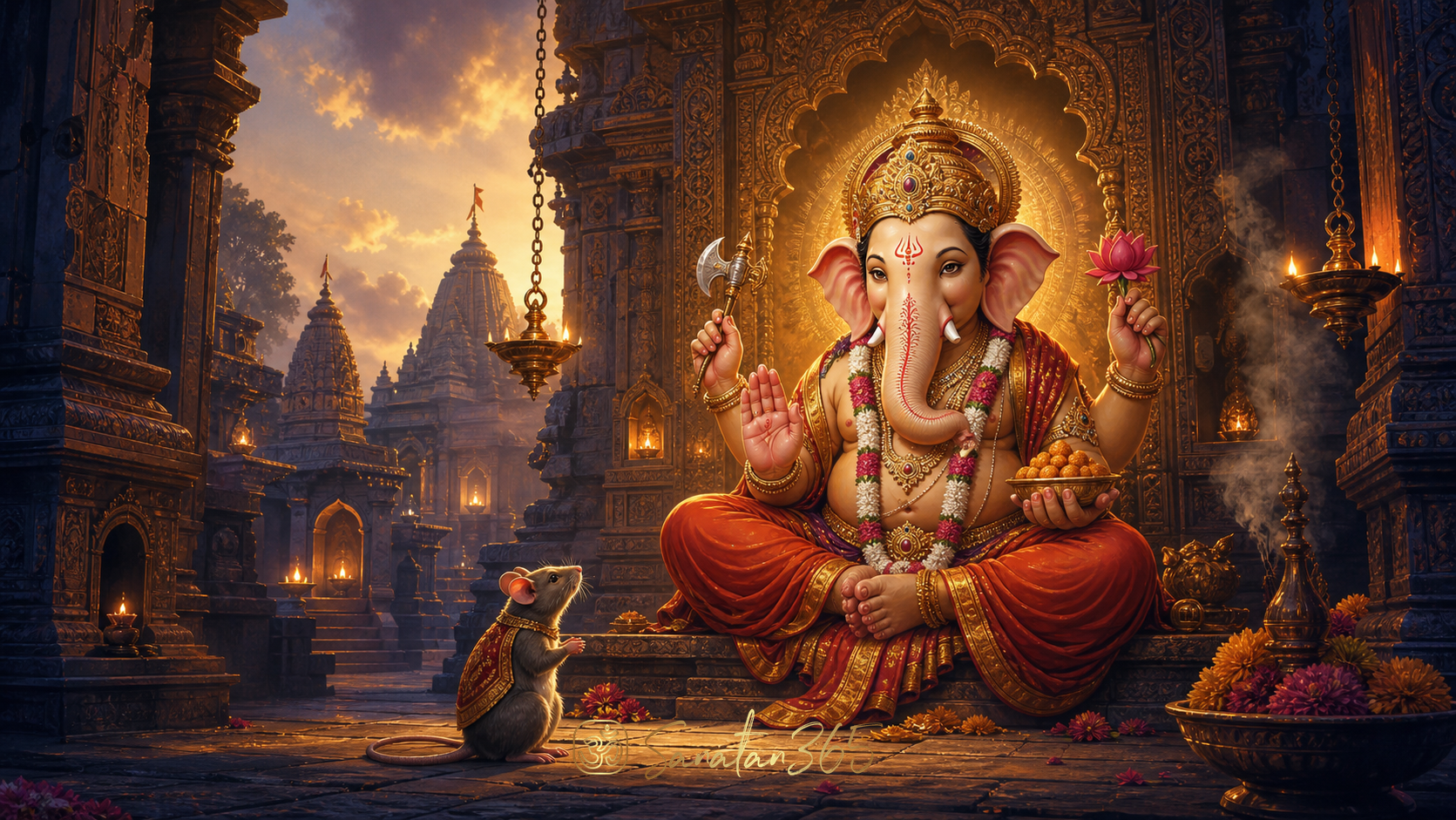
Mushika Meaning: Why Ganesha Rides a Mouse
Ganesha's tiny mouse vehicle is not a comic mismatch. Mushika expresses the reach of desire, the power of disciplined intelligence, and hum…