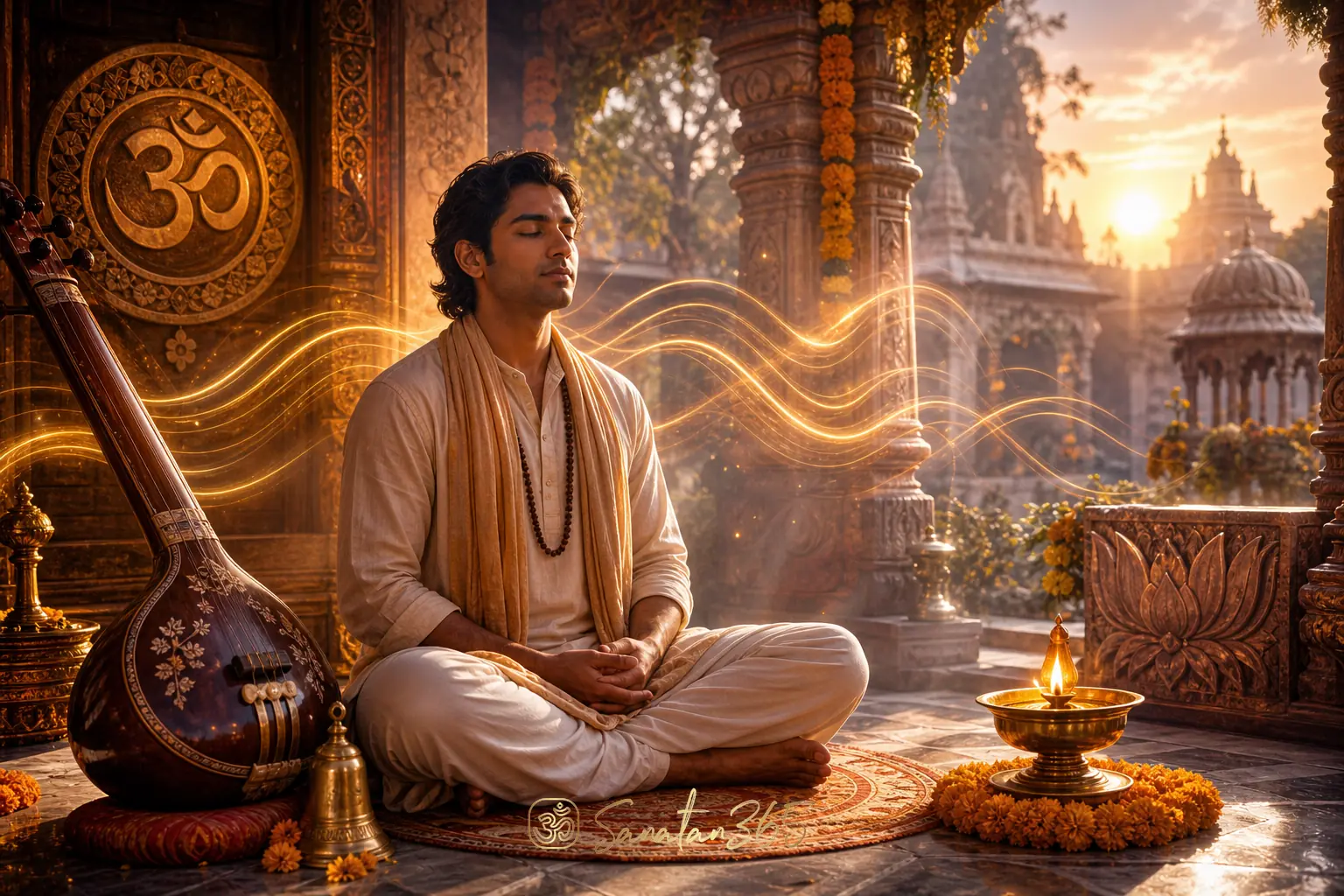
Nada Yoga Meaning: Sound Meditation in the Hindu Tradition
Nada Yoga is the yoga of sacred sound: a Hindu contemplative path that uses mantra, listening, and inner vibration to steady awareness.
Sound is not only something heard; in Hindu yoga, it can become a doorway into attention.
Nada Yoga meaning is simple at first: nada (नाद, sound or vibration) and yoga (योग, union or disciplined integration) together point to a path of meditation through sacred sound. In practice, Nada Yoga uses mantra, chanting, attentive listening, and subtle inner awareness to settle the mind without treating silence as mere emptiness. As International Day of Yoga 2026 approaches with the United Nations theme of "Yoga for Healthy Ageing," this ancient sound practice offers a gentle way to understand yoga as steady awareness, not only physical posture. United Nations
Key takeaway: Nada Yoga is Hindu sound meditation that trains attention through outer sound, mantra, and inner listening.
What Is Nada Yoga Meaning in Hindu Meditation?
The primary keyword, Nada Yoga meaning, begins with the Sanskrit word nada, often understood as sound, resonance, or vibration. The practice is not simply "music for relaxation." It belongs to a wider Hindu understanding that sound can shape attention, memory, devotion, and inner discipline.
In the Mandukya Upanishad, Om is treated as a profound symbol of waking, dreaming, deep sleep, and the fourth state beyond ordinary mental movement. That does not mean every sound is automatically sacred. It means the disciplined use of sound can help a seeker notice how consciousness moves from distraction toward stillness. Wisdom Library
Hatha Yoga texts also give sound a serious place in contemplative practice. The Hatha Yoga Pradipika describes nada-anusandhana, the attentive pursuit or contemplation of subtle sound, as a method connected with absorption of the mind. Traditional teachers often explain this in two layers: first, sound that is heard externally; later, a subtler inward listening that is not dependent on a visible instrument. Sacred Texts
For a modern reader, the point is practical. The mind often resists direct command. Tell it to be silent, and it produces more thought. Give it a mantra, a bell, a drone, or a steady chant, and attention has a finer object to rest upon. Nada Yoga works through this humane route.
Key takeaway: Nada Yoga is not background music; it is a disciplined way of making sound an object of meditation.
How Do Ahata and Anahata Nada Shape the Practice?
Traditional explanations often distinguish between ahata (आहत, struck or audible sound) and anahata (अनाहत, unstruck or subtle sound). Ahata is the sound heard through the ears: a mantra recited aloud, a temple bell, a tanpura drone, a conch, cymbals, kirtan, or the teacher's voice. Anahata points toward a subtler inward resonance, a soundless sound noticed when attention becomes refined.
This distinction matters because it protects the practice from becoming vague. A beginner does not need to chase mystical inner sounds. The first discipline is humble: listen fully to what is actually present. If a mantra is being chanted, hear its syllables. If a bell is struck, hear the beginning, swelling, fading, and disappearance of the tone. If the breath makes a soft sound, listen without forcing it.
Over time, listening becomes less restless. The practitioner begins to notice the space around sound, the silence after sound, and the awareness in which both appear. This is why Nada Yoga sits naturally beside other yoga disciplines such as pranayama (प्राणायाम, regulation of life-breath) and dhyana (ध्यान, meditative absorption). A reader who has explored Pranayama Meaning: Yogic Breath as a Hindu Practice of Prana will recognize the same principle: attention becomes steady through a concrete, repeatable support.
The ahata-anahata framework also keeps Hindu sound meditation different from passive consumption. Playing devotional music while working may be pleasant, but Nada Yoga asks for full attention. The listener is not using sound to escape life. Sound becomes a teacher of presence.
Key takeaway: Ahata begins with audible sound; anahata points toward subtler awareness, but the foundation is careful listening.
Why Is Sound So Important in Sanatan Dharma?
Sanatan Dharma gives sound a central role because sacred speech, mantra, and recitation preserve both meaning and presence. Vedic learning depended on exact oral transmission. Mantras were not treated as casual poetic lines; their syllables, accents, and rhythm mattered. The discipline of hearing and repeating carefully was itself a form of refinement.
Om, the Gayatri Mantra, the Mahamrityunjaya Mantra, kirtan, stotra recitation, temple bells, conch-blowing, and aarti singing all show this deep respect for sound. Each has a different setting and purpose. Some belong to Vedic recitation, some to bhakti, some to household worship, some to temple ritual. Together they show that Hindu practice does not separate thought, voice, body, and devotion as sharply as modern categories often do.
Nada Yoga draws from this larger sound culture but uses it for meditation. The practitioner may begin with Om chanting, a simple mantra, or a sustained drone. The goal is not performance. A beautiful voice is not required. What matters is shraddha (श्रद्धा, sincere trust), steadiness, and listening.
This is also why the practice should be approached with care. Sacred mantras should not be used as decorative sound effects. If a mantra is received from a family tradition, temple, teacher, or trusted source, it deserves respect. If a person is new, beginning with Om, a simple name of the Divine, or silent listening is often more appropriate than collecting complex mantras without context. Readers can compare this with Om Namah Shivaya Meaning: Shiva's Five-Syllable Mantra of Surrender, where repetition becomes surrender rather than display.
Key takeaway: Nada Yoga belongs to a wider Hindu respect for sacred sound, precise listening, and disciplined repetition.
How Can Beginners Practice Nada Yoga Gently?
For beginners, Nada Yoga should be simple, safe, and steady. It does not require special equipment. A quiet corner, a clean seat, and a few minutes of sincere attention are enough.
One practical sequence:
- Sit with the spine comfortable and upright.
- Let the breath settle naturally for one minute.
- Choose one sound: Om, a simple mantra, a bell, a tanpura drone, or a soft devotional chant.
- Listen to the sound fully, without analyzing it.
- If chanting, keep the voice gentle and unforced.
- After the sound fades, remain attentive to the silence for a few breaths.
- Close with gratitude, not self-judgment.
Five to ten minutes is enough at first. The practice should leave the mind clearer, not strained. If sound sensitivity, anxiety, or medical concerns are present, the person should keep volume low and choose silence or breath awareness instead. Nada Yoga is a spiritual practice, not a substitute for clinical care.
During Yoga Week, many people encounter yoga through group postures, public events, and wellness campaigns. Those are useful entry points, but Hindu yoga has always included more than movement. Ashtanga Yoga, described in Patanjali's eight limbs, includes pratyahara (प्रत्याहार, withdrawal of the senses), dharana (धारणा, concentration), and dhyana. Sound can support each of these when used with discipline. See Ashtanga Yoga Meaning: Patanjali's Eight Limbs of Inner Discipline for the wider map.
The diaspora context is also important. A Hindu family in New Jersey, London, Nairobi, Singapore, or Melbourne may not have daily access to a temple soundscape. Nada Yoga can bring a small piece of sacred listening into the home: a morning Om, a child's soft bell before study, an evening chant after work, or a quiet minute after aarti.
Key takeaway: Begin with a single sound, low pressure, and a few minutes of complete listening.
What Is the Difference Between Nada Yoga and Sound Healing?
The phrase "sound healing" is now common in wellness spaces, but Nada Yoga should not be reduced to a trend. Sound baths, ambient music, and relaxation sessions may help some people feel calm. Nada Yoga, however, has a distinct spiritual grammar: disciplined listening, mantra respect, inner awareness, and the yogic aim of steady consciousness.
This difference does not require hostility toward modern wellness. It simply asks for clarity. If someone uses gentle sound to relax before sleep, that is one thing. If someone practices Nada Yoga, the sound is not only soothing. It becomes an object of concentration and a reminder of subtler awareness.
Three distinctions help:
- Intention: Relaxation seeks comfort; Nada Yoga seeks steadiness and inner refinement.
- Method: Wellness sound may use many tones freely; Nada Yoga often uses mantra, Om, drone, or disciplined listening.
- Context: Sound healing may be therapeutic in style; Nada Yoga is rooted in Hindu yoga and contemplative practice.
This clarity protects both sides. It prevents ancient practice from being flattened into spa language, and it prevents seekers from making exaggerated claims. A respectful article on Nada Yoga should not promise guaranteed healing, supernatural results, or instant enlightenment. The honest claim is stronger: sound, used with reverence and consistency, can train attention and deepen spiritual awareness.
Key takeaway: Nada Yoga may calm the mind, but its deeper purpose is yogic concentration and sacred listening.
How Does Nada Yoga Support Yoga for Healthy Ageing?
International Day of Yoga 2026 places public attention on "Yoga for Healthy Ageing." That theme can be understood without making medical promises. Ageing well is not only about flexibility. It also involves attention, emotional steadiness, memory, devotion, breath, community, and a sense of meaning.
Nada Yoga can support this wider understanding because it is accessible. A person who cannot perform difficult asana may still chant softly. An elder can listen to Om, a familiar stotra, or a temple bell. A family can sit together for two minutes after evening prayer. A child can learn that listening itself is a spiritual act.
There is also a cultural dimension. For many Hindu elders, devotional sound carries memory: morning shlokas, temple bells, radio bhajans, a mother's aarti, a grandfather's mala, festival chants, or the conch at sunset. Nada Yoga does not turn those memories into nostalgia only. It makes them living supports for present awareness.
For younger practitioners, sound can balance overstimulation. Modern life is filled with noise, but much of it scatters attention. Nada Yoga asks for the opposite: one sound, one breath, one listening mind. In that way, it becomes especially relevant for families who want yoga to remain connected to dharma, not only fitness.
Key takeaway: Nada Yoga fits Yoga Week because it offers an accessible path of attention for children, adults, elders, and diaspora homes.
FAQ
What is Nada Yoga in simple words?
Nada Yoga is Hindu sound meditation. It uses sacred sound, mantra, chanting, or careful listening to steady the mind and deepen awareness.
Is Nada Yoga the same as mantra meditation?
They overlap, but they are not identical. Mantra meditation uses repeated sacred syllables or divine names; Nada Yoga includes mantra and also attentive listening to outer sound and subtler inner resonance.
Do beginners need a teacher for Nada Yoga?
A beginner can safely start with simple listening, Om chanting, or a familiar devotional sound. For complex mantra practice, subtle inner-sound methods, or lineage-specific techniques, guidance from a trusted teacher is better.
Can Nada Yoga be practiced without music?
Yes. Nada Yoga can use a bell, breath sound, Om, mantra, or even the fading silence after a sound. The practice is about attention, not musical skill.
Is Nada Yoga part of Hindu tradition?
Yes. Nada Yoga belongs to the broader Hindu and yogic respect for sacred sound, mantra, Om, and meditative listening. Its language and methods are rooted in Sanskrit yoga traditions.
One sound, heard with full attention, can teach the mind how to become quiet without becoming dull.
About the author
Sanatan365 Editorial
Bringing Sanatan Dharma to modern seekers through authentic, scripture-grounded content.
Related in Meditation
 Meditation
Ajapa Japa Meaning: The Mantra Remembered with Every Breath
Ajapa japa means remembrance that continues without deliberate repetition. Yogic traditions connect it with the natural rhythm of breath an…
 Meditation
Manasa Puja Meaning: The Hindu Practice of Inner Worship
Manasa Puja is worship performed inwardly: the devotee visualizes the sacred presence and offers water, flowers, light, food, and reverence…
 Meditation
Abhyasa Meaning: How Steady Practice Changes the Mind
Understand abhyasa meaning in Yoga, why Patanjali pairs steady practice with non-attachment, and how to build a sustainable daily disciplin…