Namaste Meaning: Sanskrit, Gesture, and Spiritual Significance
Namaste means ‘a respectful bow to you.’ Explore its Sanskrit roots, Anjali Mudra, spiritual depth, regional forms, and mindful everyday use.
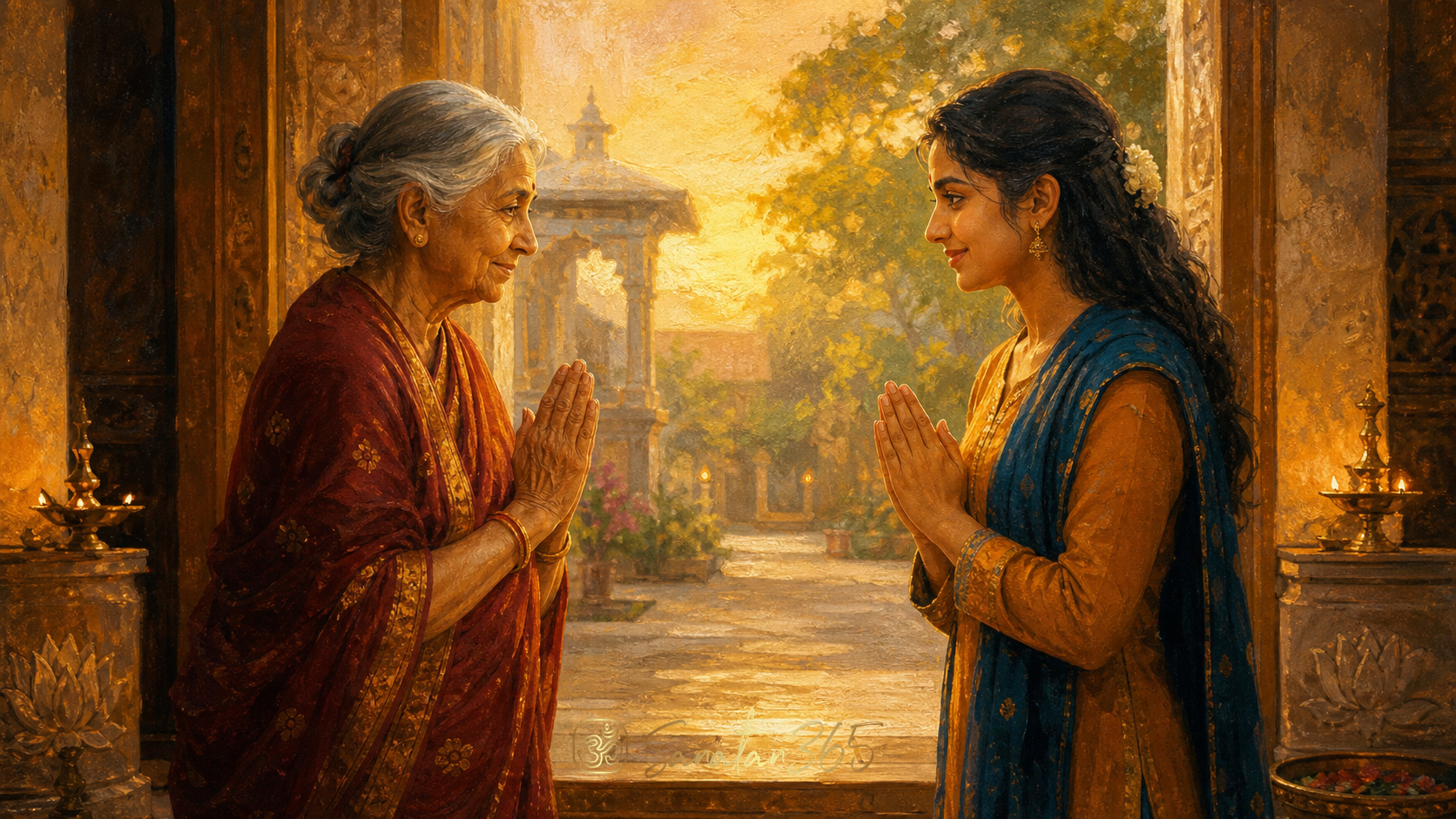
Two joined palms can carry more meaning than a long introduction. The Namaste meaning is, at its linguistic core, “a respectful bow to you”: the Sanskrit namaḥ (नमः, bow, reverence, or salutation) joins te (ते, to you). Spoken with the gesture of añjali mudrā (अञ्जलि मुद्रा, the seal of joined palms), Namaste turns a greeting into an act of attention, humility, and regard.
Namaste is neither merely a yoga-class sign-off nor a phrase that must always be translated as “the divine in me bows to the divine in you.” That familiar spiritual interpretation expresses a beautiful Vedantic possibility, but the literal grammar is simpler. Understanding both levels allows the greeting to remain culturally grounded while still revealing why it can feel sacred.
What Is the Namaste Meaning in Sanskrit?
The word namaste (नमस्ते) is a Sanskrit form made from two elements:
- namaḥ (नमः): bow, homage, reverence, or salutation
- te (ते): to you
Through a normal Sanskrit sound change called sandhi (सन्धि, joining), namaḥ and te become namaste. A clear translation is therefore “salutations to you,” “reverence to you,” or “I bow to you.” The Merriam-Webster history of Namaste similarly traces the expression to namaḥ and te, and connects namaḥ with the verbal root meaning “to bend” or “to bow.”
This grammar matters because it prevents a poetic explanation from being mistaken for a word-for-word translation. “The divine in me bows to the divine in you” is not the literal sentence hidden inside namaste. It is a contemplative expansion: a way some practitioners interpret the humility and recognition that a bow can embody.
The family of related expressions is broad. Namaskāra (नमस्कार, respectful salutation) and regional forms such as namaskāram are common across India. The ancient vocabulary of namas appears in Vedic literature in contexts of homage and reverence. The greeting heard today is therefore part of a much older language of bowing, honour, and devotional orientation, even though its everyday uses are often social rather than explicitly ritual.
Key takeaway: The literal Namaste meaning is “a respectful bow or salutation to you”; deeper spiritual readings grow from that foundation rather than replacing it.
Why Are the Palms Joined in Anjali Mudra?
The spoken word and the physical gesture are related, but they are not identical. The gesture is añjali mudrā (अञ्जलि मुद्रा, joined-palms seal). Añjali can refer to hands cupped or joined as an offering, while mudrā means a seal or meaningful gesture. It appears in worship, temple etiquette, classical dance, yoga, greetings, gratitude, and requests for forgiveness.
In an ordinary greeting, the palms are placed together near the centre of the chest, fingers pointing upward, shoulders relaxed, and head slightly inclined. The movement does not need theatrical depth. Its power lies in coherence: the body momentarily stops, the hands come away from other activity, the gaze softens, and attention is offered to the person before us.
Joined palms also carry several symbolic readings within Hindu practice:
- Unity: Two hands meet, suggesting the joining of apparent opposites.
- Offering: Empty hands show that the greeting itself is being offered.
- Humility: The slight bow lowers self-importance without erasing dignity.
- Centred awareness: Hands at the heart invite presence rather than distraction.
- Non-contact respect: Warmth can be conveyed without assuming physical touch.
The same form may carry a different intensity according to context. Before a respected elder, teacher, murti, or sacred place, the bow may be deeper. In daily life, it may be brief and conversational. During puja, joined hands can express prayerful attention. In yoga, the gesture may accompany a moment of inward recollection. The outer shape remains recognizable while the inner intention changes.
This is why añjali mudrā should not be reduced to an exotic pose. Like pradakshina, the clockwise movement around a sacred centre, it uses the body to organize attention. The gesture teaches through repetition: pause, gather, recognize, and respond.
Key takeaway: Anjali Mudra gives Namaste a bodily grammar of presence, offering, and respect.
What Is the Spiritual Meaning of Namaste?
The spiritual meaning of Namaste begins with reverence. To bow is to acknowledge that the other person cannot be reduced to a role, transaction, opinion, or passing mood. Hindu philosophical traditions deepen this intuition through teachings about ātman (आत्मन्, the deepest Self) and Brahman (ब्रह्मन्, ultimate reality).
The Upanishadic vision does not make every personality identical. It points instead toward a deeper ground of being that is not exhausted by outward differences. The teaching tat tvam asi (तत् त्वम् असि, “That you are”) in the Chandogya Upanishad invites recognition of this interior unity. A greeting offered in that light can become a small practice of seeing beyond status and ego. For a fuller exploration, see Tat Tvam Asi and the Upanishadic teaching on Atman and Brahman.
Yet care is needed. Not every person who says Namaste is making a formal Vedantic declaration. In India and Nepal, the word can function as a courteous hello, a respectful acknowledgement, a farewell, or an address to elders. Its spiritual capacity does not cancel its social simplicity.
A grounded interpretation holds both truths:
- Linguistically, Namaste offers respect to “you.”
- Ethically, it interrupts careless or dismissive behaviour.
- Spiritually, it can remind the speaker that dignity and sacred presence are not private possessions.
That last point gives the greeting practical force. If a person bows while inwardly clinging to contempt, the gesture becomes hollow. If the bow encourages patient speech, honest listening, or restraint during disagreement, it begins to shape character. This resembles shraddhā (श्रद्धा, trustful commitment): an inner orientation proven through conduct, not merely claimed in words.
The gesture can also soften the demand to dominate. Hindu traditions offer many disciplines for reducing ahaṃkāra (अहंकार, the ego-maker or “I”-sense) without denying healthy personhood. Namaste is not a complete philosophy of ego, but it can be a two-second rehearsal of humility. The person remains upright, yet bows. Respect is offered, yet no one is diminished.
Key takeaway: Spiritually, Namaste can become a practice of recognizing dignity and sacred depth beyond social labels.
How Is Namaste Used Across India and the Diaspora?
There is no single uniform script for greeting across South Asia. Language, region, age, relationship, and setting all matter. Namaste is widely understood, especially in Hindi-speaking contexts, but many communities naturally use other forms.
- Namaskar: Common in several North, West, and East Indian languages, often carrying a formal or respectful tone.
- Namaskaram: Widely heard in parts of South India, including Telugu- and Malayalam-speaking contexts.
- Vanakkam: A Tamil greeting associated with respectful welcome.
- Pranam: A respectful salutation, often directed toward elders or revered persons.
- Pranāma: The broader Sanskrit idea of bowing or prostration, with forms ranging from a slight bow to full prostration in devotional settings.
These are not interchangeable tokens stripped of context. A family may touch an elder’s feet and receive blessings; another may simply join palms. A temple devotee may bow before a murti, while colleagues may exchange a brief Namaste at a meeting. In Nepal, Namaste and Namaskar are familiar everyday greetings. Across the diaspora, joined palms may preserve cultural memory, signal hospitality, or offer a respectful alternative when physical contact is unsuitable.
Global yoga culture has made Namaste highly visible, but visibility brings responsibility. The word should not be treated as decorative “spiritual branding” or used to flatten diverse Indian traditions into a single wellness aesthetic. Respectful use begins with correct meaning, attentive pronunciation, and awareness that it is a living greeting rather than a costume.
A practical pronunciation is “nuh-muh-stay,” with the final syllable sounding like “stay.” Sanskrit pronunciation is more precise, but sincerity does not require performance. It requires willingness to learn.
Key takeaway: Namaste belongs to a living family of regional greetings and gestures; context should guide its form.
How Can Namaste Become a Daily Practice?
The most meaningful use of Namaste is not complicated. It asks for congruence between gesture and behaviour. A respectful bow should be followed by respectful conduct.
Try these five forms of practice:
- Pause before greeting. Let attention arrive before the word does.
- Join the palms naturally. Keep the hands relaxed near the heart rather than forcing a pose.
- Meet the person, not the category. Set aside title, age, occupation, and disagreement for one clear moment of recognition.
- Use the gesture appropriately. Follow local and family custom; do not demand that others mirror it.
- Carry the bow into action. Listen carefully, speak truthfully, and preserve boundaries without contempt.
Namaste can be especially valuable at thresholds: when entering a home, meeting an elder, beginning a shared practice, ending a difficult conversation, or welcoming someone whose customs differ from one’s own. It communicates warmth without requiring touch, which can be helpful across generations and cultures.
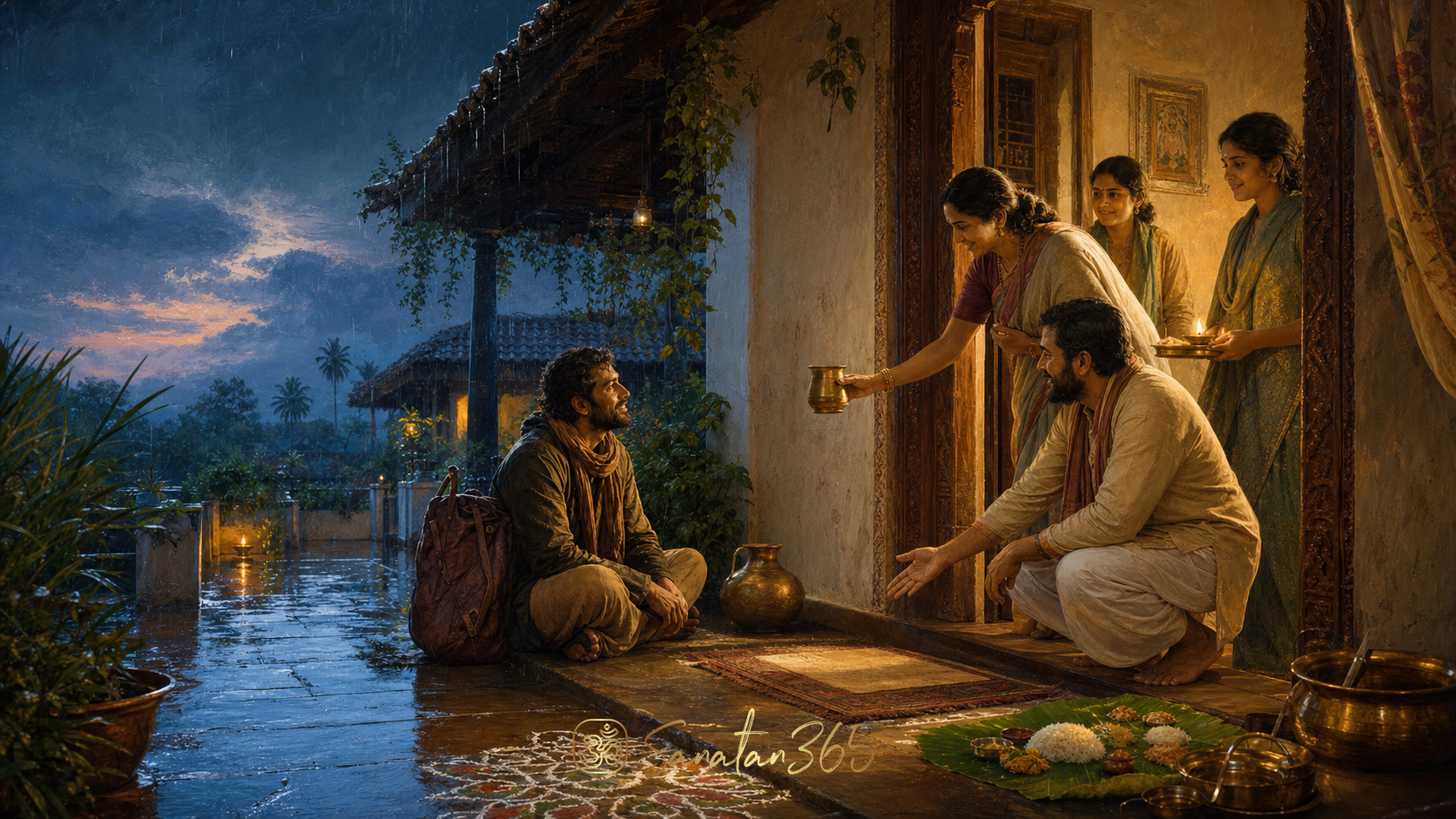
But reverence is not submission to harm. Joined palms do not require agreement, passivity, or the surrender of wise boundaries. Hindu ethics can hold courtesy and discernment together. Atithi Devo Bhava, the teaching of reverence toward a guest, likewise becomes mature only when hospitality includes dignity and judgment.
The greeting can also frame a short inward reset. Before opening a message, entering a meeting, or responding in anger, a person may silently join the palms and remember: “This encounter deserves awareness.” That is a modern application of an ancient gesture without inventing a grand claim for it.
For families, teaching Namaste can begin with meaning rather than compulsion. Children can learn that joined palms say, “I see you, I respect you, and I am present.” They can also learn that regional greetings, handshakes, waves, and spoken hellos may all be appropriate in different settings. The aim is not cultural policing. It is conscious courtesy.
Key takeaway: Namaste becomes spiritual when its moment of respect continues into listening, speech, boundaries, and action.
What Namaste Does Not Mean
Clarity protects the greeting from both exaggeration and dismissal.
Namaste does not literally translate as “the light in me sees the light in you,” although that can be a sincere spiritual reflection inspired by Hindu philosophy. It is not exclusively religious; it also functions as an everyday greeting. It is not owned by yoga studios, nor is it a universal closing formula required at the end of every yoga class. It does not mean that the speaker agrees with everything the other person says.
It also should not be presented as proof that every Indian greets in the same way. India’s languages and customs are extraordinarily varied. Respect grows when a person learns the local form rather than assuming a single expression speaks for everyone.
Finally, Namaste is not a shortcut around ethical conduct. A polished gesture cannot compensate for disrespect, exploitation, or careless speech. As with saucha, the discipline of cleanliness and clarity, the outer form matters most when it supports an inner quality.
Key takeaway: The greeting is deep enough without false translations, cultural generalizations, or spiritual performance.
Conclusion
Namaste means “a respectful bow to you.” Its Sanskrit roots are direct, its joined-palms gesture is elegant, and its spiritual possibilities are profound. In one small movement, the body pauses, attention gathers, and another person is met with dignity.
The greeting’s strength lies in its range. It can be ordinary without becoming empty, spiritual without becoming inflated, and traditional without becoming rigid. When word, gesture, and conduct agree, Namaste becomes more than a greeting: it becomes a daily discipline of recognition.
Key takeaway: Say Namaste as a bow to the person before you, then let the respect continue after the hands part.
FAQ
What does Namaste literally mean?
Namaste literally means “a bow to you,” “salutations to you,” or “reverence to you.” It combines Sanskrit namaḥ (bow or salutation) with te (to you).
Does Namaste mean “the divine in me bows to the divine in you”?
Not literally. That sentence is a spiritual interpretation influenced by Hindu teachings about the deepest Self and ultimate reality. It can express the greeting’s contemplative depth, but the direct grammatical meaning is “a respectful bow to you.”
What is the hand gesture used with Namaste called?
It is called añjali mudrā (अञ्जलि मुद्रा, joined-palms seal). The palms meet near the heart, the fingers point upward, and the head may incline slightly.
What is the difference between Namaste and Namaskar?
Both are respectful salutations. Namaste grammatically addresses “you,” while Namaskar is a related noun of salutation or homage. Everyday preference varies by language, region, family, and setting.
Is it respectful for a non-Hindu to say Namaste?
Yes, when used sincerely and with cultural awareness. Learn its meaning, avoid presenting poetic interpretations as literal translations, and follow the customs of the people and setting involved.
About the author
Sanatan365 Editorial
Bringing Sanatan Dharma to modern seekers through authentic, scripture-grounded content.
Related in Modern Life
 Modern Life
Samatva Meaning: Equanimity Without Indifference
Samatva is the evenness of mind praised in the Bhagavad Gita: acting with full care while loosening attachment to success and failure. It i…
 Modern Life
Shravana, Manana, Nididhyasana: How Vedantic Learning Becomes Lived Wisdom
Shravana, Manana, and Nididhyasana are the Vedantic disciplines of listening, reflection, and deep contemplation. Together they explain how…
 Modern Life
Atithi Devo Bhava Meaning: Sacred Hospitality in Hindu Dharma
Atithi Devo Bhava teaches that an unexpected guest should be received with reverence. Explore its Upanishadic source, ethical limits, regio…