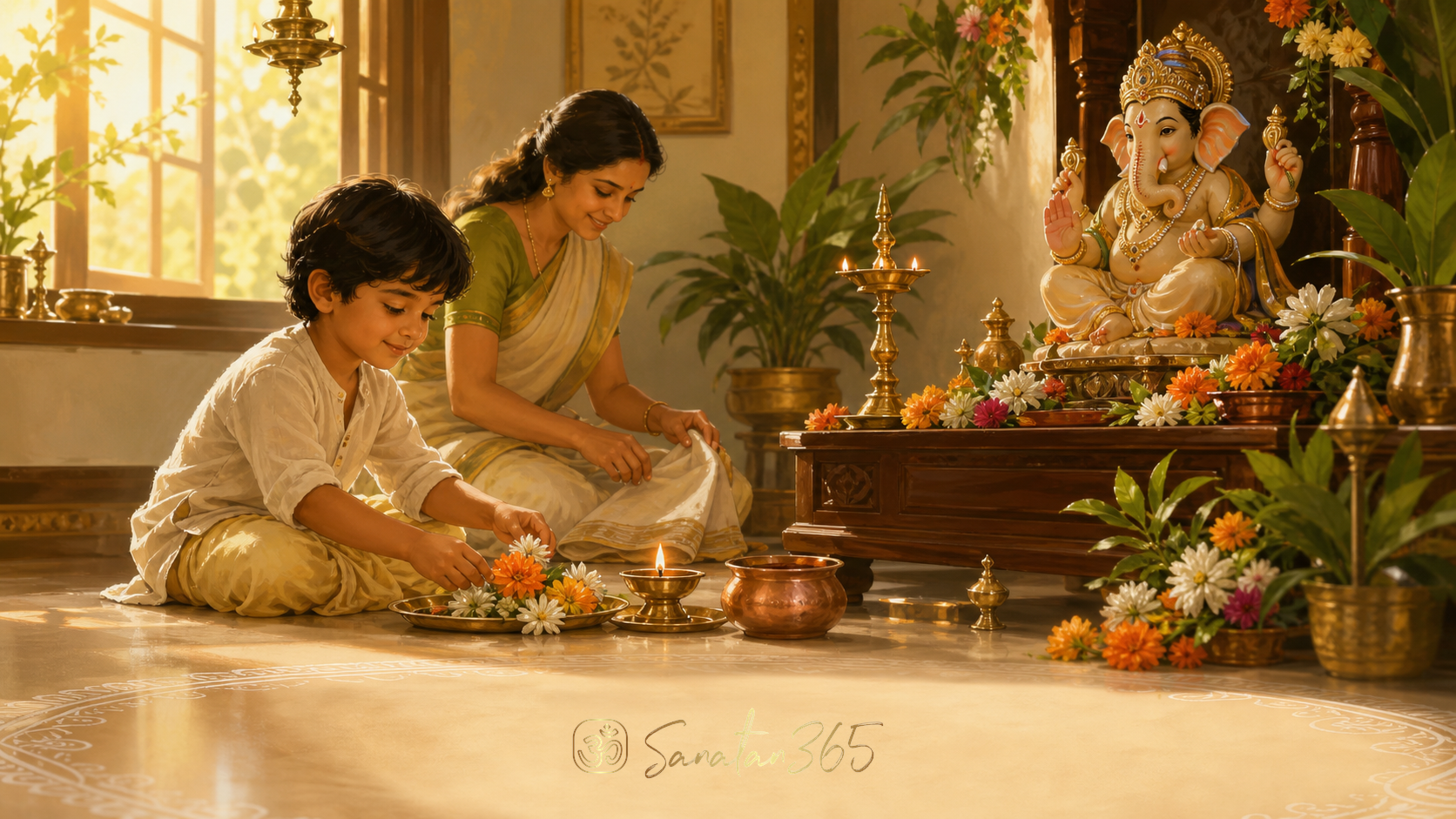
Saucha Meaning for Kids: A Hindu Lesson on Cleanliness, Clarity, and Care
Saucha teaches children that cleanliness is not only about tidy hands and rooms, but also clear speech, kind choices, and a peaceful mind.
A child can understand a sacred teaching when it begins with a small action: washing hands before eating, clearing the study desk, or speaking without spite.
Saucha meaning for kids is the Hindu and yogic lesson of cleanliness, purity, and clarity in body, surroundings, speech, and mind. Saucha (शौच, shaucha, cleanliness or purity) is not about judging people as pure or impure. It is a daily habit of keeping what we touch, say, eat, watch, and think as clean and helpful as possible.
For families, this makes Saucha one of the easiest Sanatan Dharma lessons to practice at home. A child does not need a lecture on philosophy first. The lesson begins with a clean plate, a calm prayer space, honest words, and a mind that feels less crowded.
What Is Saucha Meaning for Kids?
Saucha meaning for kids is simple: keep the body clean, keep the space clean, keep words clean, and keep the mind clear enough to choose well.
In Patanjali's Yoga Sutra 2.32, Saucha is listed as the first of the niyamas (नियम, niyama, personal observances), along with santosha (contentment), tapas (discipline), svadhyaya (self-study), and Ishvara pranidhana (surrender to the Divine). The Hindu American Foundation explains yama and niyama as the ethical foundation that helps yoga move from the mat into daily life: yama guides how one relates to the world, while niyama guides the inner life. Hindu American Foundation
For children, that means Saucha is not a punishment for making a mess. It is a way to notice: "What helps my body, my room, my family, and my thoughts feel lighter?"
Children can begin with four forms of Saucha:
- Body Saucha: bathing, brushing, washing hands, clean clothes, clean food.
- Space Saucha: keeping books, toys, puja items, and eating areas in order.
- Speech Saucha: avoiding cruel teasing, lies, and words that dirty the heart.
- Mind Saucha: choosing what one watches, hears, remembers, and repeats.
The word "purity" can sound heavy if it is used carelessly. In a Hindu family lesson, it should be taught with warmth. Saucha is not about shame, caste, gender, or exclusion. It is about care. A child is not "bad" because a room is messy or the mind is restless. The lesson is that order can be restored.
Key takeaway: Saucha gives children a positive language for cleanliness, not a fear-based one.
Why Did Hindu and Yogic Tradition Connect Cleanliness With Clarity?
Hindu and yogic traditions often connect the outer and inner life. A clean space can support attention. A clean body can support health and dignity. Clean speech can protect trust. A cleaner mind can make devotion, study, and kindness easier.
Patanjali's Yoga Sutra 2.40 and 2.41 are traditionally read as showing the deeper fruits of Saucha. Many teachers explain that external cleanliness supports inner steadiness, cheerfulness, sense-control, and fitness for self-understanding. A Yoga Sutra study resource summarizes this commentarial thread by connecting Saucha with both external and internal cleanliness. Yoga Sutra Study
This does not mean a child must become rigid. A home with children will have spilled water, scattered crayons, and half-finished projects. Saucha is not sterile perfection. It is the habit of returning to harmony.
That return is important in three everyday settings:
- Before meals: clean hands and a thankful pause turn food into a more mindful act.
- Before study: a clear desk helps the mind stay with one task.
- Before prayer: a tidy altar teaches respect without needing many words.
Hindu homes have long treated the puja space as a place of special care. Flowers are arranged, lamps are cleaned, and offerings are prepared with attention. Children learn from this repeated gesture: what is sacred deserves care, and ordinary life can also become sacred when handled with attention.
Saucha also sits close to sattva (सत्त्व, sattva, clarity and harmony). Sattva is not just a mood; it is a quality of steadiness, balance, and lightness. When a child clears the floor before sitting for homework, speaks truthfully after a mistake, or chooses a kinder thought after anger, the family can name that as Saucha moving toward sattva.
Key takeaway: Hindu cleanliness is not only hygiene; it is a training in attention, respect, and inner clarity.
How Can Parents Teach Saucha Without Shame?
The strongest way to teach Saucha is to separate the child from the mess. The mess is the thing to clean. The child is the person learning how to care.
A shame-based version says, "You are dirty." A dharmic version says, "This space needs care. Let us restore it." That one change keeps the lesson humane.
Children should also hear that Saucha is for everyone. It is not a way to rank people, judge families, or create fear around bodies. In public Sanatan Dharma teaching, this distinction matters. Saucha as a virtue means care for body, mind, food, space, and action. It must never become a claim that one birth, background, gender, or social group is spiritually cleaner than another.
Parents can use three gentle teaching lines:
- "Clean hands help us receive food with gratitude."
- "A clear desk helps a clear mind."
- "Clean words mean words that do not hurt unnecessarily."
These lines work because they connect action with meaning. A child is more likely to remember Saucha when it is tied to something visible.
A family can also turn Saucha into a short evening reflection:
- What did I clean today?
- What did I say today that made the room feel lighter?
- What did I watch, hear, or repeat that I may not want to carry tomorrow?
This is not moral policing. It is self-awareness. The point is to help children see that their choices leave impressions. A sticky table can be wiped. A harsh word can be repaired. A noisy mind can be calmed with breath, apology, prayer, or rest.
This also connects naturally with other Sanatan365 blog lessons such as Asteya Meaning for Kids: A Hindu Lesson on Honesty, Contentment, and Care and Daya Meaning for Kids: A Hindu Lesson on Compassion in Action. Asteya teaches care with what belongs to others. Daya teaches compassion. Saucha teaches care with what passes through one's own hands, words, and mind.
Key takeaway: Teach Saucha as restoration and responsibility, never as shame.
What Are Simple Saucha Practices for Children?
Saucha becomes real when it is small enough to repeat. The best family practices are visible, short, and consistent.
Try these seven child-friendly habits:
- The two-minute reset: before homework, put away three things and wipe the desk.
- The clean plate pause: wash hands, sit properly, and offer a moment of gratitude before eating.
- The puja corner helper: let the child place flowers, refill water, or straighten the cloth near the altar.
- The school-bag check: remove old papers and keep only what is needed for the next day.
- The speech filter: before speaking in anger, ask, "Is it true, needed, and kind?"
- The media filter: after watching something, ask, "Did this make my mind clearer or more restless?"
- The night close: keep tomorrow's clothes or books ready before sleep.
For younger children, use play. A Kids Yoga resource notes that Saucha can be introduced through ordinary family cleaning and body-awareness activities, because children understand the idea more easily when it is connected to movement and routine. Kidding Around Yoga
For older children, explain that Saucha includes digital life. A phone, tablet, or laptop can become mentally messy even when the room looks clean. Clean digital habits may include:
- deleting hurtful or unnecessary messages instead of rereading them
- choosing videos that do not leave the mind agitated
- taking a short break after intense screen time
- keeping school files and photos organized
- not forwarding gossip
This is modern Saucha. The ancient principle remains the same: do not keep feeding the mind with what makes it dull, harsh, greedy, or restless.
Families can also link Saucha with seva (सेवा, selfless service). Cleaning one's own cup, helping arrange shoes near the door, or keeping a shared room tidy is not just a chore. It is service to the household. This protects children from seeing cleanliness as "someone else's work." Everyone who lives in the home participates in its harmony.
Key takeaway: Saucha works best when it becomes a daily rhythm, not an occasional lecture.
How Is Saucha Different From Perfectionism?
Saucha is clarity. Perfectionism is fear.
This difference matters for children. A child who learns Saucha well becomes more responsible, more aware, and more respectful. A child who learns only perfectionism may become anxious, harsh toward others, or afraid to make mistakes.
Saucha says:
- "Let us clean what can be cleaned."
- "Let us repair what can be repaired."
- "Let us choose what helps the mind."
- "Let us begin again."
Perfectionism says:
- "Nothing is good enough."
- "A mistake means failure."
- "Other people must meet my standard."
- "Rest is laziness."
Sanatan Dharma does not ask a child to become a machine. Dharma is lived through growth, patience, family, study, play, devotion, and correction. Even in temple and home rituals, cleaning is repeated because dust returns, lamps need care, flowers fade, and human attention wanders. Repetition is part of practice.
This is why Saucha should be taught with softness and firmness together. Softness says the child is loved while learning. Firmness says care cannot be ignored.
A practical rule helps: clean enough for clarity, not for display. A room should support sleep and study. A prayer place should feel respectful. A school bag should help the child find what is needed. These are meaningful standards. They are different from trying to impress guests or scolding children over every small imperfection.
The same applies to speech and thought. Clean speech does not mean never feeling angry. It means anger should not become cruelty. A clean mind does not mean never having confusing thoughts. It means learning which thoughts deserve attention and which should be allowed to pass.
Key takeaway: Saucha gives children discipline without fear and standards without harshness.
What Does Saucha Teach About Puja, Food, and Family Life?
In Hindu family life, Saucha often appears around puja (पूजा, worship), bhojan (भोजन, food), and shared spaces.
Before puja, hands are washed, lamps are prepared, and offerings are arranged. The action teaches reverence. The child sees that devotion is not only emotion; it is also preparation.
Before meals, cleanliness becomes gratitude. Washing hands, serving food neatly, and not wasting what is on the plate are small acts of respect. Food is not treated as a casual object. It is received.
In shared rooms, Saucha becomes family dharma. A child learns that personal habits affect others. A scattered toy may trip a grandparent. A dirty cup may trouble someone else later. A sharp word may sit in the room long after it is spoken.
This is where Saucha becomes moral education without sounding moralistic. The child begins to understand that cleanliness is a form of care.
Families in India and the diaspora can adapt the practice to their homes. Some may have a full puja room. Some may have a small shelf. Some may live in apartments with very little space. The principle does not depend on size. A single clean corner can teach the lesson.
Parents can say:
"When we clean this place, we are not only removing dust. We are preparing our attention."
That sentence helps children see why Saucha belongs in spiritual life. The clean altar is not for show. It is a training of the eyes, hands, and mind toward respect.
Key takeaway: Saucha turns ordinary family actions into spiritual education.
FAQ
What is Saucha meaning for kids?
Saucha meaning for kids is cleanliness, purity, and clarity in daily life. It means keeping the body, room, speech, food habits, and mind as clean and helpful as possible.
Is Saucha only about bathing and washing hands?
No. Bathing and washing hands are part of Saucha, but the lesson also includes clean surroundings, clean speech, mindful media choices, and clear intentions.
Is Saucha a Hindu teaching or a yoga teaching?
It is both. Saucha is part of the wider Hindu and yogic ethical tradition, and Patanjali's Yoga Sutra 2.32 lists it as the first niyama, or personal observance.
How can parents teach Saucha without making children feel bad?
Teach it as care, not shame. Say, "This space needs care," rather than "You are dirty." Praise restoration, responsibility, and honest effort.
What is one simple Saucha habit for a child?
A good starting habit is a two-minute reset before homework or sleep: put away three things, clear the desk or floor, and take one calm breath before beginning the next activity.
Saucha teaches children that clarity can be practiced. A cleaner room, cleaner hands, cleaner words, and cleaner choices are not separate from spiritual life. They are small doors into it.
The single key takeaway: Saucha helps a child learn that caring for the body, space, speech, and mind is a daily form of dharma.
About the author
Sanatan365 Editorial
Bringing Sanatan Dharma to modern seekers through authentic, scripture-grounded content.
Related in Lessons
 Lessons
Monkey and Crocodile Story: Presence of Mind in the Panchatantra
A close reading of the Panchatantra fable about a generous monkey, a divided crocodile, and the clear thinking that protects a life.
 Lessons
Panchatantra Pigeons Story: Unity and Responsible Leadership
The pigeons escape a hunter together, but their freedom also depends on friendship, practical help, and a leader who puts others first.
 Lessons
Aruni Lessons: Responsibility and Care in the Mahabharata
Read Aruni’s field-breach episode closely: a student’s resolve, a teacher’s search and practical lessons in responsibility that never requi…