Navagraha Meaning: The Nine Planets in Hindu Astrology
A clear guide to the Navagraha, the nine grahas of Hindu astrology, with their symbolism, temple role, mantra practice, and everyday meaning.
Nine small shrines in a temple courtyard can teach a large truth: Hindu astrology is not only about prediction, but about learning how time, duty, and awareness move together.
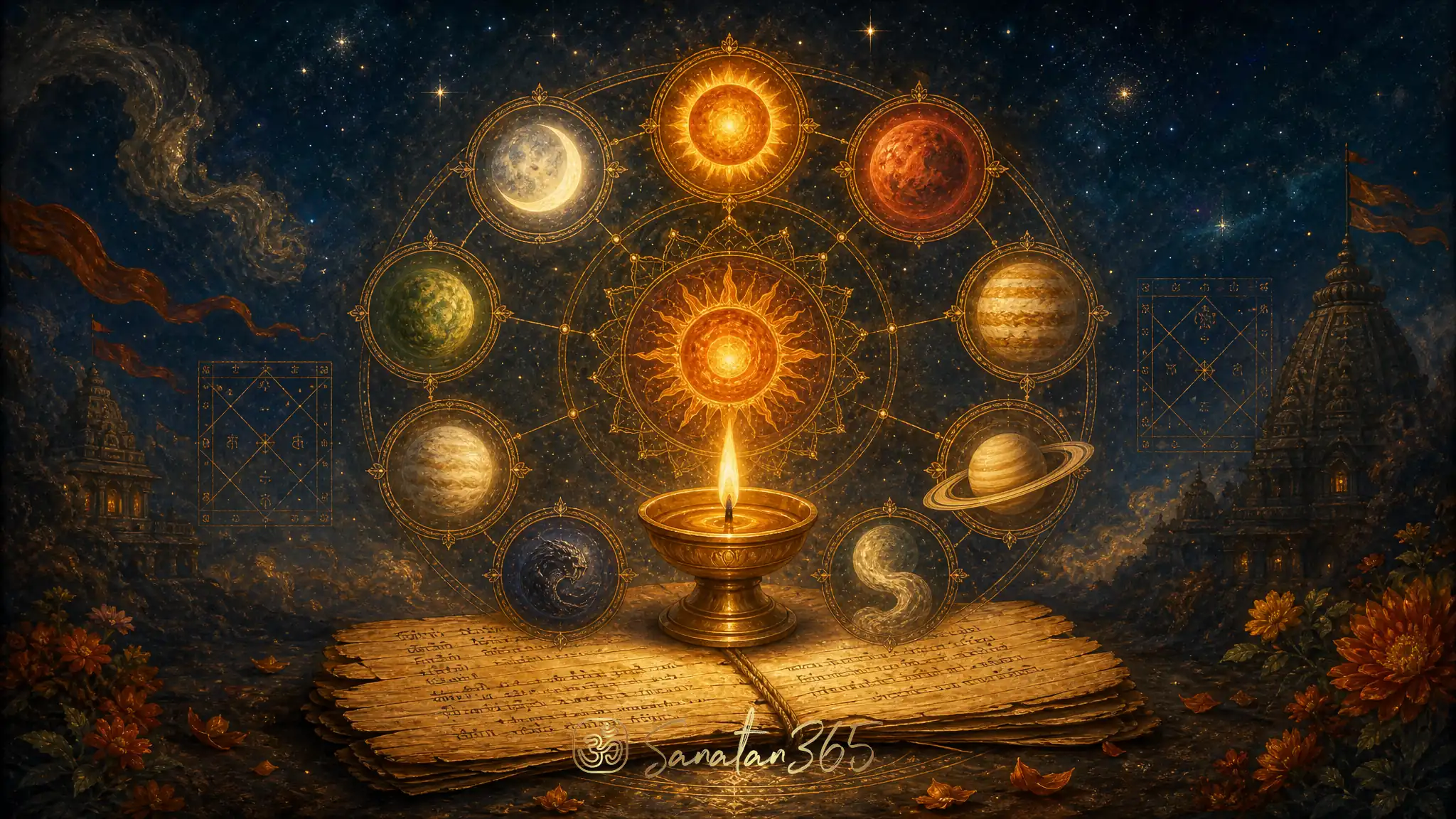
Navagraha meaning begins with two Sanskrit words: nava (नव, nine) and graha (ग्रह, that which grasps or influences). In Hindu astrology, the Navagraha are the nine celestial influences: Surya, Chandra, Mangala, Budha, Brihaspati, Shukra, Shani, Rahu, and Ketu. They are read through Jyotisha (ज्योतिष, the Hindu science of light and time), worshipped in many temples, and used as a reflective language for karma, rhythm, and inner discipline. The Hindu American Foundation describes the Navagrahas as the planets of Vedic astrology and notes their continuing role in Hindu ritual life and decision-making HAF.
What Is the Navagraha Meaning in Hindu Astrology?
The Navagraha meaning is best understood as a sacred map of influence, not a simple list of physical planets. In modern astronomy, the Sun is a star, the Moon is a satellite, and Rahu and Ketu are lunar nodes. In Jyotisha, however, graha does not mean "planet" in the modern laboratory sense. It means a factor of experience that can "hold" attention, shape timing, and reveal patterns in a person's life.
This distinction matters. A Hindu astrology chart does not treat the sky only as material space. It treats the visible and calculated sky as a symbolic clock. Surya (the Sun) points to vitality and authority. Chandra (the Moon) points to mind, mood, and receptivity. Mangala (Mars) points to courage and force. Budha (Mercury) points to speech and intelligence. Brihaspati (Jupiter) points to wisdom and expansion. Shukra (Venus) points to beauty and relationship. Shani (Saturn) points to discipline, time, and consequence. Rahu and Ketu point to karmic intensification, eclipses, and unusual turns of experience.
Britannica's overview of astrology describes astrology broadly as interpreting celestial bodies in relation to earthly affairs, while Hindu practice gives that interpretation its own ritual, philosophical, and calendrical grammar Britannica. Within that grammar, the Navagraha are not worshipped as random cosmic powers. They are approached as part of rta (ऋत, cosmic order), the ordered pattern through which Dharma becomes visible in time.
Key takeaway: The Navagraha are nine sacred influences in Jyotisha, read as a language of time, karma, temperament, and practice.
Who Are the Nine Grahas?
The nine grahas are usually listed in a fixed sequence. Their names are Sanskrit, but their meanings touch everyday life.
- Surya (सूर्य, Sun): light, vitality, dignity, visibility, fatherly authority, and the power to stand upright.
- Chandra (चन्द्र, Moon): mind, emotion, memory, nourishment, motherly care, and inner changeability.
- Mangala (मङ्गल, Mars): energy, courage, protection, discipline, land, conflict, and decisive action.
- Budha (बुध, Mercury): learning, speech, analysis, trade, humor, and adaptability.
- Brihaspati or Guru (बृहस्पति, Jupiter): wisdom, counsel, ethics, children, teaching, and expansion.
- Shukra (शुक्र, Venus): beauty, affection, art, comfort, pleasure, marriage, and refinement.
- Shani (शनि, Saturn): time, endurance, delay, humility, labor, structure, and karmic accountability.
- Rahu (राहु, north lunar node): ambition, obsession, foreignness, disruption, innovation, and eclipse-like intensity.
- Ketu (केतु, south lunar node): detachment, past karma, spiritual inwardness, loss of ego, and sudden insight.
Rahu and Ketu are especially important because they show how Hindu astrology combines observation and symbolism. They are not visible planets. They are points connected with eclipses, formed where the Moon's path intersects the Sun's apparent path. Yet in Jyotisha, they are powerful because eclipses have long carried ritual and psychological significance. The sky is read not only by what shines, but also by what interrupts light.
This is why the word graha is more subtle than "planet." A graha is a holder of meaning. It may be visible, calculated, mythic, ritual, or all of these at once.
Key takeaway: The nine grahas are symbolic forces that include the Sun, Moon, five visible planets, and the two lunar nodes Rahu and Ketu.
Why Are Navagraha Shrines Found in Temples?
Many Hindu temples include a Navagraha shrine, often placed in a courtyard or side area. Devotees may circumambulate the shrine, offer oil or flowers, chant mantras, or pause before the grahas after taking darshan (दर्शन, sacred seeing) of the main deity. This practice does not mean the grahas replace the main deity of the temple. It means time itself is being acknowledged as part of worship.
Temple practice makes Hindu astrology devotional rather than merely technical. A birth chart can become a dry chart of fear if separated from Dharma. A Navagraha shrine restores balance. The devotee is reminded that difficult periods call for humility, discipline, mantra, charity, and steadiness. Auspicious periods call for gratitude and responsible action.
The Hindu American Foundation notes that many Hindus consult astrology before major life decisions or during hardship, and that planetary worship is connected to understanding planets from a Vedic and astrological perspective HAF. In lived Hindu practice, that consultation is often paired with remedies such as japa (जप, repeated mantra), dana (दान, giving), vrata (व्रत, sacred observance), and seva (सेवा, selfless service).
The temple setting also prevents a common misunderstanding. Navagraha worship is not fatalism. The devotee is not saying, "The planets control everything, so I have no responsibility." The deeper mood is, "May I understand the season of my life and respond with the right Dharma."
Key takeaway: Navagraha shrines place astrology inside devotion, reminding seekers to meet time with worship, ethics, and self-discipline.
How Do Mantras and Remedies Relate to the Navagraha?
Navagraha practice often includes mantra, color, fasting, charity, or specific offerings. These are sometimes called remedies, but the word should be handled carefully. A remedy is not a guaranteed shortcut around karma. It is a way to refine one's response to a pattern.
For example, Shani is often feared because Saturn periods can be associated with delay, pressure, responsibility, and humbling. But spiritually, Shani also teaches patience, honesty, work, and respect for consequence. A Shani mantra or Saturday discipline is not merely an attempt to "escape Saturn." It can become a practice of accepting time, simplifying life, and acting with integrity.
Similarly, a Chandra practice may support emotional steadiness. A Budha practice may encourage clearer speech and study. A Guru practice may strengthen reverence for teachers and wisdom. The graha becomes a mirror. The mantra becomes a discipline. The offering becomes a reminder that life is not improved only by wanting different results, but by becoming a different kind of participant in one's own karma.
This is also where japa mala practice often enters. Many devotees repeat a mantra using a mala (माला, prayer beads), commonly in rounds of 108. The number 108 has broad sacred associations across Hindu practice, including mantra repetition, sacred counting, and symbolic completeness. The exact explanation varies by tradition, so it is better to treat 108 as a revered practice number rather than reduce it to one single proof.
Key takeaway: Navagraha remedies work best when treated as disciplined spiritual responses, not mechanical guarantees.
How Should Modern Seekers Understand Navagraha Without Fear?
The healthiest way to approach Navagraha meaning is through reverence without anxiety. Hindu astrology can become harmful when it turns every event into dread or every challenge into blame. That is not the mature use of Jyotisha.
A better approach has three parts.
First, use astrology as timing awareness. Some seasons are better for beginning, some for repair, some for study, some for patience. Timing does not remove free will. It helps direct free will more intelligently.
Second, use the grahas as mirrors of inner tendencies. A strong Mars pattern may ask for disciplined courage rather than anger. A strong Venus pattern may ask for beauty with restraint. A strong Rahu pattern may ask for ambition without obsession. A strong Ketu pattern may ask for detachment without neglect.
Third, place every reading under Dharma. If an interpretation encourages fear, arrogance, cruelty, or avoidance of responsibility, something has gone wrong. Dharma (धर्म, right order and sustaining duty) is the higher frame. Jyotisha should illuminate Dharma, not replace it.
This is especially important for families and diaspora readers. A child who hears only frightening language about Shani or Rahu may inherit anxiety, not wisdom. A better explanation is simple: different grahas teach different lessons, and Hindu practice gives us ways to meet those lessons with steadiness.
Key takeaway: The Navagraha should be approached as a spiritual language of timing and self-awareness, not as a fear-based system.
What Is the Difference Between Navagraha and a Birth Chart?
The Navagraha are the nine main grahas. A birth chart, often called a janma kundali (जन्म कुण्डली, birth chart), maps where these grahas were placed at the time of birth according to the rules of Jyotisha. The chart also includes houses, signs, aspects, dashas (दशा, planetary periods), and other interpretive layers.
So the Navagraha are like the core actors. The birth chart is the full stage. A graha's meaning changes depending on where it is placed, what it influences, and what timing cycle is active. This is why serious interpretation requires care. One cannot understand a chart by taking a single planet and making a dramatic conclusion.
This also explains why Hindu astrology has both popular and scholarly sides. A person may know simple associations, such as Shani with discipline or Guru with wisdom. A trained astrologer studies a much larger system involving calculation, tradition, and judgment. The public should respect that depth and avoid treating simplified social media astrology as the whole of Jyotisha.
Key takeaway: Navagraha are the nine core influences; a kundali arranges them into a larger interpretive map of birth, timing, and Dharma.
FAQ
What does Navagraha mean?
Navagraha means "nine grahas." In Hindu astrology, it refers to Surya, Chandra, Mangala, Budha, Brihaspati, Shukra, Shani, Rahu, and Ketu, the nine celestial influences used in Jyotisha.
Are Rahu and Ketu planets?
In modern astronomy, Rahu and Ketu are not physical planets. They are lunar nodes connected with eclipses. In Jyotisha, they are treated as grahas because they carry symbolic and timing significance.
Why do Hindus worship the Navagraha?
Many Hindus worship or honor the Navagraha to approach time, karma, and life challenges with humility. Practices may include mantra, offerings, charity, fasting, or temple circumambulation.
Is Navagraha worship fear-based?
It should not be. Mature Navagraha practice is about awareness, discipline, and devotion. Fear-based claims, guaranteed promises, and dramatic predictions should be treated cautiously.
How is Navagraha connected to Kundali?
A kundali maps the positions and relationships of the grahas at birth. The Navagraha are the core influences, while the kundali is the larger chart used for interpretation.
The single key takeaway: Navagraha meaning is not just "nine planets." It is a Hindu way of seeing time as sacred, karma as educative, and spiritual practice as the right response to life's changing seasons.
About the author
Sanatan365 Editorial
Bringing Sanatan Dharma to modern seekers through authentic, scripture-grounded content.
Related in Astrology
 Astrology
Vara Meaning: Seven Weekdays and the Sunrise-to-Sunrise Day
Vara is the weekday limb of a Hindu panchang. Read its seven planetary names, sunrise boundary and relationship with lunar dates without tr…
 Astrology
Ayanamsha Meaning: Why Two Zodiac Charts Can Differ
Understand the zodiac reference offset, a simple longitude conversion and the settings to check when astrology charts disagree.
 Astrology
Panchang Yoga Meaning: Reading the 27 Nitya Yogas
Understand the Sun–Moon calculation behind Panchang yoga, its 27-name cycle, ending times, and why it is different from yogic practice or a…

