Panchang Yoga Meaning: Reading the 27 Nitya Yogas
Understand the Sun–Moon calculation behind Panchang yoga, its 27-name cycle, ending times, and why it is different from yogic practice or a birth-chart combination.
A single word in a Hindu calendar can name something very different from the practice performed on a yoga mat.
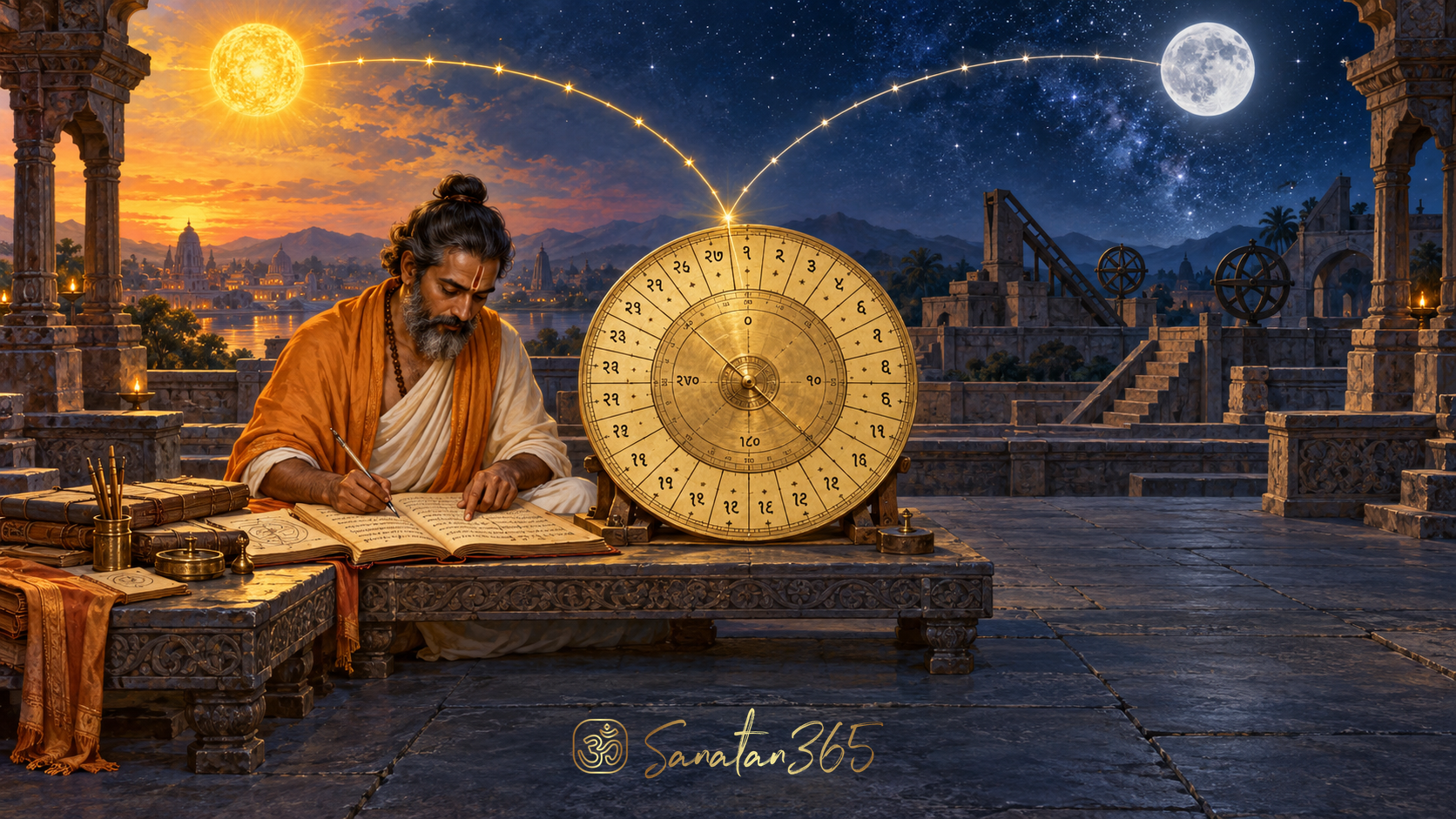
Panchang yoga meaning refers to a calculated division of time based on the sum of the Sun’s and Moon’s sidereal longitudes. Its 27 named intervals are called nitya yoga (नित्य योग, the regularly recurring calendar yoga) in a Panchang (panchanga, पञ्चाङ्ग, a five-limbed calendar). Here yoga (योग) means a joining or combination, not a posture, a meditation technique, or a promise about the day’s outcome. Understanding the calculation and the printed ending time makes this small calendar entry much easier to read.
The distinction matters because the same word appears in spiritual teaching, birth-chart interpretation and almanacs. A reader who separates these uses can respect the tradition without confusing a technical label with an instruction to abandon ordinary responsibilities.
What does Panchang yoga meaning refer to?
A panchanga (पञ्चाङ्ग, “five limbs”), often written Panchang or Panchangam, records five traditional components of calendrical time. Yoga is one of them. The others are tithi (तिथि, lunar day), vara (वार, weekday), nakshatra (नक्षत्र, lunar mansion) and karana (करण, half of a tithi).
The broader five-limbed Panchang system gives these entries their context. They are related, but they do not all measure the same relationship. Tithi follows the angular separation of Moon and Sun. Nakshatra follows the Moon’s position in a division of the stellar zodiac. Nitya yoga uses the sum of two longitudes instead.
A longitude here is an angular coordinate along the apparent path of the celestial bodies, measured around a circle. It is not the geographical longitude of a city. Nirayana (निरयण, sidereal) means that the coordinates use a stellar reference framework rather than simply beginning at the moving seasonal equinox.
The astronomical definition in the scholarly appendix to G. V. Tagare’s Skanda Purana translation explains the 27 divisions through the combined solar and lunar longitudes. This is the translator’s explanatory apparatus, not a verse being presented as a modern mathematical formula.
Three uses of the word should therefore stay separate:
- Calendar yoga: the current interval in the recurring 27-name system.
- Spiritual yoga: disciplines of attention, conduct, contemplation and liberation.
- Birth-chart yoga: an astrological combination defined through particular chart conditions.
A page showing “Shiva” in its yoga field is naming a calendar interval. It is not saying that a particular yogic posture must be performed, nor that every other field on the page has become irrelevant.
Key takeaway: Panchang yoga is a specific calendrical calculation; its meaning depends on the field in which the word appears.
How is Nitya Yoga calculated from the Sun and Moon?
Imagine a circle divided into 27 equal parts. Each part spans 13 degrees 20 arcminutes, because 360 degrees divided by 27 gives that amount. An arcminute is one-sixtieth of a degree: these “minutes” measure an angle, not time on a clock.
The calculation has four steps:
- Take the Sun’s sidereal longitude at the chosen instant.
- Take the Moon’s sidereal longitude at that same instant.
- Add them, then reduce the result to the range from 0 up to, but not including, 360 degrees.
- Find which of the 27 consecutive 13-degree-20-arcminute intervals contains the result.
The reduction in step three is often called “modulo 360.” If the sum is 405 degrees, one full circle is removed, leaving 45 degrees. A full revolution does not create a twenty-eighth yoga; the sequence begins again.
The Nityayoga astronomical reference, which cites works on Indian astronomy and calendrical history, describes this sidereal sum and the interval boundaries. The essential point is addition. Subtracting the Sun’s longitude from the Moon’s would measure a different relationship.
A worked example without a horoscope claim
For an illustration only, suppose the Sun’s longitude is 100 degrees and the Moon’s is 150 degrees. Their sum is 250 degrees. Eighteen complete intervals occupy 240 degrees; the remaining 10 degrees lie inside interval 19, named Parigha (परिघ, a bar or obstruction).
That example is not today’s Panchang, a birth reading or a recommended ceremony time. Its purpose is to show why the answer is 19 rather than 18: the quotient counts completed intervals, and the current interval is the next one.
At exactly 240 degrees, interval 19 begins. At exactly 253 degrees 20 arcminutes, interval 20 begins. Handling boundaries correctly matters when checking a printed calendar near a transition.
Equal angles do not mean equal clock durations
Every interval has the same angular width, but the duration depends on how quickly the combined longitude changes. The Moon’s apparent motion varies, so the yoga intervals are not fixed 24-hour blocks. They do not wait for midnight or sunrise before changing.
Nor does the calculated sum mean that Sun and Moon are physically meeting in the sky. It is an astronomical coordinate calculation used by the calendar tradition. Treating it as a visible conjunction would confuse addition with angular separation.
Key takeaway: Add the two sidereal longitudes, wrap the sum around one circle, and locate its 13-degree-20-arcminute interval.
What are the 27 Nitya Yogas in order?
The sequence below follows the names listed in Tagare’s scholarly appendix. Common calendar spellings sometimes use different grammatical endings or transliterations. The short English glosses help identify the names; they are not personal forecasts or guarantees.
- Vishkambha (विष्कम्भ): support or holding apart.
- Priti (प्रीति): affection or delight; often written Preeti.
- Ayushmat (आयुष्मत्): possessing life or longevity; often Ayushman.
- Saubhagya (सौभाग्य): good fortune or auspiciousness.
- Shobhana (शोभन): beautiful or splendid.
- Atiganda (अतिगण्ड): a great knot or obstruction.
- Sukarman (सुकर्मन्): good action; often Sukarma.
- Dhriti (धृति): firmness or sustaining resolve.
- Shula (शूल): a spike or pointed weapon; often Shoola.
- Ganda (गण्ड): a knot or swelling, conventionally a difficult name.
- Vriddhi (वृद्धि): growth or increase.
- Dhruva (ध्रुव): fixed or steady.
- Vyaghata (व्याघात): a striking or obstruction.
- Harshana (हर्षण): gladdening.
- Vajra (वज्र): a thunderbolt or adamantine object.
- Siddhi (सिद्धि): accomplishment.
- Vyatipata (व्यतीपात): a falling across or disruption.
- Variyas (वरीयस्): greater or more excellent; often Variyan.
- Parigha (परिघ): a bar or obstruction.
- Shiva (शिव): auspicious or gracious.
- Siddha (सिद्ध): accomplished.
- Sadhya (साध्य): to be accomplished.
- Shubha (शुभ): auspicious or favourable.
- Shukla (शुक्ल): white or bright.
- Brahman (ब्रह्मन्): a sacred name associated with the Brahma entry in calendars.
- Aindra (ऐन्द्र): relating to Indra; often simply Indra.
- Vaidhriti (वैधृति): the proper name of the final interval before the cycle repeats.
An unfamiliar spelling need not indicate a different system. Ayushmat and Ayushman, for example, can label the same place in this sequence. Check the ordinal position and neighbouring names before assuming that two calendars disagree.
Pay particular attention to Siddhi, Siddha and Sadhya. They occupy positions 16, 21 and 22 respectively. Similar sound does not make them interchangeable. A search result about one may not answer a question about another.
Some almanacs also display yogas formed from other combinations, such as a weekday together with a nakshatra. Those are separate rules, not extra names added to this 27-part list. Locate the ordinary yoga field before comparing it with a special-yoga announcement elsewhere on the page.
The names themselves carry rich Sanskrit associations. A favourable-sounding name does not supply a complete electional judgment; a severe-sounding one does not describe someone’s moral worth. The list is most useful first as a key to reading the calendar accurately.
Key takeaway: Learn the fixed order and common spelling variants before attempting any traditional interpretation of an individual name.
How should a Panchang yoga ending time be read?
The printed name is only half the information. The other half is the boundary attached to it. An entry such as “Priti until 2:10 PM” generally tells the reader when that interval ends, not when it begins.
Consider this deliberately invented example:
- The calendar lists Priti until 2:10 PM.
- The intended activity is at 11:00 AM.
- At that earlier time, Priti is still the listed interval.
- At 4:00 PM, the reader needs the next interval, Ayushmat, rather than carrying Priti forward for the whole civil date.
This example teaches the reading method only. It is not a timing recommendation for any actual city or date. A real calendar must be checked for its display convention, the relevant date and the exact instant of the activity.
Check the city, clock and next-day marker
A household in Varanasi, a family in Chennai and relatives in London cannot blindly share the same printed clock time. Time zones change the clock label; local sunrise affects how an almanac arranges its daily page. Overseas daylight-saving changes can matter as well.
With the same geocentric ephemeris and sidereal convention, the calculated yoga transition is the same instant worldwide. It does not move merely because the reader changes cities. What changes is its local clock representation and its placement within a sunrise-based daily listing. Different calculation conventions or rounding can also account for differences between sources.
A time after midnight may be printed with a next-day date, an asterisk or an extended hour such as 26:10. In that last convention, 26:10 means 2:10 AM after the intervening midnight. Never assume an unfamiliar marker means “all day”; read that publisher’s legend.
Read the whole entry, not a cropped screenshot
Before forwarding a timing, preserve enough context for another person to interpret it:
- The calendar’s date and selected location.
- The time zone or local-time convention.
- The yoga name and its ending time.
- Any next-day symbol and the following interval.
- The actual activity being discussed.
These habits also clarify the ending times of a tithi and the half-tithi karana entry, while keeping their calculations distinct. A clearer screenshot is more useful than an alarming conclusion drawn from one isolated word.
Key takeaway: Read “until” as an ending boundary, check the local clock convention, and identify the interval active at the intended time.
Why is a yoga name not a verdict on the whole day?
In muhurta (मुहूर्त, traditionally a time division and, in practical usage, a selected auspicious time), yoga is considered alongside other calendrical and astrological factors. The purpose of choosing a muhurta is therefore broader than finding one agreeable label.
For a major family ceremony, the practical question is not simply “Is this yoga good?” It is “Which time is suitable for this particular observance, within the family’s tradition and real circumstances?” A knowledgeable priest or calendar practitioner can explain how the relevant factors are being considered.
An everyday reader need not turn the 27 names into a system of dread. Necessary care, honest work, safe travel arrangements and keeping a promise remain responsibilities. A calendar label is not evidence that an unavoidable appointment will fail or that a person born during an interval lacks virtue.
Likewise, the ability to calculate an interval does not demonstrate that every interpretation attached to it is an empirically established prediction. Respect for a traditional practice and precision about what a calculation proves can coexist.
A useful approach is to separate three layers: the astronomical inputs, the calendar’s naming rule, and the tradition’s interpretation for a specific purpose. Confusion arises when the third is treated as an automatic consequence of the first two.
The deeper value of learning this entry is attentive reading. The Sun and Moon are not frozen into a civil date, and sacred time is not understood by ignoring its boundaries. A careful reader notices change, asks a precise question and avoids passing fear to someone else.
Key takeaway: Read yoga as one component of a larger traditional judgment, never as a guaranteed outcome or a substitute for responsible action.
FAQ
What is the difference between Panchang yoga and yoga practice?
Panchang yoga is a named interval calculated from the sum of solar and lunar sidereal longitudes. Spiritual yoga concerns disciplines such as ethical conduct, concentration and contemplation. The shared word means joining or combination, but the contexts and methods differ.
Why are there 27 Nitya Yogas?
The combined longitude is divided into 27 equal spans around a 360-degree circle. Each span is 13 degrees 20 arcminutes. After the final interval, Vaidhriti, the sequence returns to Vishkambha; it is a recurring cycle, not 27 separate civil days of fixed length.
Does a yoga last from one sunrise to the next?
Not necessarily. Its beginning and ending follow the changing combined longitudes, so a transition can happen during daytime or overnight. Sunrise may organise the calendar’s daily display, but it does not reset the yoga calculation.
Are Siddhi Yoga and Siddha Yoga the same?
No. Siddhi is number 16 in the sequence and Siddha is number 21. Sadhya, number 22, is different again. Check the exact name and field; other special-yoga systems can reuse similar words without referring to this daily interval.
Can one yoga name decide whether an event will succeed?
No guaranteed result follows from a single name. Traditional selection considers the purpose and multiple factors; circumstances, preparation and conduct also matter. For an important observance, seek a clear explanation from a trusted practitioner rather than relying on an isolated label.
About the author
Sanatan365 Editorial
Bringing Sanatan Dharma to modern seekers through authentic, scripture-grounded content.
Related in Astrology
 Astrology
Karana Meaning: How to Read the Half-Tithi in a Panchang
Understand the eleven karanas, their six-degree lunar measure, why they change within a day, and how to read timings without fear-based pre…
 Astrology
Rahu Kalam Meaning: Timing, Calculation, and Thoughtful Practice
Rahu Kalam is a daily interval traditionally treated as unsuitable for beginning important worldly undertakings. Learn how it is calculated…
 Astrology
Muhurta Meaning: How Hindu Tradition Chooses an Auspicious Time
Muhurta is the Hindu discipline of choosing a fitting time for a meaningful action by considering the Panchanga, the purpose of the act, an…

