Vara Meaning: Seven Weekdays and the Sunrise-to-Sunrise Day
Vara is the weekday limb of a Hindu panchang. Read its seven planetary names, sunrise boundary and relationship with lunar dates without treating a weekday as a prediction.
A phone changes the date at midnight. A traditional almanac may still be counting the same day until sunrise. Neither clock has broken; they are answering different questions.
Vara meaning is straightforward: vāra (वार, weekday) is the seven-day weekday cycle and one of the five components of a Hindu pañcāṅga (पञ्चाङ्ग, five-limbed almanac), usually called a panchang. Its familiar sequence runs from Sunday through Saturday, with each day associated with a classical planetary figure. In traditional panchang reckoning, the day is commonly counted from local sunrise to the following sunrise. Understanding that boundary helps readers distinguish a weekday from a lunar date, without turning a calendar entry into a prediction.
What is the vara meaning in a Hindu panchang?
The weekday is often the easiest line on an almanac to recognise. Someone who does not yet understand lunar calculations can still identify Monday. Yet that familiar word belongs to a larger system of sacred time: the calendar places a repeating seven-day rhythm alongside the changing relationships of Sun, Moon and stars.
The five principal entries are the lunar day, weekday, lunar mansion, a combined Sun–Moon measure, and half of a lunar day. In Sanskrit-derived usage these are tithi (तिथि, lunar day), vara, nakṣatra (नक्षत्र, lunar mansion), yoga (योग, here a Sun–Moon angular measure), and karaṇa (करण, half-tithi). The word yoga here does not mean a posture or a meditation session. Drik Panchang’s daily almanac identifies these five elements separately.
Vara answers “Which weekday is this?” It does not answer every other question a reader may bring to a calendar. It does not identify the lunar phase by itself, establish a festival date on its own, or explain the meaning of a birth chart. These distinctions are useful precisely because several entries may appear together in a small calendar box.
A printed household calendar might give the weekday in large letters and the other entries in smaller script. An online almanac may instead present them as separate rows with ending times. The arrangement changes; the underlying distinction remains. The weekday is one strand of the calendar, not a compressed verdict on the entire day.
A reader beginning with the broader system can also consult how the five limbs of a panchang work. Here the focus is narrower: learning to read the weekday line accurately and use it with proportion.
Key takeaway: Vara supplies the weekly rhythm within a calendar that also tracks lunar and other astronomical relationships.
Which seven weekday names belong to which planets?
The weekday names preserve a planetary vocabulary. “Planetary” here refers to the traditional group of seven wandering celestial lights used in this system, including the Sun and Moon. It is not the modern astronomical classification in which Earth is a planet, the Sun a star and the Moon a natural satellite.
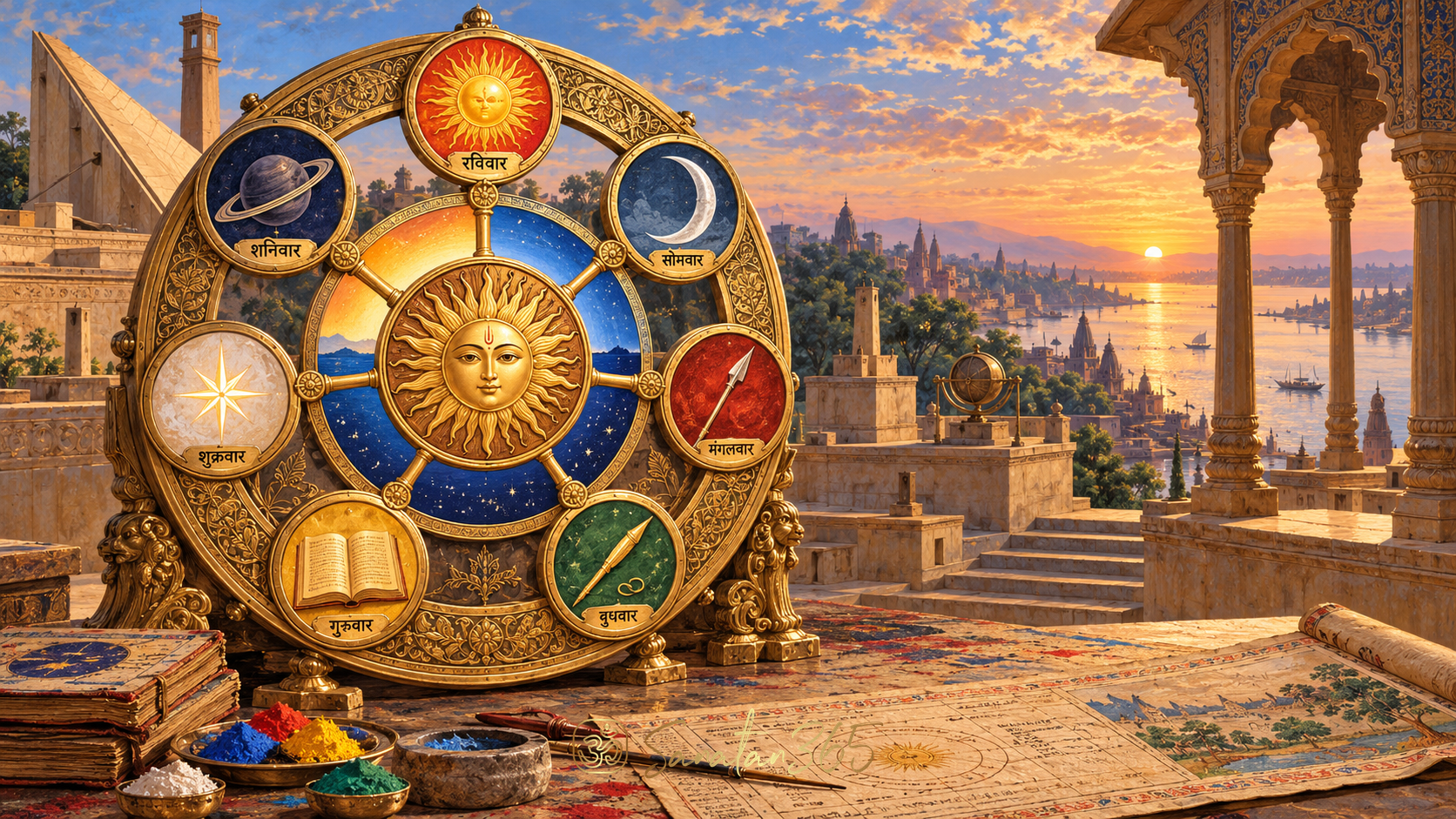
The familiar correspondences are:
- Sunday: Ravivara or Adityavara. Ravi and Aditya are names associated with the Sun.
- Monday: Somavara. Soma here refers to the Moon.
- Tuesday: Mangalavara. Mangala is Mars.
- Wednesday: Budhavara. Budha is Mercury; the name should not be confused with Buddha.
- Thursday: Guruvara or Brihaspativara. Guru or Brihaspati is associated with Jupiter in this weekday scheme.
- Friday: Shukravara. Shukra is Venus.
- Saturday: Shanivara. Shani is Saturn.
These are names and traditional associations, not promises that a day will produce a particular personal outcome. A person need not infer success, conflict, wealth or misfortune from the weekday alone. The calendar can be understood first as a language that communities use to organise observance and memory.
These correspondences can be checked in Drik Panchang’s explanation of the seven horas. Its sections identify the Sun with Raviwar or Sunday, the Moon with Somwar or Monday, and the remaining five planetary names with their corresponding weekdays. The source also makes astrological recommendations; the present article uses it for calendar terminology, not as evidence that particular outcomes are guaranteed. Reading a source selectively and explicitly keeps a useful naming explanation separate from claims about personal destiny.
Within India, spelling and spoken names vary. North Indian usage may shorten Somavara to Somvar, while South Indian languages preserve their own familiar forms and pronunciations. An English transliteration is therefore a reading aid, not a test of whether a family’s ordinary word is correct. A calendar can use regional script and still express the same seven-day cycle.
The recurring sequence also creates a memorable household pattern. One member of a family may remember a weekly temple visit by its weekday name; another may recognise the same day through a local-language calendar. Understanding the association helps those references meet without requiring everyone to use identical vocabulary.
Key takeaway: The seven Hindu weekday names carry planetary associations, but a name is not a personal forecast.
Why can the panchang day begin at sunrise rather than midnight?
A civil date and a traditional calendrical day need not share the same starting point. Modern phones, office schedules and travel bookings usually change dates at midnight. Traditional panchang presentation commonly treats sunrise as the boundary of the day. Drik Panchang explicitly notes that its panchang day starts and ends with sunrise and presents timings in local time.
Consider an imaginary example, not a timing recommendation. Suppose Monday’s sunrise is at 6:10 a.m. and Tuesday’s sunrise is at 6:11 a.m. In that sunrise-based convention, the Monday panchang day extends through the intervening night until Tuesday’s sunrise. At 2 a.m. on the civil Tuesday, the phone and the almanac can therefore appear to label the day differently.
This does not mean Tuesday appointments should be moved to Monday. The systems serve different purposes. Civil dates remain essential for tickets, legal documents, school and ordinary coordination. The sunrise boundary becomes relevant when interpreting ritual instructions and the way an almanac groups its overnight timings.
Three reading habits prevent avoidable confusion:
- Check the location. Sunrise is local. A timing displayed for Delhi should not automatically be used in Toronto or Chennai.
- Read the almanac’s notation. A next-day date marker or an hour beyond 24 may indicate a time after midnight within a sunrise-based day.
- Distinguish the displayed date from the observance rule. A ritual instruction may depend on a particular time window or another calendrical element, not merely the heading on a page.
Families living outside India encounter this most clearly. A shared screenshot may carry Indian local time, while the household follows a temple calendar calculated for its own city. Selecting the correct location matters more than copying the screenshot precisely. Daylight-saving adjustments and the source’s own settings also deserve attention.
A special case arises in high-latitude places where sunrise may be absent during part of the year. A simple sunrise-to-sunrise explanation cannot supply a complete observance rule there. Readers should follow a qualified local calendar or established temple guidance rather than inventing a boundary from a general article.
Key takeaway: Midnight and sunrise define different kinds of day; read the local almanac’s boundary without changing ordinary civil-date responsibilities.
How does vara differ from tithi and hora?
A weekly cycle and a lunar cycle can overlap without moving together. This is why “Monday” cannot by itself tell a reader which lunar date applies. The weekday follows the seven-day sequence; a tithi depends on the changing angular separation of the Moon and Sun.
The distinction becomes visible when a tithi ends partway through the day. Monday remains the weekday even if one lunar date ends in the morning and another begins. Conversely, a tithi can extend across two sunrises. Neither situation creates an extra weekday or removes one from the weekly cycle.
A useful comparison is to imagine a calendar with several transparent layers. One layer carries Monday through Sunday. Another carries the lunar dates. Turning one layer does not make all the others turn at the same speed. For a fuller account of the lunar layer, see what a tithi measures.
A second distinction concerns horā (होरा, a traditional planetary hour or time division). Vara names the weekday as a whole; hora divides time within the day and night in a traditional planetary scheme. The same Drik Panchang hora explanation describes seven recurring kinds of hora across 24 divisions of a day and night. The two terms are related in calendrical practice but are not interchangeable. Seeing a planetary name beside a time interval does not necessarily mean the weekday has changed.
For the same reason, a weekday association is not a complete muhūrta (मुहूर्त, an elected or specified auspicious time). Traditional time selection may consider several factors and the purpose of an observance. A general weekday list cannot perform that work. Readers seeking the distinction can consult how muhurta differs from a calendar label.
This is especially useful when reading festival notices. An announcement might mention a civil date, weekday, lunar date and worship period. These are not competing answers to one question. They describe different aspects of the same event. Reading each label separately is more reliable than deciding that the largest printed word must govern everything else.
Key takeaway: Vara identifies the weekday, tithi identifies a lunar division, and hora identifies a smaller traditional time division; none can substitute for the others.
How can a household use weekday tradition without fear?
A repeating week offers something simple: an occasion to remember. A household might associate a particular day with prayer, reading, a temple visit or a shared act of care. Such a pattern can give devotion continuity without demanding an elaborate daily calculation.
The important distinction is between a meaningful rhythm and a compulsory rule. Customs differ among regions, temples and families. A weekday associated with one devotional practice in one household may carry a different emphasis elsewhere. Learning a family’s reason can be more valuable than collecting a long list of supposed restrictions from unrelated sources.
An accessible approach begins with observation. Notice which weekday words elders use. Ask whether a practice is a family custom, a temple observance or a specific vow. Check the relevant local calendar when timing matters. Then choose a manageable way to participate, rather than assuming that understanding a weekday obliges someone to adopt every associated practice.
For children, the names can become an exercise in careful comparison: Which celestial name appears here? How does the same weekday sound in another language? Why does an almanac show an ending time beside the lunar date but not the ordinary weekday heading? These questions make the calendar intelligible without attaching fear to a child’s birth day or personality.
The same restraint applies to adults. A missed weekly observance is not evidence that disaster will follow. Nor should a weekday label decide a consequential personal matter by itself. Ordinary responsibilities, clear information and thoughtful judgment remain necessary. Tradition can shape attention without pretending to remove uncertainty from life.
The lasting value of vara is therefore not a verdict about which day deserves to be feared or pursued. It is an invitation to recognise a recurring pattern, understand its language and meet it consciously. The next dawn is both ordinary and worthy of attention.
Key takeaway: A weekday tradition can organise remembrance and care without becoming a prediction, a universal restriction or a source of fear.
FAQ
What does vara mean in English?
In a Hindu panchang, vara means weekday. It identifies the repeating seven-day cycle from Sunday to Saturday and carries traditional planetary associations. The word should be read in this calendrical context rather than treated as a prediction about the day.
Does a Hindu weekday start at midnight or sunrise?
Traditional panchang reckoning commonly uses local sunrise to the following sunrise. Civil calendars use midnight. Always check the source’s stated convention, location and overnight time notation when interpreting an observance.
Is vara the same as tithi?
No. Vara is the weekday; tithi is a lunar day defined by the Sun–Moon angular relationship. A tithi can end during a weekday, so one civil date can include parts of two lunar dates.
Why is Wednesday called Budhavara?
Budha is the traditional name associated with Mercury in this weekday scheme. Budhavara is therefore Wednesday. Budha and Buddha are different words and should not be treated as interchangeable names.
Does the weekday alone decide whether an activity is auspicious?
No. Traditional timing systems consider more than the weekday, and interpretations depend on purpose and practice. A general explanation of vara is not a personal forecast or a substitute for responsible decisions.
About the author
Sanatan365 Editorial
Bringing Sanatan Dharma to modern seekers through authentic, scripture-grounded content.
Related in Astrology
 Astrology
Ayanamsha Meaning: Why Two Zodiac Charts Can Differ
Understand the zodiac reference offset, a simple longitude conversion and the settings to check when astrology charts disagree.
 Astrology
Panchang Yoga Meaning: Reading the 27 Nitya Yogas
Understand the Sun–Moon calculation behind Panchang yoga, its 27-name cycle, ending times, and why it is different from yogic practice or a…
 Astrology
Karana Meaning: How to Read the Half-Tithi in a Panchang
Understand the eleven karanas, their six-degree lunar measure, why they change within a day, and how to read timings without fear-based pre…

