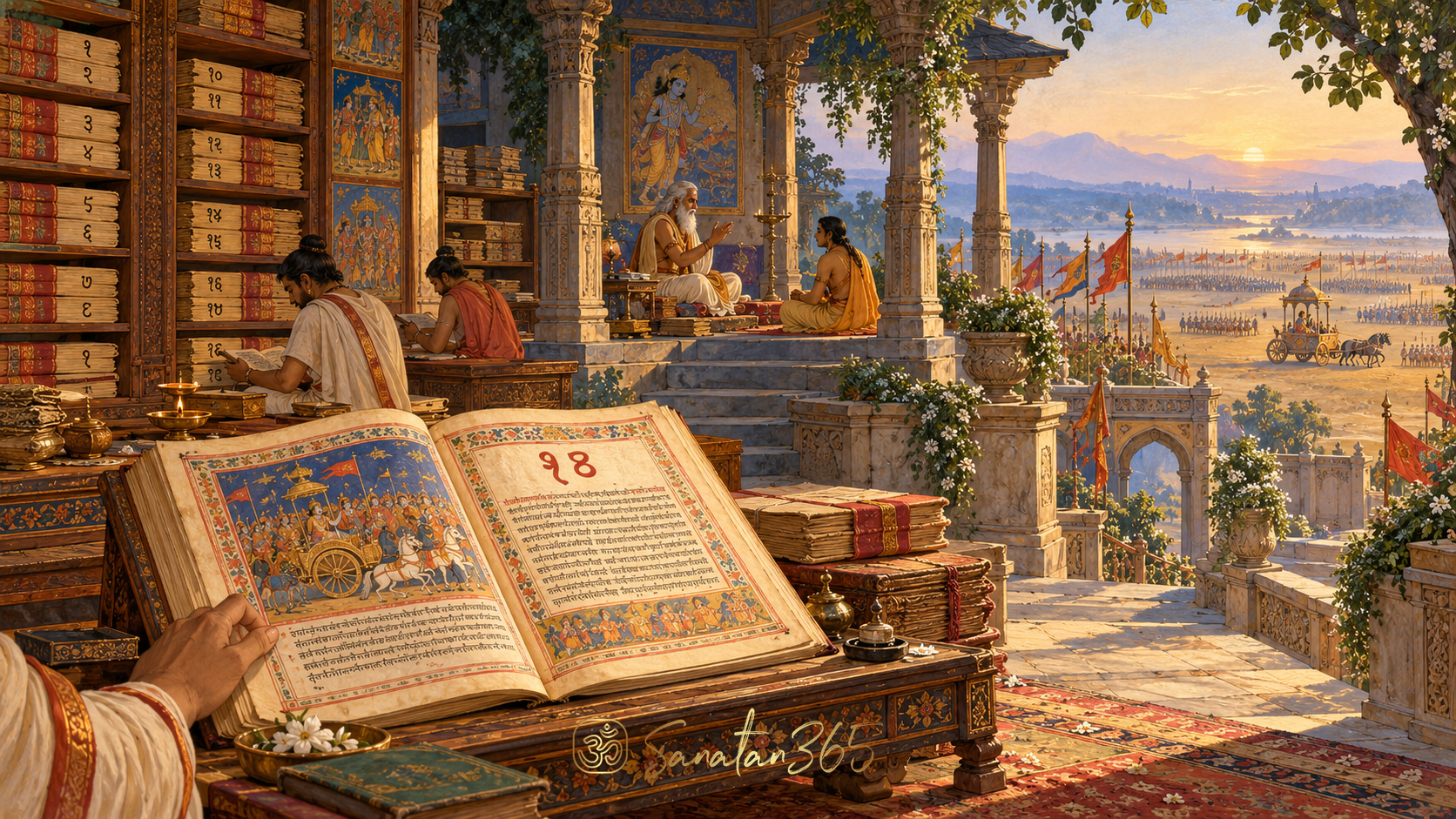
Number 18 Meaning in Hinduism: Reading the Mahabharata’s Pattern
Eighteen connects books, dialogue, war days and army units in the Mahabharata. Learn what the texts count and what those patterns do not prove.
Eighteen can describe a library of books, a conversation, a war, or an army. In the Mahabharata, it does all four.
The number 18 meaning in Hinduism is especially clear in this epic’s recurring pattern: eighteen major books, eighteen chapters of the Bhagavad Gita, eighteen days of battle, and eighteen great army units. These are different kinds of counts, not interchangeable symbols. In Sanskrit, aṣṭādaśa (अष्टादश) means eighteen. Recognizing the pattern can deepen attention to the text; it does not establish a universal secret code or predict a reader’s future.
The most fruitful question is therefore not simply, “Is eighteen lucky?” It is, “What is being counted, and what does that help a reader notice?” That small change keeps wonder intact while giving it a reliable foundation.
What does the number 18 meaning in Hinduism actually refer to?
There is no need to begin with a hidden calculation. Begin with the named objects. A book is not a day, and an army formation is not a chapter. The recurrence becomes more interesting, rather than less, when these distinctions remain visible.
The traditional pattern can be stated in four lines:
- Eighteen major books: the large-scale arrangement of the Mahabharata.
- Eighteen Gita chapters: the divisions of Krishna’s teaching to Arjuna within that larger epic.
- Eighteen battle days: the duration of the principal Kurukshetra war in the narrative.
- Eighteen army units: the combined forces described using a particular traditional military measure.
The opening synopsis in Adi Parva, Section II, in Ganguli’s translation is a particularly useful starting point. It explains the army measure, outlines the commanders’ periods of battle, and describes the distribution of the epic into eighteen large divisions. This is evidence inside the literary tradition itself, not merely a pattern assembled from modern social posts.
That evidence supports a modest but substantial claim: eighteen has a conspicuous organizing presence in the received epic. It does not, by itself, explain every occurrence, identify one authorial intention across all textual layers, or turn the number into a rule for every Hindu tradition.
Other sacred numbers organize different materials. A reader familiar with six seasons and six tastes will recognize the broader habit of remembering ideas through groups. Here, however, the subject is specifically the architecture and narrative scale of an epic, not a classification of natural experience.
Key takeaway: Identify the counted thing before assigning a meaning to the count.
How do eighteen parvas hold a story larger than war?
A parva (पर्व) is a division or book; parvas is the familiar English plural. The Mahabharata’s eighteen major parvas are not eighteen equally sized chapters. They contain very different amounts of narrative, dialogue and teaching. Calling them books helps distinguish them from the smaller divisions also discussed in traditional summaries.
The sequence begins with origins, family relationships and the conditions that make conflict possible. It moves through the royal assembly, exile, concealment and efforts preceding war. Battle occupies an important middle stretch. Mourning, instruction, responsibility after victory, withdrawal and the final departure follow it.
A simple reading map is helpful:
- Before battle: family history, competing claims, decisions, humiliation, exile and negotiation.
- During battle: changing commanders, broken relationships, difficult choices and accumulating loss.
- After battle: grief, governance, ethical teaching, departure and the limits of worldly achievement.
This is a reading aid, not a replacement for the traditional eighteen-book list. Its purpose is to reveal how much of the epic remains outside the battlefield. The opening synopsis itself continues well beyond fighting into instruction and the final books; the text does not end when a military winner emerges.
This matters for interpretation. A numerical pattern can tempt a reader to flatten the epic into an elegant diagram. Yet the books resist that simplification. The cost of decisions continues after their immediate outcome. People who survive must still ask how to live, rule, mourn and relinquish.
Consider what changes when someone asks a reading group, “What follows the war?” rather than only, “Who wins?” The group begins to notice responsibility after success. An overview of eighteen books becomes a doorway into the epic’s moral seriousness, not a substitute for it.
Ganguli’s introductory synopsis distinguishes numerous smaller sections from their arrangement into eighteen major divisions. That distinction also explains why a contents page can show far more than eighteen entries without contradicting the familiar count. Different levels of division answer different navigational questions.
Key takeaway: The eighteen-book structure includes the causes and consequences of conflict, not only the conflict itself.
What do eighteen Gita chapters count?
The Bhagavad Gita is a dialogue situated within the Mahabharata’s Bhishma Parva. Its eighteen chapters belong to that dialogue; they are not the eighteen books of the whole epic. The same number operates at two different textual scales.
An adhyāya (अध्याय) is a chapter or lesson division. Thus, “eighteen chapters of the Bhagavad Gita” counts divisions of teaching. It does not mean that Krishna spoke one chapter on each of eighteen battle days. That tempting one-to-one correspondence confuses the arrangement of a text with the duration of the war.
A reader can consult the Sanskrit, translations and classical commentaries through the Gita Supersite tradition maintained from IIT Kanpur. Reading an edition’s actual chapter divisions is more useful than relying on an unattributed chart of supposed numerical secrets.
The dialogue moves among questions of action, knowledge, devotion, discipline and freedom. These themes speak to one another across chapters. The count offers a manageable framework, but it does not make each chapter an isolated slogan. A teaching heard late in the conversation has a context built by earlier questions.
For example, a reader beginning with a devotional chapter can benefit from returning to the opening predicament: Arjuna is not collecting inspirational sayings. He faces a crisis of action among people to whom he is bound. The dialogue’s structure keeps teaching connected to that difficulty.
For a more focused introduction to one part of the conversation, the meaning of Bhagavad Gita Chapter 12 offers a different level of attention. Moving between one chapter and the whole dialogue is a sound reading habit. It makes the framework serve understanding.
There is also no obligation to finish all eighteen chapters in eighteen consecutive days. Such a schedule can be a personal study arrangement, but the number alone does not make it mandatory. A slower pace with careful comparison may be more useful than rushing to complete a pattern.
Key takeaway: Eighteen Gita chapters organize a sustained teaching conversation, not eighteen separate days of battle.
How do eighteen days and eighteen army units differ?
The war’s eighteen days belong to narrative time. The eighteen army units describe the scale of the assembled forces. They are related to the same conflict but answer entirely different questions: “How long?” and “How much?”
The army term is akṣauhiṇī (अक्षौहिणी), a great composite military formation. In Ganguli’s opening synopsis, the sages explicitly ask what it contains. The reply builds the formation from smaller units and gives a conventional combination of chariots, elephants, mounted troops and foot soldiers. Translating it simply as “army” is convenient, but can hide that technical meaning.
The distinction prevents a common misunderstanding. Eighteen akshauhinis does not mean eighteen soldiers, eighteen identical modern battalions, or eighteen separate nations. Nor should the narrative’s conventional military calculation be presented as independently verified archaeological headcounts. The text is telling the reader how its own army measure works.
The same synopsis gives Bhishma ten days, Drona five and Karna two. Shalya’s half-day and the following half-day confrontation complete the eighteenth day. The night attack follows that closing day. Stating these periods carefully is better than forcing every episode into a neat “one event equals one day” chart.
Even without calculating every component of an akshauhini, the narrative effect is clear: an immense assembly is exposed to destruction. The number carries weight through what it counts. A battlefield total concerns lives, relationships and consequences, not merely the satisfaction of a repeating digit.
For family discussion, one question is enough: “How does counting the forces change the way this story feels?” The answer need not praise military scale. It may lead toward the gravity of loss, the danger of escalating conflict, and the difficulty of repairing what conflict breaks.
This is why treating eighteen only as a fortunate number misses the epic’s emotional range. Its recurrence occurs amid teaching and organization, but also amid catastrophic loss. Reverent reading can hold those meanings together without making the number inherently lucky or unlucky.
Key takeaway: Days measure duration; akshauhinis measure forces. Neither count should be turned into a personal omen.
How can a reader study the pattern without inventing a secret code?
A pattern invites interpretation. It does not license every interpretation equally. The difference lies in whether the explanation stays connected to a source, acknowledges its limits and helps the reader understand more of the actual text.
A useful method has three levels:
- Observation: “This edition presents eighteen major books.” The claim can be checked in its contents and introductory summary.
- Interpretation: “The repeated number makes the work feel internally connected.” This is a reasoned reading, not a statement that the source explicitly proves a single explanation.
- Personal reflection: “This encourages careful attention to the relationship between learning and action.” This is an application chosen by the reader, not a prediction issued by the epic.
Problems begin when these levels collapse. An attractive observation becomes an alleged universal law; that law becomes a promise about a birthday, house number or future event. Nothing in the four counts above establishes that leap.
Adding one and eight to obtain nine is arithmetic. It does not, without a specific sourced interpretive tradition, demonstrate why the epic has eighteen books or why an individual will experience a particular outcome. A respectful explanation can mention an interpretation when its source is clear, while declining to present it as the only meaning of the text.
The same restraint helps with regional and language differences. Readers in Maharashtra, Bengal, Tamil Nadu, Karnataka and diaspora communities may encounter the Mahabharata through translations, recitation, theatre or family retellings. A condensed retelling may not reproduce the full book structure. That does not make it worthless; it means the reader should identify what kind of work is in hand before comparing its divisions with a complete edition.
For a practical beginning, open an edition’s contents, mark where the Gita sits, and read the opening explanation of the army measure. Record what each eighteen counts. Then choose one passage for unhurried reading. This brings the pattern back to language, people and decisions.
Readers working across languages can also use this guide to reading Hindu scripture in translation. Translation choices deserve attention precisely because a meaningful word such as parva or akshauhini can become less precise in a short English summary.
The lasting value of eighteen is not that it removes the need to read. It is that it can persuade someone to read more carefully.
Key takeaway: Let numerical recurrence sharpen attention to the epic rather than replace it with a code.
FAQ
Why is 18 significant in the Mahabharata?
It recurs in the traditional eighteen major books, the Gita’s eighteen chapters, the war’s eighteen days and eighteen great army formations. The recurrence is an observable textual pattern. A single explanation for every occurrence should not be asserted without a specific source.
Are the eighteen parvas the same as the eighteen Gita chapters?
No. Parvas are the major books of the whole Mahabharata. The Gita’s chapters divide one teaching dialogue within the Bhishma Parva. The two counts operate at different scales.
Did Krishna teach the Bhagavad Gita over eighteen days?
The eighteen-chapter arrangement does not mean that. The dialogue is placed at the threshold of battle. The eighteen days describe the principal war, not one day for each chapter of teaching.
Does eighteen mean eighteen soldiers or eighteen countries?
No. The traditional military count refers to akshauhinis, large composite formations with a defined conventional structure. It should not be confused with individual people or modern political units.
Is the number 18 lucky for everyone?
The epic’s repeated use of eighteen does not establish a universal prediction about luck, character or events. It is better approached as a meaningful feature of the text than as a guarantee about a person’s life.
About the author
Sanatan365 Editorial
Bringing Sanatan Dharma to modern seekers through authentic, scripture-grounded content.
Related in Numerology
 Numerology
24 Tattvas Meaning: What Sankhya Counts and Why
The 24 tattvas are a defined count in Sankhya. Follow the groups of one, seven and sixteen, then see why purusha is discussed separately.
 Numerology
Number 16 Meaning in Hinduism: Reading Shodasha in Context
Explore sixteen as a sacred count through lunar imagery, life-stage rites and offerings, while keeping each tradition’s meaning distinct fr…
 Numerology
Number 10 Meaning in Hinduism: From Sensing to Responsible Action
Ten can gather the capacities for knowing and acting into one framework, without turning a sacred number into a prediction.

