Om Jai Jagdish Hare Meaning: Words, Devotion, and Vishnu Aarti
Om Jai Jagdish Hare is one of the most widely sung Hindu aartis. This guide explains its words, devotional meaning, history, and respectful home practice.
Few devotional songs can turn a room into a shared place of prayer as quickly as Om Jai Jagdish Hare. A bell sounds, a lamp begins its circle, and people of different ages find the same refrain.
The Om Jai Jagdish Hare meaning is a prayer to Lord Vishnu as Jagdish, “Lord of the universe.” Its verses praise the Divine as protector, inner witness, compassionate refuge, and remover of suffering. Sung during aarti (आरती, a devotional offering of light), it joins words, melody, flame, and collective attention into one act of bhakti (भक्ति, loving devotion).
The song is especially associated with Vishnu worship, although many families adapt its familiar structure for other sacred forms. Understanding it does not require treating every line as a promise that worldly difficulty will instantly disappear. The deeper invitation is to bring fear, gratitude, responsibility, and hope into the presence of the Divine.
What Does Om Jai Jagdish Hare Mean?
The opening words can be understood simply:
- Om (ॐ): the sacred syllable pointing toward ultimate reality.
- Jai (जय): victory, glory, or praise.
- Jagdish (जगदीश): jagat means world or universe, and isha means lord; together, “Lord of the universe.”
- Hare (हरे): a devotional form of address, calling to the Lord.
The refrain therefore carries the sense: “Om, glory to the Lord of the universe.” In the song’s best-known form, worshippers address Swami (स्वामी, Lord or master) with intimacy as well as reverence. The Divine is cosmic enough to sustain the universe, yet close enough to hear an individual prayer.
This union of vastness and nearness is central to Vishnu bhakti. The Bhagavad Gita presents the Divine as attentive to sincere offerings: “Whoever offers Me with devotion a leaf, a flower, a fruit, or water, I accept that loving offering from the pure-hearted seeker” (Bhagavad Gita 9.26). The value lies not in material display but in the quality of devotion.
During aarti, this teaching becomes visible. The lamp is offered before the deity, then its warmth is received by devotees. Nothing is given as though the Divine lacks light. The act trains the heart to recognize that life, attention, and capacity already arise within a greater sacred order.
Key takeaway: The refrain praises the Lord of the universe while making devotion personal, direct, and accessible.
Who Is Jagdish in the Aarti?
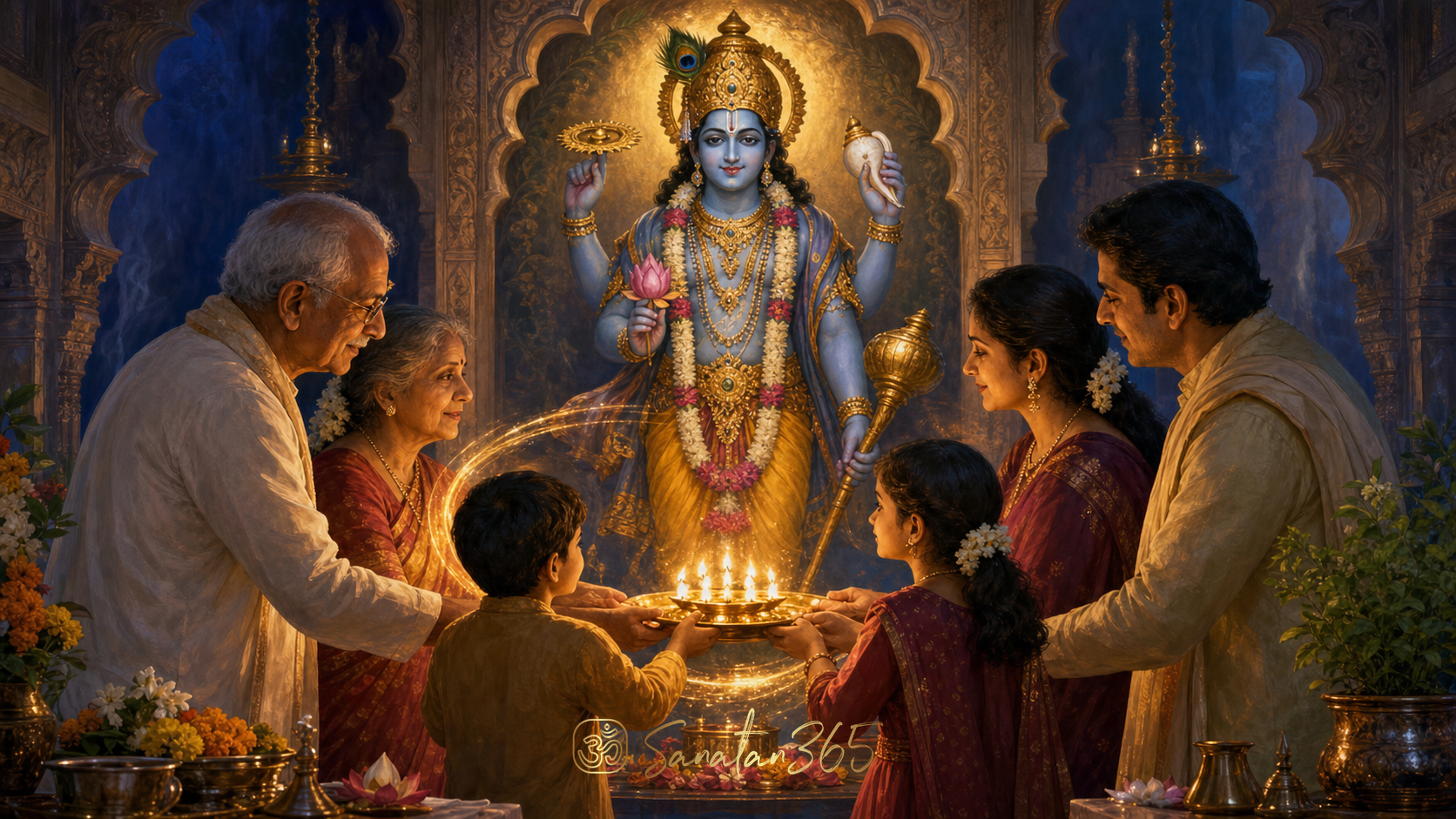
In Om Jai Jagdish Hare, Jagdish is generally understood as Lord Vishnu, the sustaining presence within the Hindu understanding of cosmic order. Vishnu is often depicted with four attributes: the shankha (शङ्ख, conch), chakra (चक्र, discus), gada (गदा, mace), and padma (पद्म, lotus). These forms communicate protection, order, strength, and purity rather than functioning as decorative details.
The name Jagdish also carries theological breadth. It does not confine the Divine to one region, household, or social group. “Lord of the universe” points toward a reality that holds all beings. The song’s language is therefore both distinctly Vaishnava and widely approachable.
Many Hindu households have an ishta-devata (इष्टदेवता, personally cherished form of the Divine). One family may sing before Vishnu or Krishna; another may use a related aarti composed for Lakshmi, Shiva, Durga, Ganesha, or Hanuman. These practices need not be placed in competition. Sanatan Dharma holds multiple devotional relationships with reverence, and no single sacred path must be diminished to honor another.
This matters when translating the word Swami. It can sound hierarchical in modern English, but devotional usage is relational: the worshipper acknowledges that the ego does not control every result. The Bhagavad Gita describes surrender not as passivity but as placing action within the Divine while continuing to fulfil one’s duty (Bhagavad Gita 18.66).
Key takeaway: Jagdish primarily names Lord Vishnu here, while also expressing the inclusive vision of the Divine as sustainer of the whole universe.
What Does Each Verse Teach?
Several versions circulate, and wording can vary by family, region, recording, or temple. It is better to understand the major devotional movements of the song than to insist that one printed sequence is universal.
The Divine knows the inner life
One verse addresses the Lord as Antaryami (अन्तर्यामी, the indwelling knower or inner witness). This does not mean that every passing thought receives divine endorsement. It means worship need not be performative. Fear, confusion, longing, and gratitude may be brought honestly into prayer.
That inner-witness theme gives the aarti emotional force. A person does not have to arrive spiritually polished. The song invites sincerity first. Such sincerity also calls for ethical accountability: if the Divine is present within, outward ritual cannot excuse harmful conduct.
The devotee seeks refuge
The recurring language of taking refuge expresses sharanagati (शरणागति, wholehearted surrender or seeking divine shelter). Surrender is sometimes misunderstood as abandoning judgment. In the devotional tradition, mature surrender loosens the belief that the individual ego alone owns action and result.
The Bhagavad Gita joins refuge with active devotion, describing those who dedicate actions to the Divine and are carried across difficulty through steadfast contemplation (Bhagavad Gita 12.6–7). Prayer can steady action; it should not replace necessary practical help, honest conversation, or responsible decision-making.
Desire is brought into a larger frame
The song openly acknowledges wishes and distress. This honesty is one reason it remains beloved. People often come to worship with real needs: livelihood, family wellbeing, courage, healing of relationships, or clarity. The aarti does not demand that ordinary human concerns be denied.
Yet devotional singing gradually reframes desire. The worshipper begins by asking, but the repeated refrain returns attention to praise. The movement is subtle: from “give me the result I want” toward “help me remain aligned with dharma whatever the result.”
Suffering is met with companionship
Lines about removing sorrow should be heard with care. Hindu devotional poetry frequently speaks in the language of divine rescue. This can express trust, resilience, and the felt companionship of prayer. It should not be turned into a guaranteed claim that singing an aarti prevents illness, loss, or hardship.
Spiritual practice can accompany medical, psychological, legal, or financial support; it is not a substitute for qualified help. The most grounded reading is that the Divine gives refuge, perspective, courage, and community while devotees still respond responsibly to circumstances.
Gratitude completes the offering
The concluding movement of aarti often includes receiving the flame, bowing, and sharing prasada (प्रसाद, blessed offering or grace). The song’s theology becomes communal: blessing is not hoarded. Light passes from shrine to gathered hands; food may be shared; the worship space returns to daily life with a quieter mind.
Key takeaway: The verses move through honest need, inner surrender, ethical responsibility, divine companionship, and gratitude.
Who Wrote Om Jai Jagdish Hare?
The hymn is widely attributed to Pandit Shardha Ram Phillauri, a nineteenth-century scholar and writer from Punjab. The attribution is common in cultural and biographical accounts, and the composition is often dated to the 1870s. As with many songs carried through oral devotion, later performance traditions have produced variations in wording and added verses.
That history helps explain the song’s accessible Hindi register. It is neither a Vedic mantra nor an ancient Sanskrit scripture. Calling it “timeless” may describe its continuing emotional life, but it should not erase its comparatively recent composition history.
Its reach expanded through household worship, congregational singing, printed prayer books, radio, cinema, cassette culture, television, and digital recordings. The same melody now appears in homes and temples far beyond North India. Diaspora families often use it because its repeated refrain lets children and guests participate before they know every verse.
This is how living devotion often grows: a composition emerges in a particular time and language, then communities receive it, remember it, and make it part of sacred routine. Popularity does not turn the hymn into scripture, but neither does recent authorship make its devotion less meaningful.
Key takeaway: Om Jai Jagdish Hare is a modern devotional composition widely attributed to Shardha Ram Phillauri, sustained by generations of living practice.
How Is Om Jai Jagdish Hare Sung at Home?
A home aarti can be simple. The purpose is gathered devotion, not performance or spectacle. Customs differ, so family tradition and guidance from a trusted temple may shape the details.
A respectful sequence
- Prepare the shrine safely. Clean the area and place the chosen murti or sacred image with flowers or another simple offering. Keep flame away from curtains, loose clothing, children, and unstable surfaces.
- Light the lamp. A small diya with ghee or oil is traditional. An electric lamp is a reasonable adaptation where open flame is unsafe or prohibited.
- Begin with quiet attention. Ringing a bell is customary in many homes, but it is not a test of devotion. A few calm breaths can settle the gathering.
- Sing together. One person may lead and others repeat the refrain. Clear pronunciation is helpful, yet sincere participation matters more than musical perfection.
- Offer the light in gentle circles. The lamp is moved before the worship focal point with steadiness and care. Regional customs differ on the number and pattern of circles.
- Receive the aarti. Devotees commonly pass their hands over the flame’s warmth and bring them toward the head or eyes, symbolically receiving divine light.
- Close with gratitude. Bow, sit briefly in silence, and share prasada if offered.
The lamp should never be left unattended. Where smoke alarms, rental rules, pets, health concerns, or travel conditions make a flame unsuitable, intention can be expressed through an LED diya, a flower, or silent prayer. Adaptation made with reverence is better than unsafe imitation.
Families teaching children can explain one phrase at a time. “Jagdish means Lord of the universe” may be enough for one evening. On another, a child can carry a flower, ring a small bell with supervision, or name something for which they are grateful. This turns repetition into understanding.
The article Aarti meaning and the Hindu offering of light explains the wider ritual. Readers exploring morning worship may also find Mangala Aarti and auspicious dawn devotion helpful. For a related Vaishnava practice, see Vishnu Sahasranama and the thousand names.
Key takeaway: A meaningful home aarti needs attention, safety, a clear sacred focus, and shared gratitude more than elaborate materials.
Why Does This Vishnu Aarti Feel So Universal?
The song’s endurance comes partly from structure. Its melody is easy to remember, the refrain returns often, and each verse speaks in direct devotional language. A newcomer can join after hearing only a few lines. An elder may carry decades of family memory in the same tune.
It also holds several human experiences at once:
- vulnerability without despair;
- desire without pretending the ego controls every result;
- praise without requiring philosophical expertise;
- family continuity without excluding new participants;
- divine majesty without emotional distance.
The lamp completes what the words begin. Its light touches many faces without becoming divided. That image gives the gathering a lived lesson: divine presence can be approached together, while each person receives it inwardly.
The aarti’s universality should not flatten its roots. It remains a Hindu devotional song, commonly offered to Vishnu as Jagdish. Respect means naming that context clearly while welcoming sincere learners. Translation is most faithful when it preserves both specificity and hospitality.
Ultimately, Om Jai Jagdish Hare is not powerful because every singer interprets every line identically. It is powerful because the refrain keeps returning a scattered mind to praise. Need becomes prayer, prayer becomes attention, and attention becomes an offering.
Key takeaway: The song endures because its simple refrain gathers personal longing, family memory, Vishnu devotion, and shared light into one accessible practice.
Conclusion
The meaning of Om Jai Jagdish Hare reaches beyond a word-for-word translation. It praises Lord Vishnu as the sustainer and inner witness, welcomes honest human need, and redirects that need toward surrender, responsible action, and gratitude. Its familiar melody has become a bridge across generations because everyone can enter through the refrain.
Key takeaway: Om Jai Jagdish Hare turns the offering of light into a practice of remembering that the Lord of the universe is both beyond the individual and intimately present within devotional life.
FAQ
What is the simple meaning of Om Jai Jagdish Hare?
It means, “Om, glory to the Lord of the universe.” The hymn praises the Divine as protector, inner witness, refuge, and compassionate sustainer.
Is Om Jai Jagdish Hare dedicated to Lord Vishnu?
Yes. The best-known form is a Vishnu aarti addressing the Lord as Jagdish. Some families use adapted forms for other deities, following their own tradition.
Is Om Jai Jagdish Hare a Vedic mantra?
No. It is a modern Hindi devotional hymn widely attributed to Pandit Shardha Ram Phillauri, not a Vedic mantra or ancient Sanskrit scripture.
When should Om Jai Jagdish Hare be sung?
It may be sung during morning or evening home worship, after puja, during Vishnu observances, or whenever a family gathers for aarti. There is no need to wait for a festival.
Can aarti be performed without an open flame?
Yes. When fire is unsafe or prohibited, a clean electric diya, flower offering, or prayerful visualization can preserve the devotional intention. Safety and reverence should guide the adaptation.
About the author
Sanatan365 Editorial
Bringing Sanatan Dharma to modern seekers through authentic, scripture-grounded content.
Related in Aarti
 Aarti
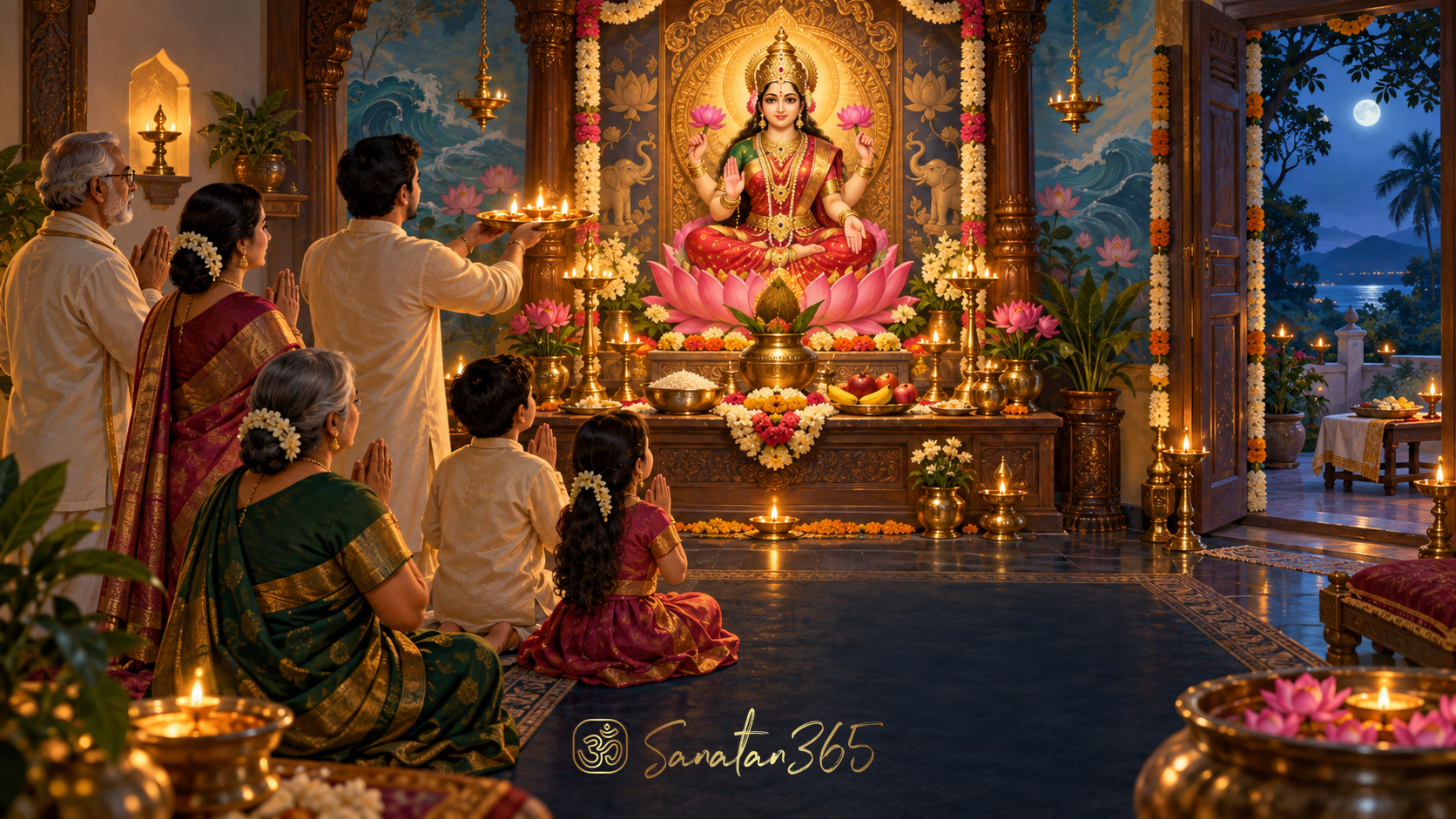
AartiOm Jai Lakshmi Mata Aarti Meaning: Grace, Prosperity, and Gratitude
Om Jai Lakshmi Mata praises Goddess Lakshmi as the source of auspicious abundance, ethical prosperity, nourishment, virtue, and household w…
 Aarti
AartiAarti Kije Hanuman Lala Ki Meaning: Hanuman’s Strength in Rama’s Service
Understand Aarti Kije Hanuman Lala Ki through its refrain, Ramayana memories, devotional themes, textual variants, and a simple home practi…
 Aarti
AartiOm Jai Shiv Omkara Aarti Meaning: Shiva, Omkara, and Sacred Unity
Om Jai Shiv Omkara is a beloved Shiva aarti whose images of Brahma, Vishnu, and Sadashiva invite devotees to see creation, preservation, an…