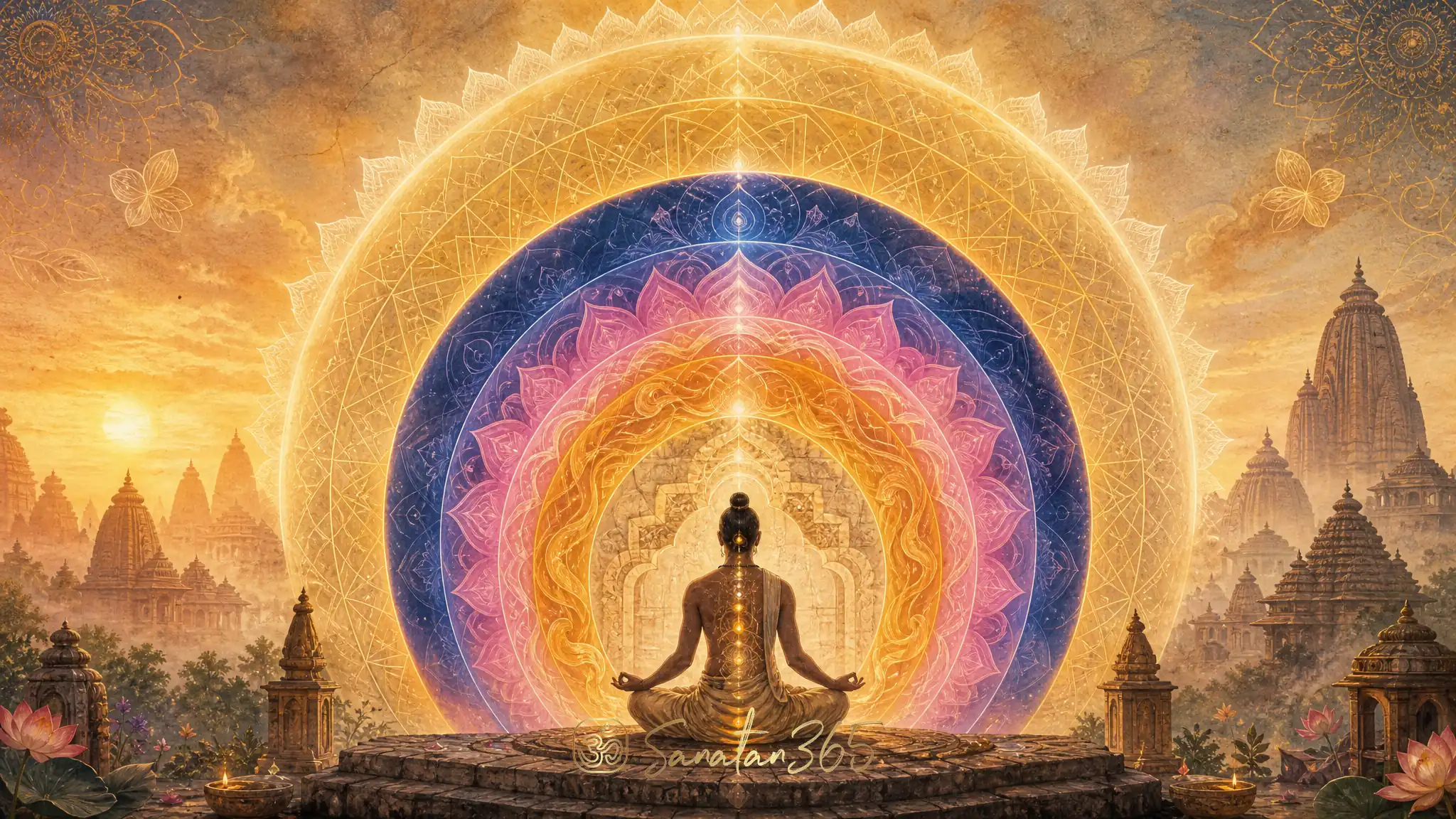
Pancha Kosha Meaning: The Five Sheaths of the Self
Pancha Kosha explains five sheaths of human experience: body, breath, mind, wisdom, and bliss. Here is what the model means in Vedanta and daily life.
A person can polish the body, calm the breath, train the mind, sharpen judgment, and still feel that something deeper is waiting to be known.
Pancha Kosha meaning is the Hindu teaching of the "five sheaths" that appear to cover the Atman (आत्मन्, the Self): annamaya (अन्नमय, food-body), pranamaya (प्राणमय, life-force), manomaya (मनोमय, mind), vijnanamaya (विज्ञानमय, discerning wisdom), and anandamaya (आनन्दमय, bliss). The model comes from the Taittiriya Upanishad's layered inquiry into human existence and points seekers from outer identity toward inner Self-knowledge.
This is not a medical map, personality theory, or quick wellness trick. It is a contemplative way of asking: "What do I mistake for myself, and what remains when that mistake softens?"
What is Pancha Kosha meaning in Vedanta?
Pancha Kosha meaning begins with two Sanskrit words: pancha (पञ्च, five) and kosha (कोश, sheath or covering). In Vedanta, the koshas are five layers through which ordinary experience is lived. They are not evil. They are not enemies of spiritual life. They are useful instruments, but they become limiting when a person treats them as the whole self.
The teaching is most closely associated with the Taittiriya Upanishad, especially the Brahmananda Valli, where the inquiry moves from the physical person toward subtler levels of existence. A concise overview of the tradition is preserved in many Vedanta summaries, including Swami Sivananda's explanation of the Taittiriya Upanishad and the broader yoga-Vedanta discussion of the koshas in the Himalayan Institute.
The five koshas are often listed from gross to subtle:
- Annamaya kosha: the food-made body.
- Pranamaya kosha: the vital energy and breath layer.
- Manomaya kosha: the mind, emotion, and sense-processing layer.
- Vijnanamaya kosha: the layer of discernment, understanding, and moral intelligence.
- Anandamaya kosha: the bliss sheath, the subtlest layer of causal peace.
The key is not to despise these layers. The body is sacred. Breath is sacred. Thought can serve dharma. Discernment is necessary. Bliss is a blessing. The Vedantic caution is simpler: none of these changing layers is the final, unchanging Self.
Key takeaway: Pancha Kosha is a map of human experience that helps a seeker honor each layer without confusing any layer for the Self.
Why does the Taittiriya Upanishad use five sheaths?
The Taittiriya Upanishad does not present spirituality as a rejection of life. It starts where everyone starts: food, body, breath, thought, intelligence, and joy. The teaching then refines attention. What seems like "I" is examined more carefully.
Annamaya kosha feels obvious because the body is visible. A person says, "I am tall," "I am tired," or "I am hungry." These statements are normal, but Vedanta asks whether the witness of hunger is identical with hunger itself. The body changes from childhood to youth to old age. Yet a sense of continuity remains.
Pranamaya kosha is subtler. Prana (प्राण, vital life-force) is expressed through breath, vitality, movement, digestion, and life rhythm. A person may feel dull, vibrant, restless, or steady. Breath practices in yoga often work at this level, though the kosha teaching itself is broader than any single breathing technique.
Manomaya kosha is the layer most people live inside without noticing. Manas (मनस्, mind) receives impressions, forms likes and dislikes, reacts, remembers, and worries. One pleasant word can brighten the day. One harsh sentence can disturb it. The mind has power, but it is not always wise.
Vijnanamaya kosha brings viveka (विवेक, discernment), the capacity to distinguish helpful from harmful, permanent from impermanent, dharma from impulse. This is where study, reflection, ethics, and self-correction become meaningful.
Anandamaya kosha is the most subtle. Ananda (आनन्द, bliss) here does not mean entertainment or excitement. It points to the quiet happiness experienced when mental agitation subsides, and in Vedantic analysis it remains a sheath because even blissful experience comes and goes.
Key takeaway: The five sheaths move from outer to inner so that self-inquiry can become precise rather than vague.
How do the five koshas appear in daily life?
The Pancha Kosha model becomes practical when it is used as a mirror. A difficult day rarely belongs to only one layer. A person may skip food, breathe shallowly, think anxiously, lose judgment, and then wonder why inner peace feels distant. The kosha model helps separate the layers without reducing the whole person to one problem.
Consider a common example. Someone wakes up late, rushes through breakfast, checks messages immediately, and enters work already tense. At annamaya kosha, the body has not been cared for. At pranamaya kosha, breath is hurried. At manomaya kosha, impressions are scattered. At vijnanamaya kosha, wise priority-setting is weak. Anandamaya kosha is covered by agitation.
This does not mean the person has failed spiritually. It means awareness has become distributed across the sheaths without clarity. A small reset may begin with the body: water, food, posture, a walk. It may continue through breath: slower exhalation, steadier rhythm. The mind may need less noise. Discernment may ask, "What is actually required now?" Quiet joy may return when the outer layers become less turbulent.
This is why the kosha model can serve Hindu wellness without becoming shallow wellness branding. It reminds us that human life is layered. Care of the body matters, but the person is not only the body. Emotional balance matters, but the person is not only emotion. Wisdom matters, but even the thought "I am wise" can become ego if it hardens.
In family life, the model also encourages compassion. A child having a difficult moment may need food or rest before moral instruction. An elder may need breath and calm before discussion. A seeker may need study, not just relaxation. The koshas help us respond more fully.
Key takeaway: In daily life, Pancha Kosha offers a layered diagnosis of experience: care for each sheath, then look deeper than all of them.
What does each kosha teach about spiritual practice?
Each kosha can be approached as a doorway to discipline, gratitude, and self-knowledge.
Annamaya kosha teaches reverence for embodiment. Anna (अन्न, food) is not merely fuel in Hindu thought. Food is connected with gratitude, prasad (प्रसाद, blessed offering), restraint, and the truth that the body is sustained by the wider world. Simple practices such as eating with attention, sleeping responsibly, and keeping the body available for seva (सेवा, selfless service) belong here.
Pranamaya kosha teaches sensitivity to life rhythm. Breath reveals the state of the nervous system before the intellect explains it. In many yoga traditions, steady breathing prepares the mind for steadier attention. The point is not to chase unusual experiences, but to let prana become less chaotic and more sattvic (सात्त्विक, clear and harmonious).
Manomaya kosha teaches responsibility for attention. The mind is shaped by what it consumes: words, images, company, memory, repetition. Japa (जप, mantra repetition), satsang (सत्संग, good spiritual company), and mindful restraint help the mind become a friend rather than a constant disturbance.
Vijnanamaya kosha teaches inquiry. This is the level where scriptural study, teacher-guided reflection, and ethical clarity matter. A person asks: Is this desire aligned with dharma? Is this reaction truthful? Is this identity permanent? This kosha is where spiritual life becomes intelligent rather than merely emotional.
Anandamaya kosha teaches humility before subtle joy. Peaceful meditation, devotion, and deep rest can bring sweetness. Vedanta still asks the seeker not to cling even to blissful states. A passing experience of bliss is precious, but the Self is not dependent on a mood.
Key takeaway: Each kosha offers a form of practice, but each practice points beyond identification with that kosha.
Is Pancha Kosha the same as modern wellness?
Pancha Kosha can enrich modern wellness, but it should not be flattened into a lifestyle checklist. The model includes body, energy, mind, wisdom, and bliss, so it naturally speaks to holistic living. Still, its root purpose is moksha (मोक्ष, liberation), not just productivity, relaxation, or emotional comfort.
Modern readers often appreciate the five sheaths because the model feels integrated. It avoids two common extremes. One extreme treats the human being as only the body. The other treats spirituality as if the body and mind do not matter. Pancha Kosha refuses both mistakes. It says the body matters, prana matters, mind matters, discernment matters, bliss matters, and the Self is deeper than all of them.
This is also why the model should be handled carefully. It does not replace medical care, mental health care, or qualified guidance. It is a spiritual and philosophical framework. Used well, it can make daily life more attentive. Used poorly, it can become another label system. The Vedantic spirit is not to collect labels but to reduce confusion.
For a practical daily reflection, a seeker might ask:
- What does my body need today so it can serve dharma?
- Is my breath hurried, dull, or steady?
- What impressions are shaping my mind?
- What would discernment advise before I react?
- Am I clinging to comfort, or resting in something quieter?
These questions do not require dramatic ritual. They require honesty. The koshas become useful when they lead to clearer living.
Key takeaway: Pancha Kosha supports holistic wellness, but its deeper aim is Self-knowledge and freedom from mistaken identity.
How can a beginner contemplate the five sheaths?
A beginner can start gently, without forcing mystical experience. Sit quietly for a few minutes and move attention layer by layer.
First, notice the body. Feel weight, posture, warmth, discomfort, and contact with the floor or seat. Acknowledge: "This body is known to me." Second, notice breath and vitality. Is the breath shallow or calm? Is energy heavy or bright? Acknowledge: "This breath and energy are known to me."
Third, notice the mind. Thoughts, memories, plans, and emotions may move quickly. Instead of fighting them, see that they are observed. Fourth, notice discernment. There may be a quiet intelligence that can choose not to follow every thought. Fifth, notice any peace that appears when grasping relaxes.
Then ask one Vedantic question: If body, breath, mind, judgment, and even peaceful feeling are all known, who is the knower?
This question should not become a mental puzzle alone. It is a doorway into viveka. Over time, the seeker begins to see that the koshas are changing fields of experience. The witness is not improved by pride or damaged by a passing thought. This recognition is subtle, and traditional guidance matters. But even a beginner can taste the direction of the teaching.
Sanatan365's broader devotional rhythm, from meditation to mantra and aarti, can support this kind of inner steadiness when used with sincerity. The important point is to keep the practice humble: devotion, attention, study, and self-inquiry should deepen one another.
Key takeaway: Beginners can contemplate the koshas by observing each layer as known, then gently turning toward the knower.
FAQ
What is Pancha Kosha meaning in simple words?
Pancha Kosha means the five sheaths or layers of human experience: body, life-force, mind, discernment, and bliss. In Vedanta, these sheaths appear to cover the Atman, the true Self, when a person identifies with them.
Where does the Pancha Kosha teaching come from?
The teaching is rooted in the Taittiriya Upanishad, especially its inquiry into the layers of human existence and Brahman. Later Vedanta and yoga traditions explain the five sheaths as a practical map for self-inquiry.
Are the five koshas physical or spiritual?
They include both gross and subtle layers. Annamaya kosha is linked with the physical body, while the others move through vitality, mind, discernment, and bliss. The teaching is spiritual because it asks the seeker to recognize the Self beyond all changing layers.
Is anandamaya kosha the same as the Atman?
No. Anandamaya kosha is the bliss sheath, the subtlest sheath in the model, but it is still treated as a sheath because blissful experience can appear and disappear. The Atman is the witnessing Self beyond all five sheaths.
How can I use Pancha Kosha in daily practice?
Use it as a reflection tool. Care for the body, steady the breath, purify the mind, strengthen discernment, and receive quiet joy without clinging. Then remember that the Self is deeper than every layer you can observe.
The single key takeaway: Pancha Kosha teaches that body, breath, mind, wisdom, and bliss are sacred parts of experience, but the seeker is invited to know the Self that witnesses them all.
About the author
Sanatan365 Editorial
Bringing Sanatan Dharma to modern seekers through authentic, scripture-grounded content.
Related in Wellness
 Wellness
Nadi Shodhana Pranayama: Meaning and a Gentle Practice
Nadi Shodhana is alternate-nostril breathing practiced with steady attention. Its deeper yogic purpose is preparing breath and mind for cla…
 Wellness
Shavasana Meaning: Why Corpse Pose Is a Practice of Conscious Rest
Explore Shavasana's meaning in Hatha Yoga, why stillness is not the same as sleep, and how beginners can practise corpse pose with attentio…
 Wellness
Bhramari Pranayama Meaning: A Careful Guide to Humming Bee Breath
Bhramari Pranayama is the humming bee breath described in the Hatha Yoga tradition. Learn its meaning, classical method, safety limits, and…

