Panchamrita Meaning: Five Sacred Ingredients in Hindu Puja
Understand Panchamrita meaning, its five traditional ingredients, its role in abhisheka and prasada, regional variations, and respectful preparation at home.
Five familiar foods can become one of Hindu worship’s most tender ritual offerings.
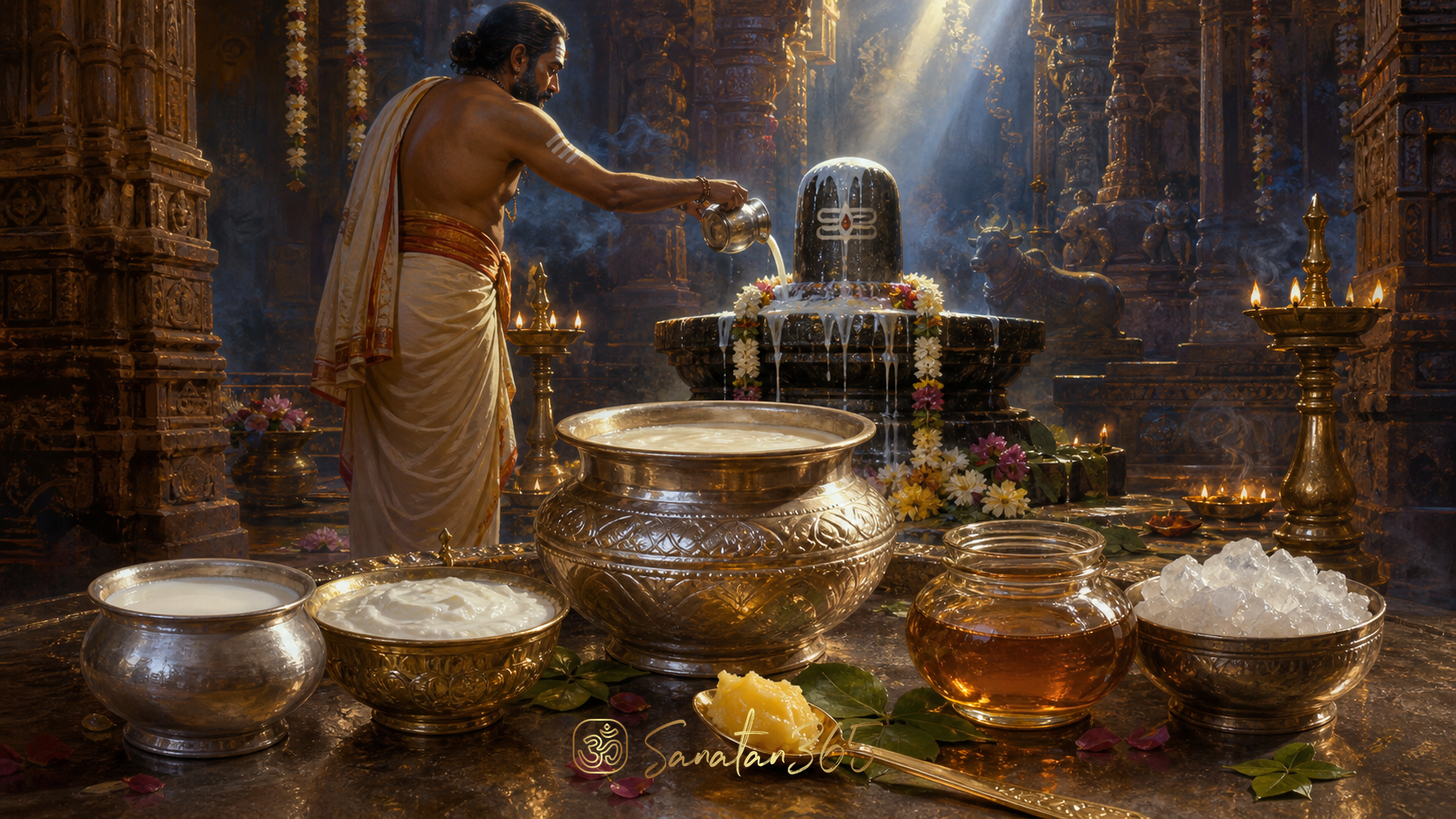
Panchamrita meaning comes from pancha (पञ्च, pañca, five) and amrita (अमृत, amṛta, nectar or deathless essence). Panchamrita is a sacred mixture traditionally made from milk, curd, ghee, honey, and sugar. It is offered during puja (पूजा, worship), often poured over a murti or Shiva linga in abhisheka (अभिषेक, ritual bathing), and then received in a small quantity as prasada (प्रसाद, blessed offering). Its purpose is devotional, not magical: five nourishing ingredients are gathered, offered to the Divine, and returned as a reminder that daily life itself can be sanctified.
What Is Panchamrita Meaning in Hindu Puja?
Panchamrita literally means “five nectars.” The name describes both its ingredients and its devotional imagination. Milk, curd, ghee, honey, and sugar are valued foods in many Hindu households. When combined cleanly and offered with mantra and reverence, they express nourishment, sweetness, care, and gratitude.
The mixture belongs within the wider language of puja. Encyclopaedia Britannica describes puja as ceremonial worship in which offerings may be presented to a deity. The Hindu American Foundation’s puja guide likewise explains how worship may include water, flowers, light, food, and other respectful offerings. Panchamrita is one such offering, especially in abhisheka traditions.
The word amrita has deep resonance in Hindu thought. It can refer to the nectar of immortality remembered in the Samudra Manthana story, but Panchamrita should not be confused with a substance that guarantees immortality or health. Here, “nectar” is devotional language. It points toward what is pure, sustaining, auspicious, and received as grace.
This distinction protects the practice from exaggeration. Panchamrita is neither a miracle medicine nor a commercial wellness formula. It is sacred food prepared for worship. Its value lies in bhava (भाव, bhāva, devotional feeling), cleanliness, correct context, and the humility with which it is offered and received.
The ritual also carries a simple spiritual movement:
- The household gathers nourishing ingredients.
- The ingredients are combined with care.
- The mixture is offered rather than immediately consumed.
- It is received back as prasada.
- Gratitude turns nourishment into remembrance.
Key takeaway: Panchamrita means five sacred nectars joined as an offering, not five ingredients used for a guaranteed worldly result.
What Are the Five Panchamrita Ingredients?
The most widely recognized Panchamrita ingredients are milk, curd, ghee, honey, and sugar. Names, proportions, and local customs vary, so a family or temple tradition should guide the final method. The stable principle is not culinary perfection but clean, reverent offering.
1. Milk
Milk forms the gentle base. In devotional interpretation, it often suggests nourishment, purity, and maternal care. Cow’s milk is traditional in many settings, but worshippers should follow family practice, temple guidance, dietary needs, and locally responsible sourcing. The ingredient should be fresh and handled hygienically.
2. Curd
Curd or yogurt brings transformation. Milk becomes curd through culture and time, making it a natural symbol of disciplined change. It also gives Panchamrita body and a mild tang. Fresh, plain curd without added flavouring is ordinarily used.
3. Ghee
Ghee (घृत, ghṛta, clarified butter) has a long ritual association with yajna (यज्ञ, sacred offering or sacrifice), lamps, and consecrated food. In Panchamrita, only a small amount may be needed. It suggests refinement: butter is clarified through heat, just as intention may become clearer through discipline.
4. Honey
Honey contributes natural sweetness and carries the image of many flowers becoming one essence. Devotional explanations sometimes connect this unity with community: many sources, one offering. Honey should never be given to infants under one year, and anyone with relevant allergies or medical restrictions should not consume it merely because it is prasada.
5. Sugar
Sugar, rock sugar, or mishri may complete the mixture, depending on custom. It represents sweetness in speech, relationship, and conduct. Some traditions use jaggery or another accepted sweetener, while others are precise about crystalline sugar. Local instruction matters more than an internet recipe presented as universal.
These symbolic readings are aids to reflection, not rigid scriptural equations. Hindu ritual traditions are diverse, and one region may explain an ingredient differently from another. A careful devotee can appreciate symbolism without claiming that every Hindu community follows one interpretation.
Key takeaway: The five Panchamrita ingredients are milk, curd, ghee, honey, and sugar, prepared freshly and interpreted through nourishment, transformation, refinement, unity, and sweetness.
Why Is Panchamrita Used in Abhisheka?
Abhisheka is the ritual bathing of a sacred form. Water is fundamental, but temples and households may also use milk, Panchamrita, fruit juice, sandal water, or other substances permitted by their sampradaya (सम्प्रदाय, tradition). The sequence, mantra, deity, and occasion differ widely.
During Panchamrita abhisheka, the mixture is poured over a murti (मूर्ति, consecrated sacred form), a Shiva linga, or another approved worship focal point. This is not done because the Divine requires physical nourishment. Hindu worship uses embodied gestures to train the devotee in attention, generosity, and surrender. Bathing the sacred form expresses hospitality and loving service.
The act is close to caring for an honoured guest. Classical puja often follows a language of welcome: offering a seat, water, fragrance, light, food, and praise. Abhisheka deepens that hospitality through bathing and adornment. The devotee offers valuable nourishment without possessiveness.
Panchamrita is especially visible in Shiva worship, but it is not exclusive to Shiva. Vaishnava, Shakta, temple, household, and regional traditions may use it according to their own ritual rules. Some sacred images should not be bathed by householders, and some temple murtis have strict priestly procedures. A devotee should never pour substances over an image merely because a video shows it. Material, consecration, temple authority, and lineage practice all matter.
After Panchamrita, clean water is commonly used to rinse the sacred form. This prevents residue and completes the bathing sequence before drying, dressing, decorating, and offering flowers or aarti. For a broader understanding of light as worship, readers can explore the meaning of aarti.
The strongest inner reading of abhisheka is not “I give this so I will receive that.” It is “May what is hard in me become softened; may what is scattered become gathered; may every resource be offered responsibly.” The outer pouring is paired with an inward cleansing of speech, motive, and conduct.
Key takeaway: Panchamrita is used in abhisheka as an act of sacred hospitality, loving service, and inward purification—not as a transaction with the Divine.
How Does Panchamrita Become Prasada?
Prasada is not simply food left over after a ritual. Prasada means grace, favour, clarity, or that which has been graciously received. Food becomes prasada through offering and return: the devotee first releases ownership, then receives a portion with gratitude.
This movement changes the relationship with food. Before offering, a person may think, “This is mine.” After offering, the same food is received as a gift. The quantity may be tiny, but the spiritual lesson is large. Possession becomes participation; appetite becomes gratitude.
In many temples, Panchamrita or a related sacred liquid is distributed in a spoonful or poured carefully into the cupped right hand. Regional etiquette differs. Some traditions call a sacred liquid charanamrita or tirtham depending on its ritual context. These words should not be flattened into perfect synonyms. The source of the liquid, the rite performed, and local usage shape the correct name.
Receiving Panchamrita respectfully can include:
- Approach calmly rather than pushing forward.
- Receive only the amount offered.
- Consume it with reverence if it is safe for you.
- Avoid wasting or placing it casually on an unclean surface.
- Help children receive it gently, without coercion.
Sacred status does not remove practical responsibility. Dairy can spoil. Shared utensils can spread illness. Honey and sugar may be unsuitable for some people. A temple or household should prepare only what can be handled safely. A person with allergies, diabetes, lactose intolerance, pregnancy-related restrictions, or another medical concern may respectfully decline consumption and still offer pranam (प्रणाम, reverent greeting or bow). Devotion should never be used to shame someone into taking a health risk.
Key takeaway: Panchamrita becomes prasada when it is first offered to the Divine and then received humbly, safely, and without waste.
How Can Panchamrita Be Prepared Respectfully at Home?
A home preparation should be simple, fresh, and proportionate. There is no need to make a large bowl when only a few people will receive it. Waste contradicts the offering’s spirit.
Before beginning, confirm that Panchamrita is appropriate for the intended puja and sacred image. Ask a family elder, priest, or trusted tradition when uncertain. Then clean the preparation area, wash the vessel and spoon, wash the hands, and use fresh ingredients.
A general household method is:
- Place a small amount of fresh milk in a clean metal or food-safe bowl.
- Add plain fresh curd and mix gently.
- Add a small amount of ghee.
- Add honey.
- Add sugar or mishri according to tradition.
- Keep the vessel covered until the offering.
- Offer it with the family’s mantra or puja sequence.
- Refrigerate promptly if it must be held briefly, and discard safely if freshness is doubtful.
Exact ratios vary. Some families use equal portions; others make milk the base and add smaller amounts of the remaining ingredients. Certain regional versions include banana, dates, tulsi leaves, coconut water, or other additions. Those may be valid within their setting, but they should not be presented as the single universal formula.
If a tulsi leaf is used, it should be clean and offered according to the deity and tradition. Tulsi has a special place in Vaishnava worship, while ritual rules differ in other contexts. Similarly, Panchamrita used for a Shiva linga may follow a Shaiva household or temple sequence. Diversity is a feature of living Hindu practice, not an error to be corrected by one online recipe.
Food safety deserves special attention in warm climates. Use pasteurised dairy where appropriate, avoid leaving the mixture at room temperature for long periods, do not return a used spoon to the common vessel, and prepare the smallest practical amount. Clean devotion is careful devotion.
Key takeaway: Respectful home Panchamrita is fresh, clean, modest in quantity, guided by tradition, and prepared without waste.
What Does Panchamrita Teach Beyond the Ritual?
Panchamrita teaches that spiritual life is not separate from the kitchen, the body, or everyday resources. Milk, curd, ghee, honey, and sugar are ordinary. Offering changes their direction.
Each ingredient also keeps its distinct character. Honey does not become milk; ghee does not become curd. Yet together they form one offering. This can become a gentle reflection on family and community: unity does not require sameness. A sacred whole can hold distinct gifts.
The ritual also challenges wasteful display. An expensive, oversized abhisheka is not automatically more devotional than a small, careful one. Hindu practice repeatedly values intention, self-restraint, and dana (दान, dāna, responsible giving). When food insecurity exists nearby, reverence for sacred food should deepen generosity toward people, animals, and the wider community.
Three questions can carry Panchamrita into daily conduct:
- Is speech becoming sweeter without becoming dishonest?
- Are resources being refined and shared responsibly?
- Is nourishment received with gratitude rather than entitlement?
The offering is complete when it shapes action. A spoonful of prasada should remind the receiver to waste less, speak more gently, serve without display, and recognise nourishment as grace.
Key takeaway: Panchamrita turns five foods into one ethical reminder—receive gratefully, offer responsibly, and let devotion sweeten conduct.
FAQ
What is Panchamrita meaning?
Panchamrita means “five nectars.” It is a sacred mixture traditionally made from milk, curd, ghee, honey, and sugar for puja, abhisheka, and distribution as prasada.
What are the five ingredients in Panchamrita?
The standard five Panchamrita ingredients are milk, curd or yogurt, ghee, honey, and sugar or mishri. Proportions and accepted variations differ by family, region, deity, and temple tradition.
Is Panchamrita the same as Charanamrita?
Not always. Panchamrita names a five-ingredient mixture. Charanamrita generally refers to sacred liquid associated with bathing or touching the feet of the deity. In some rituals the same liquid may be described using both terms, but local context determines the precise usage.
Can Panchamrita be made without dairy or honey?
Traditional Panchamrita uses dairy and honey. If allergies, vegan commitments, availability, or medical needs require changes, consult the relevant family or temple tradition rather than presenting a substitute as universally equivalent. A devotee may always offer another permitted item with sincerity.
How long can Panchamrita be kept?
Because Panchamrita contains dairy, it should be prepared fresh, kept covered, distributed promptly, and refrigerated only for a short safe period when necessary. If its freshness is uncertain, it should not be consumed.
Panchamrita meaning is ultimately simple: five nourishing ingredients are gathered, surrendered, and received again as grace. Its final lesson is not about sweetness in a bowl, but sweetness disciplined into gratitude, cleanliness, generosity, and sacred attention.
About the author
Sanatan365 Editorial
Bringing Sanatan Dharma to modern seekers through authentic, scripture-grounded content.
Related in Rituals
 Rituals
Vastra Offering Meaning: Why Clothing Is Offered in Puja
The offering of cloth turns ordinary care into sacred hospitality. Understand vastra in Hindu worship without confusing expense with devoti…
 Rituals
Madhuparka Meaning: Sweetness and Sacred Hospitality
Read madhuparka as a ceremonial honey mixture of welcome, exploring textual recipes, guest reception and its distinction from panchamrita.
 Rituals
Samavartana Meaning: Returning Home After Sacred Study
Samavartana marks the completion of traditional study through a ceremonial bath and return. Its lasting question is how learning becomes re…