Pind Daan Meaning: An Offering of Memory, Gratitude, and Duty
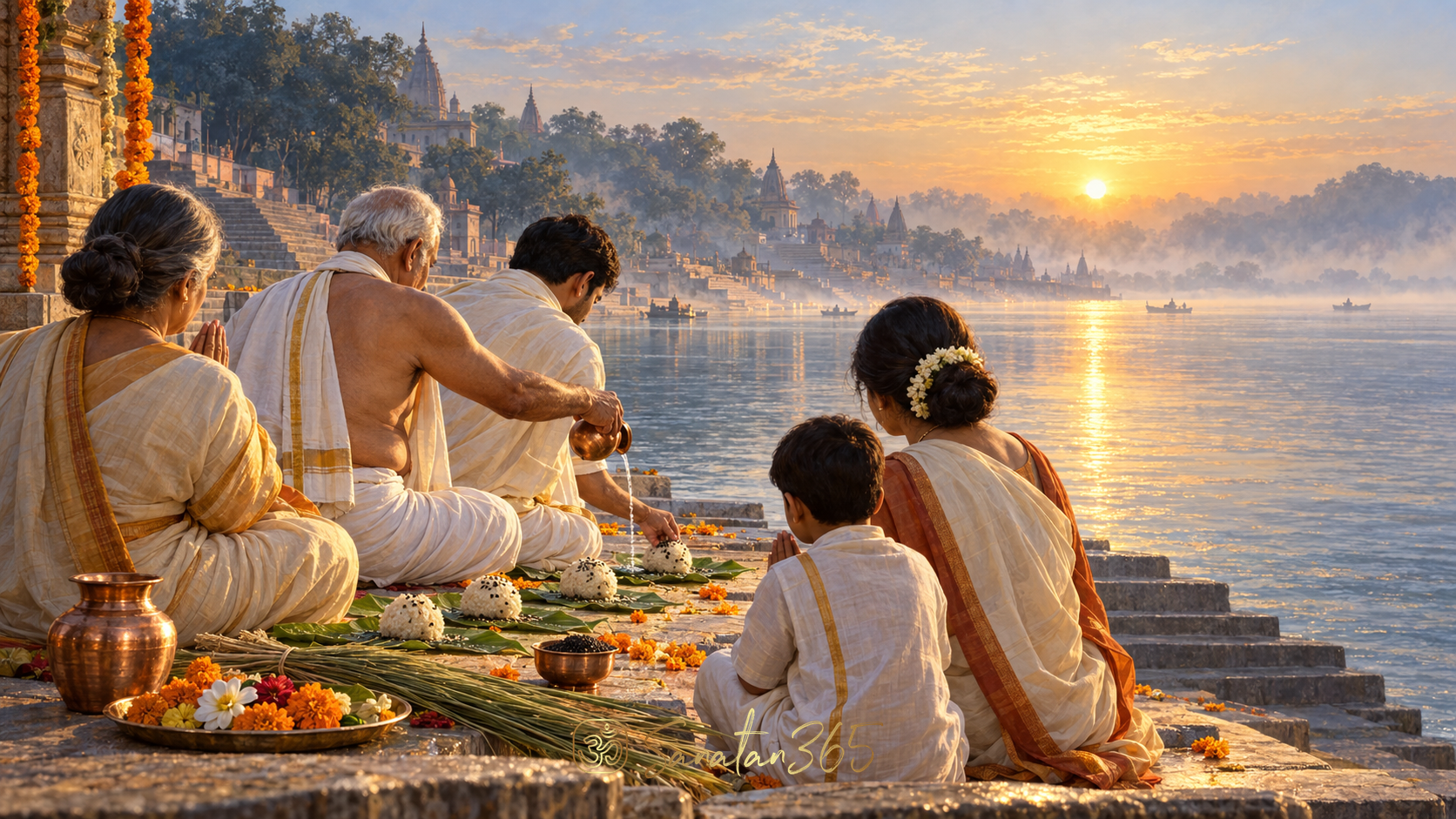
Pind Daan is a Hindu ancestral rite in which pindas, usually shaped offerings of food, are offered with remembrance and sacred intention. Its meaning joins gratitude, lineage, duty, and the hope that love can be expressed through disciplined ritual.
A small offering can carry the weight of generations. In Pind Daan, food shaped by human hands becomes a language of remembrance for those whose lives made the present family possible.
Pind Daan (piṇḍa-dāna, पिण्डदान, “the giving of a rounded food offering”) is a Hindu ancestral rite in which pindas are offered with mantra, water, and sacred intention according to one’s family and regional tradition. The Pind Daan meaning is deeper than a physical gift: it expresses gratitude to the pitrs (pitṛs, पितृ, “ancestors”), acknowledges duties inherited through lineage, and gives grief a disciplined form. It may be performed within Shraddha rites, during Pitru Paksha, or on other prescribed occasions under appropriate guidance.
What Is the Pind Daan Meaning?
The Sanskrit word pinda can refer to a rounded mass or body, while daana (dāna, दान) means “giving” or “offering.” In ancestral rites, a pinda is commonly prepared from cooked rice or another food base, with ingredients and procedures varying by tradition. Its rounded, gathered form makes several ideas visible at once: nourishment, embodied life, family continuity, and an offering made whole.
Pind Daan belongs to a larger Hindu ethic of remembering those from whom one has received life, care, language, custom, and opportunity. The Taittiriya Upanishad instructs the student, “Mātṛdevo bhava, pitṛdevo bhava,” commonly translated as “regard the mother as divine; regard the father as divine.” The passage concerns conduct toward living parents, yet it also illuminates the wider principle that gratitude to one’s sources is a sacred responsibility. An accessible translation is available through the Wisdom Library edition of the Taittiriya Upanishad.
The rite should not be reduced to a transaction promising automatic worldly rewards. Nor does one ceremony erase the complexity of a family’s history. Its spiritual force lies in truthful remembrance: receiving what was life-giving, acknowledging what was difficult, and choosing to carry the lineage forward with greater dharma, or ethical responsibility.
Key takeaway: Pind Daan turns gratitude to ancestors into a concrete act of sacred giving.
What Does a Pinda Symbolize?
A pinda is food, but ritual food is never only material. It is prepared, held, and offered within a framework of mantra, intention, relationship, and inherited procedure. This gives the pinda several connected meanings.
First, it signifies nourishment. Food sustains embodied life, and offering food recognizes that every body depends upon gifts received from earth, family, community, and the Divine. Second, its gathered form can symbolize individual embodiment within a larger lineage. A person is distinct, yet never entirely self-created. Third, the act of shaping and placing the offering asks the participant to give attention, not merely thought, to remembrance.
Traditional ingredients may include rice, sesame, barley flour, milk, ghee, honey, or other substances, but no single list should be presented as universal. Custom differs across regions, communities, ritual schools, and specific purposes. Even the number and placement of pindas may vary. A family priest or knowledgeable elder can identify the procedure appropriate to a particular lineage.
This variation does not weaken the rite. Sanatan Dharma often preserves shared principles through many local forms. What remains central is reverence, correct intention, and fidelity to the tradition being followed.
Key takeaway: The pinda symbolizes nourishment and embodied continuity, while its exact preparation belongs to living family and regional traditions.
How Are Pind Daan, Shraddha, and Tarpana Different?
These terms are related, but they are not interchangeable.
Shraddha (śrāddha, श्राद्ध) comes from shraddha (śraddhā, श्रद्धा), meaning faith, trust, or heartfelt reverence. It names a wider body of rites performed for ancestors. Depending on the tradition and occasion, Shraddha may include invocation, food offerings, hospitality, feeding others, charity, remembrance, and priest-guided actions.
Tarpana (tarpaṇa, तर्पण) means an act of satisfying or refreshing. It commonly involves offering water, often with sesame and mantra, to ancestors, deities, or sages according to ritual context. The flowing water makes remembrance visible as a sustained gesture of honour.
Pind Daan specifically centers the offering of pindas. It may form one part of a Shraddha ceremony, while Tarpana may accompany or occur within related observances. The exact relationship depends on the rite being performed.
The distinction matters because an online checklist cannot safely replace inherited instruction. Someone remembering a parent on an annual death anniversary may be following a different procedure from a pilgrim undertaking ancestral rites at Gaya. A person with limited access to ritual support may also honour ancestors through sincere remembrance, prayer, charity, or feeding living beings, while seeking informed guidance before performing technical rites.
Key takeaway: Shraddha is the broader ancestral observance, Tarpana centers liquid offerings, and Pind Daan centers shaped food offerings.
Why Are Gratitude and Lineage Duty Central to Pind Daan?
Hindu thought often describes human life through relationships of received obligation. One traditional expression is pitri rina (pitṛ ṛṇa, पितृ ऋण), the “debt to the ancestors.” Here, debt need not imply guilt. It means recognizing that life arrives through others and therefore carries responsibilities beyond individual preference.
Those responsibilities can include preserving worthy knowledge, caring for elders, raising the next generation with integrity, maintaining family memory, and using inherited resources responsibly. Ritual remembrance strengthens this ethic by naming the lineage rather than treating the self as isolated.
The opening chapter of the Bhagavad Gita records Arjuna’s fear that the breakdown of family dharma would interrupt ancestral offerings and damage continuity across generations. This is part of Arjuna’s distressed argument before Krishna’s teaching unfolds, so it should not be quoted as the Gita’s final philosophical conclusion. Still, verses 1.42–44 show that ancestral rites were understood as bound to family responsibility; readers can compare translations at Gita Supersite from IIT Kanpur.
This framework also allows mature honesty. Not every ancestral relationship was gentle, and reverence does not require denying harm. A person may acknowledge life received while setting necessary boundaries in the present. The rite can become a commitment not to repeat destructive patterns. Memory then serves dharma rather than nostalgia.
Key takeaway: Pitri rina is answered not only through ceremony, but through responsible living that honours and refines one’s inheritance.
Where and When Is Pind Daan Traditionally Performed?
Pind Daan may be performed on an annual death tithi (tithi, तिथि, “lunar day”), during prescribed funeral and post-funeral rites, in Pitru Paksha, or during pilgrimage observances. Timing varies by calendar tradition and family practice, so published dates should always be checked for the relevant location and lineage.
Pitru Paksha (pitṛ pakṣa, पितृ पक्ष, “fortnight of the ancestors”) is a widely observed period dedicated to Shraddha and remembrance. Families commonly identify the appropriate lunar day connected with an ancestor, while certain traditions also observe Sarva Pitru Amavasya for broader ancestral remembrance. Regional calendars may name or sequence observances differently.
Gaya in Bihar holds exceptional importance for Pind Daan. Its ancestral pilgrimage traditions center on sites connected with the Phalgu River and Vishnupad Temple. The Bihar Tourism account of Gaya provides practical heritage context, though ritual arrangements should still be verified through trusted local and family guidance.
Other sacred places, including Varanasi, Prayagraj, Haridwar, Nashik, Rameswaram, and pilgrimage sites linked with family customs, are also associated with ancestral rites. Yet place alone does not guarantee sincerity or correctness. The inner quality of reverence, and the disciplined guidance used, remain essential.
Key takeaway: Pind Daan is performed on lineage-specific occasions and at many sacred places, with Gaya holding a particularly prominent tradition.
How Can Families Approach Ancestral Rites Respectfully?
The most responsible first step is to ask what one’s own family actually practises. Elders, family records, a trusted priest, and the inherited sampradaya (sampradāya, सम्प्रदाय, “living tradition or lineage of teaching”) often provide context that generic online instructions cannot.
A careful approach includes:
- Confirm the occasion and tithi. Dates depend on the lunar calendar and local time.
- Identify the family tradition. Ingredients, mantras, eligibility customs, and sequences vary.
- Seek trustworthy guidance. Use an experienced priest or institution whose practice is transparent and respectful.
- Avoid fear-based selling. Ancestral devotion should not be manipulated through threats, guaranteed outcomes, or pressure to purchase extravagant services.
- Join ritual with conduct. Charity, feeding others, caring for elders, resolving family responsibilities, and preserving truthful memories give ethical depth to ceremony.
- Make room for grief. Ritual may support remembrance, but it does not replace professional mental-health care when grief becomes overwhelming or disabling.
People living far from family or without access to a priest should not feel that affection becomes meaningless. A simple, reverent act of remembrance can be sincere. Technical Pind Daan, however, deserves guidance because its form carries specific ritual meanings.
Respect also extends to the ritual setting. Food and water should be handled cleanly, sacred rivers and public spaces should not be polluted, and local rules should be followed. If a pilgrimage site is crowded, families can prepare in advance, ask clearly what a service includes, and decline anyone who uses intimidation. Transparent offerings, modest conduct, and care for the environment honour both ancestors and the living community that protects the tirtha (tīrtha, तीर्थ, “sacred crossing place”).
Children may be included through age-appropriate family stories rather than fear. Naming an ancestor’s kindness, work, sacrifices, recipes, songs, or moral courage helps remembrance become living education. Where family history includes pain, adults can speak truthfully without burdening children with unresolved conflict. In this way, ancestral memory becomes neither idealisation nor rejection, but a careful inheritance shaped by discernment.
Key takeaway: Respectful ancestral practice combines informed ritual guidance with ethical action, remembrance, and freedom from fear-based claims.
Conclusion
Pind Daan gives remembrance a form that can be prepared, held, and offered. Through the pinda, a family acknowledges that life is received before it is achieved. Through Shraddha and Tarpana, that gratitude enters a wider discipline of reverence. Through responsible living, the offering continues after the ritual space has been cleared.
Key takeaway: The deepest Pind Daan meaning is gratitude made active: honouring those who came before by offering with reverence and living the inheritance with greater dharma.
FAQ
What is Pind Daan in simple words?
Pind Daan is a Hindu ancestral rite in which rounded food offerings called pindas are offered with prayer and sacred intention. It expresses remembrance, gratitude, and responsibility toward one’s ancestors.
Is Pind Daan the same as Shraddha?
No. Shraddha is a broader category of ancestral rites. Pind Daan may be one part of Shraddha, specifically centered on offering pindas. Tarpana, which commonly centers on water offerings, may also be included according to tradition.
Can Pind Daan be performed only in Gaya?
No. Gaya is one of the most important pilgrimage centers for Pind Daan, but ancestral rites are performed in many sacred places and in family settings. The appropriate place and procedure depend on the family’s tradition and the ritual purpose.
When is Pind Daan performed?
It may be performed during post-funeral rites, on an annual death tithi, during Pitru Paksha, or on other prescribed occasions. Because dates and procedures vary, families should consult their calendar tradition and a trusted ritual guide.
What if someone cannot perform the full rite?
They can still remember ancestors reverently through prayer, charity, feeding others, preserving family stories, or caring for elders. These acts should not be presented as technical substitutes for every ritual requirement, but they can express sincere gratitude when formal access is limited.
About the author
Sanatan365 Editorial
Bringing Sanatan Dharma to modern seekers through authentic, scripture-grounded content.
Related in Rituals
 Rituals
Vastra Offering Meaning: Why Clothing Is Offered in Puja
The offering of cloth turns ordinary care into sacred hospitality. Understand vastra in Hindu worship without confusing expense with devoti…
 Rituals
Madhuparka Meaning: Sweetness and Sacred Hospitality
Read madhuparka as a ceremonial honey mixture of welcome, exploring textual recipes, guest reception and its distinction from panchamrita.
 Rituals
Samavartana Meaning: Returning Home After Sacred Study
Samavartana marks the completion of traditional study through a ceremonial bath and return. Its lasting question is how learning becomes re…

