Prashna Upanishad Meaning: Six Questions That Deepen Inquiry
Six seekers ask Pippalada about creation, vital power, sleep, Om, and the undivided Self. Their dialogue offers a thoughtful way to approach spiritual study.
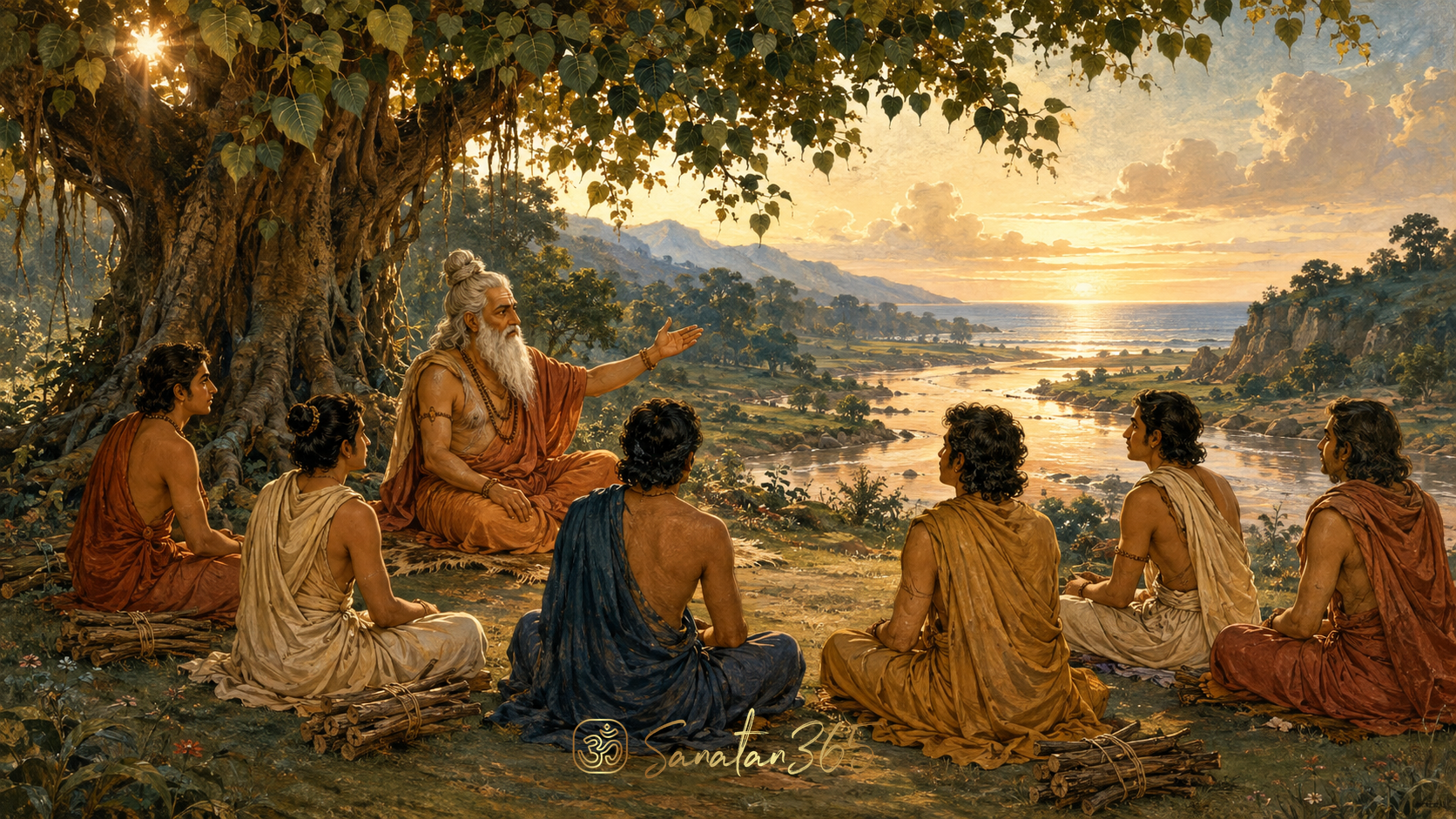
Six students arrive with questions. Their teacher asks them first to spend a year learning how to live as seekers.
Prashna Upanishad meaning begins with prashna (प्रश्न, praśna), “question.” This Upanishad, a sacred teaching text associated with the Atharva Veda, presents six dialogues with the sage Pippalada. They investigate the origin of beings, the power sustaining life, its source and functions, sleep and dreaming, meditation on the sacred syllable Om, and the inner person from whom sixteen aspects of embodied existence arise. Together, the questions lead from the visible world toward its deeper foundation.
The structure matters as much as any single answer. The students do not collect unrelated spiritual facts. Each inquiry exposes another assumption about life, perception, and identity. A reader following their sequence encounters a demanding but welcoming lesson: asking well requires attention, preparation, and the honesty to admit what remains unknown.
What does Prashna Upanishad meaning reveal about inquiry?
The opening describes six seekers approaching Pippalada with firewood in their hands, a traditional sign of readiness to enter a teacher's household and learning community. They seek Brahman (ब्रह्मन्, brahman), ultimate reality. Pippalada asks them to stay for a year with tapas (तपस्, tapas), disciplined effort; brahmacharya (ब्रह्मचर्य, brahmacarya), celibate student discipline in this setting; and shraddha (श्रद्धा, śraddhā), trusting commitment to inquiry. These details appear in Prashna Upanishad 1.1–2.
The delay is not a refusal to answer. It establishes that subtle knowledge asks something of the person receiving it. A restless listener may understand the vocabulary while missing the relationship between the ideas. Preparation creates space for a question to become more precise.
Pippalada also qualifies his promise: if he knows, he will explain. Within the narrative, this is striking intellectual humility. The teacher's authority does not depend on pretending that every question is easy, and the student's respect does not require abandoning inquiry.
The six questions of Prashna Upanishad can be remembered in this order:
- Origin: From where are living beings born?
- Support: Which powers sustain the person, and which is foremost?
- Source and movement: Where does vital power arise, and how does it function?
- Experience: What sleeps, dreams, remains awake, and rests?
- Contemplation: What does sustained meditation on Om lead toward?
- Wholeness: Where is the person associated with sixteen parts?
This is not a questionnaire with one-word answers. Several questions contain smaller questions, and each response combines imagery, sacred cosmology, and contemplative teaching. Reading only an isolated quotation can obscure that progression.
Key takeaway: In this text, disciplined preparation and sincere questioning belong together.
How do the first three questions explain creation and prana?
Kabandhi Katyayana asks the first question about the origin of beings. Pippalada answers through Prajapati (प्रजापति, prajāpati), the lord of creatures, and a pair: rayi (रयि, rayi), matter or nourishing form in this context, and prana (प्राण, prāṇa), the vital principle. The teaching associates the moon with rayi and the sun with prana, then extends these relationships to the year, month, day, food, and generation of life (1.3–16).
These correspondences belong to the text's sacred account of existence. Translating prana simply as “oxygen” or rayi as a modern scientific category would narrow the teaching and imply an equivalence the passage does not establish. Its concern is the relationship between that which gives form and that which animates, not a laboratory explanation of biological origins.
Bhargava Vaidarbhi's second question shifts attention from the cosmos to the person. Space, air, fire, water, earth, speech, mind, sight, and hearing all claim to uphold the body. Prana then demonstrates their dependence: when it appears ready to depart, the others follow; when it settles, they settle. The text compares them to bees following their leader (2.1–4).
The image gives a philosophical point dramatic form. A faculty can be impressive without being independent. Sight reveals colour and form, but the ability to see does not explain the whole living person. Speech expresses an answer, but speech alone is not the source of the speaker's life.
Why does the third student ask another question about prana?
Kaushalya Ashvalayana goes further. If prana sustains the faculties, where does prana itself come from? Pippalada answers that it arises from Atman (आत्मन्, ātman), the Self, using the relationship between a person and a shadow as an analogy (3.1–3). The sequence therefore does not stop at praising vital power as the final explanation.
The answer also describes a fivefold distribution of vital functions. Alongside prana in its narrower functional sense, it names apana (अपान, apāna), the downward-moving function; samana (समान, samāna), the equalising function associated with assimilating food; vyana (व्यान, vyāna), the pervading function; and udana (उदान, udāna), the upward-leading function (3.4–10).
This is traditional contemplative physiology, not a set of instructions for altering breathing. The article explains the terms without turning them into a self-directed technique. The related account of Vayu and life-breath explores another traditional context, while the present dialogue asks specifically about dependence and source.
Key takeaway: The first three questions move from the origin of beings to what sustains the person, then to the source of that sustaining power.
What does the fourth question ask about sleep and the Self?
Sauryayani Gargya asks what sleeps, what stays awake, what experiences dreams, whose happiness is experienced, and where all these powers finally rest. Everyday sleep becomes an opening for philosophical inquiry rather than merely a pause in daily activity.
Pippalada first compares the senses to rays gathering into the sun at sunset. During sleep, their outward activity gathers into the mind. The vital functions remain awake, described through the imagery of sacred fires within the city of the body (4.1–4).
In dreaming, the mind sees and hears again, moving among familiar and unfamiliar experiences. The passage recognises that the dream world has its own apparent fullness even when the ordinary waking relationship with external objects has changed. When the mind no longer dreams, the teaching speaks of happiness and rest (4.5–6).
Then comes another image: birds returning to a tree. Just as the birds settle on a common support, the faculties and their objects rest in the supreme Self (4.7–11). The metaphor shifts attention away from each separate activity toward the foundation on which activity depends.
The passage should not be reduced to the claim that everyone becomes fully enlightened each night. Ordinary sleep and clear knowledge of the Self are not interchangeable. The text uses changing states of experience to direct inquiry toward the imperishable, rather than presenting unconsciousness as a sufficient spiritual achievement.
Nor is this a dream-prediction manual. It does not ask readers to treat every dream as a message about tomorrow. Its question is deeper: when the usual field of sight, sound, and deliberate action changes, what can be learned about the experiencing person?
Readers familiar with the Mandukya Upanishad's account of Om and states of experience will recognise a related concern. Each text deserves to be read in its own sequence, without assuming that similar themes make their methods identical.
Key takeaway: Sleep becomes a doorway to examining experience and its foundation, not a shortcut to prediction or attainment.
How does the fifth question approach Om meditation?
Shaibya Satyakama asks about the result of meditating on Om throughout life. Pippalada describes Om as a support for approaching both higher and lower Brahman, then distinguishes contemplation of one, two, and three matras (मात्रा, mātrā), measures or sound-components (5.1–5).
The teaching presents different outcomes for partial and complete contemplation. It relates them to human life, a lunar world, and a further ascent toward the supreme Purusha (पुरुष, puruṣa), the inner or supreme Person. These are the text's spiritual and cosmological claims, not outcomes that a modern article can independently guarantee.
What is often lost in a simplified retelling is the emphasis on integration. The closing verses discuss the components in relation to one another and describe Om as the support through which the wise approach the peaceful, undecaying, fearless supreme reality (5.6–7).
The chapter is therefore more than a recommendation to repeat a sound for a particular number of minutes. Meaning, sustained contemplation, and the seeker's orientation matter. A comfortable voice recording may help someone learn pronunciation, but hearing a recording and understanding this teaching are different activities.
For a beginner, the useful first step is textual: read the question, identify what the teacher says is being contemplated, and notice how the response connects sound with its referent. Formal recitation and contemplative practice can then be learned within a trusted teaching tradition. There is no need to convert a subtle passage into an instant technique.
Key takeaway: The fifth question treats Om as a meaningful support for sustained contemplation, not a mechanical promise attached to sound.
What are the sixteen parts in the final question?
Sukesha Bharadvaja introduces the final question by recalling an encounter with a prince who asked about the person of sixteen parts. Sukesha admitted that he did not know. Rather than inventing an answer to preserve his reputation, he brings the unresolved question to Pippalada.
This opening joins ethics to understanding. The final teaching begins with an honest limit, not a display of expertise. The episode and answer can be read in Prashna Upanishad 6.1–8.
Pippalada places the Purusha within the body and describes sixteen kalas (कला, kalā), parts or aspects, arising from that source. In sequence, these are vital power, faith, space, air, light or fire, water, earth, the senses, mind, food, vigour, disciplined effort, sacred formulas, action, worlds, and names (6.2–4).
The list includes more than physical ingredients. It encompasses bodily life, attention, nourishment, spiritual discipline, meaningful action, and the named worlds in which experience takes shape. Calling these “sixteen organs” would therefore be misleading.
The concluding image is water returning to the sea. Rivers have different names and forms, yet on reaching the ocean they are spoken of as ocean. In the same way, the text describes the sixteen aspects returning to their source, pointing toward the partless and immortal Purusha (6.5).
The image is contemplative, not an instruction to erase anyone's individuality in ordinary relationships. Names and responsibilities continue to matter in daily conduct. The teaching challenges the assumption that a person is exhaustively explained by a collection of changing attributes.
Key takeaway: The final question gathers many aspects of life around one source, while making truthful admission of ignorance part of the path to understanding.
How can the six-question structure guide careful study?
A useful reading practice is to keep three columns in a notebook: the student's question, the teacher's image, and the point the image helps clarify. For the second question, these might be sustaining power, the bees, and dependence. For the sixth, they might be the source of the parts, rivers entering the ocean, and the relation between differentiation and wholeness.
This method helps prevent a common mistake: remembering a beautiful metaphor while forgetting what it answers. It also creates room for uncertainty. If the meaning of a passage remains unclear, the notebook can preserve the question instead of covering it with a confident slogan.
A study group in India or the diaspora can read one question at a time, using the same translation before comparing commentaries. Regional recitation traditions and philosophical explanations may differ; pronunciation, translation, and interpretation should be distinguished rather than treated as competing measures of devotion.
The Upanishad closes with the students honouring Pippalada for carrying them beyond ignorance. Its ending returns to the relationship established at the beginning: sincere seekers, a teacher, disciplined attention, and a willingness to ask.
Key takeaway: Read the six questions as a connected inquiry, allowing preparation, evidence, and honest uncertainty to deepen understanding.
FAQ
What is the main teaching of the Prashna Upanishad?
Its six dialogues trace the origin and support of embodied life toward the Self and the supreme reality. The progression includes creation, vital functions, sleep, Om contemplation, and the sixteen aspects that arise from and return to the Purusha.
Who teaches the six students?
The sage Pippalada answers them. The opening presents a year of preparation before questioning, emphasising disciplined effort, student restraint, and trusting commitment rather than an immediate exchange of information.
Does prana mean only physical breath?
No. In this text, prana has a broader role as the vital principle supporting the faculties and embodied life. Its fivefold functions belong to a traditional account and should not simply be equated with modern anatomical categories.
Are the sixteen parts sixteen bodily organs?
No. The list includes senses and mind but also faith, food, disciplined effort, sacred formulas, action, worlds, and names. It describes aspects of embodied existence, not merely physical organs.
Is the Prashna Upanishad suitable for beginners?
Yes, with patient reading and a reliable translation or teacher. Following the order of the six questions is more helpful than extracting isolated promises. Difficult passages can remain open questions while the reader develops context.
About the author
Sanatan365 Editorial
Bringing Sanatan Dharma to modern seekers through authentic, scripture-grounded content.
Related in Scriptures
 Scriptures
Tattva Bodha Meaning: Four Qualifications for Clear Self-Inquiry
A beginner-friendly reading of Tattva Bodha, its four qualifications, six inner disciplines, and careful distinction between preparation an…
 Scriptures
Nirvana Shatakam Meaning: Six Verses of Self-Inquiry
Read the six verses of Nirvana Shatakam as careful Advaita self-inquiry, understand Shivoham, and distinguish contemplative freedom from ne…
 Scriptures
Atharva Veda Meaning: Household Prayer and Cosmic Questions
The Atharva Veda brings household concerns, communal hopes, and questions about existence into sacred speech. Learn its scope and how to re…

