Rashi Meaning in Hindu Astrology: Moon Sign, Zodiac, and Inner Pattern
A clear guide to rashi in Hindu astrology: what it means, how Janma Rashi differs from Sun sign and Lagna, and how to approach it with spiritual maturity.
The word rashi is simple, but the way Hindu families use it is often misunderstood.
Rashi meaning in Hindu astrology is the zodiac sign connected with a person's birth chart, most commonly the Janma Rashi (जन्म राशि, birth sign), the sign where the Moon was placed at birth. In Jyotisha (ज्योतिष, the Hindu discipline of light, time, and celestial calculation), rashi helps place the Moon, planets, and Lagna within twelve sections of the zodiac. It is a language of timing and temperament, not a guarantee of destiny.
For many Indian households, rashi appears first through a child's naming letter, a panchang consultation, a Kundali discussion, or a family elder asking, "What is your rashi?" The answer may sound like Mesha, Vrishabha, Mithuna, Karka, Simha, or another familiar sign. But beneath that quick answer is a deeper system: the Moon's emotional imprint, the rising sign's worldly orientation, the nakshatra's finer rhythm, and the larger dharmic question of how a person uses self-knowledge wisely.
What Is Rashi Meaning in Hindu Astrology?
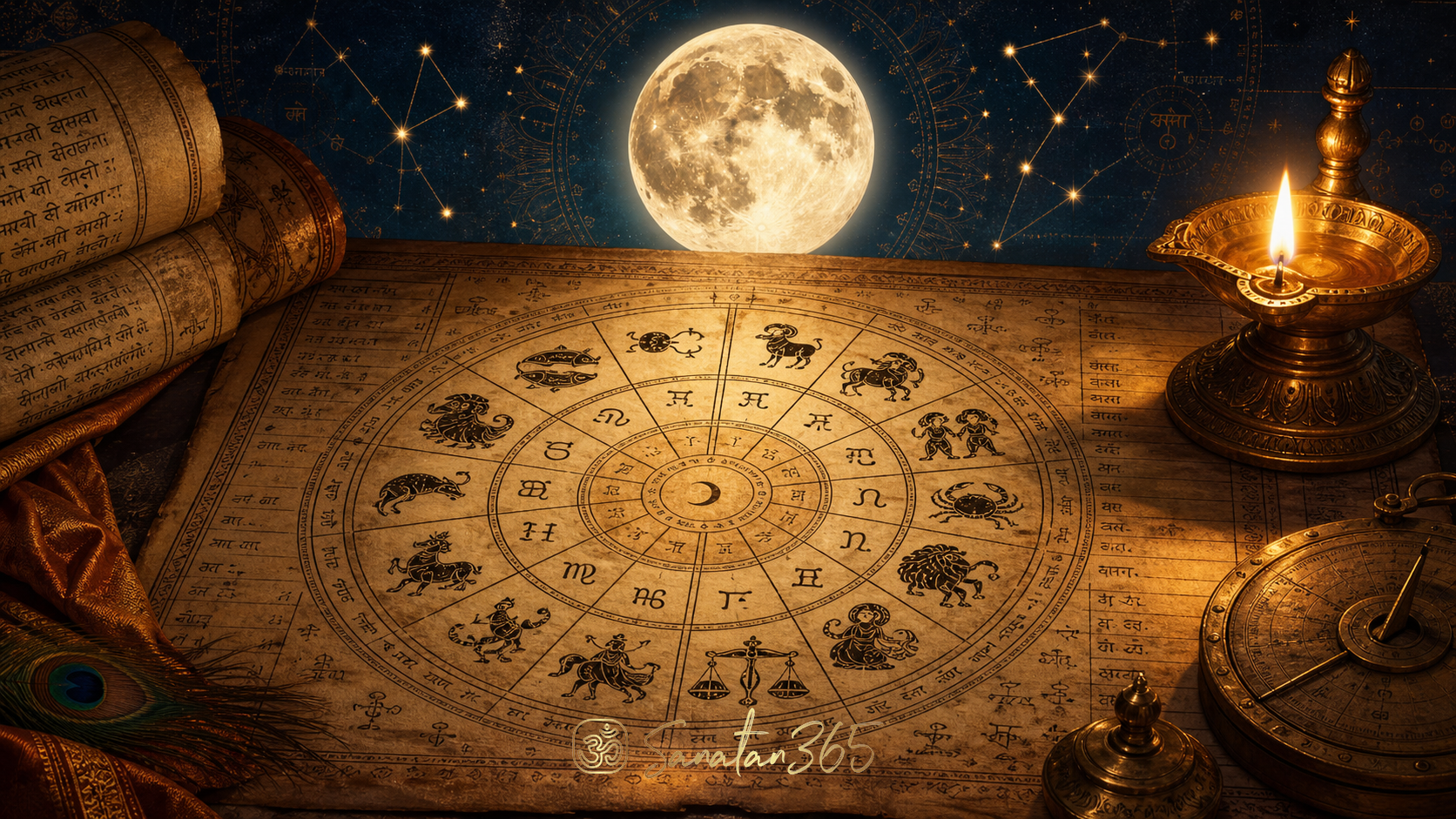
Rashi meaning begins with the Sanskrit word rashi (राशि, heap, group, or sign). In the astrological context, it refers to one of the twelve zodiacal divisions used in Jyotisha. Each rashi covers 30 degrees of the 360-degree zodiac, forming a twelve-part wheel through which the Moon, Sun, planets, and ascendant are read.
In everyday Indian use, however, "rashi" often means Janma Rashi: the Moon sign at birth. Drik Panchang defines Janma Rashi as the zodiac sign in which the Moon was located at the time of birth, and also notes that Janma Nakshatra is the lunar mansion occupied by the Moon at birth (Drik Panchang). This is why Hindu astrology often feels more Moon-centered than popular Western Sun-sign astrology.
The broader tradition is called Jyotisha, often translated as "science of light." As an ancient Indian discipline, it historically included astronomy, calendrical calculation, ritual timing, and astrological interpretation. Modern readers should keep two truths together: Jyotisha has deep cultural and religious significance, and astrology should not be treated as a scientific certainty or a substitute for practical judgment. Encyclopedic summaries of Hindu astrology also note both its traditional role and the modern scientific critique of astrology's predictive claims (Hindu astrology overview).
Key takeaway: Rashi is a zodiac sign in the Hindu astrological chart, and in ordinary family language it usually points to the Moon sign, or Janma Rashi.
How Are the Twelve Rashi Signs Named?
The twelve rashi signs are broadly parallel to the twelve zodiac signs known globally, but their Sanskrit names and cultural use belong to the Jyotisha system:
- Mesha (मेष, Aries)
- Vrishabha (वृषभ, Taurus)
- Mithuna (मिथुन, Gemini)
- Karka (कर्क, Cancer)
- Simha (सिंह, Leo)
- Kanya (कन्या, Virgo)
- Tula (तुला, Libra)
- Vrishchika (वृश्चिक, Scorpio)
- Dhanu (धनु, Sagittarius)
- Makara (मकर, Capricorn)
- Kumbha (कुम्भ, Aquarius)
- Meena (मीन, Pisces)
Each rashi is not merely a label. It becomes meaningful only when placed in a chart: which planet occupies it, which house it falls in, what the Moon is doing, how the Lagna (लग्न, ascendant) is positioned, and what the larger timing system indicates. A sign by itself is like a word without a sentence.
This is especially important because public horoscope culture can reduce rashi to personality shortcuts. In classical and household practice, a rashi is part of a larger grammar. Mesha may be associated with initiative, Karka with emotional protection, Simha with radiance, Kanya with refinement, and so on, but these meanings are never complete without context.
Key takeaway: The twelve rashis are the zodiac's twelve signs in Sanskrit usage, but their meaning depends on chart context, not isolated sign stereotypes.
Why Is Janma Rashi Often More Important Than Sun Sign?
In many Hindu astrology conversations, the Moon receives special attention because it is linked with manas (मनस्, mind or inner faculty). The Moon changes signs quickly compared with the Sun, so it gives a more specific birth-chart marker than the month-based Sun sign. This is why a Hindu family may ask for date, time, and place of birth rather than only a birthday month.
Janma Rashi is used in several familiar ways:
- Naming traditions, where the Moon's nakshatra and pada may suggest starting syllables.
- Panchang-based observances, where lunar tithi and Moon position shape timing.
- Compatibility discussions, especially in traditional Kundali matching.
- Daily or monthly rashi readings, though these should be approached lightly.
- Emotional self-reflection, because the Moon is associated with response, memory, and inner rhythm.
The Moon-centered approach does not mean the Sun is irrelevant. It means Jyotisha reads identity through a different emphasis. The Sun may show authority, vitality, and soul-centered clarity; the Moon may show receptivity, emotional pattern, and the mind's habitual movement; Lagna shows the embodied starting point of the chart.
This also explains why two people born in the same Western Sun-sign month may have different Janma Rashis. A person born in late March may be called Aries in a Sun-sign magazine but have a Karka Moon, Tula Lagna, and a nakshatra that changes the interpretation significantly.
Key takeaway: Janma Rashi matters because Hindu astrology often uses the Moon as a central marker of mind, emotion, naming, timing, and household practice.
What Is the Difference Between Rashi, Lagna, and Nakshatra?
Rashi, Lagna, and Nakshatra are related, but they are not the same.
Rashi is the zodiac sign. When someone says "my rashi," they usually mean the sign of the Moon at birth. But technically, every planet in a chart occupies a rashi.
Lagna is the ascendant, the sign rising on the eastern horizon at the time and place of birth. It becomes the first house of the Kundali and sets the chart's house structure. If Janma Rashi is the Moon's sign, Lagna is the chart's doorway.
Nakshatra (नक्षत्र, lunar mansion) is a finer division of the sky used especially for the Moon. There are 27 nakshatras in the standard Jyotisha system, and each has four padas (पाद, quarters). In family contexts, nakshatra often matters for naming syllables, muhurta (मुहूर्त, auspicious timing), and deeper temperament readings.
A simple way to understand the three:
- Rashi gives the broad sign field.
- Lagna gives the life-chart orientation and house structure.
- Nakshatra gives a subtler lunar rhythm.
For example, if the Moon is in Vrishabha Rashi, that is the Janma Rashi. If the eastern horizon at birth is Simha, the Lagna is Simha. If the Moon is in Rohini Nakshatra, that nakshatra adds another layer. Each answer is correct, but each answers a different question.
Key takeaway: Rashi is the sign, Lagna is the ascendant, and Nakshatra is the lunar mansion; confusing them creates shallow astrology.
How Should a Devotional Reader Use Rashi Without Becoming Fatalistic?
A mature Hindu approach to rashi begins with humility. The chart may be treated as a mirror for reflection, but dharma (धर्म, right order and duty), viveka (विवेक, discernment), and karma (कर्म, action) remain central. No rashi removes responsibility. No difficult placement makes a person helpless. No favorable placement guarantees wisdom.
The Bhagavad Gita repeatedly returns attention to disciplined action and inner steadiness rather than passive fate. A chart may describe tendencies, seasons, or symbolic patterns, but a person's conduct still matters. In devotional life, rashi should support self-awareness, not anxiety.
Healthy ways to use rashi include:
- Notice emotional patterns without labeling yourself permanently.
- Use lunar calendars to create rhythm for prayer, fasting, study, or charity.
- Treat compatibility readings as one input, not the whole truth of a relationship.
- Avoid fear-based remedies that pressure people into panic spending.
- Remember that spiritual practice is not limited by one's sign.
This is especially important for parents. A child's Janma Rashi may be used for naming or family rituals, but it should never become a narrow identity cage. A child is not "only Karka" or "too Vrishchika" or "destined because of Shani." Hindu thought is far richer than that. Samskara (संस्कार, refinement through values and practice), family love, education, and devotion shape life profoundly.
Key takeaway: Rashi is best used as reflective language, not fatalistic command. It should deepen steadiness, not create fear.
What Are Common Mistakes About Rashi Meaning?
The first mistake is treating rashi as identical to Western Sun sign. The two systems use similar twelve-sign language, but the default reference point is often different. Western popular astrology usually begins with the Sun sign; Hindu household astrology often begins with the Moon sign.
The second mistake is forgetting the sidereal framework. Jyotisha commonly uses a sidereal zodiac, which measures signs against a fixed stellar background, while most Western astrology uses a tropical zodiac tied to equinoxes and seasons. Over centuries, these two reference systems shift apart because of precession. This is why a person's Western Sun sign and Vedic sign may differ.
The third mistake is turning every rashi reading into a prediction. A sign can suggest qualities and symbolic themes, but serious interpretation needs the whole chart, including Lagna, houses, grahas (ग्रह, planets or seizing influences), aspects, dashas, and transits. Even then, good counsel should be careful, ethical, and non-coercive.
The fourth mistake is using astrology to avoid ordinary wisdom. Health decisions need qualified medical care. Legal and financial decisions need proper experts. Relationships need honesty, patience, and communication. Rashi can be part of cultural and spiritual reflection, but it should never replace grounded responsibility.
Key takeaway: Rashi becomes misleading when it is separated from Moon sign context, sidereal calculation, the whole chart, and practical judgment.
FAQ
What is rashi in simple words?
Rashi is a zodiac sign in Hindu astrology. In everyday use, it usually means Janma Rashi, the sign where the Moon was located when a person was born.
Is rashi the same as Moon sign?
Often, yes. When Indian families ask "What is your rashi?" they usually mean the Moon sign or Janma Rashi. Technically, every planet also occupies a rashi in the chart.
Is rashi the same as Lagna?
No. Rashi usually refers to the Moon sign in common speech, while Lagna is the ascendant, the sign rising on the eastern horizon at birth. Both are important, but they answer different chart questions.
Why does my Vedic rashi differ from my Western zodiac sign?
The systems often use different reference points. Jyotisha commonly uses the sidereal zodiac and often emphasizes the Moon sign, while popular Western astrology usually uses the tropical Sun sign.
Should rashi decide major life choices?
Rashi should not be the sole basis for major decisions. It can support reflection and cultural practice, but health, legal, financial, marriage, and career decisions need practical judgment and qualified guidance.
Conclusion
Rashi meaning is not just "your sign." It is a doorway into how Hindu astrology reads the Moon, the zodiac, time, temperament, and spiritual responsibility. When understood carefully, Janma Rashi can help a person notice inner patterns, respect lunar rhythms, and participate in family traditions with more clarity.
The single key takeaway: rashi is useful when it supports self-knowledge and dharma, and harmful when it becomes fear, fatalism, or a substitute for wise action.
About the author
Sanatan365 Editorial
Bringing Sanatan Dharma to modern seekers through authentic, scripture-grounded content.
Related in Astrology
 Astrology
Karana Meaning: How to Read the Half-Tithi in a Panchang
Understand the eleven karanas, their six-degree lunar measure, why they change within a day, and how to read timings without fear-based pre…
 Astrology
Rahu Kalam Meaning: Timing, Calculation, and Thoughtful Practice
Rahu Kalam is a daily interval traditionally treated as unsuitable for beginning important worldly undertakings. Learn how it is calculated…
 Astrology
Muhurta Meaning: How Hindu Tradition Chooses an Auspicious Time
Muhurta is the Hindu discipline of choosing a fitting time for a meaningful action by considering the Panchanga, the purpose of the act, an…