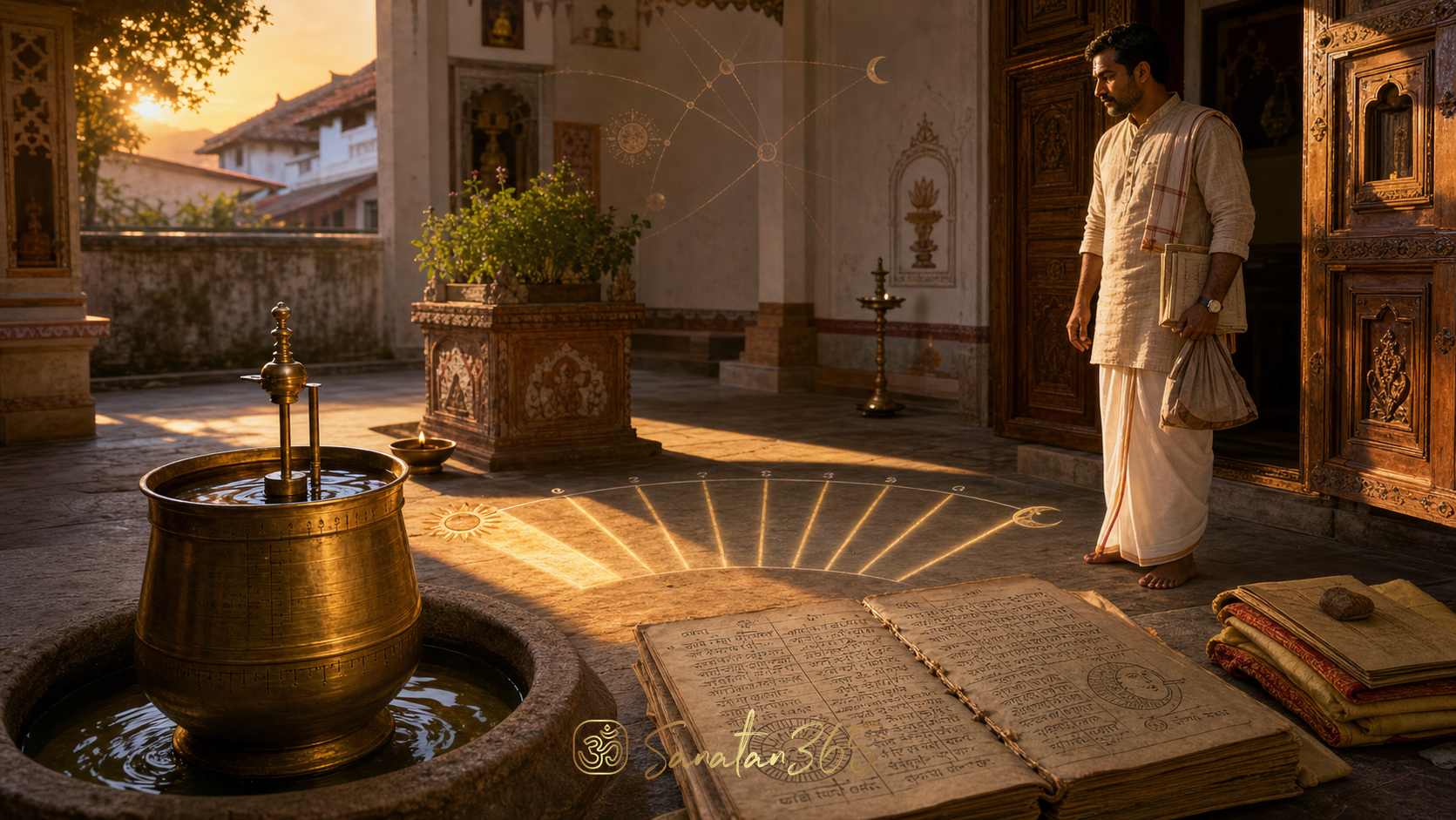
Rahu Kalam Meaning: Timing, Calculation, and Thoughtful Practice
Rahu Kalam is a daily interval traditionally treated as unsuitable for beginning important worldly undertakings. Learn how it is calculated and approached without fear.
A clock may say 9:00 a.m., yet a traditional Hindu calendar may ask a more subtle question: what quality does this part of the day carry?
Rahu Kalam meaning refers to a recurring daytime interval that many Hindu astrology traditions consider unsuitable for starting important worldly undertakings. Rahu Kalam, also written Rahu Kaal, is not a fixed hour. Its local time changes with sunrise, sunset, weekday, and location because the daylight period is divided into eight equal parts. The custom is best understood as a discipline of timing, not a prediction that something terrible must happen.
What Is Rahu Kalam Meaning in Hindu Astrology?
Rāhu Kāla (राहु काल, “the time of Rahu”) combines Rāhu, the shadow graha associated in Jyotisha with obscuration, appetite, disruption, and unconventional movement, with kāla (काल, time). A graha (ग्रह, “seizer” or planetary influence) is not identical to a physical planet in modern astronomy; it belongs to the interpretive language of Jyotisha, the Indian tradition of astral calculation and interpretation.
Rahu and Ketu are understood as the ascending and descending lunar nodes. Astronomically, these are the two points where the Moon’s apparent path crosses the ecliptic, and eclipses occur when the Sun, Moon, and a node align closely. NASA’s explanation of eclipse geometry and lunar nodes helps clarify the astronomical relationship without reducing the religious symbolism to mechanics alone.
In calendar practice, Rahu Kalam assigns one of eight daytime portions to Rahu on each weekday. Many households consult a pañcāṅga (पञ्चाङ्ग, “five-limbed calendar”), commonly written panchang or panchanga, before a journey, ceremony, purchase, agreement, or other meaningful beginning. The interval is particularly visible in South Indian calendars, though digital panchangas have made it familiar far beyond one region.
The practical emphasis falls on beginnings. Work already underway does not ordinarily become invalid merely because Rahu Kalam arrives. Daily duties, care work, worship, study, meals, medical needs, and unavoidable responsibilities are not reasons for panic or neglect.
Key takeaway: Rahu Kalam is a traditional timing caution for selected beginnings, not a declaration that the whole interval is evil.
How Is Rahu Kalam Calculated Each Day?
Rahu Kalam timing is calculated from the local span between sunrise and sunset. That daylight span is divided into eight equal segments. Each weekday assigns Rahu Kalam to a different segment.
The traditional weekday sequence is often remembered this way:
- Monday: second segment
- Saturday: third segment
- Friday: fourth segment
- Wednesday: fifth segment
- Thursday: sixth segment
- Tuesday: seventh segment
- Sunday: eighth segment
This list is arranged as a mnemonic sequence, not in ordinary Sunday-to-Saturday order. In weekday order, Sunday takes the eighth segment, Monday the second, Tuesday the seventh, Wednesday the fifth, Thursday the sixth, Friday the fourth, and Saturday the third.
A worked example
Suppose sunrise is 6:00 a.m. and sunset is 6:00 p.m. Daylight lasts 12 hours, or 720 minutes. Dividing 720 by eight gives segments of 90 minutes each:
- Segment 1: 6:00–7:30 a.m.
- Segment 2: 7:30–9:00 a.m.
- Segment 3: 9:00–10:30 a.m.
- Segment 4: 10:30 a.m.–12:00 p.m.
- Segment 5: 12:00–1:30 p.m.
- Segment 6: 1:30–3:00 p.m.
- Segment 7: 3:00–4:30 p.m.
- Segment 8: 4:30–6:00 p.m.
On Monday, Rahu Kalam would then be 7:30–9:00 a.m.; on Friday, 10:30 a.m.–12:00 p.m.; on Sunday, 4:30–6:00 p.m.
Those familiar clock times are only approximations for a 6-to-6 daylight day. In London, Chennai, Singapore, or Toronto, sunrise and sunset differ. They also shift across seasons. A panchanga using the correct location is therefore more reliable than a copied universal chart. Drik Panchang’s overview of Rahu Kalam calculation likewise emphasizes location-based sunrise and sunset.
Key takeaway: To calculate Rahu Kalam, divide local daylight into eight equal parts and select the weekday’s assigned segment.
What Do People Traditionally Avoid During Rahu Kalam?
Custom commonly advises against inaugurating a consequential undertaking during Rahu Kalam. Examples may include:
- beginning a long journey when timing is freely adjustable;
- signing a major agreement;
- opening a business or entering new premises;
- making the ceremonial first move in an important purchase;
- commencing a wedding rite or other muhūrta (मुहूर्त, selected auspicious time) event;
- launching a project whose beginning carries symbolic weight.
Practice varies by family, teacher, region, and the kind of activity involved. Rahu Kalam is also only one element within muhūrta-śāstra (मुहूर्तशास्त्र, the discipline of selecting time). Tithi, nakshatra, weekday, local custom, and the individual context may matter. A single interval should not be treated as a complete astrological judgment.
Many practitioners make a distinction between commencing and continuing. If a train journey began earlier, Rahu Kalam need not turn the middle of the trip into a crisis. If a nurse’s shift, examination, funeral duty, caregiving responsibility, or necessary appointment falls in the interval, dharma and practical care take precedence over anxiety.
This distinction resembles the broader Hindu habit of bringing intention to beginnings. The meaning of sankalpa in puja shows how a conscious opening can orient an action, while the practice of Sandhya Vandana illustrates how transitions in the day can become occasions for recollection.
Key takeaway: Rahu Kalam traditionally concerns freely chosen beginnings; it is not a command to abandon necessary duties or interrupt responsible work.
Does Rahu Kalam Mean Something Bad Will Happen?
No responsible reading can guarantee that harm will occur because a task began during Rahu Kalam. Jyotisha offers a traditional interpretive framework, not a mechanism for making absolute promises about success or failure.
Fear grows when a timing custom is detached from proportion. Three distinctions help restore balance:
First, caution is not certainty. A sailor may check the tide without believing every other hour brings disaster. In the same way, a family may prefer another starting time without condemning the interval.
Second, Rahu’s symbolism is not simply “evil.” Hindu narratives and astrological traditions often use Rahu to speak about eclipse, concealment, restless desire, worldly ambition, foreignness, disruption, and perception. These themes can be difficult, yet difficulty is not the same as moral wickedness.
Third, ethical action matters more than magical control. Choosing a preferred time cannot make a dishonest contract righteous, and an unavoidable time cannot make compassionate service wrong. The Bhagavad Gita repeatedly directs attention toward disciplined action, discernment, and relinquishment of possessive control over results. Timing may support intention, but it cannot replace dharma.
People experiencing persistent anxiety around calendars or omens should step back from compulsive checking and speak with a trusted elder, qualified counsellor, or mental-health professional as appropriate. Spiritual customs can complement well-being; they should not become instruments of distress.
Key takeaway: Rahu Kalam expresses traditional caution, never a guaranteed prediction of misfortune.
How Can a Modern Household Use Rahu Kalam Thoughtfully?
A balanced practice can remain faithful to tradition while fitting contemporary life.
1. Use the correct location
Check sunrise and sunset for the place where the activity begins. Do not assume a printed 90-minute table applies year-round everywhere.
2. Reserve it for meaningful choices
Consult Rahu Kalam for important beginnings when there is genuine flexibility. Avoid turning every email, meal, phone call, or doorstep crossing into an astrological test.
3. Do not neglect duty
Health care, safety, employment obligations, school requirements, caregiving, and urgent travel should not be delayed merely to satisfy a preferred interval. If a medical situation is urgent, seek professional care immediately.
4. Ask what the pause is teaching
When a beginning can wait, the interval may be used for review, preparation, prayer, japa, or quiet correction. The value may lie partly in refusing impulsiveness. One can check the contract again, gather missing documents, clarify motivation, or remember those affected by the decision.
5. Keep the custom non-judgmental
Not every Hindu family observes Rahu Kalam, and those who do may follow different panchangas. Respecting one’s lineage does not require declaring another household careless or spiritually inferior.
6. Consult expertise for major rites
For a wedding, consecration, house-entry ceremony, or complex horoscope-based election, a knowledgeable priest or Jyotisha practitioner can consider the full context. A generic online table is not a substitute for a complete muhurta assessment.
Used this way, Rahu Kalam becomes a modest rhythm of discernment. It reminds a household that not every moment must be forced into productivity and that beginnings deserve attention. It remains a servant of thoughtful action rather than a master of fear.
Key takeaway: The most constructive observance is local, proportionate, flexible around duty, and free from judgment.
Conclusion
Rahu Kalam is a daily, location-dependent interval calculated by dividing daylight into eight equal parts and assigning one segment to Rahu according to the weekday. Tradition often avoids starting major elective undertakings during it, while allowing necessary duties and already-begun work to continue. Its wisdom is clearest when it creates preparation and humility, not dread.
Key takeaway: Honour Rahu Kalam as a traditional aid to intentional timing, never as a guarantee, threat, or replacement for ethical judgment.
FAQ
What is Rahu Kalam in simple words?
Rahu Kalam is one of eight daytime segments that Hindu astrology traditionally treats as unsuitable for beginning selected important worldly activities. Its exact clock time depends on local sunrise, sunset, and weekday.
Is Rahu Kalam the same time every day?
No. The assigned segment changes by weekday, and its clock time changes with location and seasonal daylight. Fixed tables usually assume a 6:00 a.m. sunrise and 6:00 p.m. sunset and are therefore approximate.
Can worship be done during Rahu Kalam?
Many people continue regular prayer, temple worship, japa, and devotional duties during Rahu Kalam. Local and lineage customs vary, so a family may follow guidance from its priest or tradition.
What if an important task cannot be postponed?
Necessary duties should be handled responsibly. Rahu Kalam is a traditional timing preference, not a reason to delay urgent medical care, safety measures, caregiving, examinations, or unavoidable work.
Is Rahu Kalam scientifically proven to cause failure?
No scientific evidence establishes that starting during Rahu Kalam causes failure. It belongs to the traditional framework of Jyotisha. It should not be presented as a guaranteed causal prediction.
About the author
Sanatan365 Editorial
Bringing Sanatan Dharma to modern seekers through authentic, scripture-grounded content.
Related in Astrology
 Astrology
Muhurta Meaning: How Hindu Tradition Chooses an Auspicious Time
Muhurta is the Hindu discipline of choosing a fitting time for a meaningful action by considering the Panchanga, the purpose of the act, an…
 Astrology
Tithi Meaning: How the Hindu Lunar Day Shapes Sacred Time
Learn what a tithi is, how the Sun-Moon angle creates 30 lunar days, why festival dates shift, and how to read Shukla and Krishna Paksha wi…
 Astrology
Rashi Meaning in Hindu Astrology: Moon Sign, Zodiac, and Inner Pattern
A clear guide to rashi in Hindu astrology: what it means, how Janma Rashi differs from Sun sign and Lagna, and how to approach it with spir…

