Rohini Nakshatra Meaning: Growth, Beauty, and the Moon's Gentle Power
A careful guide to Rohini Nakshatra meaning in Hindu astrology, including its Moon rulership, Taurus placement, symbols, deity, and practical spiritual lessons.
Some stars are read not as distant lights, but as mirrors of growth.
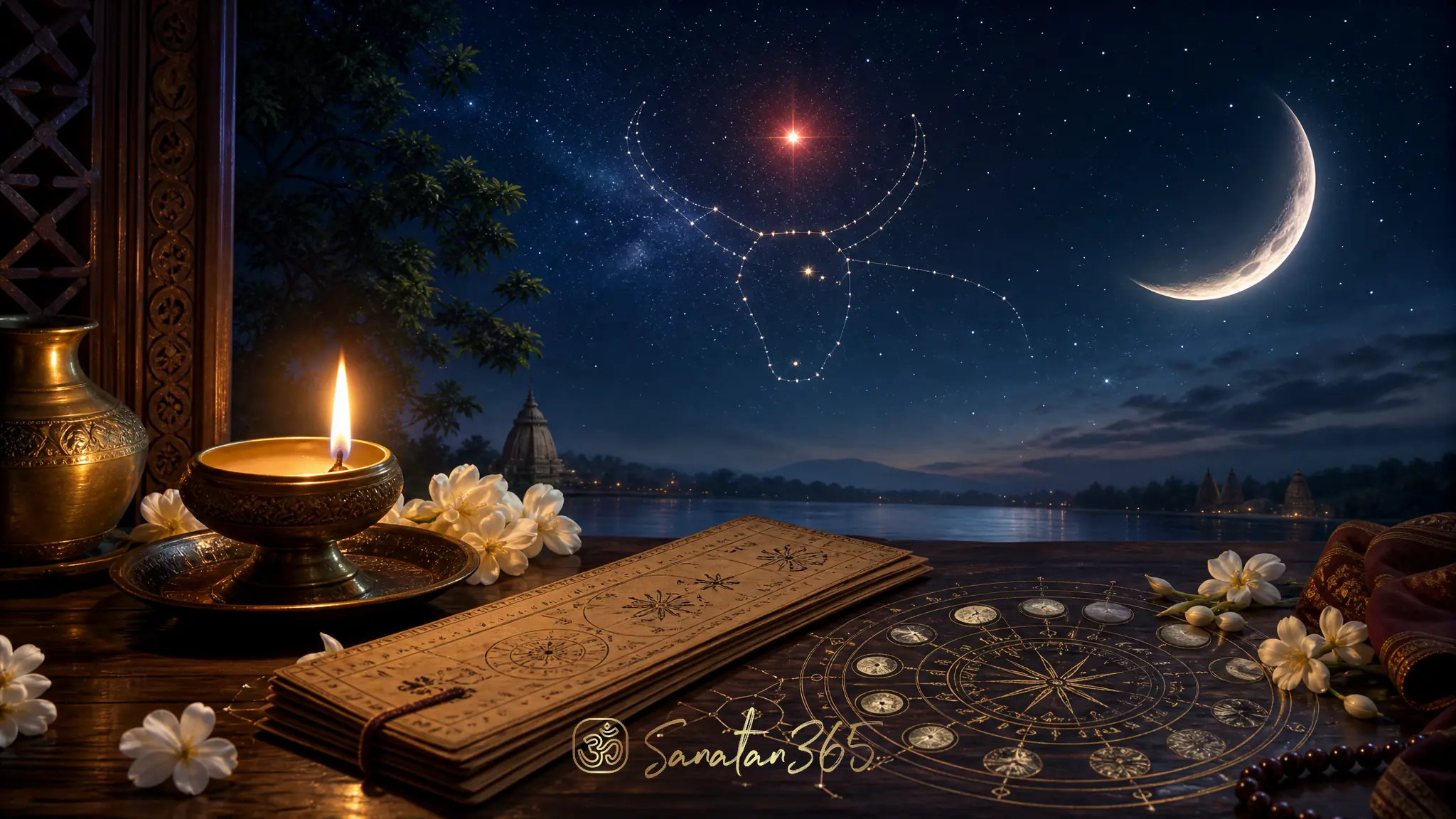
Rohini Nakshatra meaning begins with nourishment, beauty, creativity, and the Moon's gentle power in Hindu astrology. Rohini (रोहिणी, the reddish or growing one) is the fourth nakshatra (नक्षत्र, lunar mansion) in the 27-fold lunar zodiac. It is linked with the reddish star Aldebaran, placed in Vrishabha (वृषभ, Taurus), ruled by Chandra (चन्द्र, the Moon), and traditionally associated with Prajapati or Brahma, the creative principle. Its deeper lesson is not vanity or luxury, but sacred growth: how desire, beauty, fertility, and emotional life can be refined into dharma.
On June 14, 2026, several panchang listings noted Rohini Nakshatra through much of the day, making it a fitting moment to revisit what this lunar mansion means for seekers, families, and students of Jyotisha (ज्योतिष, Hindu astrology). The point is not fatalism. A nakshatra is a language of timing, temperament, and reflection. It helps a person ask better questions about attention, nourishment, and inner cultivation.
What Is Rohini Nakshatra Meaning in Hindu Astrology?
The simplest Rohini Nakshatra meaning is "the growing one." The Sanskrit root suggests rising, growth, redness, and flourishing. In the sky, Rohini is often connected with Aldebaran, the bright reddish star in Taurus. In the symbolic sky of Hindu astrology, it becomes a lunar mansion of fertility, attraction, artistic refinement, food, abundance, and emotional receptivity.
Britannica explains lunar mansions as divisions of the ecliptic that mark the Moon's movement across successive nights, with the Indian system known as nakshatras (Britannica). This astronomical frame matters because nakshatras are lunar before they are psychological. The Moon passes through them; the mind, memory, emotion, and daily rhythm are then interpreted through that lunar movement.
In Jyotisha practice, Rohini is the fourth nakshatra. It falls within Taurus, a sign associated with earthiness, stability, form, value, food, voice, and beauty. Classical and contemporary astrology traditions commonly give Rohini the range of 10 degrees to 23 degrees 20 minutes of Taurus and connect it with the Moon. These technical details should be handled with humility, because interpretation varies by school, chart context, and teacher.
Still, the central symbolism is consistent: Rohini grows things. It can grow crops, relationships, beauty, art, wealth, attachment, comfort, devotion, or desire. The spiritual question is not whether growth is good. The question is what kind of growth is being nourished.
Key takeaway: Rohini Nakshatra meaning points to growth, beauty, nourishment, and emotional receptivity under the Moon's influence.
Why Is Rohini Connected With the Moon and Taurus?
Rohini feels lunar because it is shaped by change, softness, attraction, rhythm, and emotional need. Chandra, the Moon, governs the mind in much of Hindu astrology. The Moon waxes, wanes, reflects light, affects calendar timing, and governs the inner weather of memory and feeling.
Taurus adds a different layer. It brings the symbolism down into form: food, land, music, fabric, fragrance, voice, art, and the body. This is why Rohini is often described in lush terms. It is not abstract spirituality floating above life. It is spirituality that asks what a person does with comfort, beauty, and desire.
That makes Rohini powerful, but also morally delicate. Beauty can refine the mind, or it can trap the mind. Wealth can serve dharma, or it can thicken possessiveness. Emotional sensitivity can become compassion, or it can become dependency. A pleasing voice can speak truth, or it can manipulate. Rohini teaches that the same lunar sweetness can mature into devotion or drift into attachment.
This is why nakshatra study should never be reduced to flattering personality labels. A Moon in Rohini may be interpreted by some astrologers as artistic, attractive, fertile, persuasive, emotionally responsive, or materially aware. But a birth chart is never one placement. It must be read through lagna, grahas (ग्रह, planetary factors), dashas (दशा, timing cycles), dignity, aspects, house placement, and lived conduct.
For spiritual practice, the lesson is cleaner: notice what you feed. The mind becomes shaped by its nourishment. Food, music, speech, company, screens, rituals, stories, and desires all plant seeds in the lunar field of awareness.
Key takeaway: Rohini joins the Moon's emotional rhythm with Taurus's embodied beauty, asking seekers to nourish what is dharmic rather than merely pleasant.
What Are Rohini's Symbols and Deity?
Rohini is often associated with symbols of fertility, movement, and cultivation: an ox-cart, chariot, temple, banyan tree, or growing field. These symbols vary across traditions, but they share one thread. Rohini does not only imagine growth; it carries growth into form.
The ox-cart is especially useful as a teaching image. It suggests agriculture, patience, transport, and productive effort. A field does not become fertile because someone merely wants abundance. It needs soil, water, timing, labor, seed, and protection. Rohini's beauty has this agricultural intelligence beneath it. It is not only ornament. It is cultivation.
The presiding deity is commonly given as Prajapati, often identified with Brahma in later interpretation. Prajapati (प्रजापति, lord of creatures or progenitor) represents creative ordering and generative power. This association deepens Rohini's meaning. Creation is sacred, but creation without restraint can become restless multiplication. Prajapati reminds the seeker that creativity should be aligned with order, not merely impulse.
Rohini is also linked in popular mythology with Chandra's affection. Traditional stories speak of Rohini as especially beloved of the Moon. These stories should be read symbolically and respectfully rather than flattened into gossip about divine figures. The Moon's attraction to Rohini tells us something about the mind's attraction to beauty, comfort, and emotional sweetness.
The spiritual reading is straightforward. The mind loves what nourishes it. The danger is that the mind may call everything pleasant "nourishing" even when it is not. Rohini asks for discernment: which forms of beauty make the heart more generous, truthful, and steady?
Key takeaway: Rohini's symbols of cart, field, growth, and Prajapati point toward cultivated creativity rather than uncontrolled desire.
How Does Rohini Nakshatra Shape Character and Practice?
In astrological interpretation, Rohini can suggest charisma, creativity, sensual refinement, artistic speech, financial awareness, fertility, and a need for emotional security. These traits are not guaranteed promises. They are symbolic tendencies that require full-chart context and personal discipline.
A Rohini pattern may express beautifully when it produces:
- Careful speech that nourishes rather than flatters.
- Artistic talent used with humility.
- Love of food and home turned into hospitality.
- Prosperity handled as stewardship.
- Emotional sensitivity refined into compassion.
- Desire transformed through devotion.
The same pattern may become difficult when it produces possessiveness, vanity, over-attachment to comfort, jealousy, or hunger for admiration. This is why Hindu astrology works best when paired with dharma. A chart can describe tendencies; it does not excuse conduct. The purpose of insight is refinement.
For a seeker, Rohini practice can begin with one question: "What am I growing by repetition?" If a person repeats complaint, comparison, indulgence, and restless craving, those seeds grow. If a person repeats mantra, gratitude, disciplined work, honest speech, and service, those seeds grow too.
There is a quiet connection here with karma (कर्म, action and consequence). Rohini may feel soft and beautiful, but its lesson is practical. Growth is not accidental. The inner field responds to what is planted daily.
Key takeaway: Rohini can indicate creative and emotional gifts, but its higher expression depends on discipline, humility, and dharmic nourishment.
What Does Moon in Rohini Mean for Reflection, Not Prediction?
"Moon in Rohini" is one of the most searched phrases around this nakshatra. It usually means the Moon occupies Rohini in a birth chart or in the current panchang. Because the Moon is associated with mind and emotion, astrologers often read this placement as important for temperament and daily timing.
For a birth chart, Moon in Rohini may be discussed in terms of emotional beauty, artistic taste, attraction, desire for stability, family attachment, speech, comfort, and material awareness. But responsible interpretation requires caution. No one should make major life decisions from one placement alone. No article can replace a complete reading by a trained, ethical practitioner.
For a daily panchang, Moon in Rohini can be used more gently. A family may treat the day as favorable for beautifying a home altar, cooking with care, singing bhajans, beginning an art practice, tending plants, or reflecting on emotional habits. Some panchang traditions may mark specific tasks as suitable or unsuitable, but local calendar, sampradaya (सम्प्रदाय, tradition), and family practice matter.
On June 14, 2026, public panchang coverage noted Rohini Nakshatra for the day alongside the Adhik Maas lunar context (Times of India). Such references are useful for daily awareness, but they should not become fear-based dependence.
The mature use of Rohini is reflective. Ask:
- What kind of beauty am I allowing into the mind?
- Where has comfort become attachment?
- What needs patient cultivation?
- How can speech become more nourishing?
- Which desire can be offered into devotion?
Key takeaway: Moon in Rohini is best approached as a mirror for emotional cultivation, not as a one-line prediction of destiny.
How Can Rohini's Growth Become Spiritual Growth?
Rohini's highest teaching is that growth must be sanctified. A garden grows weeds and flowers unless the gardener pays attention. The same is true of the mind.
A simple Rohini-inspired practice can be done without superstition:
- Light a diya before a clean altar or quiet space.
- Offer water, flowers, or fruit with gratitude.
- Chant a known mantra gently, such as Om (ॐ) or a family mantra.
- Write down one desire that needs refinement.
- Write down one habit that deserves nourishment.
- Do one beautiful act of service: cooking, cleaning, feeding, teaching, or speaking kindly.
- End by asking that beauty serve dharma.
This practice does not promise guaranteed prosperity, marriage, fame, or success. Hindu spirituality is not a vending machine. The value of the practice is inner alignment. Rohini teaches that beauty becomes sacred when it is joined to humility, restraint, and offering.
For families, Rohini can also become a teaching moment for children. A parent can explain that the Moon moves through different nakshatras, just as the mind moves through different moods. Rohini reminds us to grow good things: kindness, study, song, food shared with others, and gratitude for the earth.
For adults, the lesson is sharper. Many people want growth but resist cultivation. Rohini says: choose the seed, prepare the field, water patiently, and protect the harvest from ego.
Key takeaway: Rohini's growth becomes spiritual when beauty, comfort, speech, and desire are consciously offered toward dharma.
Rohini Nakshatra meaning is not simply "good fortune" or "attraction." It is the Moon's lesson in cultivation. What the mind loves, it feeds; what it feeds, it grows. When beauty is joined to dharma, Rohini becomes a path of nourishment rather than attachment.
Key takeaway: Rohini invites the seeker to grow what is beautiful, useful, reverent, and true.
FAQ
What is Rohini Nakshatra meaning?
Rohini Nakshatra meaning centers on growth, nourishment, beauty, fertility, creativity, and the Moon's emotional power. It is the fourth lunar mansion in Hindu astrology and is connected with Taurus and the reddish star Aldebaran.
Who is the deity of Rohini Nakshatra?
Rohini Nakshatra is commonly associated with Prajapati, often identified with Brahma, the creative principle. It is also linked through mythology with Chandra, the Moon, and his affection for Rohini.
What does Moon in Rohini mean?
Moon in Rohini may suggest emotional sensitivity, artistic taste, attraction, love of comfort, and a desire to nurture or be nurtured. A full chart is needed for serious interpretation, so it should not be read as a single destiny statement.
Is Rohini Nakshatra good or bad?
Rohini should not be reduced to good or bad. Its higher expression is creativity, nourishment, beauty, and steady growth. Its difficult expression can be attachment, indulgence, vanity, or possessiveness. Dharma determines how the tendency matures.
How can someone honor Rohini Nakshatra spiritually?
A seeker can honor Rohini by cultivating beauty with restraint: lighting a diya, chanting a known mantra, tending plants, cooking with gratitude, speaking gently, serving family, and consciously nourishing habits that support dharma.
About the author
Sanatan365 Editorial
Bringing Sanatan Dharma to modern seekers through authentic, scripture-grounded content.
Related in Astrology
 Astrology
Vara Meaning: Seven Weekdays and the Sunrise-to-Sunrise Day
Vara is the weekday limb of a Hindu panchang. Read its seven planetary names, sunrise boundary and relationship with lunar dates without tr…
 Astrology
Ayanamsha Meaning: Why Two Zodiac Charts Can Differ
Understand the zodiac reference offset, a simple longitude conversion and the settings to check when astrology charts disagree.
 Astrology
Panchang Yoga Meaning: Reading the 27 Nitya Yogas
Understand the Sun–Moon calculation behind Panchang yoga, its 27-name cycle, ending times, and why it is different from yogic practice or a…