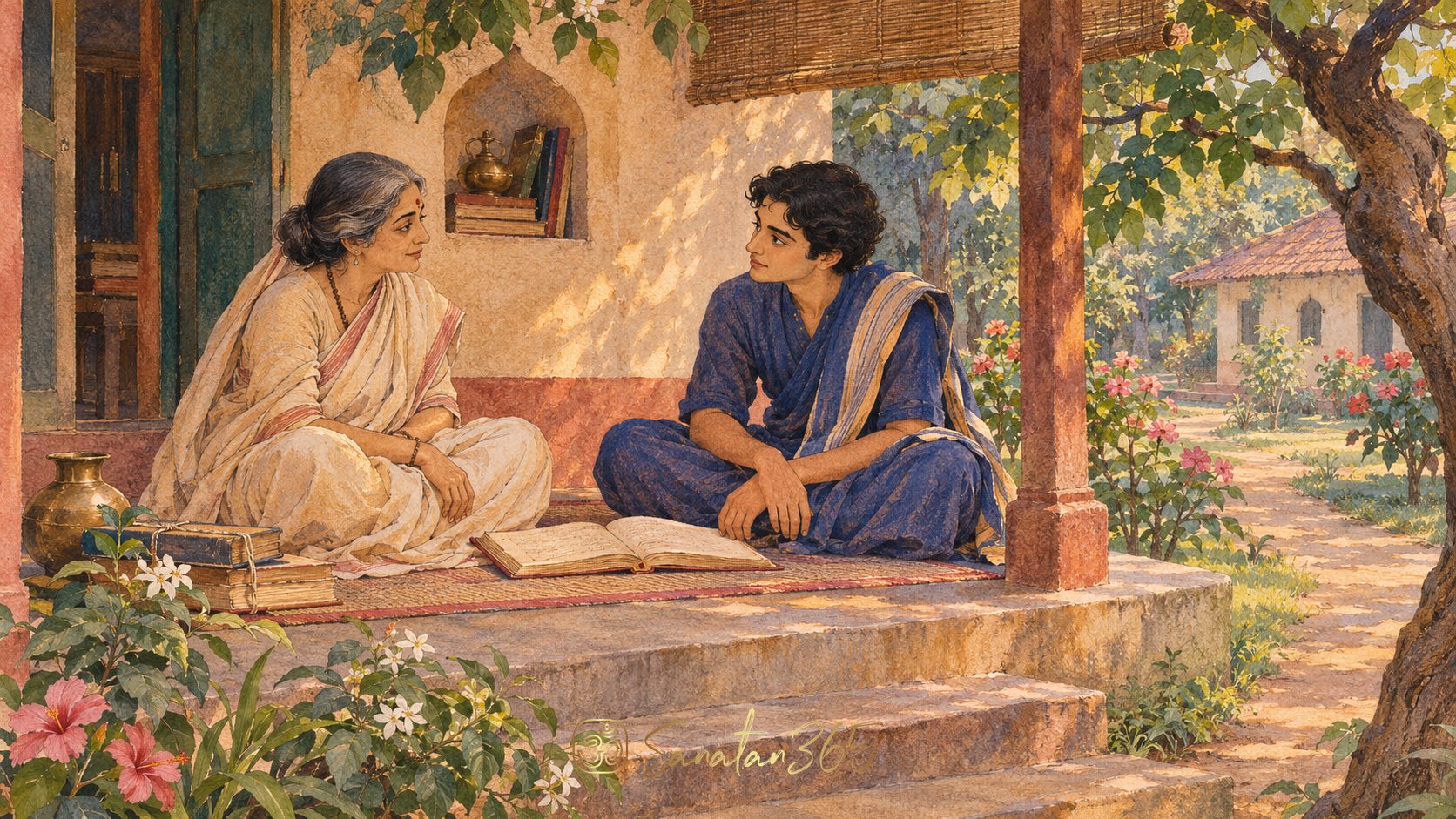
Saha Navavatu Meaning: A Prayer for Learning Together
Before the lesson begins, teacher and learner ask for something together. Follow the invocation from shared protection to study without ill will.
A teacher and a learner have different work to do. This invocation begins by giving them words they can say together.
The Saha Navavatu meaning is a shared prayer for protection, nourishment, energetic effort, clear study and freedom from ill will. Saha nāv avatu (सह नाववतु, may we both be protected together) opens the request. In the Taittirīya Upaniṣad (तैत्तिरीय उपनिषद्, the Taittiriya Upanishad), the invocation brings the two people into one undertaking before the lesson gets under way.
What is the Saha Navavatu meaning?
The text and translation of the invocation place it at the start of the second section. The Chinmaya International Foundation study edition identifies the people speaking as teacher and learner. It explains the lines about strength, clarity and ill feeling in the setting of study.
A reader following the invocation for the first time can mark the order. The people first ask for conditions in which they can learn together. Next they ask to work with energy. They ask that what they study become bright. Finally, they ask to be free of ill will toward each other. The prayer closes with peace spoken three times. Its order makes the last request easier to hear. The people have asked for something worth doing and then asked to treat each other in a way that lets them keep doing it.
The reference to brightness describes learning in the language of light. A reader can hear that as a wish for what is studied to become clear and fruitful. At the start of a session, the text or question can still be difficult. Saying that the study should shine expresses an aim before anyone knows how quickly the topic will become clear.
The guide to Hindu peace invocations gives a wider context for such prayers. The distinctive feature here is the repeated attention to what two people share. Hearing that feature makes the invocation more than an opening sound whose sense is left behind once the teaching starts.
Key takeaway. The request moves in order from protection and nourishment to effort, clarity and a relationship that can sustain study.
Why is this a teacher and student prayer?
The opening phrase speaks of both people. In the subsequent lines, saha (सह, together) recurs. The prayer lets the learner and teacher ask for protection and nourishment in the same voice. Its grammar gives the gathering a shape even before anyone names the day's subject or opens the book.
The two roles still carry different tasks. A teacher must bring a passage, explanation or question within reach. A learner must attend, reflect and ask for help when the explanation is incomplete. The fact that one teaches and the other learns does not mean that only one of them needs patience, preparation or care. The repeated request makes those needs understandable as part of one occasion.
Consider a reading in which a teacher asks the student to explain one sentence back in their own words. The student's answer can show an unfamiliar term or an assumption the teacher has skipped. Both people now have work suited to their roles. The learner can name the point of difficulty. The teacher can return to the passage and give one example at the place where it matters.
The article on the Taittiriya student's farewell looks at what another section asks of a student leaving instruction. Reading the two pieces alongside one another throws light on their different moments. Here the issue is what the participants hope to bring to the very beginning of shared study.
A reader might also make a small comparison with the opening of an ordinary lesson. One participant brings a reliable edition, while the other brings a question that has remained unresolved. Neither contribution settles what the outcome will be. The edition gives both something steady to read, and the question gives their attention a direction. In that limited example, the shared readiness expressed by the invocation becomes visible. The pair can sit down with different knowledge and still depend on the same opportunity to study.
Key takeaway. The teacher and learner can keep their distinct duties while asking for the conditions of study together.
What does shared effort in study ask of both people?
The line concerning vīrya (वीर्य, strength or vigour) asks the pair to exert themselves together. It is followed by a request for the study to be bright. These are related requests. Energy can help both people stay with a hard question long enough to understand it. Clarity lets them see what that work has yielded.
A practical parallel is the difference between hearing an explanation once and being able to point to the part of the passage that supports it. The teacher can pause on the exact sentence. The learner can look for how it connects to the sentence before it. If the connection remains unclear, the pair can try another reading and compare what each version explains. That work can take place slowly, with sustained attention on a small part of the text.
The sequence also allows an ordinary distinction between effort and speed. A fast exchange can contain little shared work if only one person is thinking through the question aloud. An unhurried exchange can involve attention on both sides if each person has a clear opportunity to respond. The invocation leaves room for that kind of study because the wish concerns what both do and what becomes clear through it.
The guide to listening, reflecting and assimilating a Vedantic teaching follows a different grouping of study activities. In this invocation, the focus is more immediate. The pair are about to begin. What they ask for can be recognised in the way they read, listen and return to the difficult line together.
Key takeaway. The invitation to effort has a partner in the prayer for clarity. Each person can work toward something both can understand.
Why does the prayer ask for study without ill will?
Near the end, mā vidviṣāvahai (मा विद्विषावहै, may we bear no ill will toward each other) turns attention toward the relationship itself. The Chinmaya study edition places the invocation in the teaching situation. That setting makes the request precise. The speakers will need to listen to each other when a difficult question arises, when an explanation needs revision or when a correction is made.
A learner can disagree with an interpretation and still address the question with care. A teacher can correct an error and still respect the person who made it. The line can be heard as a wish that such necessary moments do not take on a hostile character. It speaks to the manner of study as well as the mood with which it starts.
Imagine that a translation has led two readers to different senses of the same word. One way to begin is for each person to say which words in the passage led to the reading. They can leave the question open and look up another edition later. The participants may keep their different views for a while, yet the exchange can still contribute to clearer study. It gives everyone a way to return to evidence without turning a difficulty into a judgment about a person.
This is also why the threefold peace at the end belongs in the reading. Śānti (शान्ति, peace) completes what the pair have asked for. Readers may encounter different traditional explanations of why it is said three times. The present sequence already gives a reason to attend to the closing word. The prayer for effort and intelligibility has led directly into a prayer about the way people treat one another.
Key takeaway. The closing request gives the teacher and learner a way to stay in relationship while their understanding is still developing.
How can a group use the invocation before learning?
A group with an established way of chanting can follow its customary rendering. A beginner can listen for the repeated word for together and read the meaning afterward. The sequence gives the listener simple landmarks. The first concerns protection. The second concerns nourishment. Then the speakers turn to their work, ask for clear study and finish with their relationship and peace.
Consider a group that meets to read a short passage once a week. After the invocation, the facilitator might ask participants to name one sentence that was unclear in the previous reading. Someone can read that sentence aloud and someone else can paraphrase it. The group can check which details survive the paraphrase. A member who is following in translation can say where the English leaves a question open. These are examples of applying the meaning. They can give the wish for energetic and clear study a visible place in what the group actually does.
Another useful option is to keep a small note marked “questions for the next meeting.” At the end of a discussion, record questions that still need reading or source comparison. The next session can begin by choosing one of those notes. This gives the prayer for shared study a continuity across meetings. When one person misses a session, they can see what the group was still trying to understand and join the work again without needing to reconstruct the whole conversation.
At the end of a lesson, a teacher and learner can ask where the study became clear and where a question remains. Each can bring one answer to the next session. The invocation then has a small practical echo. What began as one shared wish can be noticed in the way two people keep making room for understanding.
A useful check after group study is to ask what each person could explain in their own words. One person may remember why a sentence was difficult. Another may be able to point to the line that resolved it. A third may notice that a question has changed. Each gives the group a concrete way to see what its effort produced.
This works with a single learner too. Instead of attempting a long discussion, the teacher and learner can choose one small uncertainty and write down the words that prompted it. When they meet again, the note makes a familiar place to start. They can reread the source together and say whether the explanation is clearer. That return can turn the prayer for bright study into a quiet, recognisable habit.
Key takeaway. A group can carry the invocation into its actual study through shared work on a question and a willingness to keep listening.
FAQ
What does Saha Navavatu mean in English?
The opening asks for both people to be protected together. The rest of the invocation asks for nourishment, vigour in their shared work, bright study and freedom from ill will. It ends with peace.
Who are the two people in the prayer?
The teaching tradition represented by the Chinmaya edition understands them as teacher and student. Their tasks are different, and they can speak the invocation as people engaged in one study.
Does the prayer ask people to avoid any disagreement?
The closing request concerns ill will toward each other. An application to a group reading can allow participants to ask questions or test interpretations while they remain attentive to how they speak.
Is the invocation part of the Taittiriya Upanishad?
The cited edition presents it before the second section. Other editions also print it before the third section. Its placement helps the reader hear it as preparation for study.
About the author
Sanatan365 Editorial
Bringing Sanatan Dharma to modern seekers through authentic, scripture-grounded content.
Related in Mantras
 Mantras
Madhu Vata Ritayate Meaning: The Rigveda’s Prayer for Sweetness
Read the Rigveda’s three honeyed verses through wind, rivers, night, dawn, trees and cattle, and discover what sweetness means in the praye…
 Mantras
Shantakaram Bhujagashayanam Meaning: Reading Vishnu’s Peaceful Form
Read Shantakaram Bhujagashayanam through Vishnu’s peaceful form, serpent couch, cloud hue and lotus eyes, then follow the verse’s closing a…
 Mantras
Karagre Vasate Lakshmi Meaning: The Morning Prayer to the Hands
Read the morning hand-viewing prayer through its words, three divine names and gentle invitation to begin the day with reverence and respon…

