Shantakaram Bhujagashayanam Meaning: Reading Vishnu’s Peaceful Form
Read Shantakaram Bhujagashayanam through Vishnu’s peaceful form, serpent couch, cloud hue and lotus eyes, then follow the verse’s closing act of reverence.
The verse gives the listener a peaceful form, a serpent couch and the breadth of the sky. Only near its close does the speaker say what they are doing with those images.
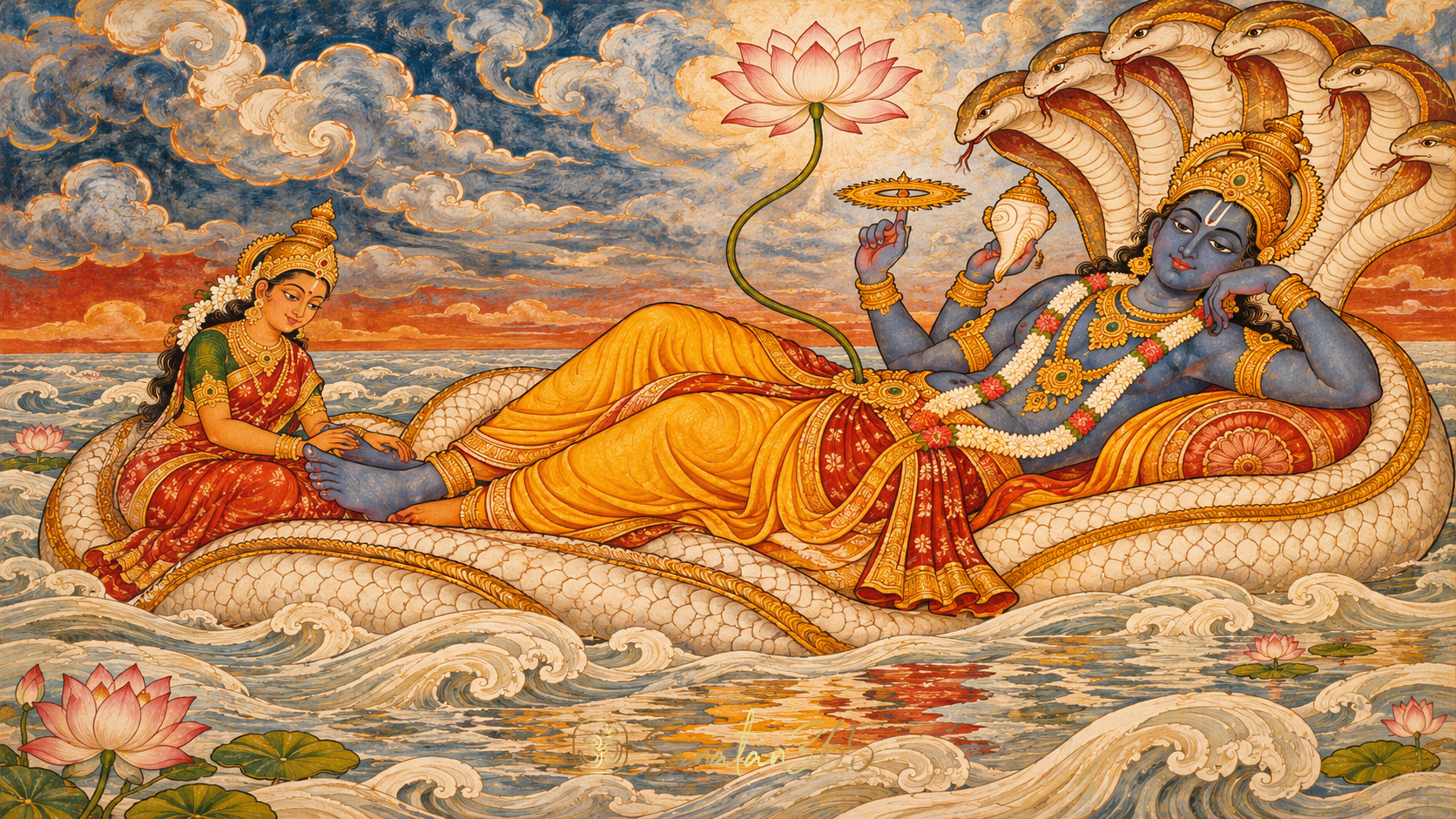
Shantakaram Bhujagashayanam meaning is a praise of Vishnu as peaceful in form, reclining on a serpent, lotus-navelled, cloud-hued and accessible through meditation. This dhyāna śloka (ध्यान श्लोक, a verse for contemplation) gathers qualities and images before reaching vande (वन्दे, I bow to or revere). Following that movement helps a reader hear it as an act of attention and devotion.
What is the Shantakaram Bhujagashayanam meaning?
The Sanskrit Documents recitation text of the Vishnu Sahasranama places this verse in a section headed atha dhyānam (अथ ध्यानम्, now contemplation). A separate heading introduces the hymn of names afterward. That arrangement gives a useful reading context. The listener first attends to a form and its qualities, then proceeds to the larger recitation.
The Sanskrit text can be followed in four lines.
शान्ताकारं भुजगशयनं पद्मनाभं सुरेशं विश्वाधारं गगनसदृशं मेघवर्णं शुभाङ्गम् । लक्ष्मीकान्तं कमलनयनं योगिभिर्ध्यानगम्यं वन्दे विष्णुं भवभयहरं सर्वलोकैकनाथम् ॥
A plain transliteration is śāntākāraṃ bhujagaśayanaṃ padmanābhaṃ sureśaṃ; viśvādhāraṃ gaganasadṛśaṃ meghavarṇaṃ śubhāṅgam; lakṣmīkāntaṃ kamalanayanaṃ yogibhirdhyānagamyaṃ; vande viṣṇuṃ bhavabhayaharaṃ sarvalokaikanātham. The semicolons here mark the printed lines for a reader following the sound. They are not instructions to interrupt a teacher’s established chanting rhythm.
In an original plain rendering, the speaker bows to Vishnu, whose form is peaceful, who rests on a serpent, whose navel bears the lotus, and who is lord of the divine beings. The verse calls him the support of the universe, like the sky, cloud-hued and auspicious in form. It names him as Lakshmi’s beloved, lotus-eyed and approached through meditation by yogis. It closes by revering him as remover of the fear of worldly existence and the one lord of all worlds.
The sequence matters as much as any isolated English equivalent. A reader begins with what can be pictured and gradually hears the relationship between that form and the speaker. The verse gives the eye something to hold, the ear a sequence to follow and the voice a concluding gesture. Someone who knows only its first words can therefore discover a progression inside a familiar prayer.
Key takeaway: The verse moves through a series of qualities toward the speaker’s act of reverence. Its ending helps the opening images make sense together.
How does the Vishnu dhyana shloka begin with a peaceful form?
Śāntākāram (शान्ताकारम्, peaceful in form) joins the quality of peace to visible appearance. The next compound, bhujagaśayanam (भुजगशयनम्, reclining on a serpent), makes the opening more particular. A listener is given a posture and a resting place. The familiar devotional image of Vishnu reclining on Ananta, the serpent also known as Shesha, provides a way to see that phrase.
It is possible to pause at this pairing before explaining the rest. What does a peaceful face look like when the body is resting? How does a serpent couch change the scale of the image? These are questions for contemplation of the verse. They allow its language to work before the reader searches for a single moral to attach to it. The peaceful form is described in relation to something visibly powerful.
Padmanābham (पद्मनाभम्, lotus-navelled) adds the lotus at the navel, and sureśam (सुरेशम्, lord of the divine beings) gives a title of sovereignty. The passage moves between an embodied image and a statement of divine status. A reader does not have to make one erase the other. The verse places them beside one another, giving both a place in its act of praise.
These details can also change how someone looks at devotional art. Rather than taking in a reclining figure all at once, the viewer can follow the words through posture, couch and lotus. That slower looking may reveal the artist’s choices about the curve of a serpent’s hood or the way a stem rises from the body. The article on Vishnu’s conch, discus, mace and lotus introduces other recognizable elements of his iconography.
Key takeaway: The opening makes peace visible through a particular form. Follow the resting posture, serpent and lotus before moving on to abstract explanations.
Why do the sky and cloud images belong together?
The next line opens with viśvādhāram (विश्वाधारम्, support of the universe). It then calls Vishnu gaganasadṛśam (गगनसदृशम्, like the sky) and meghavarṇam (मेघवर्णम्, cloud-coloured). The terms can be heard one at a time. The first concerns what supports existence. The second offers an image of vastness. The third brings the listener back to colour.
The sky is difficult to hold within an edge. A cloud has a visible colour and shape. Putting these comparisons together gives the mind a movement from breadth toward form. A reader can contemplate that movement without treating it as a scientific statement about the sky or a diagram of how the universe is arranged. It is the verse’s poetic language for the deity being praised.
The colour image is especially concrete. A rain cloud can suggest depth, shade and a rich darkness. It gives a viewer of a blue Vishnu image a word to return to while looking. The verse also says śubhāṅgam (शुभाङ्गम्, auspicious in form or limbs). The line therefore brings the vast and the bodily into the same praise. Its changes of scale are part of its beauty.
An attentive reading might linger on the shift from the first line to the second. At first there is a resting body. Then there is the support of the universe and the openness of the sky. The mind has moved far beyond the outline of the figure while still returning to a visible hue. This is a reader’s observation about the sequence, and a useful one to test by reciting the lines aloud.
Key takeaway: The sky comparison opens the image outward, while cloud colour gives it a visible quality. The verse lets breadth and form remain together.
What does the Shantakaram prayer say about meditation and fear?
The third line begins with a relationship. Lakṣmīkāntam (लक्ष्मीकान्तम्, beloved of Lakshmi) names Vishnu with Lakshmi, the goddess of prosperity and auspiciousness. Kamalanayanam (कमलनयनम्, lotus-eyed) returns to a feature of the face. The lotus has already appeared at the navel. Its return at the eyes gives a reader another connection to notice within the verse itself.
Yogibhir dhyānagamyam (योगिभिर्ध्यानगम्यम्, approached or reached through meditation by yogis) concerns the manner of approach. Here yogis means practitioners of spiritual discipline. The wording gives contemplation a place inside a verse that is already doing the work of directing attention. The recitation text also notes yogihṛddhyānagamyam, a variant referring to contemplation in the yogi’s heart. A learner may encounter either wording in an established edition.
The word meanings presented by Shlokam help readers separate the compounds without losing the sentence. Its brief glosses are a starting point for following the text. Wider philosophical explanations can differ by teacher and tradition, so a learner can return to the verse’s actual words while listening to those explanations.
In the closing line, bhavabhayaharam (भवभयहरम्, remover of the fear of worldly existence) makes the prayer’s devotional appeal audible. This is praise spoken by someone who bows to Vishnu. A devotee may bring real fear to that act of reverence. The phrase can be understood in its religious setting without converting it into a promise that every worry will end after recitation.
The final compound is sarvalokaikanātham (सर्वलोकैकनाथम्, the one lord of all worlds). By now the listener has heard a peaceful face, the sky, a relationship, meditation and fear. The title gathers the address into a concluding sense of sovereignty. Reading it slowly can make the final bow feel connected to everything that came before it.
Key takeaway: Meditation describes a way of approaching Vishnu, and the removal of fear belongs to the verse’s devotional praise. Both are heard within a relationship of reverence.
How can readers follow the verse while reciting?
Begin by reading the Sanskrit or transliteration beside a plain meaning. A learner does not need to keep every English explanation in mind at once. One image can accompany one line. On the first reading the resting form may be enough. On another, the sky and cloud comparisons may become clearer. Over time the sequence can become familiar as a whole.
A simple reading practice has four parts.
- Hear the complete verse once from a trusted teacher or a clear recording within an established tradition. Listen for the sound of the whole before trying to copy each part.
- Read one printed line and its meaning together. Mark a compound that is unfamiliar and learn how it is divided.
- Recite that line at a comfortable pace, allowing its principal image to remain in attention.
- Return to the whole verse and notice where the speaker says vande. The descriptions now have an action to lead toward.
The Roman spellings found in prayer books can look different. Shantakaram, Shaantaakaaram and Śāntākāram may be attempts to represent the same Sanskrit sound for different readers. A consistent text and a reliable spoken model are more helpful at first than switching between several spellings in one sitting. The recitation edition also matters when a line has a documented variant.
Families can learn this together without turning the verse into a test. An adult might ask a child which image they remember, then read that part again. One listener may remember the serpent couch while another notices the lotus eyes. Each can point to words in the prayer. The conversation then returns to the text, and a familiar recitation becomes an occasion to listen more carefully.
For someone proceeding to the thousand names, the guide to Vishnu Sahasranama and devotional remembrance offers the wider setting. This short contemplation verse can be studied on its own as well. A reader can end by carrying a single image into the day and returning later to see whether another word has become more vivid. The repeated encounter is a chance to hear more of a prayer that may already be loved.
Key takeaway: Learn the images in their order and let the closing act of bowing connect them. Familiarity grows through patient listening to the same words.
FAQ
What is Shantakaram Bhujagashayanam meaning in simple English?
The verse reveres Vishnu’s peaceful form, his serpent couch, lotus imagery and cloud-like hue. It praises him as the support of the universe and closes with a bow to him.
Is this the Vishnu Sahasranama itself?
In the cited recitation edition it appears in the contemplation section before the separate hymn of names. It introduces a way to attend to Vishnu’s form.
What does bhujagashayanam mean?
It means reclining on a serpent. Devotional imagery commonly represents Vishnu resting on Ananta or Shesha.
Why do some books print a different third line?
The cited edition records both yogibhir dhyanagamyam and a variant referring to contemplation in the yogi’s heart. A learner can follow the text used by their teacher or established recitation tradition.
About the author
Sanatan365 Editorial
Bringing Sanatan Dharma to modern seekers through authentic, scripture-grounded content.
Related in Mantras
 Mantras
Madhu Vata Ritayate Meaning: The Rigveda’s Prayer for Sweetness
Read the Rigveda’s three honeyed verses through wind, rivers, night, dawn, trees and cattle, and discover what sweetness means in the praye…
 Mantras
Karagre Vasate Lakshmi Meaning: The Morning Prayer to the Hands
Read the morning hand-viewing prayer through its words, three divine names and gentle invitation to begin the day with reverence and respon…
 Mantras
Tvameva Mata Meaning: A Prayer of Divine Kinship
Read Tvameva Mata line by line: a Sanskrit prayer that addresses the Divine as parent, friend, knowledge, wealth, and the ground of belongi…

