Mahishasura and the Shadow Within
The buffalo demon in the Devi Mahatmya isn't just mythology — he's a precise psychology.
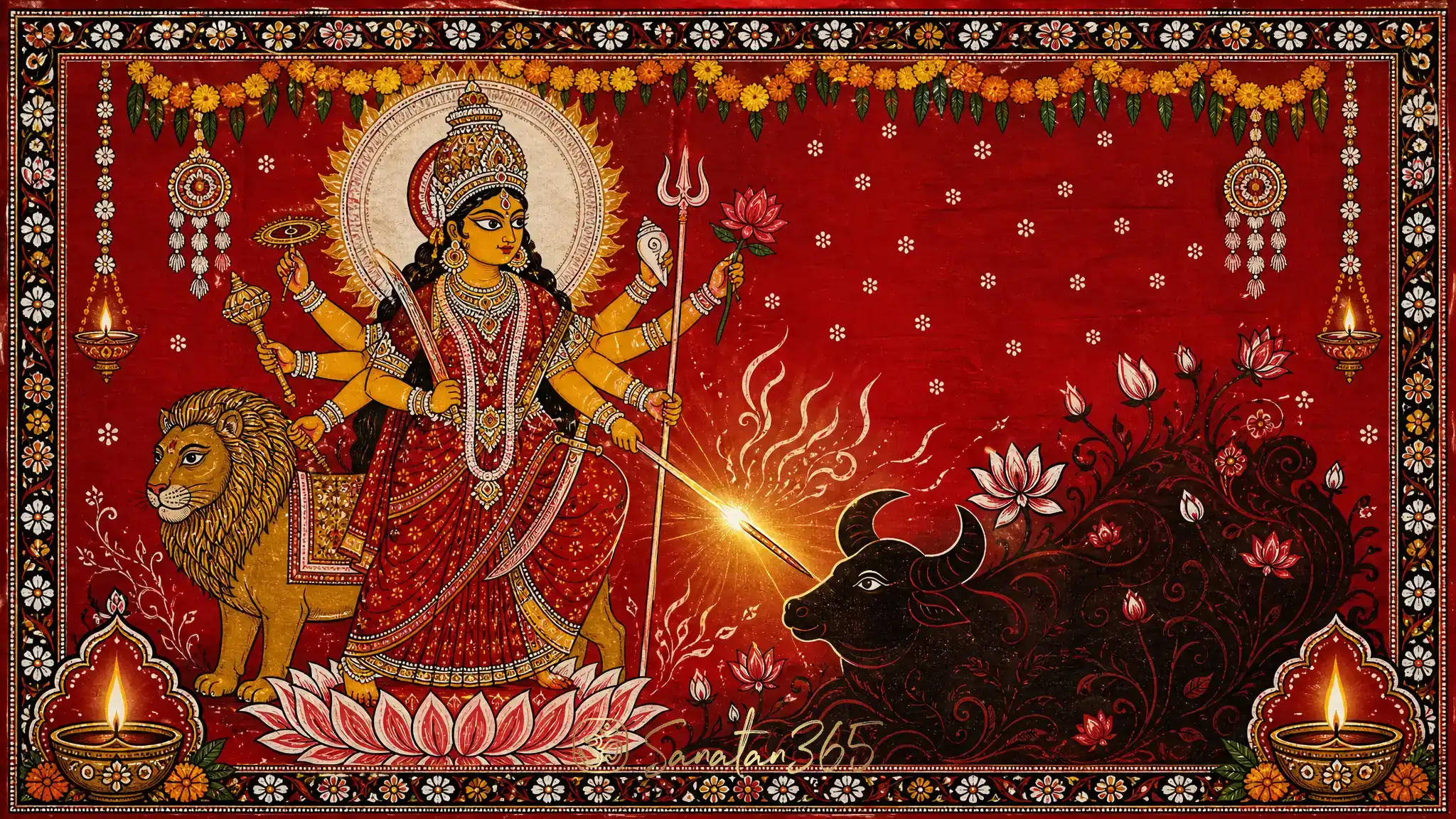
Most tellings of Durga's victory over Mahishasura stop at the spectacle: the lion, the ten arms, the gleaming weapons, the demon defeated. But the Devi Mahatmya is rarely interested in spectacle for its own sake. It is interested in us.
Read carefully, the buffalo demon is not a creature out there. He is a psychology — and one we know intimately.
The Demon Who Cannot Be Killed by a Man
Mahishasura's defining boon is that no man and no god can slay him. He has chosen his enemies carefully, eliminating every opponent he can imagine. What he forgets to imagine is the feminine principle — Shakti — and so she is the one form he is unprepared for.
This is the first teaching. The parts of ourselves that resist awakening are clever. They have already accounted for every voice we usually listen to: the parental voice, the rational voice, the social voice. The voice we are unprepared for is the one that comes from the deepest, most unguarded part of ourselves — and that voice, in the Devi Mahatmya, is feminine.
Why a Buffalo
The choice of the buffalo is not arbitrary. The buffalo, in classical symbolism, is the animal of tamas — heaviness, dullness, the inertia that says not today, not yet, not me. Mahishasura is not pride or greed (those are other demons in other stories). He is the comfortable sluggishness that refuses to be moved.
"She who is the form of consciousness in all beings — to her, salutations again and again." — Devi Mahatmya 5.17
The Devi's weapons are deliberately varied — discus, bow, sword, conch, mace. Different tools for different aspects of the inner work. But the kill is made with a single trident, raised in a single moment of total clarity. Inertia, when finally confronted, falls all at once.
What This Story Asks of Us
The reader of the Devi Mahatmya is not a spectator. The text is a stotra — a prayer that is meant to be done as much as read. To recite it is to invite the Devi into one's own inertia, one's own buffalo, and to let her do what she came to do.
That is harder than it sounds. The buffalo, after all, is comfortable. He is us, mostly. To pray for the Devi to come is to pray for our most familiar self to be undone — and to trust that what remains will be more truly ourselves than the buffalo ever was.
About the author
Sanatan365 Editorial
Bringing Sanatan Dharma to modern seekers through authentic, scripture-grounded content.
Related in Lessons
 Lessons
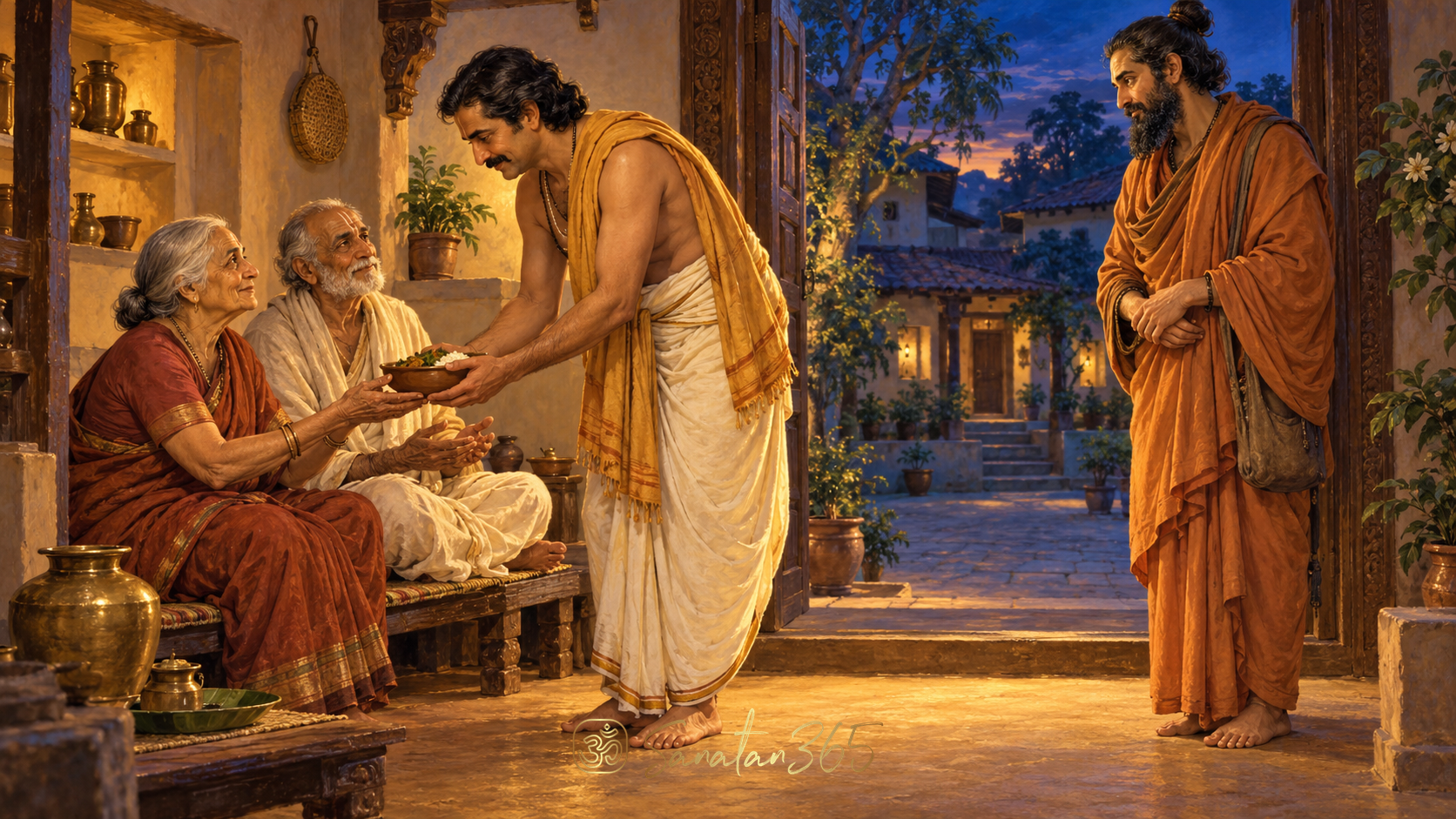
Dharmavyadha Lessons: When Daily Duty Teaches a Scholar
The Mahabharata’s Dharmavyadha episode asks how anger, learning, and ordinary responsibilities reveal the quality of spiritual practice.
 Lessons
Ashtavakra and Bandin: Wisdom Beyond Appearance
The Ashtavakra and Bandin story in the Mahabharata follows a young scholar who enters King Janaka's court, answers prejudice with learning,…
 Lessons
Gargi Vachaknavi: The Upanishadic Voice of Fearless Inquiry
Gargi Vachaknavi stands in the Brihadaranyaka Upanishad as a formidable questioner whose disciplined dialogue with Yajnavalkya reveals cour…