Ashtavakra and Bandin: Wisdom Beyond Appearance
The Ashtavakra and Bandin story in the Mahabharata follows a young scholar who enters King Janaka's court, answers prejudice with learning, and restores his father through courage and truth.
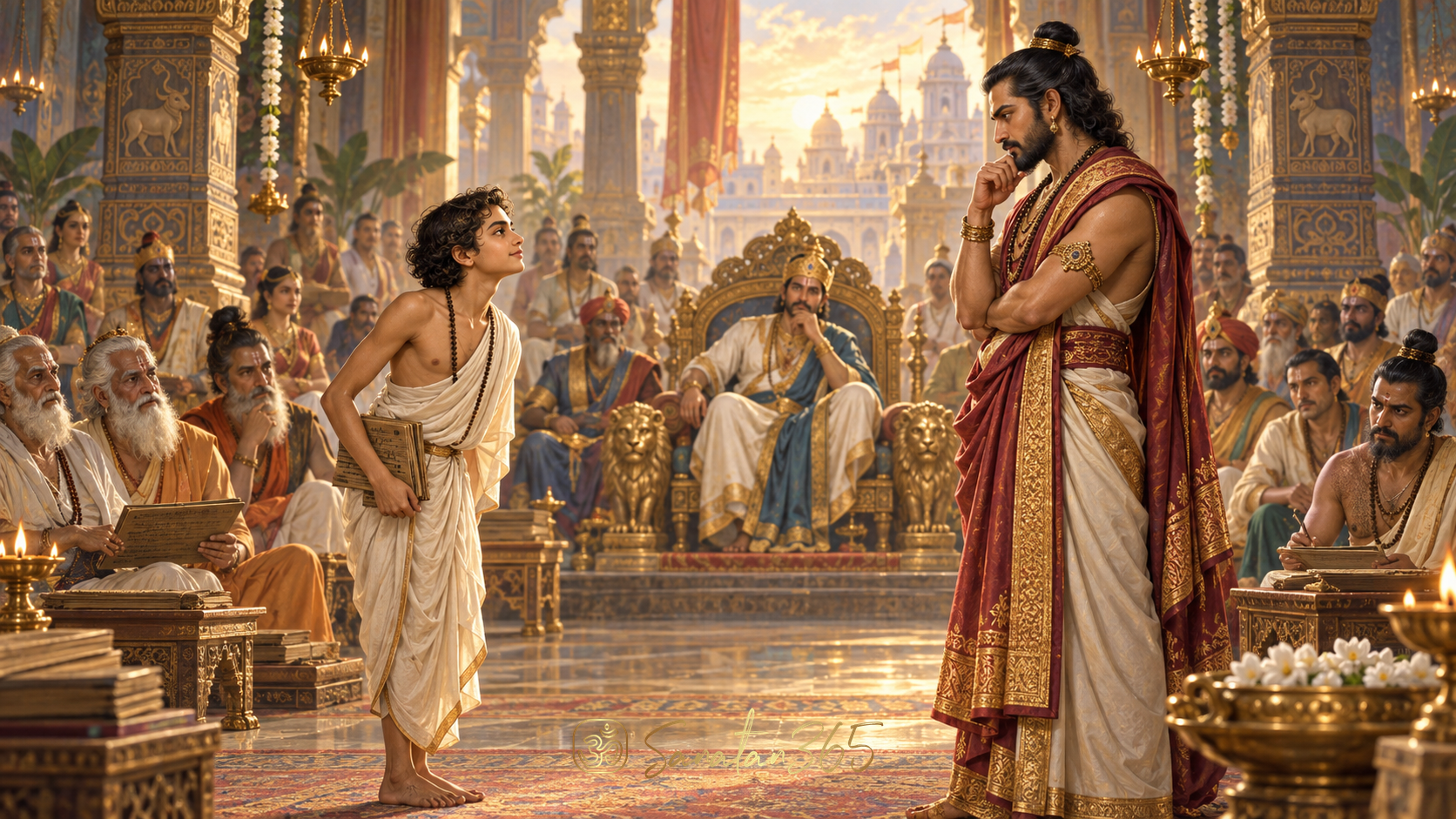
The scholar at the palace gate was still a boy, and his body did not match the court's idea of authority.
The Ashtavakra and Bandin story in the Mahabharata tells how young Ashtavakra entered King Janaka's court, refused to let age or appearance define knowledge, defeated the celebrated debater Bandin, and helped restore his father Kahoda. Its enduring lesson is not that hardship automatically creates wisdom. It is that careful learning, moral courage, and fair judgment can reveal worth where prejudice fails to see it.
What Is the Ashtavakra and Bandin Story in the Mahabharata?
The episode appears in the Vana Parva (वन पर्व, Book of the Forest) of the Mahabharata. During the Pandavas' pilgrimage, the sage Lomasha recounts the story of Ashtavakra, his family, and the royal court of King Janaka. The narrative unfolds across Sections 132-134 in the public-domain Kisari Mohan Ganguli translation of the Mahabharata's Tirtha-yatra Parva.
Ashtavakra grows up in the household of the learned sage Uddalaka. He initially believes Uddalaka to be his father and Uddalaka's son Shvetaketu to be his brother. One day, a painful family truth comes to light: Ashtavakra's father is Kahoda, a student of Uddalaka who had gone to King Janaka's sacrifice seeking support.
At Janaka's court, Kahoda entered a learned contest with Bandin, a formidable debater. According to the narrative, scholars defeated by Bandin were sent into the water. Kahoda did not return home. When Ashtavakra learns what happened, he decides to travel to Janaka's court with Shvetaketu.
This is not simply a revenge tale. Ashtavakra goes because knowledge has been joined to an unjust consequence, because his father's fate remains unresolved, and because a court that claims to honor wisdom must be tested by its own standard. The story therefore holds several questions together: Who deserves to be heard? What makes someone mature? Can an institution devoted to learning recognize knowledge when it arrives in an unexpected form?
Key takeaway: The story begins when a young seeker discovers that restoring truth may require entering the very institution that failed his family.
Why Did Ashtavakra Go to King Janaka's Court?
Ashtavakra's decision contains both putra-dharma (पुत्र-धर्म, a child's duty toward parents) and a scholar's commitment to truth. He does not possess military power or royal status. His strength is preparation. He believes he can meet Bandin in the field Bandin himself has chosen: disciplined debate.
The Mahabharata does not present the journey as effortless. Ashtavakra and Shvetaketu are young, and the royal setting magnifies every imbalance of status. Janaka's court represents authority, public reputation, ritual prestige, and expert judgment. Walking into it means accepting scrutiny before any argument begins.
Yet Ashtavakra does not ask the assembly to lower its intellectual standard out of sympathy. He asks it to apply the right standard. This distinction matters. Compassion does not require patronizing a person or treating rigorous evaluation as cruelty. It requires removing irrelevant prejudice so that ability, truth, and conduct can be judged fairly.
The motivation is also relational. Kahoda's absence is not an abstract injustice. It has shaped a household. Ashtavakra's learning becomes seva (सेवा, selfless service) when it is placed at the service of another person's restoration. Knowledge here is not a trophy. It is a responsibility.
Modern readers can recognize this pattern. A student may speak because a family member was dismissed. A younger colleague may question a confident but harmful practice. A person whose body is judged unfairly may insist that the room attend to the quality of the work. Courage is not always loud rebellion. Sometimes it is careful preparation followed by a clear request to be evaluated honestly.
Key takeaway: Ashtavakra goes to Janaka's court not to display cleverness, but to make learning answerable to duty, truth, and the fate of his father.
How Did Ashtavakra Answer the Gatekeeper's Judgment About Age?
Before Ashtavakra can meet Bandin, he must pass a gatekeeper who treats youth as proof of immaturity. The exchange becomes one of the episode's most memorable teachings. Ashtavakra challenges the assumption that years alone make an elder. The Ganguli translation presents his argument through comparisons: size does not make a tree fruitful, and grey hair does not by itself make a person learned. Understanding, not appearance alone, deserves respect.
The point is not to dishonor age. Hindu traditions repeatedly value elders, teachers, lived experience, and the discipline that can mature over time. Ashtavakra's correction is narrower and more precise: chronological age is not a substitute for wisdom, just as youth is not proof of ignorance.
This distinction protects both tradition and truth. Respect becomes shallow when it is reduced to social appearance. Genuine reverence asks what a person has studied, how carefully they reason, whether their speech is truthful, and whether their conduct serves dharma (धर्म, sustaining ethical and sacred order).
The gate scene also warns against deciding someone's capacity before hearing them. Ashtavakra's body and age are visible immediately; his learning is not. The gatekeeper must choose whether visible difference will end the encounter or whether conversation will disclose what sight cannot.
That lesson remains urgent in classrooms, workplaces, families, temples, and public life. People are often sorted by accent, age, disability, dress, confidence, or social position before their ideas are considered. The story asks for a disciplined pause: what evidence actually matters here?
Readers may find a related lesson in Satyakama Jabala's commitment to truth, where a student's worth is recognized through honesty rather than pedigree. Gargi Vachaknavi's fearless inquiry similarly shows that a serious question deserves attention because of its substance.
Key takeaway: Respect for age and tradition remains meaningful, but neither should become an excuse to ignore demonstrated knowledge or silence an unexpected voice.
What Happened in Ashtavakra's Debate with Bandin?
Once admitted, Ashtavakra faces King Janaka's questions and then meets Bandin. Their contest is built around numbered verses. Bandin begins with a statement organized around the number one; Ashtavakra answers with two. The exchange proceeds through successive numbers, drawing upon Vedic, ritual, cosmological, and cultural associations.
To a modern reader, the form may feel unusual. It is not a debate in which each participant gives a long speech on a single policy. It is closer to an exacting test of memory, pattern, scriptural learning, and the ability to answer within a shared intellectual form. Bandin sets the movement; Ashtavakra keeps pace and completes it.
The young scholar's victory matters because it follows the rules of the court rather than escaping them. He does not win merely because the narrative favors an underdog. He demonstrates command of the knowledge the assembly claims to value. This protects the story from a sentimental reading. Dignity is affirmed, but discipline is still required.
After Bandin is defeated, the mystery of the drowned scholars is explained. Bandin identifies himself as the son of Varuna and says the scholars had been sent to attend a long sacrificial rite performed by his father. They return, including Kahoda. The earlier terror of irreversible loss gives way to restoration.
The explanation does not erase every moral discomfort in the contest. The story permits readers to feel the danger of turning scholarship into domination. A culture of learning becomes distorted when losing an argument threatens a person's dignity or life. Bandin's defeat restores balance because intellectual power is no longer allowed to stand beyond accountability.
Kahoda then blesses his son. The narrative closes with Ashtavakra entering the river Samanga and emerging with his body straightened. This ending belongs to the sacred story and should be read reverently, not converted into a promise about disability or physical healing. Hindu narrative often uses transformation symbolically and miraculously; it must never be used to suggest that bodily difference reflects lesser worth or insufficient faith.
Key takeaway: Ashtavakra wins through mastery within a demanding shared form, and the result turns competitive knowledge back toward restoration.
What Does the Story Teach About Appearance, Knowledge, and Courage?
The episode offers at least five distinct lessons.
- A visible body is not a measure of invisible understanding. Ashtavakra's form draws attention, but his learning reveals who he is in the court's relevant field.
- Youth and wisdom are different categories. Experience deserves respect, yet a younger person may still possess real knowledge and moral clarity.
- Preparation gives courage a foundation. Ashtavakra does not rely on outrage alone. He studies, travels, answers questions, and accepts the test.
- Institutions must examine their gates. A court may praise wisdom while its gatekeeping prevents wisdom from entering.
- Learning reaches its highest use in service. The debate matters because it leads to accountability, reunion, and restoration.
These lessons should not be simplified into "confidence solves everything." Confidence without study can become noise. Study without humility can become Bandin-like pride. Compassion without fair standards can become condescension. The narrative joins qualities that modern culture often separates: self-respect and rigor, courage and filial love, public excellence and responsibility.
It also invites a better understanding of disability. Ashtavakra should not be reduced to an inspirational device for able-bodied readers. His bodily difference is part of the narrative, but the moral failure belongs to those who confuse appearance with capacity. Dignity is not something the court grants after he wins. It was his before he crossed the gate.
This point changes how the story is applied. The lesson is not that a person with a different body must perform extraordinary brilliance to earn ordinary respect. Every person deserves dignity. Ashtavakra's achievement additionally proves that prejudice is intellectually unreliable: it causes observers to misread the very excellence they claim to seek.
Key takeaway: The story opposes both prejudice and empty flattery by insisting on two truths together: dignity is unconditional, and learning deserves disciplined cultivation.
How Can Families Apply Ashtavakra's Lesson Without Romanticising Suffering?
Families can begin by changing the questions they ask. Instead of "Why does this child not look, move, speak, or learn like others?" they can ask, "What helps this person participate fully, and what strengths are we failing to notice?" This is not lowering expectations. It is removing a distorted lens.
A thoughtful family practice might include:
- letting children finish an answer before correcting their age or tone;
- refusing jokes that turn bodies, disability, or difference into entertainment;
- praising preparation, honesty, and helpfulness rather than appearance alone;
- teaching children to question ideas respectfully, even when the speaker has status;
- making homes, classrooms, and devotional spaces more accessible;
- distinguishing a person's inherent dignity from the outcome of any contest.
The story can also guide mentors. A good mentor does not merely announce that every learner is gifted. A mentor discovers what kind of guidance, access, practice, and challenge allows each learner to grow. Uddalaka's household represents a world of disciplined study; Janaka's eventual hearing represents institutional openness; Ashtavakra represents the learner's agency. Healthy education needs all three.
At the same time, suffering should never be romanticised. Physical pain, exclusion, and humiliation are not spiritually necessary gifts. If a child or adult needs medical care, accessibility support, counselling, or legal protection, a sacred story is not a replacement for professional help. The dharmic response is to combine reverence with practical care.
In conflict, Ashtavakra's example also asks families to move from insult to substance. He identifies the gatekeeper's mistaken criterion and supplies a better one. That is more constructive than reversing the prejudice and declaring every elder foolish. Dharma corrects false judgment without creating a new form of contempt.
For a complementary reflection on speaking truth in difficult settings, Vidura Niti's counsel before power explores how clarity and duty can remain joined.
Key takeaway: Families honor Ashtavakra by building fair access, listening for substance, opposing mockery, and supporting real needs without turning suffering into a spiritual spectacle.
Ashtavakra enters Janaka's court as someone others believe they can assess at a glance. He leaves having exposed the poverty of that glance. The Mahabharata's lesson is not merely that an exceptional boy defeated a famous scholar. It is that wisdom requires better seeing: the patience to hear before judging, the discipline to prepare before speaking, and the courage to put knowledge in service of restoration.
Key takeaway: Wisdom begins when appearance stops being the verdict and becomes only the beginning of attention.
FAQ
Who were Ashtavakra and Bandin?
Ashtavakra is a young learned sage in the Mahabharata episode. Bandin is the celebrated debater at King Janaka's court who had defeated Ashtavakra's father Kahoda and other scholars. Their contest tests knowledge, memory, composure, and public judgment.
Why was Ashtavakra called Ashtavakra?
The name Ashtavakra (अष्टावक्र) is traditionally understood as "eight bends" or "bent in eight places," referring to his bodily form in the sacred narrative. The name should never be used mockingly; the story directly challenges the assumption that bodily appearance determines wisdom.
How did Ashtavakra defeat Bandin?
They exchanged carefully structured verses associated with successive numbers. Ashtavakra answered Bandin's learned challenges and completed the contest successfully, demonstrating the knowledge and composure required by Janaka's court.
What happened to Kahoda after the debate?
After Bandin's defeat, the scholars previously sent into the water returned from Varuna's sacrificial rite, including Ashtavakra's father Kahoda. The story therefore ends in family reunion and restoration rather than revenge alone.
What is the main lesson of the Ashtavakra and Bandin story?
Its central lesson is that age and appearance cannot reliably measure wisdom. People deserve inherent dignity, while knowledge should be judged through preparation, truth, reasoning, and conduct. The episode also shows how learning becomes dharmic when it serves justice and restoration.
About the author
Sanatan365 Editorial
Bringing Sanatan Dharma to modern seekers through authentic, scripture-grounded content.
Related in Lessons
 Lessons
Aruni Lessons: Responsibility and Care in the Mahabharata
Read Aruni’s field-breach episode closely: a student’s resolve, a teacher’s search and practical lessons in responsibility that never requi…
 Lessons
Dharmavyadha Lessons: When Daily Duty Teaches a Scholar
The Mahabharata’s Dharmavyadha episode asks how anger, learning, and ordinary responsibilities reveal the quality of spiritual practice.
 Lessons
Gargi Vachaknavi: The Upanishadic Voice of Fearless Inquiry
Gargi Vachaknavi stands in the Brihadaranyaka Upanishad as a formidable questioner whose disciplined dialogue with Yajnavalkya reveals cour…

