Gargi Vachaknavi: The Upanishadic Voice of Fearless Inquiry
Gargi Vachaknavi stands in the Brihadaranyaka Upanishad as a formidable questioner whose disciplined dialogue with Yajnavalkya reveals courage, humility, and the sacred responsibility of inquiry.
Gargi Vachaknavi does not enter the Brihadaranyaka Upanishad as a decorative figure or a silent listener. She enters a royal assembly of learned teachers, challenges the celebrated sage Yajnavalkya, and asks what supports the visible world when every familiar explanation has been exhausted. Her importance lies not only in being a woman among philosophers, but in showing what serious spiritual inquiry demands: courage to ask, discipline to proceed step by step, humility before the limits of speech, and loyalty to truth above personal victory.
The text remembers Gargi as a brahmavadini (ब्रह्मवादिनी, a woman devoted to inquiry and discourse about Brahman, ultimate reality). Her questions move from the structure of the cosmos toward akshara (अक्षर, the imperishable), the reality that is not itself another object within creation. Read carefully, her dialogue is neither a modern debate spectacle nor a simple story of one thinker defeating another. It is a demanding lesson in how questions can become a sacred practice.
Who Was Gargi Vachaknavi in the Upanishads?
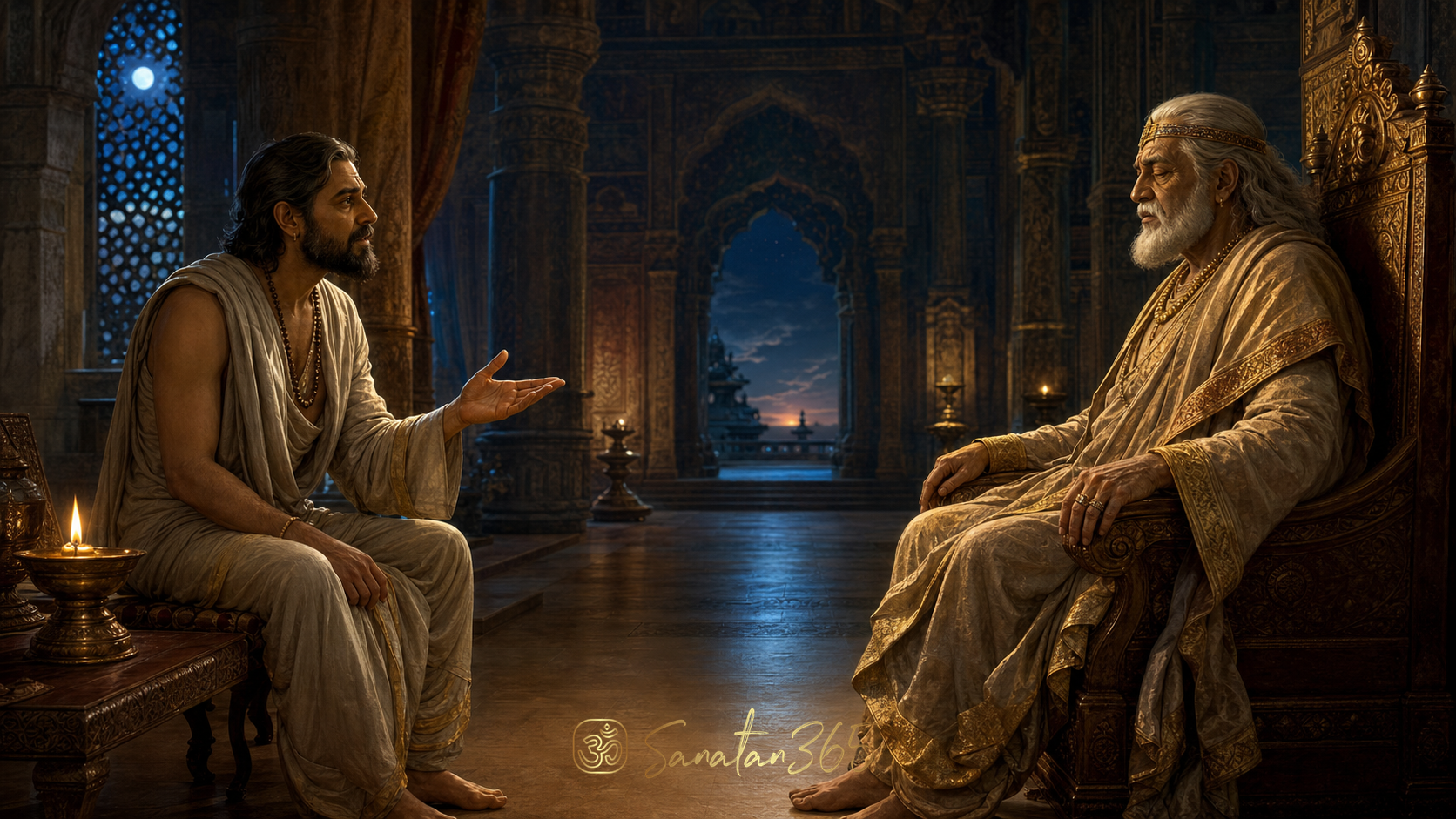
Gargi appears in the third chapter of the Brihadaranyaka Upanishad, during an assembly convened by King Janaka of Videha. Janaka offers a large reward to the most learned knower of Brahman. Yajnavalkya has the cows taken away before the discussion is settled, provoking a series of exchanges with other scholars. Gargi is one of the voices who tests his claim. The setting and sequence can be read in the Brihadaranyaka Upanishad, chapter 3.
Her patronymic, Vachaknavi, identifies her through the lineage of Vachaknu. The text gives few biographical details, so responsible reading should resist inventing a complete life story around her. What it does preserve is more valuable than a legend embellished for inspiration: Gargi is recognized by the assembly as capable of asking questions at the highest level of Upanishadic inquiry.
The word Upanishad is often connected with sitting near a teacher, but the literature it names includes searching conversations, reversals, analogies, and challenges. Knowledge is not presented as passive information. A student or interlocutor must listen closely, detect where an answer remains incomplete, and ask what follows. Gargi embodies that active attention.
Her presence also complicates any simplistic claim that ancient Indian intellectual life can be described by one social pattern. The text does not provide a complete history of women's education, nor does one prominent figure prove universal equality in every period. It does, however, preserve unmistakable evidence that a woman could be portrayed as an authoritative participant in a major philosophical assembly. Scholarly reference works consequently discuss Gargi alongside Maitreyi as an important female voice in early Upanishadic literature; readers can compare the different form of inquiry in the Maitreyi–Yajnavalkya dialogue.
Key takeaway: Gargi matters because the Upanishad presents her as a recognized philosophical agent whose questions help disclose the depth of its teaching.
What Did Gargi Ask Yajnavalkya?
Gargi's first exchange follows a repeated structure. She asks, in effect, what the world is woven upon. When Yajnavalkya supplies an answer, she asks what that answer itself is woven upon. The image uses the language of warp and weft: reality appears as a fabric whose visible layer depends upon a subtler ground.
The questioning ascends through increasingly expansive levels. Water is not the final explanation; neither are air, sky, celestial worlds, or the categories beyond them. Gargi keeps asking because any answer that names one conditioned part of the cosmos can still be questioned: what sustains that?
This method is intellectually precise. She does not jump immediately to a slogan about ultimate reality. She follows the consequences of each proposed ground. Her approach teaches three habits:
- Accept provisional answers without mistaking them for final ones. An answer may be useful at one level and incomplete at another.
- Keep the central question stable. Gargi does not change subjects whenever the inquiry becomes difficult.
- Distinguish explanation from ultimate ground. A chain of dependent things cannot explain why dependence exists at all.
At one point Yajnavalkya warns Gargi not to press further in that particular sequence. Modern readers sometimes isolate the warning and turn the scene into either hostility or unquestioned submission. The wider chapter is more complex. Gargi later returns, addresses the assembly, and conducts a second exchange. She has not disappeared from the conversation. The narrative preserves both a boundary and her renewed agency.
Her second challenge is framed with the confidence of a skilled archer preparing two arrows. She asks two connected questions: what pervades what is above the heavens and below the earth, and what encompasses past, present, and future? Yajnavalkya answers that these are woven upon akasha (आकाश, space or subtle expanse). Gargi then asks the decisive question: upon what is akasha woven?
Key takeaway: Gargi's questioning moves carefully from visible dependence to the search for a ground that is not merely another dependent object.
Why Does Gargi's Question About Akshara Matter?
Yajnavalkya answers that akasha is woven upon the akshara, the imperishable. This word requires care. It should not be reduced to a physical substance hidden behind other substances. The imperishable is described through negation: not gross, not subtle, not short, not long, without the ordinary qualities by which objects are grasped. Yet it is not presented as nothingness. Under its governance, the ordered movements of sun, moon, time, rivers, and cosmic directions hold their course.
This is a central Upanishadic shift. Ordinary knowledge works by identifying an object, describing its qualities, and relating it to other objects. Gargi's final question reaches toward that which makes all such relations possible but cannot be confined within them. Language must therefore work differently. It points, removes misconceptions, and acknowledges where objectifying thought fails.
The inquiry resembles the discipline found in the Upanishadic expression neti neti, “not this, not this”, though the passages should not be collapsed into one formula. Both resist treating Brahman as a thing among things. Both train the mind to notice how quickly it turns the ultimate into a manageable concept.
Yajnavalkya also connects knowledge with conduct and consequence. The imperishable is not a puzzle whose solution earns intellectual prestige. To perform rites or austerities without knowing their deeper ground leaves their fruit limited. To depart this life without understanding the imperishable is described as a profound loss; to know it is to become a true knower of Brahman. The point is not contempt for ritual, but the distinction between finite action and liberating knowledge.
Gargi's question matters because it brings the discussion to that threshold. She forces the assembly to confront whether its categories explain reality or simply rearrange its contents. Her contribution is therefore structural: without the question, the teaching about the imperishable would not arise in this form.
Key takeaway: The imperishable is not the last item in a cosmic list; it is the unconditioned ground that cannot be captured as an ordinary object.
What Does Gargi Teach About Courageous Inquiry?
Gargi's courage is easy to admire and easy to misunderstand. Courageous inquiry is not loudness, reflexive opposition, or the refusal of every boundary. Her example joins boldness with disciplined form.
First, she prepares. Her questions reveal knowledge of the cosmological categories used by her interlocutors. She can challenge an answer because she understands its implications. Inquiry without preparation easily becomes performance; Gargi's inquiry is substantive.
Second, she listens. Each next question responds to the actual answer given. She does not merely wait for her turn to speak. This quality is close to the Vedantic discipline of shravana, manana, and nididhyasana: hearing a teaching, reflecting until doubt is clarified, and allowing understanding to deepen. Gargi's scene is public and dialogical, but its attentiveness belongs to the same culture of serious learning.
Third, she risks status. King Janaka's assembly is not a casual gathering. Yajnavalkya has already answered formidable interlocutors. Gargi nevertheless asks what she believes must be asked. A search for truth cannot be governed entirely by fear of embarrassment.
Fourth, she recognizes the scale of the subject. After Yajnavalkya's answer concerning the imperishable, Gargi tells the assembly that they should consider it a great achievement if they can depart after offering him respect; she does not claim an easy triumph. Intellectual humility is not the opposite of courage. It is what keeps courage from hardening into vanity.
Finally, her exchange shows that disagreement need not become contempt. The participants press one another sharply, but the purpose is the testing of knowledge. A modern audience can learn from this without copying every ancient convention. Questions can be rigorous without humiliating a person. Respect can remain intact without making claims immune from examination.
Key takeaway: Gargi's fearlessness is disciplined by knowledge, listening, humility, and commitment to the question rather than to personal victory.
How Can Gargi's Example Guide Modern Learning?
Gargi's example can guide classrooms, spiritual study groups, families, and personal reflection, provided it is not reduced to motivational branding. Her method suggests a practical sequence for responsible inquiry.
Begin with the strongest honest question
Ask what genuinely remains unclear. A useful question is specific enough to examine and important enough to sustain attention. “What supports this claim?” is stronger than a vague gesture of doubt. “What would count as evidence?” is stronger than assuming agreement or disagreement in advance.
Trace dependence one level further
When an explanation is offered, notice whether it is final or whether it depends upon another assumption. This does not require endless skepticism. It requires knowing what kind of answer has actually been given. Scientific, historical, ethical, and spiritual questions use different forms of evidence; clarity about the level prevents confusion.
Define terms before arguing about them
Gargi's dialogue turns on precise categories such as akasha and akshara. Modern disagreements often continue because one word carries several meanings. Before defending a position, ask what its key terms mean in the relevant tradition and text.
Let primary sources correct inherited summaries
Popular accounts may portray Gargi only as a symbol of confidence. Returning to the Upanishad reveals a subtler figure: prepared, persistent, restrained, and metaphysically exact. The same discipline applies elsewhere. The Nachiketa story becomes richer when read as a sustained inquiry into choice and the Self, not merely as a tale of a brave child.
Keep inquiry ethically grounded
Questions affect people. In a spiritual context, humility matters because the subject exceeds any individual's mastery. In a human context, dignity matters because another person's error does not erase their worth. A responsible question seeks illumination, not domination.
A simple reflection practice can make these principles concrete:
- Write one belief or teaching you want to understand.
- State the best reason you currently have for accepting it.
- Identify one term or assumption that remains unclear.
- Consult a reliable primary text or qualified teacher.
- Revise the question in light of what you learn.
- End by recording what remains genuinely unknown.
This practice is not a substitute for traditional study under a competent teacher, especially for subtle Vedantic interpretation. It is a way to become a better listener and a more responsible questioner.
Key takeaway: Modern inquiry becomes more truthful when questions are precise, sources are respected, assumptions are examined, and human dignity remains intact.
Conclusion: A Question Can Be an Offering
Gargi Vachaknavi's enduring power comes from the union of intellectual strength and spiritual seriousness. She enters a difficult conversation, follows each answer beyond its surface, and brings the assembly to the teaching of the imperishable. She neither accepts prestige as proof nor treats questioning as rebellion for its own sake.
Her dialogue reminds us that a sincere question can be an offering: attention offered to truth, ego placed under examination, and speech used in service of understanding. The courage to ask is only the beginning. The deeper discipline is to listen, refine, and remain humble when reality exceeds the categories we brought to it.
Key takeaway: Gargi teaches that fearless inquiry reaches its highest form when courage, precision, reverence, and humility work together.
FAQ
Who was Gargi Vachaknavi?
Gargi Vachaknavi was a woman philosopher presented in the Brihadaranyaka Upanishad. In King Janaka's assembly, she questions the sage Yajnavalkya about the ground of the cosmos and the nature of the imperishable.
What did Gargi ask Yajnavalkya?
Gargi first asks what the world and successive cosmic levels are “woven” upon. In her later exchange, she asks what pervades all existence across space and time, and finally what supports akasha, or subtle space. This leads to Yajnavalkya's teaching on akshara, the imperishable.
What does brahmavadini mean?
Brahmavadini (ब्रह्मवादिनी) refers to a woman devoted to discourse or inquiry concerning Brahman, ultimate reality. The term highlights Gargi's identity as a serious participant in sacred philosophical learning.
Did Gargi defeat Yajnavalkya?
The Upanishad is better read as a rigorous examination of knowledge than as a modern contest with a simple winner. Gargi tests Yajnavalkya with demanding questions, receives his teaching on the imperishable, and acknowledges the strength of his answers before the assembly.
Why is Gargi relevant today?
Gargi models inquiry that is brave without being careless. She prepares, listens, follows assumptions, respects the scale of the subject, and values truth above personal victory. Those habits remain relevant wherever people study, teach, debate, or seek spiritual understanding.
About the author
Sanatan365 Editorial
Bringing Sanatan Dharma to modern seekers through authentic, scripture-grounded content.
Related in Lessons
 Lessons
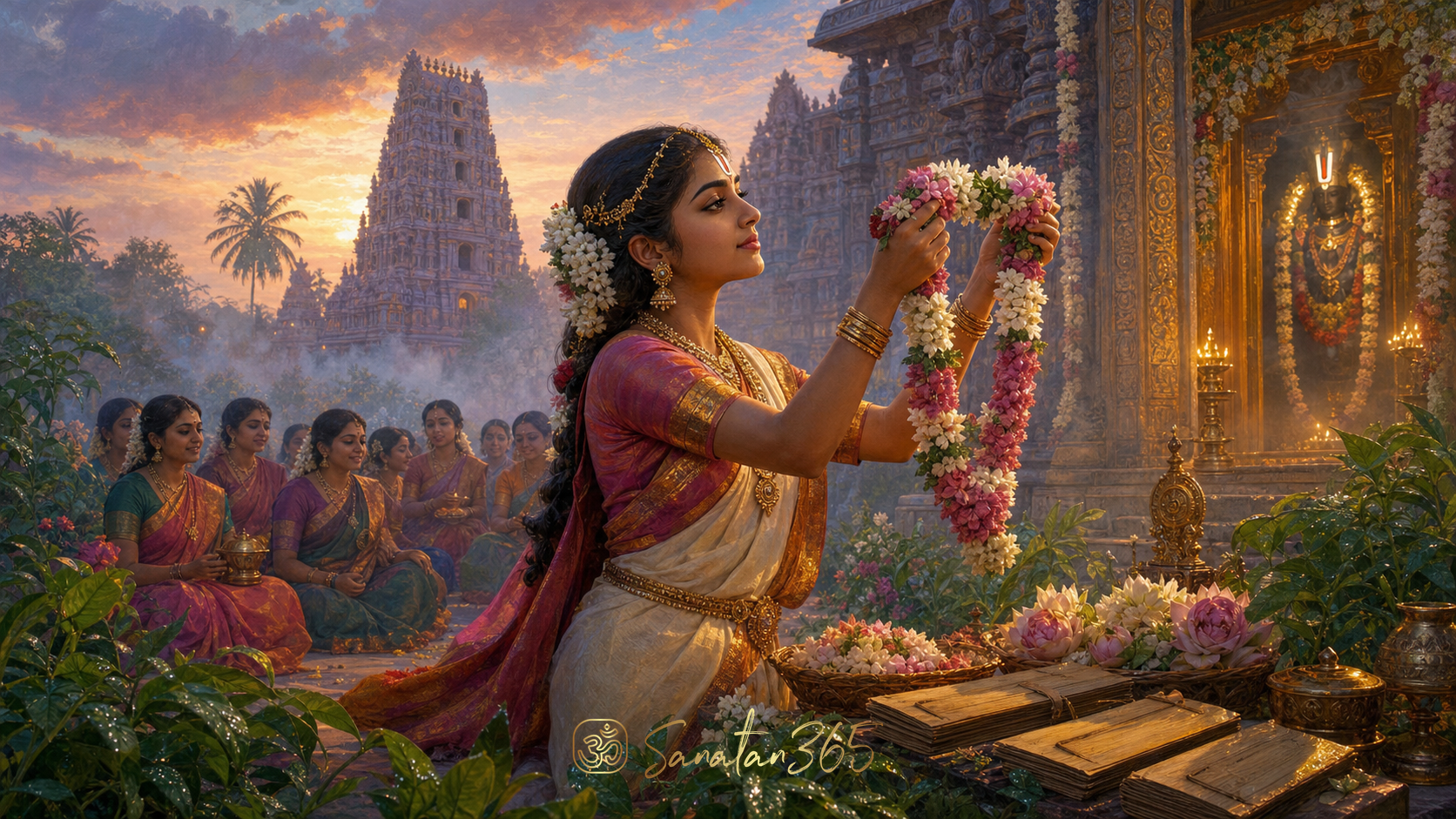
Andal: The Poet-Saint Who Made Longing a Path of Devotion
Discover Andal, the Tamil poet-saint whose Tiruppavai transformed sacred longing, shared song, and wholehearted surrender into a living pat…
 Lessons
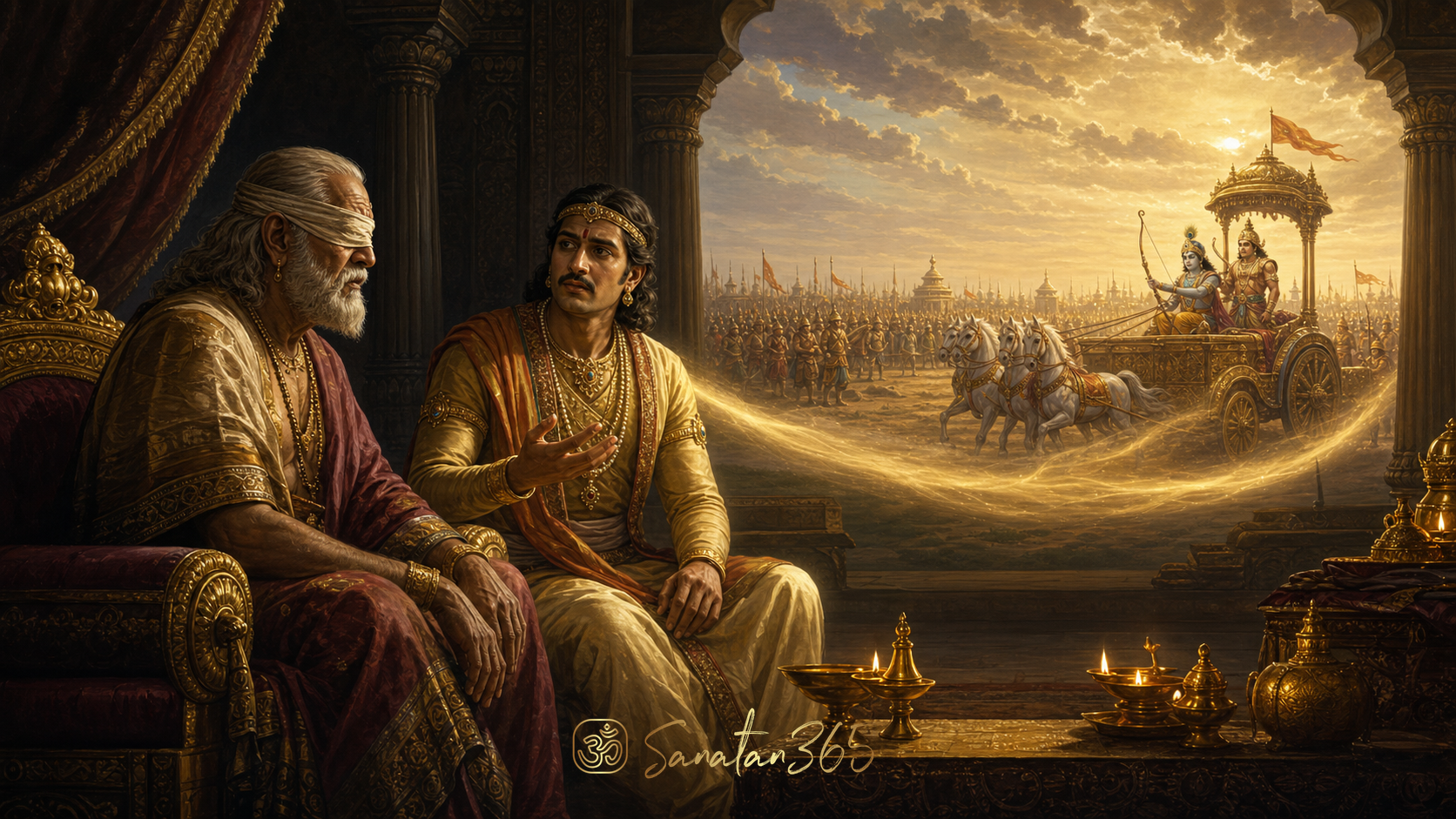
Sanjaya in the Mahabharata: Divine Sight and the Duty to Tell the Truth
Sanjaya receives divine sight to narrate Kurukshetra to the blind king Dhritarashtra. His story asks what it means to see clearly, speak tr…
 Lessons
Vidura Niti Meaning: Wise Counsel When Power Refuses to Listen
Vidura Niti offers a disciplined vision of leadership, self-mastery, truthful counsel, and dharma in moments when power resists wisdom.