Shadbala Meaning: Reading Six Strengths Without Ranking a Life
A clear guide to Shadbala's six components, report units and comparison ratios, with careful limits on what planetary strength can mean.
A planet can lead a strength table without turning a person's life into a success certificate.
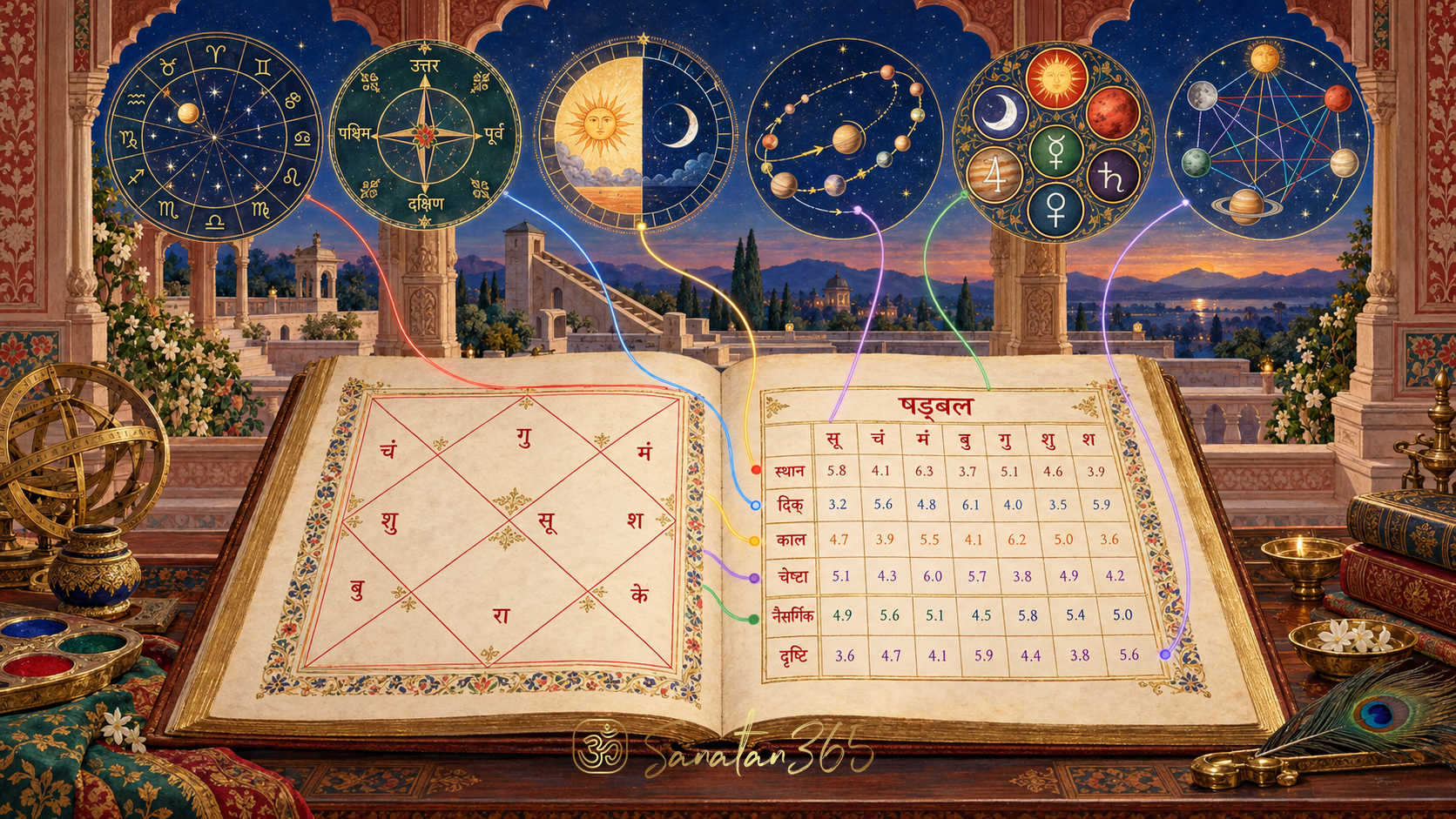
Shadbala meaning is sixfold strength: a traditional calculation in Jyotisha (ज्योतिष, the Hindu discipline of astrology) that combines six kinds of planetary strength. In a Kundali (कुण्डली, birth chart), these describe position, direction, time, motion, inherent strength and received aspects. The conventional calculation concerns the seven classical grahas (ग्रह, astrological planetary factors), from the Sun to Saturn. It is a technical framework within a tradition, not a scientifically established measure of personal worth or a guarantee of events.
The useful first question is therefore not “Which planet wins?” It is “What exactly does this column measure?” That small change makes a complicated report more understandable and discourages the fearful reading that one low number settles everything.
What is the Shadbala meaning in a birth-chart report?
The Sanskrit expression Shadbala (षड्बल, sixfold strength) joins the idea of six with bala (बल, strength). A total is assembled from different components rather than inferred from a single attractive placement. A planet's position in a sign is part of the calculation, but not the whole calculation.
Chapter 27 of the Brihat Parashara Hora Shastra, in R. Santhanam's translation, sets out the six sources and their subdivisions. The explanatory note near the chapter's opening specifically identifies the seven planets from the Sun through Saturn and excludes the lunar nodes from this conventional calculation. Chapter and printed-page references are more useful here than assuming every digital edition has identical PDF pagination.
The seven are the Sun, Moon, Mars, Mercury, Jupiter, Venus and Saturn. Calling the Sun and Moon planets follows astrological usage; it does not change their astronomical identities. Rahu and Ketu (राहु and केतु, the ascending and descending lunar nodes) belong to broader chart interpretation, but a standard seven-planet Shadbala table is not incomplete simply because they are absent.
For someone new to chart reading, this distinction prevents an immediate mistake: expecting every object shown in a horoscope to appear in every technical table. Different tables answer different questions. The basic structure of a Kundali gives the wider context; a strength report adds one specific analytical layer.
A report should also identify its method. A row called “strength” could refer to Shadbala, a divisional-chart score, house strength or a software-specific index. Similar English labels do not make those calculations interchangeable. Look for the actual heading before interpreting a colour, rank or percentage.
Key takeaway: Shadbala is a defined six-part calculation, not a general synonym for everything favourable in a horoscope.
Which six components make up the strength total?
The six components can be understood as six separate questions. Their technical rules are detailed; the following explanations introduce their purpose without pretending to replace a calculation manual.
1. Sthana Bala: where is the planet placed?
Sthana Bala (स्थान बल, positional strength) gathers several placement-based measures. These include a planet's distance from its traditional debilitation point, its positions in specified chart divisions, and other classified placements. Santhanam's chapter 27 treats these as subdivisions that are added to obtain positional strength.
This explains why “the planet is exalted” does not complete a Shadbala reading. Exaltation strength is one contribution within one component. A large contribution there cannot tell the reader what direction, time or aspect calculations will contribute elsewhere.
2. Dig Bala: how does direction contribute?
Dig Bala (दिग्बल, directional strength) evaluates planetary position relative to the chart's directional reference points. In the cited chapter, Jupiter and Mercury have their strongest directional point at the ascendant; the Moon and Venus at the lower meridian; Saturn at the descendant; and the Sun and Mars at the upper meridian.
The calculation is related to precise reference degrees, not merely a sticker attached to an entire house. Its role is also not to instruct someone which direction to face a desk. Reading a chart's directional component and giving a household direction prescription are different activities.
3. Kala Bala: what does the time contribute?
Kala Bala (काल बल, temporal strength) brings together several time-dependent considerations. Chapter 27 discusses day and night, the lunar fortnight, divisions of day or night, and specified time lordships, among other factors. It includes Ayana Bala (अयन बल, a strength associated with celestial declination) within its explanation of temporal strength.
That last detail matters when checking software: a displayed subcomponent should not be added a second time if it is already included in a subtotal. An expanded report may show both a subtotal and the figures used to make it. The reader needs the calculation legend, not a habit of summing every visible number.
4. Cheshta Bala: how is motion treated?
Cheshta Bala (चेष्टा बल, motional strength) concerns the traditional treatment of apparent planetary motion. Retrograde motion belongs to this discussion, but it is not a complete substitute for the component's rules. Chapter 27 distinguishes the treatment of the Sun and Moon from that of the other five classical planets.
A beginner should therefore avoid assigning the same motion score to every body by applying one slogan. Nor does a motion-related strength make every expression of that planet beneficial. Calculation and interpretation remain separate steps.
5. Naisargika Bala: what is assigned inherently?
Naisargika Bala (नैसर्गिक बल, natural or inherent strength) is the fixed contribution assigned to each of the seven planets in this system. It does not vary from one person's birth chart to another. Santhanam's chapter gives the Sun the largest contribution and Saturn the smallest in this particular component.
This is not a ranking of people's lives, and it is not the final planetary-strength ranking. A constant contribution is only one part of the total. The other five components vary with the chart and calculation conditions.
6. Drik Bala: what aspects are received?
Drik Bala (दृग्बल, aspectual strength) evaluates received planetary aspects under the method's rules. Drishti (दृष्टि, an astrological aspect or directed influence) is the related technical concept. The calculation distinguishes contributions according to traditional classifications of the aspecting planets.
Here “benefic” and “malefic” are inherited astrological categories, not judgments that a person or deity is good or bad. Chapter 26 supplies aspect evaluation, while chapter 27 uses aspectual strength in the wider strength system. A visible line drawn between planets is not, by itself, the numerical calculation.
Key takeaway: The six components describe distinct inputs; a shortcut about one input cannot stand in for the whole total.
How do rupas, virupas and ratios differ?
Many reports show the same underlying total in more than one form. Rupa (रूप, a whole strength unit in this context) and virupa (विरूप, its smaller subdivision) are related by a simple conversion: one rupa equals 60 virupas. The cited translation explains the sixty-part relationship in chapter 26 and applies it in chapter 27.
Consider an explicitly invented arithmetic example. Suppose six already-calculated contributions, all expressed in virupas, are:
- Positional: 180
- Directional: 40
- Temporal: 100
- Motional: 30
- Natural: 30
- Aspectual: 10
Their sum is 390 virupas. Dividing by 60 gives 6.5 rupas. This is an illustration of addition and unit conversion, not an actual horoscope or a demonstration of how the six component values were obtained.
Now imagine a comparison column that divides this total by a required reference strength of 390 virupas. The ratio would be 1.00, or 100% if the software explicitly uses percentage notation. It would not mean a 100% probability of success. It would mean that the illustrative total equals the selected reference.
The reference is planet-specific in the cited chapter's requirements: 390 for the Sun, 360 for the Moon, 300 for Mars, 420 for Mercury, 390 for Jupiter, 330 for Venus and 300 for Saturn, all in virupas. This is why equal raw totals need not produce equal comparison ratios.
For example, a purely illustrative total of 360 virupas gives a ratio of 1.00 against 360, but approximately 0.857 against 420. Nothing mysterious happened; the denominator changed. Before comparing two planets, check whether the report shows raw totals, rupas, ratios or ranks.
Key takeaway: A unit conversion changes presentation; a ratio changes the comparison basis. Neither is a probability forecast.
Why is a strong planet not automatically favourable?
A strength calculation and a full interpretation ask related but different questions. The first concerns a planet's measured strength under specified rules. The second considers what the planet signifies and how it relates to the chart as a whole. Treating the first answer as the whole second answer loses context.
The traditional source itself does not end with a single total. Its subsequent discussion addresses constituent strengths, house effects and interpretive qualifications; chapter 28 separately considers favourable and unfavourable effects. Reading only the highest number while ignoring those distinctions is a selective reading of the framework.
For a modern reader, the most responsible conclusion is modest: the table describes an internal astrological assessment. It does not measure moral character, spiritual attainment, intelligence, lovability or entitlement to opportunity. A low entry is not a diagnosis, and a high entry cannot guarantee an event.
The twelve houses of a birth chart provide another layer of context, but adding more technical layers still does not remove uncertainty. A thoughtful consultation should explain its assumptions and limits rather than turn terminology into certainty.
No purchasing decision or major personal decision should be forced by a frightening score. In particular, the arithmetic alone cannot establish that someone must buy an object, perform an expensive ritual or abandon a plan. Reverence for a tradition and freedom from pressure can coexist.
Key takeaway: Strength is one technical consideration, not a verdict on a person or a guaranteed description of their future.
How should a reader compare two software reports?
Two different-looking reports are not automatically evidence that one calculation is fraudulent. First establish whether they describe the same birth input and use the same settings. A difference in birth time, location or calculation convention deserves investigation before interpretation.
P. V. R. Narasimha Rao's Vedic Astrology: An Integrated Approach, section 15.3, explicitly observes that computer programs may use somewhat different definitions in computing Shadbala. That observation supports asking about the method; it does not mean that any unexplained number should be accepted.
A practical comparison can proceed in this order:
- Match the birth date, recorded time, place and time-zone handling.
- Check the zodiac convention and named calculation settings.
- Match units before comparing totals.
- Compare each of the six components, not just the final rank.
- Check whether separately displayed subcomponents are already included in subtotals.
- Ask which textual method or software documentation explains the difference.
Keep the original reports while investigating. Writing down one specific discrepancy, such as “directional strength differs while the other five components match,” produces a more useful question than asking which chart is correct in every possible respect.
Responsible learning begins with knowing what was calculated. Key takeaway: Read the legend, preserve the inputs, and ask for an explanation before giving a number authority over a life.
FAQ
Is Shadbala calculated for Rahu and Ketu?
The conventional sixfold calculation described in Santhanam's chapter 27 concerns the seven classical planets from the Sun to Saturn, not the lunar nodes. Software may offer additional node assessments, but those should be identified separately rather than silently treated as identical calculations.
Does the planet with the highest Shadbala always give the best results?
No. A raw total or rank is not a complete interpretation. Its meaning depends on the method, planet-specific reference values and wider chart context. It cannot guarantee good fortune or measure the value of the person whose chart is being studied.
What is the difference between rupas and virupas?
One rupa equals 60 virupas. A total of 390 virupas therefore equals 6.5 rupas. Compare reports only after confirming their units; an apparent sixtyfold discrepancy may simply be a difference in presentation.
Does a Shadbala ratio below one mean life will go badly?
No. If the software defines its ratio as total divided by required reference strength, a value below one means the total is below that reference. It does not translate into a probability of failure or a prediction that a person's life will go badly.
Can Shadbala be read without an astrologer?
A beginner can learn the six labels, units and arithmetic without making personal predictions. Detailed computation and interpretation require more study. A helpful teacher explains assumptions and welcomes questions; technical complexity is not a reason to demand unquestioning belief.
About the author
Sanatan365 Editorial
Bringing Sanatan Dharma to modern seekers through authentic, scripture-grounded content.
Related in Kundali
 Kundali
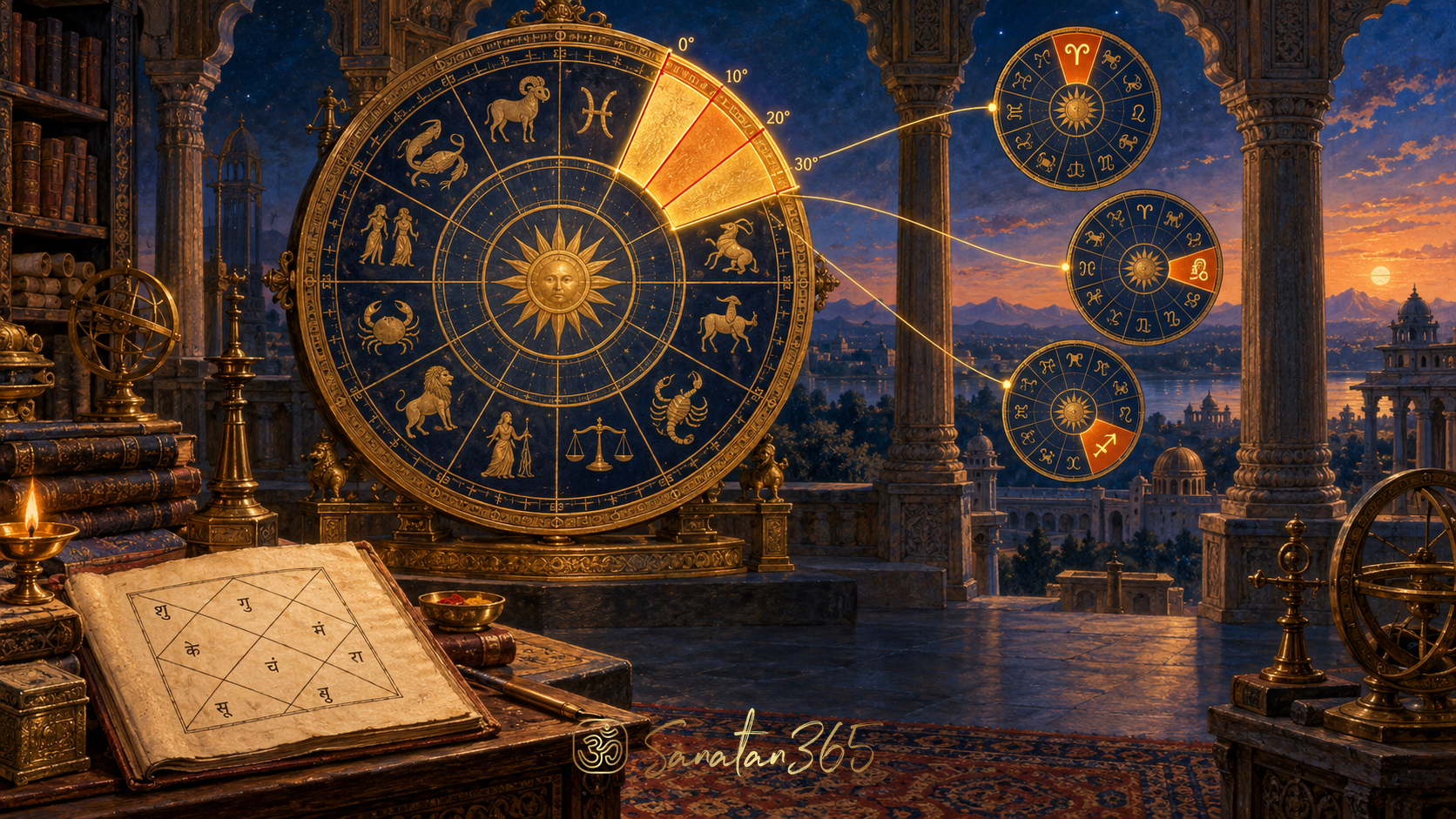
Drekkana Chart Meaning: How the D3 Divides a Birth Chart
Understand the Drekkana D3 chart through ten-degree divisions, worked examples, its traditional focus on siblings, and clear limits on inte…
 Kundali
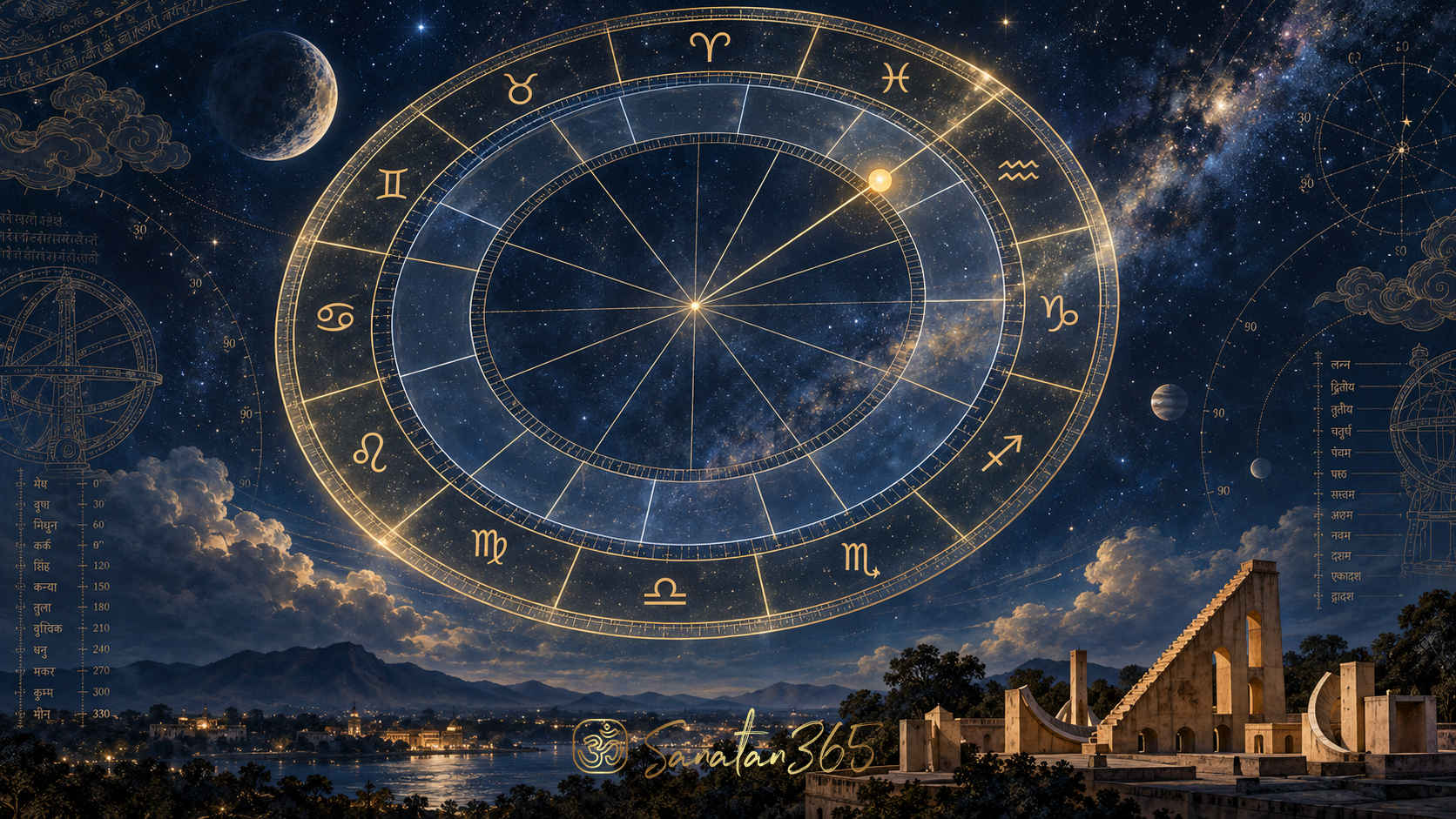
Bhava Chalit Chart Meaning: Why Houses Change but Signs Do Not
Read a Bhava Chalit chart without confusing a planet’s zodiac sign with its calculated house. Understand midpoint conventions, a worked exa…
 Kundali
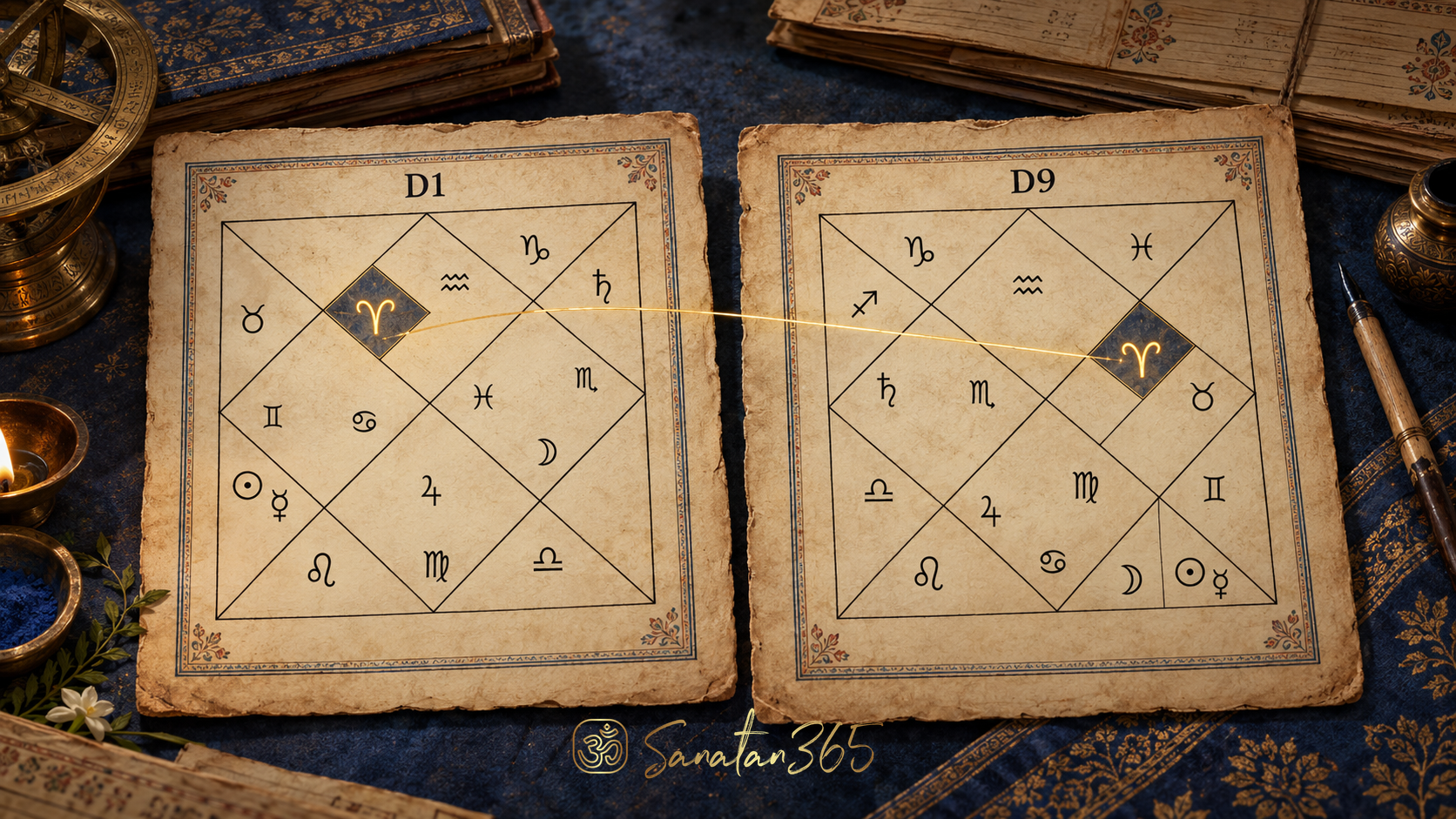
Vargottama Meaning: When D1 and D9 Repeat a Zodiac Sign
Understand the same-sign relationship between a birth chart and its Navamsa, how to identify it, and why it is not a stand-alone promise of…

