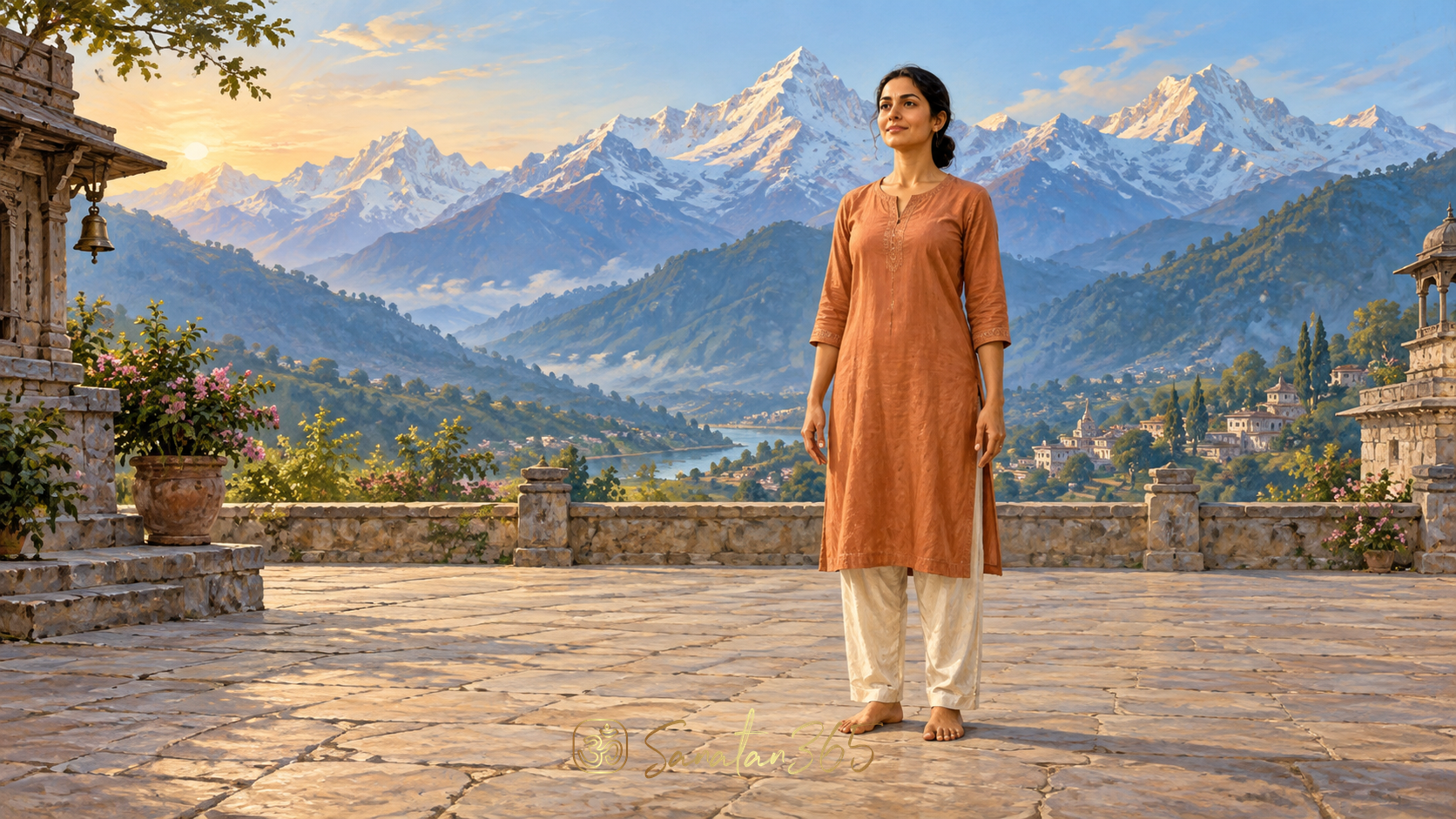
Tadasana Meaning: Mountain Pose and the Art of Standing Well
Why a simple standing posture deserves careful attention, how Mountain Pose differs from the raised-arm Palm Tree version, and how to practise without strain.
The simplest yoga posture can reveal how much effort hides inside ordinary standing.
Tadasana meaning is commonly given as Mountain Pose or Palm Tree Pose. Tadasana (ताड़ासन, tāḍāsana) is a yoga posture of upright steadiness; āsana (आसन) means posture or seat. In many classes it is an arms-down standing foundation. The Ministry of AYUSH's Common Yoga Protocol teaches a raised-arm, heel-lifting form called Palm Tree Posture. Understanding that difference helps a beginner follow instructions clearly, without assuming every version must look identical.
Neither form needs to become a test of endurance. The useful question is not how impressive standing can look, but how carefully it can be felt.
What is the Tadasana meaning, and why are there two forms?
The Ministry of AYUSH Common Yoga Protocol, in its standing-posture section, glosses tāḍa as palm tree or mountain. It presents Tadasana as a foundation for standing postures and a practice of stability and firmness. Its sequence begins with the feet a small distance apart, interlocks the fingers, turns the palms upward, raises the arms, and includes lifting the heels.
Many modern yoga classes use Mountain Pose for an upright position with the arms resting beside the body and both feet remaining on the floor. These are recognizably related practices, but they ask different things of balance, shoulders, and attention.
This distinction explains a common beginner's puzzle. One teacher says, “Stand quietly with your arms down.” Another says, “Reach upward and rise onto your toes.” Neither instruction should be followed merely because a photograph carries the same label. The teacher's actual sequence, the intended variation, and the practitioner's comfort matter more than a name alone.
The Common Yoga Protocol also uses samasthiti (समस्थिति, balanced or steady standing) for its alert standing position. That overlap is useful to recognize, but it does not mean all schools use every name interchangeably. Yoga vocabulary travels through teaching lineages, languages, printed manuals, and contemporary classes. A responsible introduction acknowledges that variation rather than announcing one universal version.
For practical clarity, this article calls the arms-down, feet-grounded form Mountain Pose and the raised-arm version described in the protocol Palm Tree Pose. The beginner sequence below stays with Mountain Pose. It does not ask the reader to lift the heels, hold the breath, or add a backbend.
The mountain image offers a thoughtful metaphor: steadiness need not be dramatic. The palm-tree image suggests upward reach. These are ways of understanding a posture, not scientific explanations of what the body must do.
Key takeaway: Ask which version is being taught before following the pose name; a feet-grounded stance and a heel-lifting stretch are not the same task.
How does standing become a practice of attention?
Ordinary standing usually serves another activity. A person stands to cook, wait for a bus, speak to someone, or reach a shelf. Attention belongs to the task, while the standing body stays in the background.
Mountain Pose brings that background into view. Where does the weight rest? Are the toes gripping? Is one shoulder held higher than the other? Has the jaw tightened even though no difficult movement is happening?
These observations are not a search for faults. They are information. A beginner does not need to possess a perfectly symmetrical body or force every joint into a diagram. The point is to notice a manageable pattern and make a small, comfortable adjustment.
There is an important difference between alertness and rigidity. Alertness can include soft hands, a relaxed face, and unforced breathing. Rigidity treats stillness as an order not to move. When a practitioner starts clenching the thighs, lifting the chest aggressively, or suppressing natural breathing to look composed, the visible shape has become more important than the experience.
A simple experiment makes the distinction clear. First, stand as if being photographed and try to appear exceptionally upright. Then release the performance, let the shoulders settle, and observe the contact of the feet with the floor. The second attempt may look less theatrical. It can nevertheless offer more useful information about habitual effort.
This is a practice instruction, not a promise that one posture will cure distress or correct a medical condition. Even published research about complete yoga programmes cannot automatically be turned into a claim about a few moments of Tadasana. The modest goal here is attentive standing.
Breathing deserves the same restraint. There is no need to turn Mountain Pose into prāṇāyāma (प्राणायाम, a discipline of regulating the breath). A beginner can let breathing remain natural. Readers interested in a separate breathing practice can explore the distinction in the gentle introduction to Nadi Shodhana (नाड़ी शोधन, nāḍī śodhana, alternate-nostril breathing), rather than mixing techniques without guidance.
Key takeaway: Standing becomes practice when attention becomes specific, not when the body becomes unnaturally stiff.
How can a beginner try the feet-grounded form?
Choose a clear, level surface where it is easy to stop or sit down. A stable chair or wall nearby can make the setting more practical. There is no advantage in practising on an uneven ledge, a slippery floor, or a crowded pathway.
The following sequence is a gentle introduction, not an individualized prescription. Its arms-down stance, comfortable foot spacing, and steady gaze are consistent with the basic guidance in Cleveland Clinic's explanation of Mountain Pose. A trained teacher can adapt details to the person in front of them.
- Place the feet comfortably apart. A roughly hip-width stance is a reasonable starting point. Keep both feet grounded rather than narrowing the stance to imitate an advanced-looking photograph.
- Notice the contact with the floor. Observe the heels and the areas beneath the big and little toes. Let the toes rest instead of clawing at the surface.
- Let the knees remain comfortable. Avoid deliberately pushing them into a hard locked position. The legs support standing without needing maximal effort.
- Allow the trunk to rise naturally. Think of a comfortable upright position, not a military pose. Do not thrust the ribs forward or force the lower back into an exaggerated curve.
- Rest the arms beside the body. Let the fingers soften. Keep the shoulders away from the ears without pulling them sharply downward.
- Keep the head easy and the eyes open. Look toward a still point at a comfortable height. There is no need to tip the chin upward or close the eyes to make the exercise more spiritual.
- Take a few ordinary breaths. Notice whether attention can remain with standing while breathing stays free. Stop before the posture becomes a struggle.
- Release deliberately. Soften the effort and step out, or sit down. Observe the difference between ending consciously and abruptly abandoning an uncomfortable hold.
A first attempt can be brief. A few comfortable breaths are enough to learn what the instructions feel like. Longer holds do not prove deeper understanding, and no universal duration suits every beginner.
Try attending to one area at a time. During one breath, notice the feet. During the next, notice the hands. Then notice whether the shoulders can remain easy. This small sequence is often clearer than attempting ten alignment corrections simultaneously.
Do not repeatedly scan the body for imperfections. Once a useful adjustment has been made, let attention rest. The posture should not become a miniature examination in which every sensation earns a mark.
If dizziness, pain, unusual breathlessness, or instability appears, stop and sit safely. Persistent symptoms or a relevant health condition call for qualified professional advice, not stronger determination on the mat. This introductory practice does not replace medical care.
Key takeaway: Begin with a stable setting, both feet grounded, ordinary breathing, and a short, comfortable attempt.
Which adjustments keep the posture comfortable?
The most useful adjustment may be doing less. Raising the arms, lifting the heels, closing the eyes, and extending the hold all change the task. They are not automatic upgrades.
Feet apart rather than pressed together
Some teachers demonstrate Mountain Pose with the feet together. Others use more space between them. A beginner can choose comfortable spacing rather than treating a narrow base as a badge of seriousness. The Cleveland Clinic guide starts with hip-width feet and also describes using support when unsteady.
Foot spacing is an instruction to explore with a teacher, not a moral standard. Bodies differ, and a photograph cannot show the practitioner's history, balance, or comfort.
Arms down before arms overhead
An overhead reach adds a shoulder movement to standing. The AYUSH Palm Tree sequence goes further by adding a heel lift. A reader whose only aim is to understand upright awareness need not include either movement.
The protocol carries cautions for the heel-lifting version, including concerns involving vertigo and certain medical conditions. Its caution list should not be read as a personalized diagnosis or a complete screening tool. Anyone with balance difficulties, an injury, or a relevant condition should ask a qualified teacher and healthcare professional about suitability before attempting that variation.
Keeping the feet down is not a guarantee that practice is suitable for everyone. It simply avoids adding the particular challenge of rising onto the toes in this introductory sequence.
A chair as an alternative context
The Cleveland Clinic guidance also describes an upright seated adaptation using a sturdy chair, supported feet, and relaxed hands. A seated practice changes the posture, so it should not be presented as identical to standing Tadasana. It can still provide a practical setting for attending to support, uprightness, and unforced breathing.
A reader who cannot comfortably stand need not be excluded from learning. The shared principle is careful attention within an appropriate form, rather than forcing the same shape on every body.
Rest instead of endurance
If the legs tire or attention becomes strained, stop. Taking a break is not failure. Yoga practice includes recognizing when an instruction is no longer useful in its present form.
The discussion of conscious rest in Shavasana offers a helpful contrast: standing gathers attention through upright support, while a resting posture changes that relationship. Neither needs to win a contest against the other.
Key takeaway: Adjust the task to the person; support, shorter practice, and an appropriate alternative are more useful than forcing a uniform shape.
What can this simple posture teach beyond the mat?
A posture does not automatically make someone patient, truthful, or kind. Physical steadiness is not proof of spiritual maturity. Yet the way a person learns to practise can offer a useful pattern for other situations.
One pattern is notice before correcting. In Mountain Pose, that means observing where effort collects before adding another instruction. In daily life, it might mean recognizing a rushed tone before continuing a conversation. The connection is reflective, not a claim that a standing exercise directly produces ethical change.
Another is support before ambition. A clear floor and comfortable stance come before a heel lift. Similarly, a workable routine comes before an elaborate promise. The foundation matters because it makes the next step honest.
A third is clarity before imitation. The difference between Mountain Pose and Palm Tree Pose shows why a label alone is insufficient. In spiritual learning, too, the meaning of an instruction depends on context, a trustworthy teacher, and an understanding of what is actually being asked.
These reflections keep the practice connected to yoga's wider discipline without pretending that Tadasana is a complete spiritual path. A bodily exercise can serve attentive learning; it cannot substitute for study, ethical conduct, or responsible relationships.
The setting need not be picturesque. A quiet corner in an Indian household, a community-class floor, or a modest room in the diaspora can all offer a suitable place. A mountain landscape may inspire an illustration, but it is not a requirement for the practice.
The simplest conclusion is also the most usable: stand with care, understand the version being taught, and leave room for the body to respond. Nothing needs to be conquered.
Key takeaway: The deeper lesson is proportion: a clear foundation, a manageable instruction, and attention without performance.
FAQ
Is Tadasana Mountain Pose or Palm Tree Pose?
Both names are used. Many classes teach Mountain Pose as arms-down standing with the feet grounded. The AYUSH Common Yoga Protocol calls its raised-arm, heel-lifting sequence Palm Tree Posture. Follow the actual instructions and clarify the version with the teacher.
Does Tadasana require lifting the heels?
Not in the feet-grounded Mountain Pose described here. The heel lift belongs to the Palm Tree sequence in the cited protocol. It adds a balance challenge and should not be treated as compulsory for every beginner.
How long should a beginner hold Mountain Pose?
Begin with a few comfortable, natural breaths rather than a fixed endurance goal. Stop sooner if the posture becomes uncomfortable or unsteady. A qualified teacher can suggest a suitable duration and adaptation for individual circumstances.
Can Tadasana increase height or cure back pain?
This article makes neither claim. Attentive standing is not a guaranteed treatment or a promise of increased height. Pain and health concerns should be discussed with a qualified healthcare professional rather than managed through an online posture guide alone.
Is a chair-based practice the same as standing Tadasana?
No. An upright seated adaptation changes the physical form, though it can retain attention to support and easy breathing. It is an alternative learning context, not evidence that everyone must eventually progress to unsupported standing.
About the author
Sanatan365 Editorial
Bringing Sanatan Dharma to modern seekers through authentic, scripture-grounded content.
Related in Wellness
 Wellness
Nadi Shodhana Pranayama: Meaning and a Gentle Practice
Nadi Shodhana is alternate-nostril breathing practiced with steady attention. Its deeper yogic purpose is preparing breath and mind for cla…
 Wellness
Shavasana Meaning: Why Corpse Pose Is a Practice of Conscious Rest
Explore Shavasana's meaning in Hatha Yoga, why stillness is not the same as sleep, and how beginners can practise corpse pose with attentio…
 Wellness
Bhramari Pranayama Meaning: A Careful Guide to Humming Bee Breath
Bhramari Pranayama is the humming bee breath described in the Hatha Yoga tradition. Learn its meaning, classical method, safety limits, and…

