Sukhasana Meaning: Finding Ease in a Supported Seat
Sukhasana is a simple cross-legged yoga seat, not a test of flexibility. Learn its meaning, practical supports and the value of choosing steadiness without strain.
An “easy” yoga pose can become difficult the moment someone tries to look like its photograph.
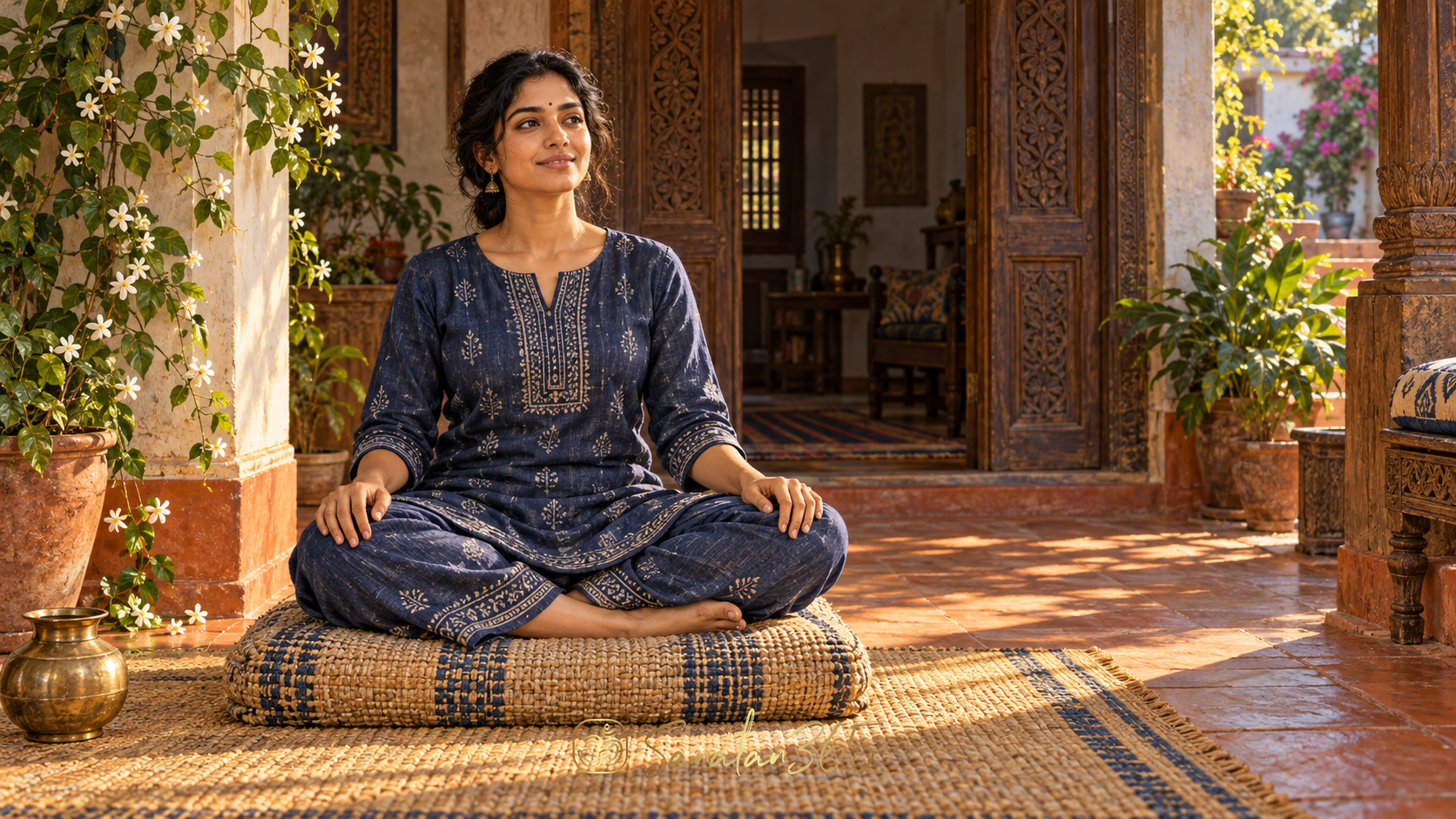
Sukhasana meaning begins with sukha (सुख, ease or comfort) and asana (आसन, a seat or posture). Sukhasana (सुखासन, easy pose) is a simple cross-legged seat, with neither foot placed on the opposite thigh. It offers a place for attentive sitting, but comfort depends on the person, the support and the duration. The aim is not to force the knees downward. A supported seat, or a chair when appropriate, can serve attention more honestly than an impressive but strained shape.
This distinction matters in devotional life. Someone may sit to read a sacred passage, remember a Divine Name or quietly prepare for worship. If every moment is spent enduring the legs, the seat has become the main event. A useful posture lets the intended practice remain central.
The following guidance concerns ordinary posture literacy, not treatment. It makes no promise that a particular sitting position will cure an illness, remove anxiety or produce a spiritual experience. A trained yoga teacher can help with individual alignment; an injury or persistent pain needs appropriate professional advice.
What does Sukhasana meaning reveal about an easy seat?
The name describes a quality worth seeking, not an admission requirement. A beginner does not have to arrive already flexible, calm or capable of sitting on the floor for half an hour. Ease may need to be discovered through a cushion, a shorter practice or a different seat.
The Art of Living's Sukhasana teaching calls it a foundational posture for seated meditation and acknowledges that “easy pose” can be misleading, particularly for people accustomed to chairs. Its instructions include sitting on a block, bolster or folded towel when needed. Support is therefore part of the teaching, not evidence that the posture has failed.
There is a useful difference between settling and collapsing. Settling means the body finds a sustainable arrangement: weight is supported, the head is balanced and unnecessary effort can soften. Collapsing means the torso loses its workable support and sitting itself becomes tiring. The opposite extreme, holding the body rigidly upright, can be equally distracting.
A simple seat can have an upright spine without a lifted chin, drawn-back shoulders or a tense face. The hands can rest naturally. Breathing can remain ordinary. There is no requirement to add a complicated hand gesture merely because it appears in a familiar meditation image.
Nor should the word “easy” become a judgment about another person's body. Some people find cross-legged sitting familiar from childhood meals or family gatherings. Others have spent most of their lives in chairs. Age, mobility, previous injuries and individual proportions affect what is practical. Neither history establishes greater spiritual seriousness.
For a reader exploring the wider language of posture, Tadasana and standing awareness offers a related principle: a simple shape deserves careful attention. Simplicity does not make a practice empty.
Key takeaway: An easy seat is judged by its workable steadiness, not by resemblance to someone else's body.
How is Sukhasana different from lotus and kneeling poses?
The familiar crossed-leg silhouette hides important differences. In Sukhasana, one shin crosses in front of the other and the feet remain low, beneath or near the opposite legs. The knees open outward to the extent that is comfortable. The position should not depend on someone pushing them toward the ground.
Padmasana (पद्मासन, lotus pose) is different: the feet are placed on the opposite thighs. That distinction is not cosmetic. It changes the demands of the posture. Sukhasana should not be turned into a halfway attempt at lotus by pulling a foot upward while the rest of the leg resists.
Vajrasana (वज्रासन, thunderbolt pose), commonly taught as a kneeling seat, arranges the legs differently again. A kneeling posture is not automatically the comfortable alternative for every person. If one seat causes strain, the answer is not to assume another traditional seat will be suitable without checking.
These names help a practitioner describe what is happening. They are not a ladder on which the most elaborate posture proves the highest attainment. The Art of Living presents Sukhasana as a seated option in place of lotus; it does not make lotus a compulsory destination for everyone who begins with easy pose.
A chair also needs honest naming. Sitting in a chair is not literally the same crossed-leg configuration as Sukhasana. Yet it can fulfil the practical purpose of providing a stable seat for reading, prayer or attentive listening. Accuracy about the posture and generosity about participation can coexist.
This is especially useful in mixed-age family practice. A child may sit easily on a mat, a parent may prefer a cushion and a grandparent may choose a chair. A shared prayer need not wait until all three bodies arrange themselves identically. The common intention does not require a common knee angle.
The distinction prevents a frequent beginner mistake: concentrating on the feet while ignoring the rest of the body. A low, uncomplicated leg position with a sustainable torso is more relevant here than a difficult foot placement acquired through force.
Key takeaway: Sukhasana is a simple low cross-legged seat; it is neither lotus in disguise nor a measure of spiritual rank.
How can support make cross-legged sitting more comfortable?
Begin with the surface, not with the knees. A stable mat or folded blanket can make contact with the floor less harsh. A firm cushion or suitable bolster under the sitting bones may make it easier to maintain an upright torso. The Art of Living explicitly includes these supports, and Yoga With Adriene's easy-pose guidance similarly recommends elevation when the hips feel tight.
An ordinary starting sequence can be kept uncomplicated:
- Choose a stable place. Use a level surface and a support that does not slide or tip.
- Sit on the support before arranging the legs. Notice whether the torso can remain upright without gripping.
- Cross the shins gently. Keep the feet low rather than pulling them onto the thighs.
- Let the legs find their available position. Do not press the knees down with the hands.
- Rest the hands comfortably. Thighs or knees can offer support without a prescribed gesture.
- Balance the head above the torso. Let the chin stay roughly level and the face soften.
- Try a brief stay. Notice how the arrangement feels before deciding to remain longer.
This is an orientation, not a personalized prescription. The position of a cushion and the amount of support needed differ between people. If the arrangement remains awkward, a teacher can observe what written instructions cannot see.
A useful support changes the conditions of sitting. It should not become a device for enduring a posture that still feels wrong. If a higher cushion produces instability, if a hard block creates uncomfortable pressure or if the body keeps leaning to one side, reconsider the setup.
Wall support is another option identified in the Art of Living teaching for beginners sitting longer. It need not mean pushing the entire back flat against a wall. Its usefulness lies in reducing the demand of unsupported sitting. The particular arrangement should remain comfortable rather than creating a new rigid rule.
Small practical choices can matter as much as specialized equipment. Clothing that permits movement, a quiet place without constant interruption and a reading stand that avoids repeated neck bending may help the intended activity stay in view. Expensive accessories are not the point.
When repeating the practice, notice which shin naturally comes forward. Trying the other crossing gently on another occasion can reveal a habitual preference. There is no obligation to force equal-looking sides or make both arrangements last equally long.
Key takeaway: Support is successful when it makes sitting more sustainable, not when it helps the body endure a forced shape.
What should change when the seat stops feeling easy?
A posture is not fixed forever once the legs cross. The body continues giving information. A seat that initially feels ordinary may become uncomfortable as time passes. That is a reason to reassess, not a test of loyalty to the practice.
Separate ordinary adjustment from symptoms that should not be ignored. Pain, tingling, numbness, increasing pressure or a sense that a joint is being forced are reasons to come out of the position. Uncross the legs carefully, choose a suitable alternative and do not turn the response into a personal failure.
The Art of Living lists knee and hip injury among the precautions. Adriene's guidance suggests a chair or bench for a knee injury. These cautions belong beside the attractive photograph, not hidden after a long list of claimed benefits. With an existing condition or persistent symptoms, seek appropriate advice before continuing floor practice.
Three questions can keep the response practical:
- Is the seat suitable today? Yesterday's comfortable arrangement may not be today's best choice.
- Is the stay too long? A shorter period may serve the intended practice without accumulating discomfort.
- Is another seat more honest? A stable chair can allow attentive sitting without the same crossed-leg demands.
This is not an invitation to become anxious about every sensation. It is an invitation to remain responsive. A practitioner need not monitor every muscle continuously, but should not suppress clear discomfort in order to meet a timer.
A chair alternative can be simple: choose a stable chair, allow the feet to be supported and find a workable upright position. Back support is available when needed. The aim is not to reproduce a floor posture at chair height, nor to sit precariously at an edge because a photograph appears more disciplined that way.
Duration should grow from experience and qualified guidance rather than an invented universal target. A brief comfortable practice completed regularly can be more useful than an occasional prolonged struggle. The clock measures time; it does not certify attention.
Changing position during a sacred reading need not be treated as disrespect. Quiet, deliberate adjustment can preserve the reading itself. A practice becomes unnecessarily narrow when the avoidance of movement matters more than whether the person can listen.
Key takeaway: Discomfort calls for a responsive change of position, support or duration, not a display of endurance.
How can a simple seat support devotional attention?
Sukhasana gives a practical place to sit. What follows depends on the chosen practice. A person may listen to a hymn, read a passage aloud or quietly recollect a Divine Name. The seat does not determine the content, and its shape does not guarantee a particular inner state.
Japa (जप, repetition of a mantra or sacred name) is one possible activity. Dhyana (ध्यान, meditation or sustained contemplative attention) is another. Neither term should be reduced to the visible arrangement of the legs. A comfortable seat supports the activity; it is not the whole activity.
A beginner can separate setup from practice. First find the seat and make needed adjustments. Then choose one modest focus, such as listening carefully to a short prayer already familiar to the family. Let breathing remain natural. There is no need to add breath retention, a forced breathing rhythm or an advanced technique to make the sitting count.
For readers who want to understand attention beyond its external appearance, the meaning of dhyana provides further context. Before beginning, it helps to know what the practice is asking rather than assuming every quiet person is doing the same thing.
The setting can remain ordinary. In an Indian home it might be a clean corner before the household becomes busy. In a diaspora apartment it might be a chair beside a bookshelf. Neither location requires the invention of an exotic atmosphere. A little preparation is useful when it serves the practice, but a perfect room is not a prerequisite.
The same principle applies after the sitting ends. Rise carefully, allow time to uncross the legs and return to the day's responsibilities. There is no need to report a special sensation or compare the experience with another person's description. Sometimes the useful discovery is simply that a different cushion made the reading less distracting.
Sukhasana's quiet lesson is therefore concrete: find an arrangement in which attention is not continually interrupted by a demand to look impressive. Ease is not indifference. It is a practical ally of steadiness, built through support, responsiveness and respect for the body actually present.
Key takeaway: The seat serves prayer or contemplation best when bodily arrangement supports attention instead of competing with it.
FAQ
Does Sukhasana mean that the pose should feel easy immediately?
No. The name points toward ease, but a person accustomed to chairs may not find cross-legged sitting comfortable at first. Support, a shorter stay or a different seat may be appropriate. Difficulty is information about the arrangement, not a judgment about the practitioner.
Should the knees touch the floor in Sukhasana?
There is no reason to force them down. The knees open only as far as the person's comfortable range permits. If the legs remain strained or unsupported, reconsider the seat and seek individual guidance rather than using pressure to reproduce a picture.
Is Sukhasana the same as Padmasana?
No. In Sukhasana the feet stay low beneath or near the opposite legs. In Padmasana, or lotus pose, the feet are placed on the opposite thighs. The latter arrangement should not be forced or treated as compulsory progress.
Can a chair be used for prayer or meditation instead?
Yes. A chair is a different posture, but it can provide a stable seat for prayer, reading or meditation. The cited teaching resources include chair alternatives. Choose suitable support and individual advice when needed; the crossed-leg shape is not the measure of devotion.
About the author
Sanatan365 Editorial
Bringing Sanatan Dharma to modern seekers through authentic, scripture-grounded content.
Related in Wellness
 Wellness
Tadasana Meaning: Mountain Pose and the Art of Standing Well
Why a simple standing posture deserves careful attention, how Mountain Pose differs from the raised-arm Palm Tree version, and how to pract…
 Wellness
Nadi Shodhana Pranayama: Meaning and a Gentle Practice
Nadi Shodhana is alternate-nostril breathing practiced with steady attention. Its deeper yogic purpose is preparing breath and mind for cla…
 Wellness
Shavasana Meaning: Why Corpse Pose Is a Practice of Conscious Rest
Explore Shavasana's meaning in Hatha Yoga, why stillness is not the same as sleep, and how beginners can practise corpse pose with attentio…

