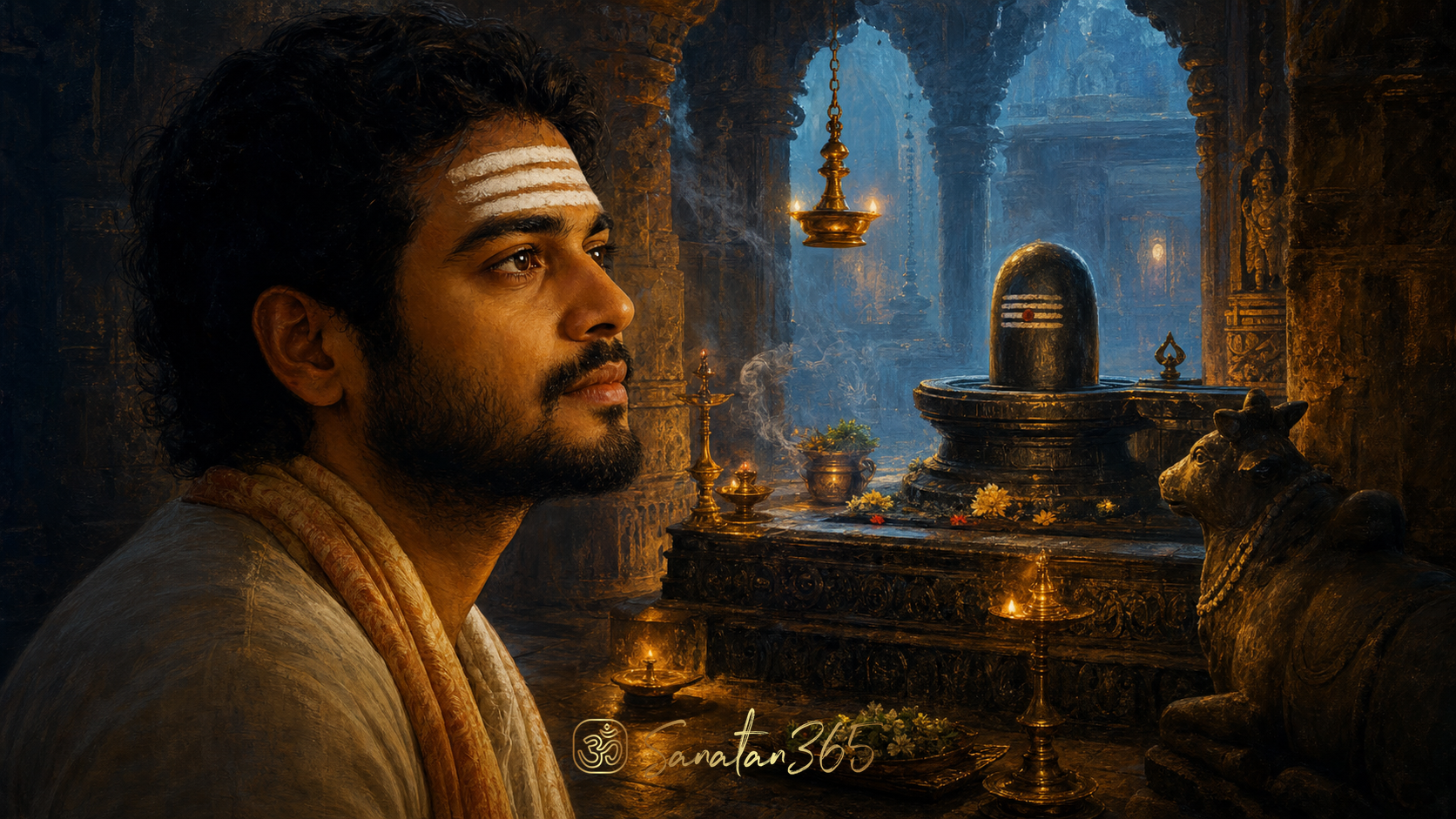
Tripundra Meaning: Three Sacred Ash Lines in Shiva Worship
Tripundra is the Shaiva forehead mark of three horizontal sacred-ash lines. Learn its scriptural symbolism, regional forms, and respectful daily practice.
Three lines of ash can carry an entire philosophy of life. Tripundra meaning begins with a simple Shaiva mark: three horizontal lines drawn with sacred ash, usually across the forehead, as a visible remembrance of Lord Shiva, impermanence, purification, and the spiritual discipline of seeing beyond ego.
The Sanskrit term tripuṇḍra (त्रिपुण्ड्र, “three marks”) names the form itself. The ash is commonly called vibhūti (विभूति, “sacred ash” or “spiritual glory”) or bhasma (भस्म, “ash”). In Shaiva communities, the mark can express devotion, lineage, temple custom, or a daily personal vow. Its symbolism is not limited to one fixed interpretation: scriptures and regional traditions connect the three lines with several sacred triads, all pointing toward integration and transcendence.
What is Tripundra, and why does Shiva wear three lines?
Tripundra is a tilaka (तिलक, a sacred mark worn on the body) formed by three horizontal bands of ash. It appears most often on the forehead, though some ritual traditions apply sacred ash to other parts of the body as well. The mark is strongly associated with worshippers of Shiva and is also used in some Smarta traditions.
Shiva's association with ash is profound. Ash is what remains after fire has consumed form. It therefore recalls that bodies, possessions, social identities, and achievements are temporary. Yet ash is not merely a symbol of ending. Sacred fire also purifies, and what remains can signify clarity after attachment has been burned away.
This is why the mark can hold two truths at once:
- life in embodied form is impermanent;
- awareness of impermanence can make life more truthful, compassionate, and disciplined.
The Kalagni Rudra Upanishad, a Shaiva Upanishad devoted to sacred ash and Tripundra, maps the three lines to multiple triads. These include the three sacred fires, the three syllabic elements of Om, the three guṇas, and other threefold structures through which the tradition interprets reality. The purpose is not to force every wearer into one decoding system. It is to make the forehead, the place associated with attention and discernment, carry a repeated reminder of Shiva-consciousness.
In icons of Shiva, the three lines also distinguish Shaiva visual language from vertical Vaishnava forehead marks. That difference should be understood as diversity within Sanatan Dharma, never as rivalry. Sacred marks reflect different devotional relationships while pointing toward the Divine.
Key takeaway: Tripundra is a visible Shaiva discipline: remember Shiva, remember impermanence, and let awareness refine action.
What do the three lines of Tripundra symbolize?
There is no need to reduce the three lines to a single slogan. Hindu sacred symbols often gather layers of meaning through scripture, temple practice, philosophical teaching, and family tradition. Several interpretations can be held respectfully together.
The three guṇas
The guṇas (गुण, “qualities” or “strands of nature”) are sattva, rajas, and tamas. Sattva relates to clarity and harmony, rajas to motion and desire, and tamas to inertia and obscurity. All embodied experience involves their changing interplay.
When Tripundra is connected with the three guṇas, the mark can remind a seeker not to mistake any passing mental state for the deepest Self. Even clarity can become a source of pride if it is claimed by ego. Shiva represents the awareness before which all three qualities arise, act, and subside.
Creation, preservation, and dissolution
Another reading sees the lines through the three cosmic functions: sṛṣṭi (सृष्टि, creation), sthiti (स्थिति, preservation), and saṃhāra (संहार, dissolution). Every day contains these movements. A plan begins, receives care, and eventually changes or ends. A mature spiritual life does not cling only to beginnings or fear every ending.
Ash gives dissolution a place of dignity. It teaches that an ending may clear space for renewal, repentance, better judgment, or liberation from a habit that no longer serves dharma.
The sounds of Om and the states of experience
Traditions also relate the three lines to A-U-M, the audible elements of Om, and to the waking, dreaming, and deep-sleep states discussed in Upanishadic thought. The Mandukya Upanishad uses Om to examine these states and the reality that grounds them.
Under this interpretation, Tripundra becomes an invitation to ask: Who is aware through changing states? The mark does not provide a quick intellectual answer. It brings the question back to daily consciousness.
The three impurities in Shaiva teaching
Some Shaiva philosophical traditions speak of bonds or obscurations that limit full recognition: āṇava (आणव, limitation or contracted individuality), karma (कर्म, action and its consequences), and māyā (माया, the power through which multiplicity and limitation are experienced). Terminology and emphasis vary among Shaiva schools, so this triad should not be presented as the only universal explanation of Tripundra.
As a contemplative reading, however, it is practical. The wearer can remember to soften egoic narrowness, act responsibly, and question appearances before treating them as the whole truth.
Key takeaway: The three lines hold multiple sacred triads, but each interpretation turns attention from fragmentation toward a larger awareness associated with Shiva.
Why is sacred ash used in Hinduism?
Sacred ash in Hinduism is not ordinary residue casually taken from any fire. Vibhuti or bhasma used for worship is prepared, blessed, or received according to particular temple, monastic, household, or lineage customs. In Tamil Shaiva settings it is widely known as tirunīru (திருநீறு, “sacred ash”). Devotees may receive it as prasada after worship or obtain it from a trusted temple source.
Ash works as a spiritual teacher because it is materially plain. Gold can display status; perfume can attract; elaborate clothing can distinguish. Ash levels such distinctions. On the forehead it says that every role is temporary and that dignity rests in conduct, devotion, and insight rather than display.
It also carries the memory of agni (अग्नि, sacred fire). Fire transforms offerings so completely that their previous form cannot be recovered. Applied thoughtfully, ash can symbolize a wish that anger, vanity, greed, and confusion be offered into disciplined awareness.
This symbolism must not be converted into a guaranteed claim. Wearing Tripundra does not mechanically erase consequences or replace ethical repair. If someone has caused harm, the appropriate practice includes truthfulness, apology, restitution where possible, and changed behavior. The mark is strongest when outer sign and inner conduct support one another.
During Shravan or Sawan, devotion to Shiva becomes especially visible across many parts of India. Calendar systems differ regionally, and Shravan dates can begin about a fortnight apart depending on whether a community follows an amanta or purnimanta lunar reckoning. Location-specific observance should therefore be checked with a trusted local panchang; the Drik Panchang Shravan guide illustrates these regional timing differences.
Key takeaway: Sacred ash teaches transformation and humility; it becomes meaningful through reverent sourcing, ethical conduct, and conscious remembrance.
How to apply Tripundra respectfully
The most respectful method is the one taught by a person's family, temple, guru, or established sampradāya (सम्प्रदाय, “living tradition or lineage”). Practices vary. Some use particular fingers, mantras, directions, or numbers of body locations; others simply place three lines on the forehead after bathing and prayer.
A simple household approach can follow these steps:
- Use clean, trusted sacred ash. Receive vibhuti from a temple or obtain ash prepared specifically for devotional use. Do not use unknown industrial ash, incense residue, or material that may irritate the skin.
- Begin with clean hands and a calm intention. The act need not be elaborate. A brief inward pause matters more than performance.
- Take a small amount of vibhuti. Depending on local custom, it may be applied dry or mixed with a few drops of clean water into a light paste.
- Draw three horizontal lines. Apply them gently across the forehead without pressing hard. Exact width and thickness vary by tradition.
- Remember Shiva. Many devotees repeat “Om Namah Shivaya,” the five-syllabled Shiva mantra when Om is treated as the sacred prefix. Others use a lineage-specific mantra or silent contemplation.
- Let the practice shape the day. Before speaking or acting, recall what the ash represents: pride can be softened, reactions can be purified, and time should not be wasted in cruelty.
People with sensitive or broken skin should avoid applying unfamiliar substances and seek appropriate professional advice if irritation occurs. Sacred practice should never require ignoring bodily safety. Children can participate under family guidance with clean, skin-safe vibhuti and without pressure.
For someone who does not belong to a Shaiva lineage, respectful learning is welcome. The mark should not be worn as costume, trend, joke, or aesthetic prop. If uncertainty remains, observing temple etiquette and asking a knowledgeable practitioner is wiser than inventing a method.
Key takeaway: Apply Tripundra with clean sacred ash, lineage-aware respect, and an intention that continues after the visible lines are drawn.
How can Tripundra become a daily spiritual practice?
A forehead mark can disappear within hours while the discipline behind it remains. The deeper practice is to translate the three lines into three daily recollections.
Before action: remember consequence
Karma does not mean passive fate. It places responsibility on intention and action. Before an important decision, the first line can prompt a pause: Is this truthful? Does it reduce harm? Does it serve dharma rather than impulse?
During action: remember presence
The second line can recall steadiness. Work, parenting, study, and service are rarely sustained by dramatic inspiration. They mature through attention. Shiva's stillness offers a model for remaining present without becoming inert.
After action: release ownership
The third line can recall letting go. One should learn from results and repair mistakes, but not build identity entirely from praise or blame. The Bhagavad Gita's teaching on action repeatedly distinguishes disciplined effort from possessiveness over outcomes; the Katha Upanishad Chariot Metaphor: Senses, Mind, Intellect, and Self offers a complementary image of disciplined self-governance.
This three-part reflection can be used even when Tripundra is not physically worn. A traveller, office worker, student, or devotee living where visible marks are difficult may keep the symbolism inwardly: responsibility before action, presence during action, and release after action.
Tripundra also complements other Shiva practices without replacing them. A seeker might combine it with japa, quiet meditation, temple darshan, study, seva (सेवा, “selfless service”), or simple ethical restraint. During Shravan Somwar, the practice may accompany fasting or abhisheka, but no single observance defines the sincerity of Shiva bhakti.
Key takeaway: The three lines become alive when they guide responsibility, presence, and release throughout ordinary life.
Tripundra across regions and communities
Shaiva traditions are richly regional. In Tamil Nadu, tiruniru is highly visible in temples and daily devotion, sometimes applied broadly across the forehead. In Karnataka, Andhra Pradesh, Telangana, Maharashtra, North India, Nepal, and diaspora temples, materials, mantras, line thickness, and associated central dots may differ.
A bindu (बिन्दु, “point” or “dot”) may appear with the three lines in some customs, often in red kumkum or sandal paste, but it should not be treated as a mandatory universal component. Nor should every three-lined representation be assigned the same philosophical explanation without context.
This variety is not inconsistency. Sanatan Dharma often preserves unity through living forms rather than enforced uniformity. The responsible learner notices the shared Shaiva orientation while allowing each community to explain its own practice.
For visitors to a temple, three principles help:
- receive sacred ash with the right hand or as local custom indicates;
- follow the temple's visible etiquette without turning the moment into spectacle;
- ask before photographing worshippers, priests, or intimate ritual acts.
The mark is public, but devotion remains personal.
Key takeaway: Regional forms of Tripundra differ; reverence means learning from living communities instead of flattening them into one rule.
Conclusion: let the ash clarify what matters
Tripundra turns the forehead into a place of remembrance. Its three sacred ash lines carry Shaiva devotion, the wisdom of impermanence, and several scriptural triads that point beyond fragmented identity. Yet its deepest test is not visual correctness. It is whether remembrance changes conduct.
Key takeaway: Wear Tripundra, when appropriate, as a vow of humility: let ego soften, let action become responsible, and let awareness return to Shiva.
FAQ
What is the simple Tripundra meaning?
Tripundra is the Shaiva sacred mark of three horizontal ash lines, usually worn on the forehead. It expresses devotion to Shiva and recalls purification, impermanence, and transcendence of limiting qualities.
Why does Shiva have three lines on his forehead?
The lines are associated with several sacred triads, including the three guṇas, the cosmic functions of creation-preservation-dissolution, and the components of Om. Different Shaiva traditions emphasize different meanings.
Is Tripundra the same as vibhuti?
Not exactly. Vibhuti is sacred ash. Tripundra is the three-line mark made with that ash. Vibhuti may also be received or applied in other ways according to temple and family custom.
Can anyone wear Tripundra?
People may approach the practice with sincere respect, but it should not be used as costume or decoration. Following a family, temple, guru, or established Shaiva custom is the most grounded approach.
How should Tripundra be applied?
Use clean sacred ash from a trusted devotional source and draw three gentle horizontal lines across the forehead while remembering Shiva or repeating a customary mantra. Exact methods vary by lineage and region.
About the author
Sanatan365 Editorial
Bringing Sanatan Dharma to modern seekers through authentic, scripture-grounded content.
Related in Practices
 Practices
Parayana Meaning: Giving Sacred Reading a Steady Place
Understand parayana as sustained devotional reading or recitation, with distinctions from study and mantra repetition and a respectful way…
 Practices
Smarana Meaning: Remembering the Divine Between Daily Tasks
Smarana is devotional remembrance. Explore its scriptural context, its relationship with chanting, and gentle ways to remember the Divine d…
 Practices
Upasana Meaning: Why Worship Is a Practice of Drawing Near
Upasana means drawing near to the Divine through sustained attention. Explore how sacred symbols, daily worship and inward recollection bel…

