Katha Upanishad Chariot Metaphor: Senses, Mind, Intellect, and Self
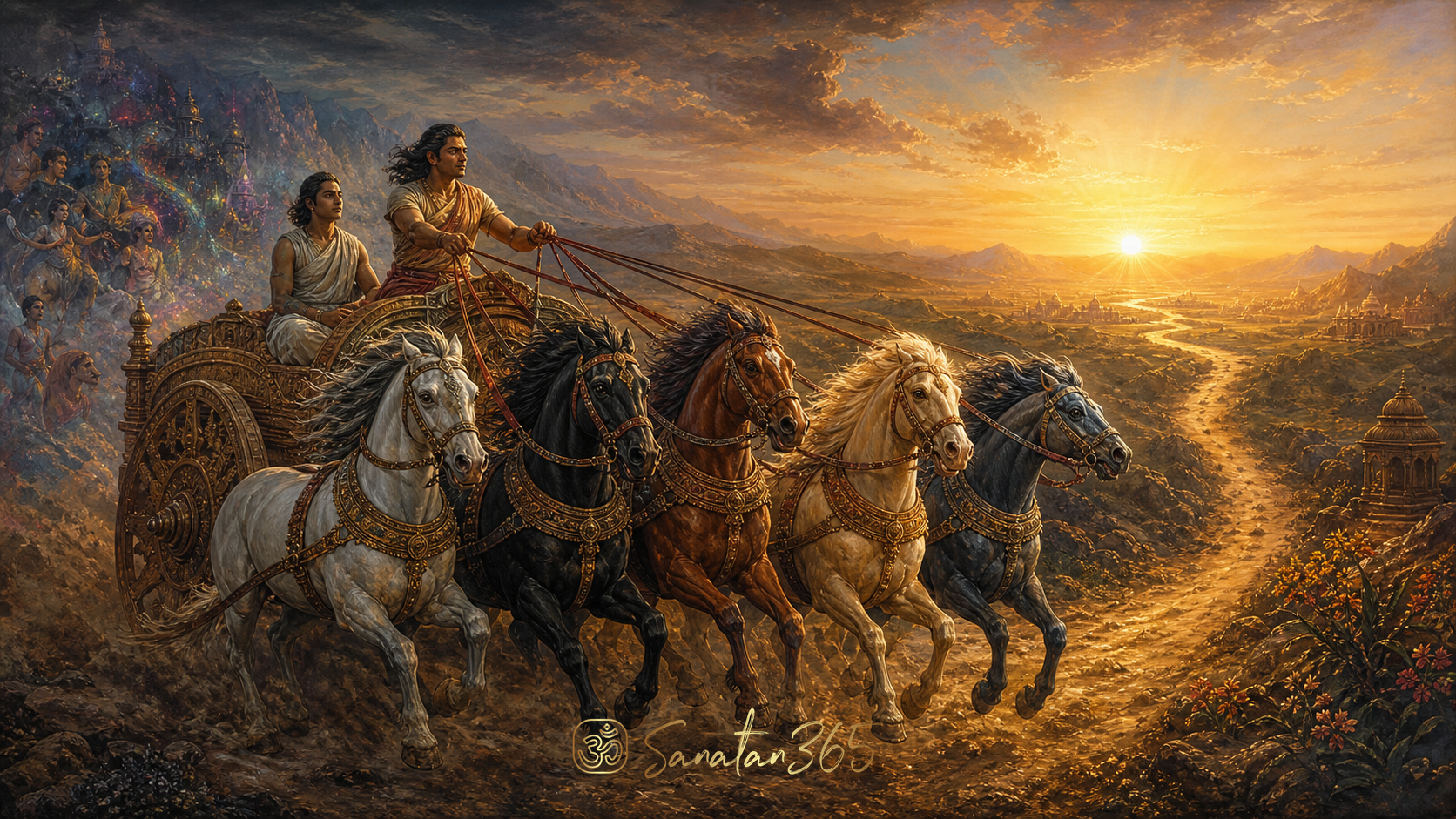
The Katha Upanishad compares human life to a chariot: the body is the vehicle, the senses are horses, the mind is the reins, the intellect is the driver, and the Self is the rider.
A chariot cannot choose its destination merely because its horses are strong. The Katha Upanishad chariot metaphor teaches that human freedom depends on the relationship between the senses, mind, intellect, and the deepest Self.
In this ancient image, the body is the chariot, the senses are its horses, the mind is the reins, the intellect is the charioteer, and Atman, the inner Self, is the rider. When these parts work in harmony, life moves with direction. When the senses pull without guidance and the mind cannot hold them, even great energy becomes disorder. The teaching is not a rejection of the body or senses. It is a map for using them wisely.
What Is the Katha Upanishad Chariot Metaphor?
The metaphor appears in verses 1.3.3-1.3.9 of the Katha Upanishad. It is often called ratha kalpana (रथ कल्पना, “the image or conception of the chariot”). The text asks the student to understand the human person through a precise set of correspondences:
- Atman (आत्मन्, the deepest Self) is the master or rider of the chariot.
- Sharira (शरीर, the body) is the chariot.
- Buddhi (बुद्धि, discriminating intelligence) is the charioteer.
- Manas (मनस्, the coordinating mind) is the reins.
- The indriyas (इन्द्रिय, the senses) are the horses.
- Sense objects are the roads along which the horses travel.
The Katha Upanishad 1.3.3 translation and commentary states the central image directly: know the Self as the lord of the chariot, the body as the chariot, intelligence as the driver, and the mind as the reins. A concise account in The Hindu similarly identifies the senses as horses and sense objects as the roads they travel.
This is a layered model, not a claim that a person is simply a machine controlled by reason. Each element has a worthy function. Horses provide motion. Reins communicate direction. The driver judges the road. The chariot makes travel possible. Yet none of these alone explains why the journey matters. The rider gives the whole arrangement its center.
Key takeaway: The chariot image values every human faculty while placing each one in a relationship of intelligent cooperation.
Why Are the Senses Compared to Horses?
Horses are powerful, responsive, and naturally drawn toward what catches their attention. The comparison is therefore more generous than it first appears. The senses are not enemies. Sight, sound, taste, touch, and smell connect embodied life to beauty, relationship, danger, nourishment, art, and worship. Without their energy, the chariot would not move.
The difficulty begins when attention has no direction. One horse turns toward a pleasing sound, another toward an attractive sight, while a third recoils from discomfort. Modern life intensifies this condition. A notification, advertisement, argument, craving, or stream of short videos can pull attention before a deliberate choice has formed.
The Upanishadic response is not numbness. It is dama (दम, wise regulation of the senses) and disciplined attention. A trained horse does not lose its strength; it becomes capable of carrying the traveler safely. In the same way, sensory discipline preserves vitality while freeing it from constant reaction.
This distinction matters in spiritual practice. Closing the eyes during japa may reduce visual distraction, but the purpose is not hostility toward sight. Offering fragrant incense in puja does not condemn smell; it gives the sense a sacred orientation. Temple music, lamp light, flowers, and prasad show that Sanatan practice can educate the senses through beauty rather than merely suppress them.
Practical sensory discipline may include:
- Pausing before opening a distracting app.
- Eating with attention instead of constant stimulation.
- Choosing music and speech that steady rather than agitate the mind.
- Keeping one short period each day free of unnecessary notifications.
- Bringing full attention to one act of prayer, study, service, or family presence.
Key takeaway: The senses become allies when their energy is trained toward what is genuinely worth attending to.
What Do the Mind and Intellect Do in the Chariot Analogy?
The Katha Upanishad distinguishes manas, the mind as reins, from buddhi, the intellect as charioteer. In everyday speech, “mind” may cover both. The metaphor separates them because impulse management and wise judgment are related but different capacities.
Manas gathers impressions, forms preferences, hesitates, and moves between alternatives. Like reins, it must remain connected both to the horses and the driver. If the reins are slack or torn, the charioteer may know the right road but cannot communicate that direction to the horses. This resembles the familiar experience of knowing what is wise while being unable to hold attention long enough to act on it.
Buddhi is the faculty of viveka (विवेक, discernment): the capacity to distinguish the enduring from the fleeting, responsibility from impulse, and a worthy aim from an attractive diversion. It reads the terrain. It remembers consequences. It can ask, “Where does this choice lead?”
The charioteer is not a harsh inner commander. Good judgment requires clarity, experience, humility, and steady care for the whole vehicle. Buddhi matures through scripture study, reflection, guidance from trustworthy teachers, honest conversation, and learning from consequences. It weakens when it is repeatedly recruited to justify desires after the senses have already chosen.
The teaching therefore suggests two forms of practice:
- Strengthen the reins: cultivate attention, emotional steadiness, and the ability to pause.
- Educate the driver: study dharma, consider consequences, and clarify the purpose guiding a decision.
A simple evening reflection can serve both. One may ask: What pulled my attention today? Where did I respond automatically? Which choice felt aligned with dharma? What small correction will make tomorrow’s reins steadier?
Key takeaway: Self-mastery needs both a steady mind that can carry direction and an educated intellect that can choose it.
Where Is Atman in the Katha Upanishad Chariot Metaphor?
The most radical part of the image is not the horses or driver. It is the rider. Atman is not another mental function competing for control. It is the deepest Self, distinct from the changing body, sensations, moods, and thoughts.
This does not mean ordinary personality is unreal in the casual sense or that bodily life can be neglected. The metaphor instead invites a shift in identity. A person can observe a craving without becoming identical to it. One can notice anger without concluding, “Anger is my whole self.” One can experience praise or criticism without allowing either to define the inner witness.
The verses following the basic comparison describe the result of an ungoverned and a well-governed chariot. When the intellect lacks understanding and the mind is uncontrolled, the senses become difficult to direct. When understanding is present and the mind is disciplined, the senses become manageable, and the traveler can proceed toward the highest goal. An accessible section guide to Katha Upanishad chapter 1, section 3 highlights this relationship between control, understanding, and realization.
The rider also prevents a common misunderstanding: productivity is not the final goal of the metaphor. A perfectly managed chariot racing toward an unworthy destination is still misdirected. Discipline serves awakening, dharma, and freedom; it is not valuable merely because it makes a person more efficient.
Vedanta uses moksha (मोक्ष, liberation) for freedom from fundamental ignorance about the Self. In daily life, one may approach this great teaching modestly: remember that awareness is larger than the passing content appearing within it. This remembrance creates space for a wiser response.
Key takeaway: The chariot is organized not for control as an end in itself, but so the traveler may recognize and live from the deeper Self.
How Can the Chariot Analogy Guide Modern Daily Life?
The chariot model becomes useful when translated into concrete questions. Before a difficult choice, a person can briefly examine each part of the system.
1. Notice the horses
What are the senses moving toward or away from? Is there fatigue, hunger, attraction, irritation, or overstimulation? Naming the pull reduces its hidden power.
2. Check the reins
Can the mind hold attention for even three calm breaths? If not, postpone a non-urgent decision. A short pause may be the practical difference between reaction and response.
3. Consult the charioteer
What does buddhi see about consequences, responsibilities, and dharma? Which option will still appear honorable tomorrow? Advice from a trusted person may help when judgment is clouded.
4. Remember the rider
Is the choice being made from fear of a passing feeling, or from a steadier awareness of who one aspires to be? The rider does not panic every time a horse moves.
5. Choose the road
Intent needs a specific next action. Put the phone away. Speak the truthful but compassionate sentence. Complete the duty. Leave the harmful setting. Begin the prayer. Rest when rest is responsible.
This framework can support study, work, family life, spending, digital habits, and devotional practice. It should not be used to shame ordinary human emotion. A distressed or exhausted system may need rest, support, or professional care, not moral condemnation. Spiritual reflection can complement appropriate care but should never replace medical or mental-health support.
The metaphor also encourages compassion toward others. A person acting impulsively is not reduced to the impulse. The horses may be frightened, the reins strained, or the driver confused. Boundaries may still be necessary, but understanding can replace contempt.
For readers exploring related teachings, the practices of Dharana Meaning: Yogic Concentration Before Meditation and Brahmacharya Meaning: Disciplined Energy for Modern Hindu Life develop attention and disciplined energy, while Guru Tattva Meaning: The Hindu Principle of the Spiritual Teacher examines the role of guidance in spiritual learning.
Key takeaway: Use the chariot as a five-part pause: notice sensation, steady attention, discern wisely, remember the deeper Self, and act deliberately.
Does the Chariot Teaching Reject Pleasure or the Body?
No. The body is the vehicle of dharma, relationship, learning, service, and worship. The senses are the horses that make embodied experience possible. A responsible charioteer cares for the chariot and horses; neglect would make the journey impossible.
The teaching challenges enslavement to sensation, not the existence of pleasure. There is a difference between enjoying a beautiful meal with gratitude and being unable to stop when discernment says enough. There is a difference between appreciating praise and depending upon it for identity. Freedom allows enjoyment without captivity.
This balance is visible throughout Hindu household life. Celebration, music, color, food, pilgrimage, and family affection can coexist with vrata, study, restraint, and meditation. The question is not whether life contains pleasure, but whether pleasure serves a meaningful life or silently chooses its direction.
Care for the body likewise belongs within the metaphor. Sleep, nourishment, movement, hygiene, and medical care maintain the chariot. Yet the vehicle is not mistaken for the rider. This middle path avoids both indulgence and contempt for embodied life.
Key takeaway: The Upanishadic aim is ordered participation in life, not rejection of the body or the beauty perceived through the senses.
The Katha Upanishad gives one of the clearest maps of inner life in world philosophy. Its image remains vivid because everyone knows what it feels like to be pulled in several directions at once. The teaching does not ask the horses to disappear. It asks for strong reins, clear discernment, a cared-for vehicle, and remembrance of the rider.
Key takeaway: Human freedom grows when sensory energy, attentive mind, discerning intellect, and embodied action become aligned with the deeper Self.
FAQ
What is the chariot analogy in the Katha Upanishad?
The analogy compares the body to a chariot, the senses to horses, the mind to reins, the intellect to the charioteer, and Atman, the deepest Self, to the rider. It appears in Katha Upanishad 1.3.3-1.3.9.
What does ratha kalpana mean?
Ratha kalpana (रथ कल्पना) means the “chariot image” or “conception of the chariot.” It is a teaching device for understanding the relationship between body, senses, mind, intellect, and Self.
Why is the mind compared to reins?
Reins connect the driver’s judgment to the horses’ movement. Similarly, the mind carries the intellect’s direction into attention and action. An unsteady mind may fail to translate good judgment into conduct.
Is buddhi the same as the mind?
In this metaphor, no. Manas is the coordinating mind and is compared to the reins. Buddhi is discriminating intelligence, compared to the charioteer who judges the road and directs the journey.
How can someone practise the Katha Upanishad chariot teaching?
Begin with a brief pause: notice the sensory pull, steady attention, consider consequences and dharma, remember that the passing impulse is not the whole Self, and choose one deliberate next action.
About the author
Sanatan365 Editorial
Bringing Sanatan Dharma to modern seekers through authentic, scripture-grounded content.
Related in Scriptures
 Scriptures
Antaryamin Meaning: The Inner Controller in the Brihadaranyaka Upanishad
The Brihadaranyaka Upanishad describes Antaryamin as the immortal inner presence dwelling within earth, life, mind, and every being while r…
 Scriptures
Maitri Upanishad: The Meaning of Sixfold Yoga
The Maitri Upanishad presents a sixfold yoga that joins breath restraint, sensory withdrawal, meditation, concentration, inquiry, and absor…
 Scriptures
Kaivalya Upanishad Meaning: Shiva and the Self Beyond Isolation
The Kaivalya Upanishad presents liberation as recognition of the complete Self, joining devotion to Shiva, disciplined meditation, and Veda…

