'Tukaram Abhang Meaning: Devotion in the Language of Everyday Life'
How Tukaram’s Marathi devotional poems bring work, honest self-examination, and love for Vithoba into spiritual life.
A child searching for its mother, a guest waiting at a door, a fish separated from water: Tukaram makes spiritual longing recognizable before he explains it. His poems begin close to ordinary life, where affection, disappointment, pride, and need are already familiar.
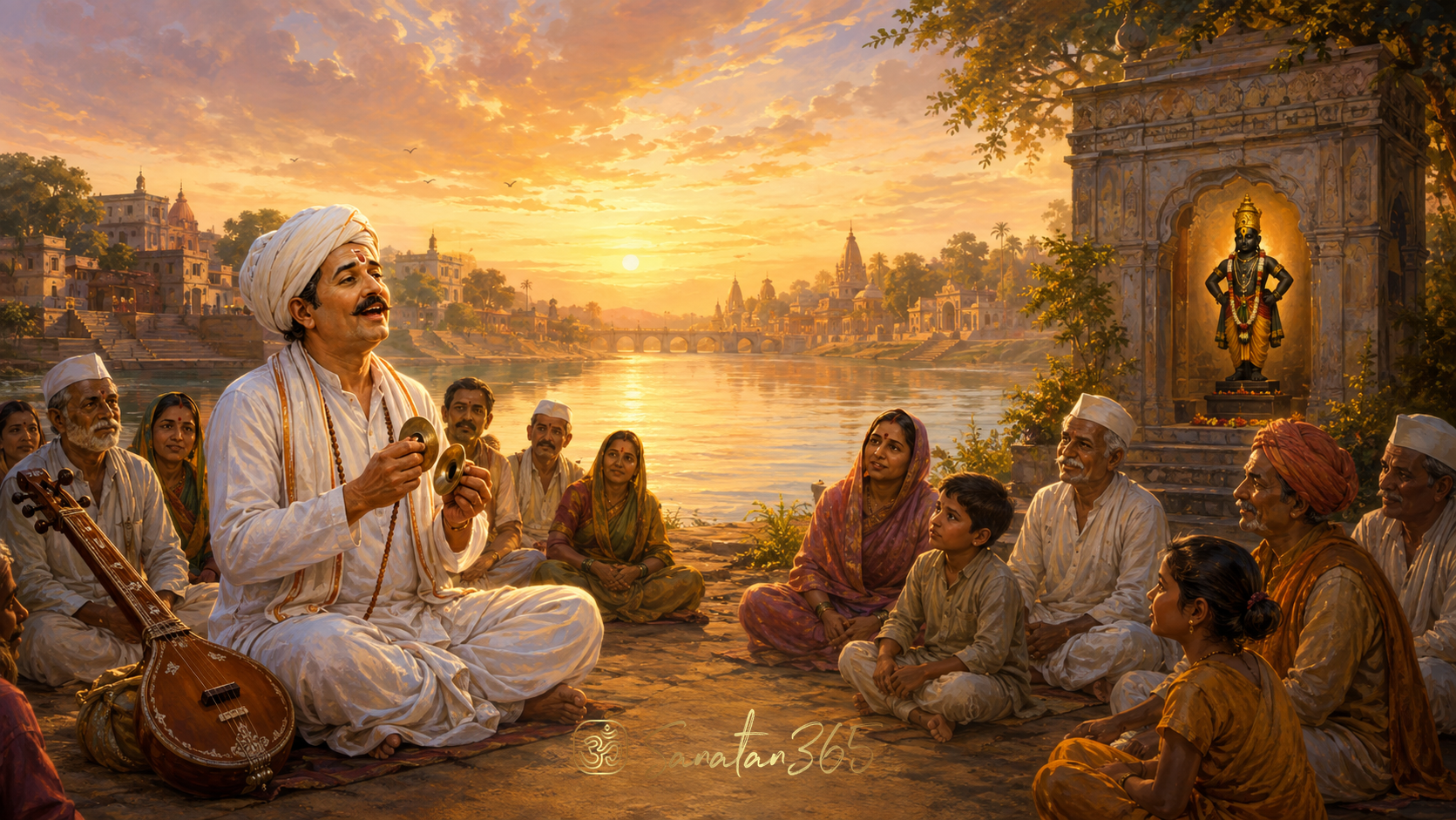
Tukaram abhang meaning centers on short Marathi devotional poems addressed chiefly to Vithoba, the beloved form of Vishnu worshipped at Pandharpur in Maharashtra. Abhang (अभंग, abhaṅga) means “unbroken”; in this literary setting, it names a sung devotional form. Tukaram brings bhakti (भक्ति, loving devotion) into an intimate speaking voice, one that praises, questions, confesses, and calls for grace rather than pretending to have mastered every difficulty.
What does Tukaram abhang meaning reveal about devotion?
An abhang is not simply an inspirational quotation arranged into lines. It belongs to a language, a musical life, and a relationship with the Divine. Tukaram’s poems are often short enough to remember, yet their speaker can move through several emotional positions in a small space: confidence, complaint, self-doubt, and renewed trust.
The word “unbroken” is a helpful entry point, but it should not be expanded into an unsupported promise that singing produces uninterrupted concentration. A person can sing while distracted. The literary name does not certify the singer’s spiritual attainment. What the form offers is a compact expression that can be returned to, carried in memory, and shared aloud.
The Northern Virginia Community College selection of Tukaram’s poems introduces the abhang as a short hymn designed for sung performance. Its included poems, translated by Nicol Macnicol, show devotion through familiar images rather than abstract definitions alone. A reader meets the person who waits, the child who calls, and the petitioner who has no claim to demand a gift.
That last distinction matters. In the poem presented as “A Beggar for Love,” the speaker asks for love that cannot be purchased or earned through bargaining. The prayer does not resemble a transaction in which a prescribed quantity of worship guarantees a material return. Its force lies in need honestly acknowledged.
For readers new to the wider tradition, this is one concrete doorway into bhakti as loving devotion. It makes a large spiritual idea audible in a small human voice.
Key takeaway: An abhang is a devotional poem to hear and inhabit, not a formula that guarantees a result.
Who was Tukaram and why does Dehu matter?
Tukaram was a seventeenth-century Marathi poet associated with Dehu, near Pune. He is commonly called Sant Tukaram; sant (संत) means a saint or spiritually revered person. His remembered presence belongs especially to Maharashtra, while his poems continue to reach readers and listeners beyond the Marathi-speaking world.
Encyclopaedia Britannica’s account of Tukaram identifies Dehu, his Marathi authorship, and the central place of Vithoba in his poetry. These broad coordinates are more useful for an introductory reading than a crowded list of dates or a seamless biography assembled from different traditions. Accounts of a saint’s life can combine historical information with devotional remembrance. They should not automatically be treated as the same kind of evidence.
Dehu matters here because a poem comes from somewhere. Marathi is not an interchangeable container for a universal message. Its rhythms, ordinary comparisons, and ways of addressing another person shape how Tukaram sounds. English translations make the poems available to many readers, but they also make choices about intimacy, musicality, and tone.
Tukaram is associated with the Varkari tradition, a devotional community especially linked with Vithoba and pilgrimage to Pandharpur. Varkari (वारकरी) is commonly used for a participant in that recurring pilgrimage tradition. The connection places the poems within shared singing and remembrance, rather than treating their author only as a solitary literary figure.
This regional grounding need not narrow their relevance. A Marathi-speaking household in Maharashtra may receive a familiar song through family memory. A listener elsewhere may first encounter an English translation or a concert recording. Both encounters can be meaningful, provided the second does not erase the language and devotional community that carried the poem.
Knowing Dehu and Pandharpur therefore changes the reading. The poet’s longing has a beloved name and a sacred geography; it is not merely a floating statement about feeling better.
Key takeaway: Tukaram’s poetry travels widely without ceasing to be rooted in Marathi devotional life.
How does an abhang bring poetry close to daily life?
The poems in the college anthology repeatedly use relationships and situations a listener can picture. “The Mother’s House” begins with a bride looking back toward home, then turns to a child missing its mother and a fish outside water. Each comparison intensifies separation. The images are ordinary; their arrangement gives longing its pressure.
A careful reader need not reduce the poem to “family is important.” Its subject is the speaker’s desire to meet the Divine. Family experience supplies the emotional vocabulary. The difference between image and meaning protects both: the household scene remains vivid, while the poem’s devotional direction remains intact.
“The Suppliant” uses another recognizable situation. Someone stands at a door, calling and receiving no answer. The speaker reminds the Divine of the courtesy normally offered to a guest. Here devotion is not distant politeness. It has the boldness of a relationship in which the person waiting believes an answer is possible.
“From the Depths” shifts the scrutiny inward. The speaker looks back at plans distorted by pride and falsehood. This is not a lecture delivered from a position of flawless authority. The person asking for help is also examining the habits that have made help necessary.
These three movements offer a useful way to listen:
- Notice the scene: a departure, a doorway, or a failed plan.
- Identify the feeling: longing, frustration, or remorse.
- Follow the address: the feeling is spoken to the Divine, not left as a private monologue.
- Hear the turn: the poem may move from accusation toward dependence, or from self-confidence toward honesty.
The sequence is a reading aid, not a rule governing every abhang. Some poems will resist it. That resistance is useful because it prevents a reader from forcing an entire poetic body into one lesson.
The everyday quality of the imagery also explains why these poems invite repeated hearing. A doorway means something different after waiting for news. An admission of pride sounds different after an avoidable argument. The words may be familiar while the listener’s understanding becomes more precise.
Key takeaway: Tukaram’s familiar images carry a specific devotional argument; they are more than decorative examples.
Why is Vithoba at the center of Tukaram’s songs?
Vithoba is also known as Vitthal or Vitthala, and as Pandurang. In this devotional setting, these names refer to the beloved deity of Pandharpur, understood within the worship of Vishnu. Different spellings in translations need not indicate different gods or unrelated poems.
The named relationship gives the songs their emotional center. A speaker can address Vithoba as a parent, a protector, or the one whose presence makes a place feel like home. These are devotional ways of speaking, not competing technical definitions that must be reduced to a single image.
In “Mother Vithoba,” as presented in Macnicol’s translation, maternal language expresses nourishment, nearness, and care. The poem does not require every devotional relationship to use that language. It shows one way love reaches for a form that can express its need.
Other poems in the same selection sound impatient. They ask why the beloved has delayed, or why a person who trusts still feels distant. This can surprise readers who expect sacred poetry to remain uniformly serene. Tukaram’s speaking voice allows emotional difficulty into prayer without making difficulty the final measure of the relationship.
That is also why the poems should not be converted into promises of immediate intervention. Their longing often remains longing. A song can deepen the expression of trust without supplying a timetable for its fulfillment.
In sung settings, a repeated divine name gives listeners a shared point of return. The broader practice of kirtan, devotional singing, helps explain how poetry can be heard collectively rather than consumed only on a page. An individual complaint becomes a voice that others recognize and sing with.
Key takeaway: Vithoba is the personal center of the poems, making devotion a relationship rather than a vague positive feeling.
How can Tukaram be read without flattening his voice?
The first safeguard is to identify the translation. The college page discusses English translation history in its introduction, while its displayed selection explicitly credits Nicol Macnicol. Those are different pieces of information. A quotation from the displayed poems should be attributed to that translator, not automatically to another translator named nearby.
Older English versions also use words and rhythms that may feel distant today. Their formal diction is part of the translation’s style, not proof that Tukaram’s Marathi sounded equally remote to his listeners. A reader can appreciate the version while remembering that it is an interpretation of a poem in another language.
The second safeguard is to preserve a complete movement of thought. A forceful line about pride may be followed by a plea for help. Removed from that setting, it can look like a command aimed at other people, when the poem’s speaker is confronting himself. Reading the lines before and after a quotation often changes its ethical tone.
The third safeguard concerns familiar signatures. Many translations close with a phrase such as “Tuka says.” That expression belongs to the poetic voice, but its presence on a social-media image is not sufficient proof of authenticity. Attribution still needs a traceable collection, edition, or reliable translation.
A practical reading process is straightforward:
- Choose one complete poem from an identified edition.
- Read its introduction and translator credit.
- Mark the everyday image and the person being addressed.
- Describe the poem’s change of feeling in plain language.
- Separate what the poem says from a personal application drawn from it.
This method leaves room for discovery. A poem need not become a productivity tip to justify attention. Sometimes its contribution is a more honest vocabulary for affection, dependence, impatience, or gratitude.
Key takeaway: Good reading preserves attribution, context, and emotional complexity before extracting a lesson.
What do Tukaram’s poems invite a listener to practise?
One contemporary application is honest self-examination. Before repeating a poem about vanity, a listener might consider a recent conversation in which the wish to appear right overwhelmed the wish to understand. That is an application of the poem’s concern, not a claim that Tukaram prescribed a modern communication exercise.
Another is patient attention to a single song. Instead of moving rapidly through a playlist, a family or reading group can hear one abhang, look up its meaning, and discuss its central image. Marathi speakers may be able to explain an expression that an English translation compresses. Others can contribute questions without pretending to possess the same linguistic knowledge.
A third is care in sharing. A complete title, translator credit, and source link are modest acts, yet they preserve the work of the people through whom the poem arrives. Reverence includes not improving a quotation and continuing to present the altered wording as the poet’s own.
The most useful question may be small: what did this poem make harder to hide from oneself? Pride, impatience, affection, and gratitude can all become clearer when a voice names them without decoration. The answer need not be announced publicly or converted into evidence of spiritual progress.
Key takeaway: Tukaram’s songs invite sincere attention and truthful relationship, beginning with ordinary conduct.
FAQ
What is the simple meaning of a Tukaram abhang?
It is a short Marathi devotional poem associated with Tukaram, usually centered on love for Vithoba. Abhang means “unbroken,” and the poems are strongly connected with singing and shared remembrance.
Are Vithoba, Vitthal, and Pandurang different deities?
In the context of Tukaram’s devotion, these are names for the beloved deity of Pandharpur. Translations and regional usage may use different forms of the name.
Can someone understand Tukaram without knowing Marathi?
Yes. An identified translation offers a meaningful beginning. Listening to Marathi performance alongside the translation can reveal rhythm and emphasis, while a knowledgeable speaker can clarify expressions that English does not fully carry.
Is every quotation ending with “Tuka says” authentic?
No. The familiar signature is not enough to establish authorship. A responsible reader checks a reliable collection or translation and avoids attributing edited motivational lines to Tukaram without evidence.
About the author
Sanatan365 Editorial
Bringing Sanatan Dharma to modern seekers through authentic, scripture-grounded content.
Related in Wisdom
 Wisdom
Mudita Meaning: Joy in Another Person's Goodness
Explore mudita in Yoga Sutra 1.33: appreciative joy in another person's goodness, its limits, and a grounded way to practise it.
 Wisdom
Anugraha Meaning: Divine Grace and Human Effort in Hindu Thought
Anugraha names grace, but not a bargain for a particular result. Explore how Hindu traditions hold divine help and human effort together.
 Wisdom
Vasudhaiva Kutumbakam Meaning: When the World Becomes One Family
Vasudhaiva Kutumbakam means that the whole earth is one family. Rooted in the Maha Upanishad, the teaching asks seekers to move beyond narr…

