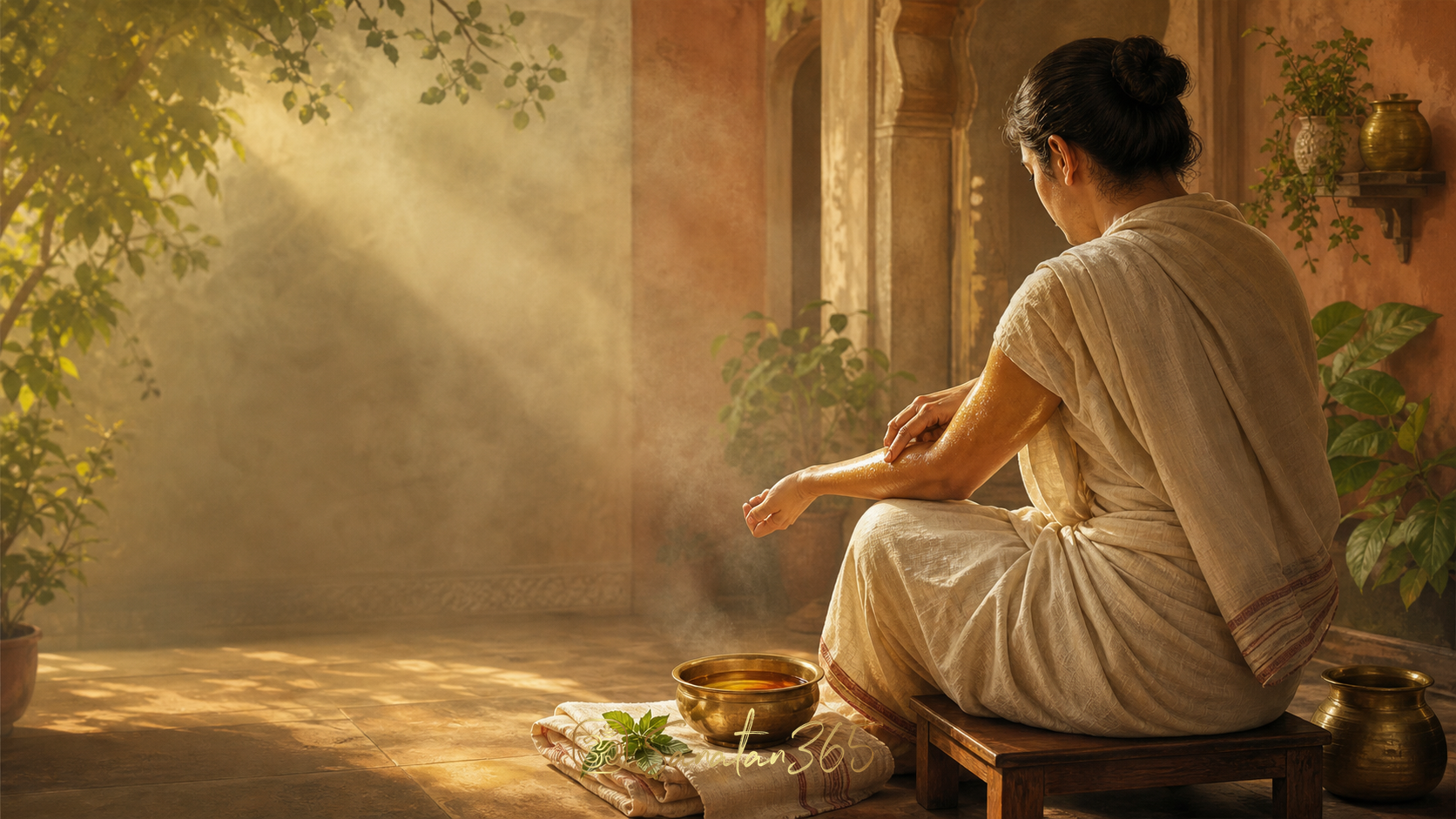
Abhyanga Meaning: Ayurvedic Self-Oil Massage as Daily Care
A grounded guide to Abhyanga meaning, its place in Ayurvedic daily routine, a gentle home practice, and the safety limits every beginner should know.
Warm oil can turn an ordinary morning into a deliberate act of attention. Abhyanga meaning is the Ayurvedic practice of applying oil to the body with gentle massage, traditionally as part of dinacharya (दिनचर्या, daily routine). It may be performed by oneself or by a trained practitioner. At home, its spiritual value is not a promise to cure disease. It is a measured way to care for the body, slow down, and remember that discipline can be tender.
Ayurveda is one of India's traditional systems of health knowledge, and Abhyanga belongs to that larger framework. The practice is often described with warm oil, rhythmic strokes, and attention from the scalp or limbs toward the feet. Yet a responsible modern approach begins with humility: traditions vary, research specific to Abhyanga is limited, and skin conditions, injuries, pregnancy, allergies, medicines, and other health circumstances can change what is safe. The National Center for Complementary and Integrative Health advises discussing complementary approaches with qualified healthcare professionals rather than using them to replace conventional care.
Key takeaway: Abhyanga is best understood as a traditional practice of attentive oiling and massage, not as a guaranteed treatment.
What Is the Abhyanga Meaning in Ayurveda?
The Sanskrit word abhyanga (अभ्यङ्ग, oil application or massage) refers to anointing and massaging the body with oil. In the Ayurvedic understanding of daily conduct, it sits beside bathing, movement, food, rest, and other habits that give shape to the day. The Government of India's Ministry of Ayush includes Abhyanga Chikitsa within its Ayusoft Ayurvedic knowledge resource, reflecting the practice's established place in the tradition.
Abhyanga is sometimes linked with sneha (स्नेह), a Sanskrit word that can carry the senses of oiliness, affection, or tenderness depending on context. This double resonance has made the practice a powerful metaphor: care is not merely an idea but something applied through patient, non-violent touch. The metaphor should not be mistaken for a clinical claim. It simply explains why many practitioners experience the ritual as more than skin care.
Traditional instruction may describe full-body oiling, including the head, ears, and feet. A beginner does not need to imitate every classical detail on the first day. The underlying discipline can begin with one small area, a simple oil known to be suitable for the person's skin, and five quiet minutes. A qualified Ayurvedic physician can offer individualized guidance where constitution, season, age, or health history matters.
Abhyanga also belongs to a wider Hindu ethic of respecting the body without worshipping appearance. The body is the field through which one serves family, fulfils duty, studies, prays, and acts. Caring for it can therefore support seva (सेवा, selfless service) and sadhana (साधना, disciplined spiritual practice), provided self-care does not become vanity or avoidance.
This balance resembles the steadiness described in Dinacharya Meaning: Ayurvedic Daily Routine for Body, Mind, and Dharma: a routine becomes valuable when it is repeatable, moderate, and responsive to real life.
Key takeaway: The deeper Abhyanga meaning joins oil application with a disciplined attitude of care, moderation, and respect for the body.
Why Can Oil Massage Feel Like a Spiritual Practice?
A spiritual practice changes the quality of attention. Abhyanga can do this without requiring elaborate ritual. The hands move slowly. The person notices pressure, warmth, breath, fatigue, and areas held with unnecessary tension. For a few minutes, the body is no longer treated as a machine expected to perform without care.
That shift can cultivate ahimsa (अहिंसा, non-harming). Ahimsa is usually discussed in relation to how one treats other beings, but its discipline also asks whether one's habits are harsh, reckless, or neglectful. Gentle self-massage can become a small exercise in non-violent attention. It does not erase pain, stress, or illness. It invites a kinder response to the fact that the body has limits.
Abhyanga can also teach maryada (मर्यादा, right boundary or dignified restraint). More oil is not automatically better. Greater pressure is not automatically more effective. A longer ritual is not spiritually superior to a short one. Stopping when something hurts, irritates the skin, or feels medically uncertain is itself an act of discernment.
For householders, this makes the practice unusually practical. It can happen before a bath, after exercise when appropriate, or on a slower weekly morning. Parents and caregivers may find that five calm minutes are more realistic than a complex daily routine. Older adults may need help with balance and slippery surfaces. Diaspora families may adapt oil choice, timing, and cleanup to a colder climate or a small apartment. Adaptation does not empty the practice of meaning; thoughtless imitation does.
One may begin with a simple sankalpa (संकल्प, clear intention): “May this act support steadiness and responsible care.” No grand promise is needed. Attention is enough.
Key takeaway: Abhyanga becomes spiritually meaningful when it trains gentleness, boundaries, gratitude, and sustained attention.
How Can a Beginner Practise Ayurvedic Self Massage at Home?
The safest beginner version is simple. It avoids complex herbal oils, forceful techniques, and medical promises. It also prevents the common mistake of turning a contemplative practice into a slippery race against time.
1. Choose an uncomplicated setting
Use a warm room with a stable chair or non-slip mat. Keep an old towel nearby and protect the floor. If balance is uncertain, remain seated and ask a trusted person for assistance. Oil on tile can create a serious fall risk.
2. Patch-test a plain oil
Choose a simple topical oil that the skin has tolerated before. Sesame oil is commonly associated with traditional Abhyanga, while other oils are used according to climate, season, and individual suitability. Tradition is not a substitute for allergy awareness. Apply a small amount to a limited patch first and wait for any sign of irritation. Fragranced or herb-infused products add ingredients that may not suit everyone.
3. Warm gently, never excessively
Place the oil container in a bowl of warm water or warm a little between the palms. Test the temperature carefully. Hot oil can burn. Never heat oil unattended or apply it when sensation is impaired.
4. Begin with five to ten minutes
Apply a small amount with slow, comfortable strokes. Many contemporary guides describe longer strokes along limbs and gentle circular movement around joints, but pressure should remain pleasant and never painful. The purpose is attentive application, not deep-tissue treatment. Avoid broken, infected, inflamed, recently injured, or medically restricted areas.
5. Pause before bathing
If comfortable, sit quietly for a few minutes. Then bathe with comfortably warm water and clean the skin without aggressive scrubbing. Wash the tub or floor thoroughly. Oil-soaked cloths should be handled carefully and kept away from open flames.
6. Observe rather than judge
Notice how the skin and body respond over the next day. Redness, itching, swelling, pain, dizziness, breathing difficulty, or any other concerning reaction is a reason to stop and seek appropriate medical advice. A practice that does not suit someone is not a spiritual failure.
Key takeaway: A sound home practice uses a patch-tested oil, gentle warmth, light pressure, a safe floor, and permission to stop.
When Should Abhyanga Be Avoided or Professionally Guided?
Abhyanga is not appropriate in every circumstance. The evidence base for specific health outcomes remains limited, and generalized online advice cannot account for an individual's diagnoses, medicines, mobility, skin integrity, or pregnancy. The NCCIH Ayurveda overview emphasizes that evidence for many Ayurvedic approaches is limited and that some products may create safety concerns. Abhyanga uses topical oil rather than an ingested preparation, but the same principle of informed caution applies.
Seek guidance from a qualified healthcare professional before beginning if any of these apply:
- pregnancy or recent childbirth;
- fever, acute illness, or unexplained symptoms;
- recent surgery, fracture, sprain, or open wound;
- active rash, infection, burn, severe acne, or significant skin sensitivity;
- circulation problems, reduced sensation, bleeding risk, or medicines that affect bruising;
- severe pain, swelling, dizziness, or mobility limitations;
- known allergies to oils, herbs, fragrances, nuts, or seeds;
- any condition for which massage or heat has been restricted.
Do not apply oil inside the eyes, ears, nose, or other body openings without specific professional instruction. Do not massage a painful area in an attempt to “release toxins.” “Detox” language is often used loosely online and can encourage unsafe certainty. The body's medical needs deserve precise assessment, not spiritualized guesswork.
Children, frail elders, and people who need help transferring or bathing require particular care. The practice should never override consent. Touch must remain respectful, wanted, and appropriate.
A trained Ayurvedic practitioner may help interpret traditional factors such as prakriti (प्रकृति, constitutional pattern), dosha (दोष, functional principle in Ayurveda), climate, and season. For medical symptoms, that guidance should complement, not replace, care from licensed health professionals.
Key takeaway: Caution is part of the practice; professional guidance matters whenever health, skin, pregnancy, medication, pain, or mobility creates uncertainty.
How Can Abhyanga Become a Sustainable Daily-Care Ritual?
Consistency does not require daily perfection. A sustainable rhythm may be five minutes twice a week, a foot-and-hand oiling practice before a bath, or a fuller session on one unhurried morning. The right frequency is the one that remains safe, clean, and compatible with household duties.
Three principles help:
- Keep the threshold small. Store one suitable oil and one washable towel together. Reduce setup rather than relying on motivation.
- Connect it to an existing habit. Practise before a planned bath or after laying out clean clothes. A stable cue makes repetition easier.
- End with gratitude. Notice one thing the body allowed that day: walking, cooking, working, embracing a child, offering prayer, or simply breathing through difficulty.
Seasonal intelligence matters too. Oil texture and comfort can change in humid, cold, or very hot conditions. A heavy application that feels grounding in winter may feel unpleasant during a humid monsoon. The home tradition of Ayurveda values desha (देश, place), kala (काल, time or season), and patra (पात्र, the person and context). These are reminders to adapt rather than copy.
Abhyanga can pair naturally with quiet breathing, mantra remembrance, or the awareness practices described in Pancha Kosha Meaning: The Five Sheaths of the Self. It should not become another metric of spiritual achievement. Missing a day does not erase its value. Returning gently is part of the discipline.
The single key takeaway is this: Abhyanga is most powerful as a humble rhythm of care, where warm oil, safe touch, and clear boundaries help a person inhabit the body with gratitude rather than neglect.
FAQ
What is the simplest Abhyanga meaning?
Abhyanga means the Ayurvedic practice of applying oil to the body with gentle massage. It is traditionally included in daily routine and may be done by oneself or by a trained practitioner.
Is Abhyanga the same as a spa massage?
No. A spa service may borrow oil-massage techniques, but traditional Abhyanga belongs to a wider Ayurvedic framework of daily conduct, season, individual suitability, and disciplined care. At home, it can be a simple five-to-ten-minute practice rather than a luxury treatment.
Which oil is best for Ayurvedic self massage?
There is no universally best oil. Sesame oil is commonly associated with Abhyanga, but climate, skin sensitivity, allergies, health history, and professional guidance matter. Beginners should use a simple oil they tolerate, patch-test first, and avoid complex herbal or fragranced products when suitability is unclear.
Does Abhyanga treat stress, pain, or illness?
Abhyanga should not be presented as a guaranteed treatment. Some people find gentle oil massage calming or comforting, but research specific to Abhyanga is limited. It must not replace diagnosis, medicines, therapy, physiotherapy, or other professional care.
Can Abhyanga be practised every day?
Traditional routines may recommend frequent practice, but daily use is not suitable or practical for everyone. A safe schedule depends on skin, health, mobility, climate, oil choice, and professional advice. A short weekly or twice-weekly rhythm can still carry the practice's meaning.
About the author
Sanatan365 Editorial
Bringing Sanatan Dharma to modern seekers through authentic, scripture-grounded content.
Related in Wellness
 Wellness
Sukhasana Meaning: Finding Ease in a Supported Seat
Sukhasana is a simple cross-legged yoga seat, not a test of flexibility. Learn its meaning, practical supports and the value of choosing st…
 Wellness
Tadasana Meaning: Mountain Pose and the Art of Standing Well
Why a simple standing posture deserves careful attention, how Mountain Pose differs from the raised-arm Palm Tree version, and how to pract…
 Wellness
Nadi Shodhana Pranayama: Meaning and a Gentle Practice
Nadi Shodhana is alternate-nostril breathing practiced with steady attention. Its deeper yogic purpose is preparing breath and mind for cla…

