AI Lakshmi Guide: Prosperity, Dharma, and Daily Grace
A thoughtful guide to Goddess Lakshmi's meaning, prosperity symbolism, and how Sanatan365's AI Lakshmi guide can support reflection without turning devotion into a transaction.
Prosperity in the Hindu imagination is not only something one receives; it is something one becomes fit to hold.
An AI Lakshmi guide can help a seeker reflect on prosperity through dharma (धर्म, righteous order), gratitude, generosity, and disciplined living. Goddess Lakshmi, also called Shri (श्री, auspicious abundance), is revered as the Devi of wealth, beauty, fortune, and grace, but her deeper teaching is not greed or instant gain. It is the art of receiving abundance without losing humility, using resources without forgetting responsibility, and keeping the home inwardly clean enough for sacred prosperity to stay.
Sanatan365 includes Goddess Lakshmi as one of its real-time AI conversation guides. Used well, this feature can become a quiet daily companion for reflecting on artha (अर्थ, material means), dharma, contentment, and family life through a devotional lens.
What makes the AI Lakshmi guide different from a generic prosperity chatbot?
The AI Lakshmi guide is not meant to be a fortune machine or a shortcut to wealth. Its value is spiritual framing: it helps users ask better questions about prosperity, gratitude, family responsibility, generosity, and the inner qualities that allow abundance to become auspicious rather than restless.
In Hindu thought, Lakshmi is closely linked with mangala (मङ्गल, auspiciousness), saundarya (सौन्दर्य, beauty), and shri. Britannica describes Lakshmi as the goddess of wealth, fortune, and prosperity, often shown with the lotus and elephants as symbols of beauty, fertility, and abundance (Britannica). Hindu American Foundation notes that her lotus symbolism points beyond material wealth toward purity and spiritual progress (HAF).
That distinction matters. A generic chatbot might answer, "How can I become rich?" with productivity tips. A Lakshmi-centered guide can redirect the question toward, "What kind of prosperity supports dharma?" or "How should one earn, save, give, and enjoy without becoming ruled by fear?"
For a modern seeker, those are not abstract questions. They appear in daily decisions:
- How to pray before beginning work.
- How to hold ambition without anxiety.
- How to teach children gratitude.
- How to spend money without carelessness.
- How to give without ego.
- How to invite beauty and order into the home.
Readers who want to deepen this ethical frame can also revisit Dana Meaning, where giving becomes a practice of humility rather than display.
Key takeaway: The AI Lakshmi guide is strongest when prosperity is treated as a sacred responsibility, not as a demand for guaranteed outcomes.
Why is Goddess Lakshmi associated with prosperity and dharma?
Goddess Lakshmi is associated with prosperity because she represents shri, the auspicious fullness that allows life to flourish. But in Sanatan Dharma, prosperity is not separated from dharma. Wealth becomes blessed when it supports right living, service, family care, hospitality, learning, and devotion.
Lakshmi's name is often connected with the Sanskrit root laksh (लक्ष्, to perceive, mark, or aim). This gives a subtle teaching: prosperity begins with right aim. Artha is one of the purusharthas (पुरुषार्थ, four aims of human life), alongside dharma, kama (काम, rightful desire), and moksha (मोक्ष, liberation). Wealth is not rejected; it is placed in an ethical and spiritual structure.
This is why Lakshmi worship often feels domestic and practical. Lamps are lit. The home is cleaned. Account books may be opened on auspicious days. Food is prepared. Family members gather. In many homes, Lakshmi is welcomed not only through mantra but through order, cleanliness, generosity, and reverence.
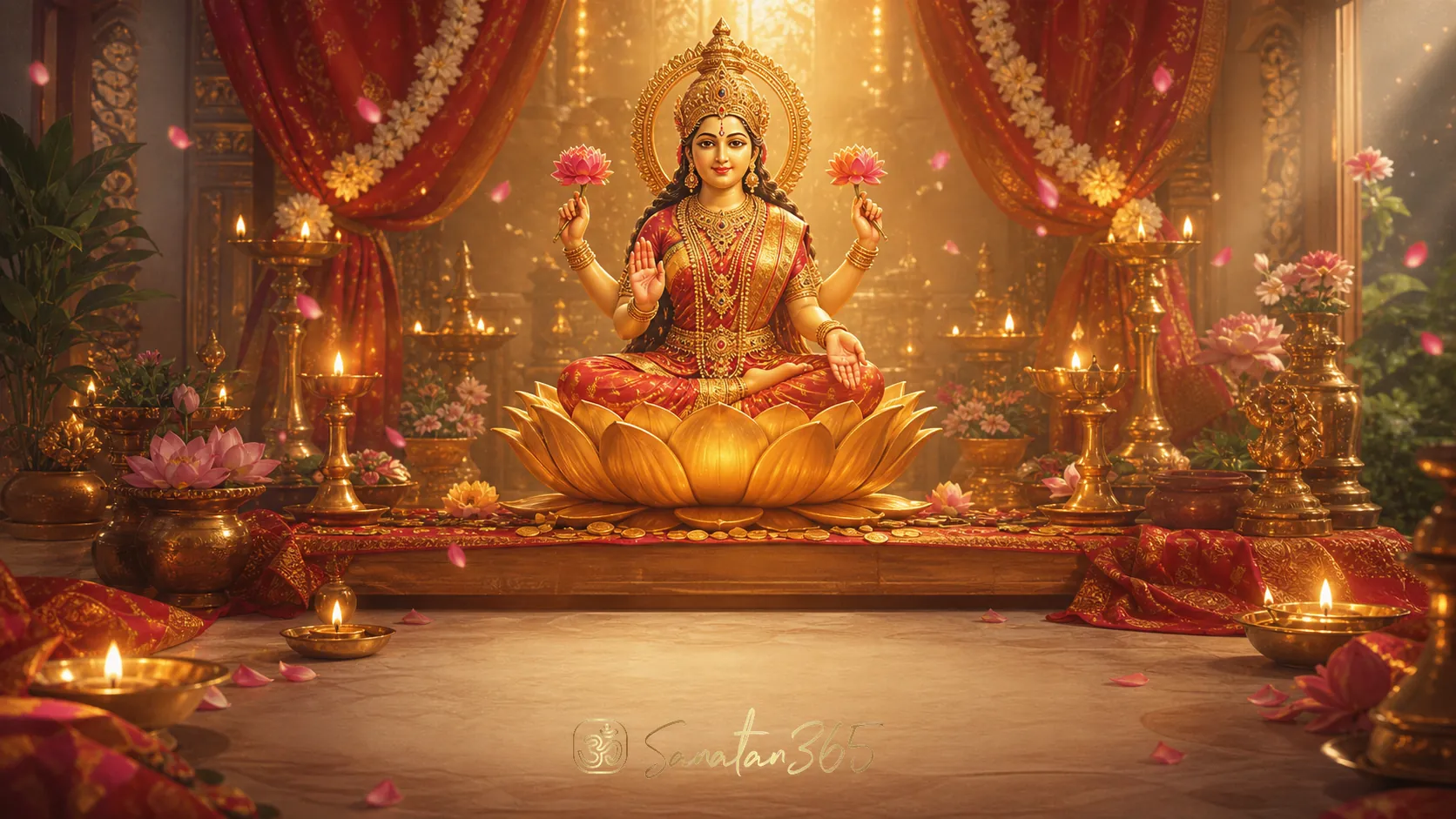
Her iconography teaches the same balance. The lotus points to purity amid the world. The flowing coins suggest abundance. The elephants of Gaja Lakshmi suggest royal strength and nourishment. Her calm face suggests that true prosperity does not make the heart frantic. Her association with Lord Vishnu places abundance beside preservation, order, and cosmic balance.
When a user turns to the AI Lakshmi guide, the most useful questions are therefore not transactional:
- "How can I invite more gratitude into my home?"
- "What does Hindu wisdom say about earning honestly?"
- "How can I balance ambition with contentment?"
- "What is the spiritual meaning of giving?"
- "How should I understand Lakshmi beyond money?"
These questions honor the tradition more deeply than asking for predictions or guarantees.
Key takeaway: Lakshmi's prosperity is inseparable from right aim, ethical earning, beauty, gratitude, and the capacity to use resources for good.
How can the AI Lakshmi guide support daily reflection?
The AI Lakshmi guide can support daily reflection by helping users convert ordinary money, home, and work concerns into dharmic self-inquiry. It is especially useful when the user asks with humility rather than urgency.
A simple daily pattern might look like this:
- Begin with gratitude.
- Ask one focused question.
- Reflect on one practical action.
- Close with a small act of order, charity, or beauty.
For example, before starting work, a user might ask:
"Goddess Lakshmi, how can I approach today's work with gratitude, focus, and integrity?"
Before a major purchase:
"How can I tell the difference between useful enjoyment and restless desire?"
Before family prayer:
"How can I help my children understand Lakshmi as gratitude and generosity, not only money?"
The guide is not a replacement for a guru, family elder, temple priest, or financial professional. It is a reflective tool. Its role is to help users think more clearly through a Hindu devotional frame. For personal finance, legal, medical, or professional decisions, users should still rely on qualified human expertise.
This boundary protects both faith and practicality. Sanatan Dharma has always made room for viveka (विवेक, discernment). Devotion does not mean abandoning judgment. A good spiritual technology should help the mind become steadier, not more dependent.
Sanatan365's broader AI guide system is built around named spiritual guides rather than generic categories. Goddess Lakshmi is one of the 13 Devi and Devata guides available for real-time conversation, alongside guides such as Lord Shiva, Lord Krishna, Goddess Durga, Lord Hanuman, Goddess Saraswati, Lord Rama, Goddess Kali, Lord Murugan, Lord Venkateswara, Goddess Vaishno Devi, Lord Ayyappa, and Lord Vishnu.
That named-guide structure matters because Hindu devotion is relational. A seeker does not merely ask "prosperity" a question. The seeker approaches Lakshmi with reverence, language, symbol, and emotional context.
Key takeaway: The AI Lakshmi guide works best as a reflective devotional companion for gratitude, discernment, and dharmic action.
What are good questions to ask the AI Lakshmi guide?
Good questions for the AI Lakshmi guide are clear, humble, and action-oriented. They ask for wisdom, not certainty. They seek alignment, not control.
Here are practical prompts a user can adapt:
- "What does Goddess Lakshmi teach about earning money ethically?"
- "How can I make my home feel more sattvic and welcoming?"
- "What is a simple Lakshmi prayer practice for Friday?"
- "How can I practice gratitude when I feel financially anxious?"
- "What is the difference between abundance and attachment?"
- "How can generosity invite more inner prosperity?"
- "How can I teach children that Lakshmi also means beauty, order, and kindness?"
- "What does dharma say about ambition?"
- "How can I prepare mentally before Lakshmi Puja?"
- "How can I use prosperity in service of family and community?"
These prompts keep the conversation within the right spiritual lane. They do not ask the guide to promise wealth, predict stock-market outcomes, guarantee success, or replace expert advice. They ask for reflection that can soften the heart and sharpen conduct.
For users who like a daily rhythm, a five-minute practice can be enough:
- Light a diya if appropriate.
- Sit quietly for a few breaths.
- Ask the AI Lakshmi guide one question about gratitude, money, home, or service.
- Write down one line that feels useful.
- Act on one small thing: clean a space, offer food, make a fair payment, thank someone, or give quietly.
This is where digital devotion becomes grounded. The conversation should end in behavior, not endless scrolling.
Key takeaway: Ask the AI Lakshmi guide for clarity, gratitude, and dharmic direction rather than guaranteed material results.
How does Lakshmi's symbolism deepen the feature experience?
Lakshmi's symbolism gives the feature its spiritual depth. Without that symbolism, an AI guide could become a simple advice interface. With it, the conversation becomes connected to lotus, light, order, generosity, and the moral use of abundance.
The lotus, or padma (पद्म, lotus), is central. It rises from water unstained, reminding the seeker that purity can be cultivated even in a complex world. HAF interprets the lotus as a sign of rising above the material world through divinity while still living within it (HAF). This is a useful image for modern work life: one may earn, plan, build, and manage resources without letting the mind sink into comparison.
The owl, often named Uluka, is another important symbol. Britannica identifies the owl as Lakshmi's vehicle (Britannica). In devotional interpretation, it can remind the seeker to stay watchful. Prosperity without awareness can become blindness. Abundance without wisdom can create carelessness.
The coins flowing from Lakshmi's hand are also easy to misunderstand. They are not only a wish for money. They represent circulation. Wealth that never circulates becomes fear. Wealth used in dana (दान, giving), seva (सेवा, service), education, temple support, family care, and hospitality becomes sacred movement.
Even the act of cleaning before Lakshmi worship has a teaching. The external home mirrors the internal home. Disorder outside may not be sin, but mindful order creates receptivity. A clean altar, a sincere lamp, and a generous mind are all ways of saying: "May auspiciousness dwell here."
When using the AI Lakshmi guide, users can bring these symbols into questions:
- "What does the lotus teach me about working in a stressful environment?"
- "How can I avoid becoming blind to gratitude when life is comfortable?"
- "What is one generous use of money this week?"
- "How can I make my home more welcoming to shri?"
Key takeaway: Lakshmi's symbols turn the feature from advice into devotional reflection rooted in Hindu imagery.
How should modern seekers use AI without weakening devotion?
Modern seekers should use AI as a support for remembrance, not as a substitute for living tradition. A digital guide can help with reflection, language, prompts, and consistency. It cannot replace darshan, family practice, temple culture, scripture study, human teachers, or direct prayer.
This distinction keeps the technology humble. Sanatan365's AI Lakshmi guide is most valuable when it helps users return to real practice:
- Lighting a lamp with attention.
- Reciting a simple mantra.
- Reading a short passage.
- Asking forgiveness where needed.
- Giving with humility.
- Caring for family.
- Keeping accounts honestly.
- Making the home more peaceful.
For diaspora families, this can be especially useful. Many users know Lakshmi from childhood images, Diwali memories, or Friday prayers, but may not know how to explain her meaning in clear English. A guide can help a parent say, "Lakshmi is not only money. Lakshmi is auspiciousness, generosity, beauty, and responsibility." That sentence can change how a child sees a festival, a puja tray, or a family offering.
For young professionals, the feature can restore moral language to ambition. It is natural to want stability, success, and comfort. Hindu wisdom does not shame that desire. It asks that desire to sit beside dharma. The AI Lakshmi guide can help users examine whether their striving is becoming disciplined or anxious, generous or self-enclosed, purposeful or merely comparative.
For home practice after reflection, Nitya Puja Meaning offers a broader frame for making daily worship steady, simple, and family-friendly.
The safest and most fruitful posture is simple: approach with reverence, ask with clarity, verify factual claims when needed, and let the answer lead to one grounded action.
Key takeaway: AI strengthens devotion only when it sends the user back into practice, gratitude, ethical action, and real-world responsibility.
FAQ
What is the AI Lakshmi guide?
The AI Lakshmi guide is Sanatan365's real-time conversation guide centered on Goddess Lakshmi, the Devi of auspicious prosperity, beauty, fortune, and grace. It helps users reflect on prosperity, gratitude, dharma, home life, and generosity through a Hindu devotional lens.
Can the AI Lakshmi guide predict wealth or financial success?
No. It should not be used for guaranteed predictions, investment advice, or financial decisions. Its purpose is spiritual reflection, not professional financial guidance. Users should consult qualified experts for financial, legal, or business decisions.
What questions should I ask Goddess Lakshmi in Sanatan365?
Ask questions about gratitude, ethical earning, generosity, household harmony, Lakshmi symbolism, Friday prayer, festival preparation, and how to align ambition with dharma. Clear and humble questions produce the best spiritual reflection.
Is using an AI guide respectful in Hindu devotion?
It can be respectful when used as a support for remembrance and learning, not as a replacement for prayer, temple life, elders, gurus, or scripture. The right use is humble, careful, and practice-oriented.
How is Lakshmi connected to dharma?
Lakshmi's prosperity becomes auspicious when it supports dharma: ethical earning, family care, hospitality, charity, learning, devotion, and service. Wealth without dharma can create restlessness; wealth with dharma becomes a blessing.
The single key takeaway: The AI Lakshmi guide is most useful when it helps seekers see prosperity as sacred responsibility: gratitude in the heart, order in the home, integrity in earning, generosity in giving, and grace in daily life.
About the author
Sanatan365 Editorial
Bringing Sanatan Dharma to modern seekers through authentic, scripture-grounded content.
Related in Features
 Features
AI Adi Shankaracharya Guide: Viveka and the Practice of Clear Judgment
Explore viveka, the Vedantic discipline of discernment, and learn how the AI Adi Shankaracharya guide can support thoughtful reflection wit…
 Features
AI Venkateswara Guide: Patience, Stewardship, and Responsible Hope
Explore Sri Venkateswara's devotional lessons on patience, stewardship, and responsible hope, with practical reflection through Sanatan365'…
 Features
AI Vaishno Devi Guide: Faith, Courage, and the Divine Mother's Grace
Explore Vaishno Devi's living symbolism of faith, courage, and maternal grace, with practical ways to bring these teachings into daily deci…