Nitya Puja Meaning: Daily Worship as a Living Hindu Practice
Nitya puja is the daily Hindu practice of worship that turns a home altar, simple offerings, and steady remembrance into a rhythm of devotion.
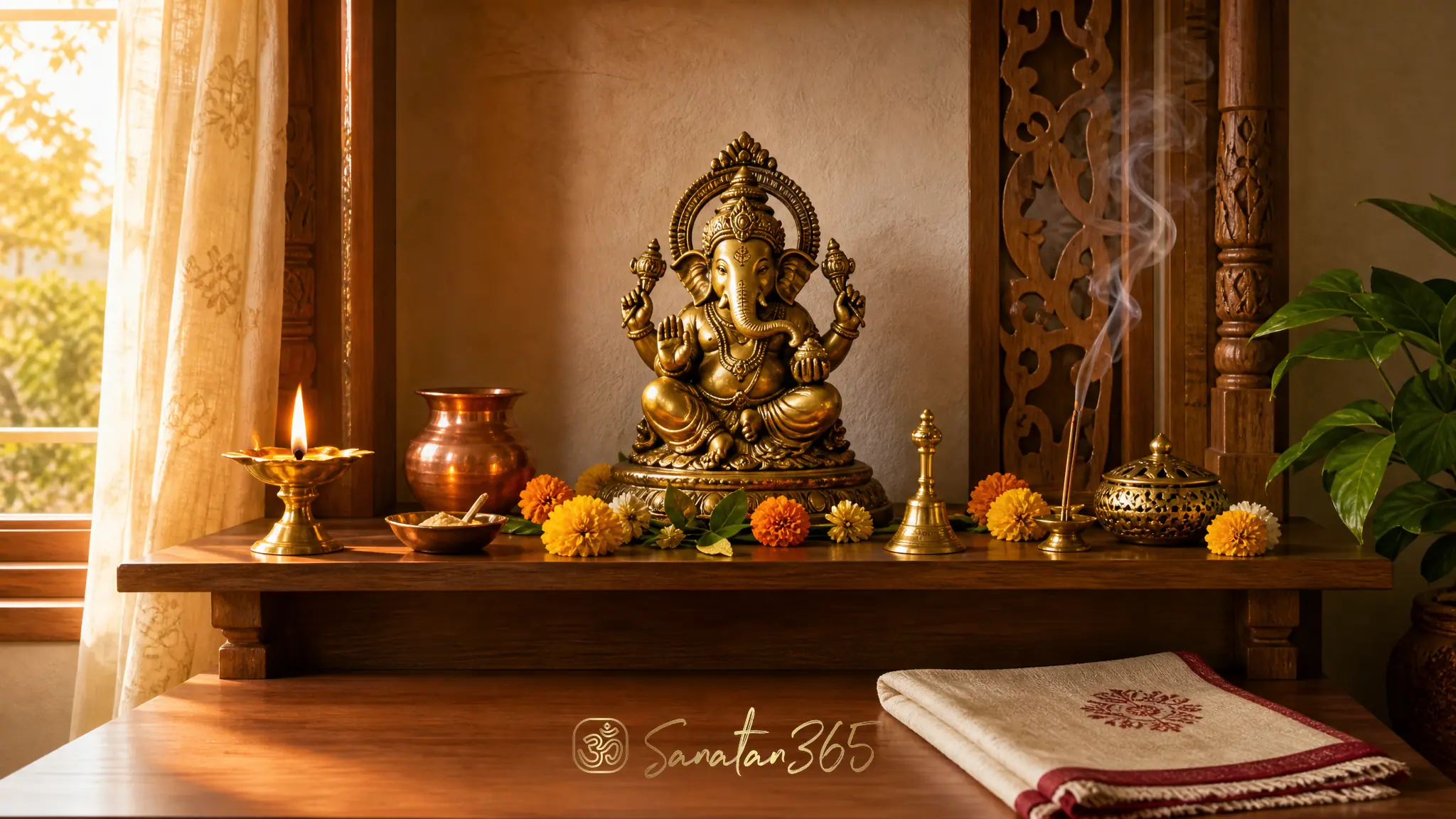
A home altar does not have to be large to become spiritually serious.
Nitya Puja meaning is the meaning of daily Hindu worship: a steady practice of honoring the Divine through presence, cleanliness, offerings, mantra, light, and gratitude. Nitya (नित्य, daily or regular) and puja (पूजा, reverent worship or offering) together point to worship that is not reserved only for festivals. It is the small, repeated act by which a household remembers dharma, welcomes sacred presence, and begins or closes the day with humility.
What Is Nitya Puja Meaning in Daily Hindu Worship?
Nitya puja is daily worship performed at home, in a temple, or in a personal sacred space. It may be brief or elaborate, depending on family tradition, sampradaya (सम्प्रदाय, lineage or tradition), time, and capacity. The heart of the practice is not performance. It is reverent attention.
Britannica's overview of puja describes puja as worship in Hinduism involving offerings to deities, performed both in homes and temples. That range matters. A temple puja may include a trained pujari (priest), formal upacharas (उपचार, acts of service or attendance), music, lamps, food offerings, and shared prasad. A home puja may be only a diya, a flower, a mantra, and a quiet bow before a murti (मूर्ति, consecrated or devotional image), photo, Shiva linga, yantra, or sacred symbol.
The word nitya protects the practice from becoming occasional spirituality. A festival can lift the heart, but daily worship trains the heart. The same small act, repeated with sincerity, slowly changes the home atmosphere. It reminds the family that food is not merely consumed, speech is not merely useful, time is not merely spent, and the day is not merely managed. Life is received.
Key takeaway: Nitya puja is daily worship that turns ordinary household time into a rhythm of remembrance, offering, and gratitude.
Why Does Daily Puja Matter at Home?
Daily puja matters because Hindu practice is not only a set of beliefs. It is embodied. It uses hands, breath, sound, light, fragrance, food, space, and attention. The body learns what the mind forgets.
Many families understand this intuitively. A clean altar changes how people enter a room. A lit diya creates a pause before the day's rush. A bell calls wandering attention back. Flowers remind the devotee that beauty is best when offered. Prasad (प्रसाद, blessed offering received with grace) turns food from possession into blessing.
The Hindu American Foundation puja guide frames puja as a discipline that supports karma, bhakti, jnana, and dhyana: action, devotion, knowledge, and meditative focus. This is a useful way to understand home worship. Puja is not only emotional devotion. It can also be action done carefully, knowledge remembered through symbols, and meditation supported by repetition.
Daily puja also gives children a visible grammar of reverence. They see that the family bows before something higher than ego. They learn that a home can contain sacred responsibility, not only private comfort. Even if the child does not understand every mantra, the atmosphere teaches: speak gently near the altar, offer before taking, clean before worship, and receive prasad with gratitude.
For adults, daily puja becomes a check on spiritual drift. It asks simple questions without words:
- Did the day begin with gratitude or only urgency?
- Was the home treated as sacred space?
- Did speech become more mindful after prayer?
- Was food received as prasad or only as fuel?
- Did devotion lead to better conduct?
Key takeaway: Daily puja matters because it trains body, home, and mind to remember the sacred through repeated action.
What Are the Basic Elements of a Simple Home Puja?
A simple home puja does not require expensive items. It requires cleanliness, respect, and consistency. Families vary widely, so the following is a gentle template, not a universal rule.
Common elements include:
- A clean altar or shelf with a murti, image, Shiva linga, yantra, or sacred symbol.
- A diya (दीया, lamp), often with ghee or oil.
- Fresh water in a small vessel.
- Flowers, leaves, or fruit where available.
- Incense if the household uses it safely.
- A bell.
- Kumkum, haldi, chandan, or vibhuti according to family practice.
- A short mantra, stotra, aarti, or silent prayer.
- Naivedya (नैवेद्य, food offering) before receiving it as prasad.
- A final bow or moment of stillness.
The deeper idea is hospitality. In many forms of puja, the deity is honored like the most cherished guest. The offering of seat, water, fragrance, light, food, and praise expresses love through service. BYU Museum of Art's notes on Hindu temple worship describe darshan (दर्शन, sacred seeing) as a reciprocal encounter between devotee and deity. Home puja carries the same intuition in a quieter form: the devotee comes to see and be seen.
This is why even a very short puja can be complete in feeling. A person may light a lamp, chant "Om Namah Shivaya" or "Om Namo Bhagavate Vasudevaya," offer water, sit silently, and close with gratitude. Another household may recite Vishnu Sahasranama, Hanuman Chalisa, Lalita Sahasranama, Durga Chalisa, or a family stotra. Both can be valid when done with shraddha (श्रद्धा, trusting reverence).
Key takeaway: The basic elements of home puja are not spiritual decoration; they are acts of welcome, offering, and sacred attention.
How Can a Beginner Do Nitya Puja Without Feeling Overwhelmed?
Beginners often worry that they will do puja incorrectly. Respect matters, but fear is not the best teacher. A simple, honest practice is better than a complex practice done with anxiety and inconsistency.
Start with a ten-minute form:
- Wash hands and face, or bathe if that is your household norm.
- Clean the altar area.
- Light a diya safely.
- Offer water and a flower or leaf.
- Chant one known mantra 11 times, or sit in silent prayer.
- Offer a small piece of fruit, milk, or cooked food if appropriate.
- Read one verse, teaching, or family prayer.
- Bow, sit quietly, and receive prasad.
- Carry one quality into the day: patience, truthfulness, courage, or kindness.
This structure is intentionally simple. It gives the mind enough form to settle, but not so much form that the practice collapses under pressure. Over time, a family may add aarti, stotra recitation, japa (जप, repeated mantra recitation), or a longer shodashopachara (षोडशोपचार, sixteenfold worship) sequence if guided by tradition.
It is also wise to keep a steady time. Morning puja sets the tone for the day. Evening puja helps the household gather itself again after work, school, travel, and screens. Some people do both. Some do one. The key is sincerity with regularity.
Regional variation should be honored. A Tamil household, a Gujarati Vaishnava home, a Bengali Shakta family, a Maharashtrian Ganapati devotee, a Kashmiri Shaiva practitioner, and a diaspora family in New Jersey or Singapore may all keep different altar customs. Hindu practice is not weakened by this variety. It is strengthened when families preserve their living forms with humility.
Key takeaway: Beginners can practice nitya puja through a short, clean, consistent form that grows naturally with family tradition and guidance.
What Is the Inner Meaning of Offerings in Puja?
Puja offerings are outward actions with inward meaning. A flower is not a bribe to the Divine. A lamp is not a performance. Water is not merely water when offered with attention. Each item becomes a way to train the heart.
The diya offers light. Inwardly, it asks for clarity. Flowers offer beauty. Inwardly, they ask the devotee to make conduct fragrant. Incense offers subtle fragrance. Inwardly, it suggests that prayer should spread beyond the altar into speech and behavior. Food becomes naivedya before it becomes prasad. Inwardly, it teaches that what sustains the body is first returned to the sacred source.
Even the bell has meaning. It marks a transition from scattered attention to gathered attention. The sound is brief, but it cuts through mental noise. The devotee is reminded: be here now.
The most important offering is not an item. It is ahamkara (अहंकार, ego-sense) softened by devotion. A person can place many fruits before the altar and still remain harsh, vain, and careless. Another person may offer one flower and genuinely become more patient. Hindu ritual becomes spiritually alive when the outer act and inner transformation remain connected.
This is why nitya puja should flow into conduct. After worshipping Lakshmi, one should handle wealth with honesty and generosity. After worshipping Shiva, one should practice restraint and inner stillness. After worshipping Krishna, one should remember love, wisdom, and right action. After worshipping Durga, one should protect dharma without cruelty. The altar is not separate from the day. It trains the day.
Key takeaway: Puja offerings teach the devotee to offer light, beauty, food, sound, and ego back into sacred awareness.
How Should Nitya Puja Adapt for Modern Homes and Diaspora Life?
Modern homes often have constraints: small apartments, shared rentals, work schedules, school mornings, smoke alarms, travel, and mixed family routines. Nitya puja can adapt without losing reverence.
For a small apartment, a clean shelf may be enough. For a family with young children, a shorter puja may be more sustainable. For a person who travels, a small cloth, mala, pocket image, or memorized mantra can preserve continuity. For homes where incense is impractical, flowers, water, and silent japa can replace fragrance. For people living outside India, local flowers, seasonal fruit, and available materials can be offered with the same sincerity.
The main rule is not to make convenience an excuse for carelessness. If the altar is small, keep it clean. If the puja is short, keep it attentive. If Sanskrit pronunciation is still developing, chant slowly and respectfully. If a mantra was received from a guru or family elder, preserve its discipline. If unsure about a complex ritual, ask a trusted priest, elder, or teacher rather than improvising with false confidence.
Technology can also support devotion when used carefully. A family may use a calendar reminder, listen to a correct pronunciation, read a digital stotra, or join a live temple darshan. But the screen should serve the puja, not swallow it. The moment of worship deserves uncluttered attention.
Sanatan365's daily devotional tools, such as Daily Mantras Chanting with Sage Narada Muni, Daily Aarti Singing with Goswami Tulsidas, and Daily Live Temple Darshan from Home, can support this rhythm when a user wants guided practice. They are aids to daily remembrance, not replacements for sincerity, family tradition, or lived dharma.
Key takeaway: Nitya puja can adapt to modern life when the essentials remain intact: cleanliness, attention, offering, humility, and daily remembrance.
How Does Daily Puja Become Daily Dharma?
Nitya puja becomes powerful when it changes the quality of the day after the lamp is extinguished. The practice is not complete merely because the ritual sequence is finished. It is complete when worship becomes conduct.
A useful closing reflection is:
- What did I offer today?
- What quality should I carry from this puja?
- Whom should I speak to more gently?
- What action would make this prayer honest?
- What should I receive as prasad rather than entitlement?
This connects puja with dharma (धर्म, sacred order and right conduct). The daily altar becomes a daily correction. It does not shame the devotee. It reorients the devotee. Every morning, begin again. Every evening, return again.
The deeper promise of nitya puja is not that life becomes free from difficulty. It is that the devotee becomes less forgetful inside difficulty. Work pressure, family duty, grief, ambition, and uncertainty remain part of life. Daily worship creates a place where the person can return to steadiness.
Over months and years, this rhythm builds samskara (संस्कार, inner impression or refinement). A child remembers the lamp. An adult remembers the mantra during stress. A household remembers to offer before eating. A tired person remembers to bow before speaking harshly. These are not small things. They are how a civilization lives inside daily behavior.
Key takeaway: Daily puja becomes daily dharma when worship shapes speech, food, money, family life, and the choices made after prayer.
Nitya Puja meaning is finally very simple: show up daily before the sacred with a clean space, a humble heart, and a sincere offering. The altar may be small, the mantra may be short, and the lamp may burn only for a few minutes. But when the practice is steady, it teaches the whole home to remember.
Key takeaway: Nitya puja is daily remembrance made visible through worship, and its highest fruit is a life that carries devotion into action.
FAQ
What is Nitya Puja meaning?
Nitya Puja meaning is daily Hindu worship performed with regularity, usually at home or in a personal sacred space. Nitya means daily or regular, and puja means reverent worship or offering.
How long should daily puja take at home?
Daily puja can take five to ten minutes or much longer depending on family tradition. A short puja with cleanliness, attention, lamp, offering, mantra, and gratitude is better than an elaborate practice done inconsistently.
What items are needed for a simple home puja?
A simple home puja may use a clean altar, murti or sacred image, diya, water, flowers, incense if suitable, bell, food offering, and a short mantra or prayer. Regional and family customs can change the details.
Can someone do nitya puja without knowing Sanskrit?
Yes. Sanskrit mantras should be treated respectfully, but a beginner may also pray in their own language, chant a simple known mantra, or sit silently with devotion. Learning correct pronunciation over time is a good practice.
Is home puja the same as temple puja?
Home puja and temple puja share the same devotional spirit, but temple puja may involve trained priests, formal ritual sequences, and community darshan. Home puja is usually simpler and shaped by household tradition.
About the author
Sanatan365 Editorial
Bringing Sanatan Dharma to modern seekers through authentic, scripture-grounded content.
Related in Practices
 Practices
Kusha Grass Meaning: Why Darbha Has a Place in Hindu Rituals
Understand kusha or darbha grass, its traditional place in worship and ancestral rites, and how to approach varied customs with care.
 Practices
Bhuta Shuddhi Meaning: Purifying the Five Elements Within
Bhuta Shuddhi means the purification of the five elements: earth, water, fire, air, and space. In Hindu yogic and Tantric traditions, it is…
 Practices
Likhita Japa: Meaning and Practice of Writing a Mantra
Likhita japa turns mantra repetition into a written devotional discipline. Learn its meaning, how it differs from spoken and mental japa, a…