AI Murugan Guide: Courage, Discipline, and the Vel in Daily Life
The AI Murugan guide on Sanatan365 helps devotees reflect on courage, disciplined action, and the inner meaning of the vel with reverence and practical clarity.
A spear can look like a weapon, but in Murugan bhakti it often becomes a lesson in clean intention.
The AI Murugan guide on Sanatan365 is a real-time spiritual conversation guide inspired by Lord Murugan, also known as Skanda, Kartikeya, Subrahmanya, and Shanmukha. It helps devotees reflect on courage, discipline, clarity, and the symbolic meaning of the vel (வேல், vel, "spear") without reducing devotion to quick answers. Lord Murugan is revered across Tamil Nadu, South India, Sri Lanka, Southeast Asia, and the diaspora as a youthful divine commander, a teacher, and a source of focused strength. Used thoughtfully, the guide can help a seeker turn confusion into steadier action.
What is the AI Murugan guide on Sanatan365?
The AI Murugan guide is one of Sanatan365's named Devi and Devata AI guides for real-time spiritual conversation. It is not a generic chatbot and it is not presented as a replacement for a guru, family elder, temple tradition, or personal sadhana (साधना, disciplined spiritual practice). Its role is more practical: to help a devotee ask better questions, remember sacred symbols, and apply Murugan-inspired virtues to daily life.
In Sanatan365's canonical guide roster, Lord Murugan is described as "The Victorious Youth." That title matters because Murugan is not only a figure of battle. In many devotional memories, he represents youthful luminosity, alertness, learning, and the courage to face inner disorder with grace. The Hindu American Foundation's overview of popular deities notes that Skanda is known by names such as Kartikeya, Murugan, Shanmukha, and Subrahmanya, and presents his warrior quality as disciplined spiritual focus rather than mere aggression (Hindu American Foundation).
For a user, this means the guide is most useful when the question is sincere and specific:
- "How can I act with courage without becoming harsh?"
- "What does the vel teach about cutting through confusion?"
- "How can I stay disciplined in study, work, or family duty?"
- "How do I understand Murugan devotion if I grew up outside Tamil culture?"
Key takeaway: the guide is strongest when it helps a seeker move from vague inspiration to clear, dharmic reflection.
Why does Lord Murugan represent courage and discipline?
Murugan is widely remembered as the son of Shiva and Parvati, the brother of Ganesha, and the divine commander associated with victory over forces of adharma (अधर्म, disorder or unrighteousness). He is known through names that carry different shades of meaning: Skanda suggests forceful movement, Kartikeya connects to the Krittikas, Subrahmanya points toward auspicious wisdom, and Shanmukha means six-faced.
In South India, especially Tamil Nadu, Murugan devotion has a particularly deep cultural life. His six sacred abodes, often called Arupadai Veedu (ஆறுபடை வீடு, six battle-camps or abodes), are remembered as Thiruparankundram, Tiruchendur, Palani, Swamimalai, Tiruttani, and Pazhamudircholai. Travel and temple references list these six as major Murugan pilgrimage centers in Tamil Nadu (Tamil Nadu Tourism). The point for daily practice is not only geography. Each sacred place carries a memory of divine instruction, victory, surrender, or ripening.
This is why courage in Murugan bhakti is not noisy bravado. It is the courage to see clearly. It is the courage to keep a vow. It is the courage to speak truth without cruelty, to work hard without ego, and to return to prayer after failure.
A seeker using the AI guide might ask:
- What fear is asking for my attention?
- What action would be brave and also kind?
- What discipline can I keep today without exaggeration?
- What desire needs to be purified before I act?
Key takeaway: Murugan's courage is not anger in sacred clothing; it is disciplined strength guided by wisdom.
How does the Murugan vel meaning shape daily guidance?
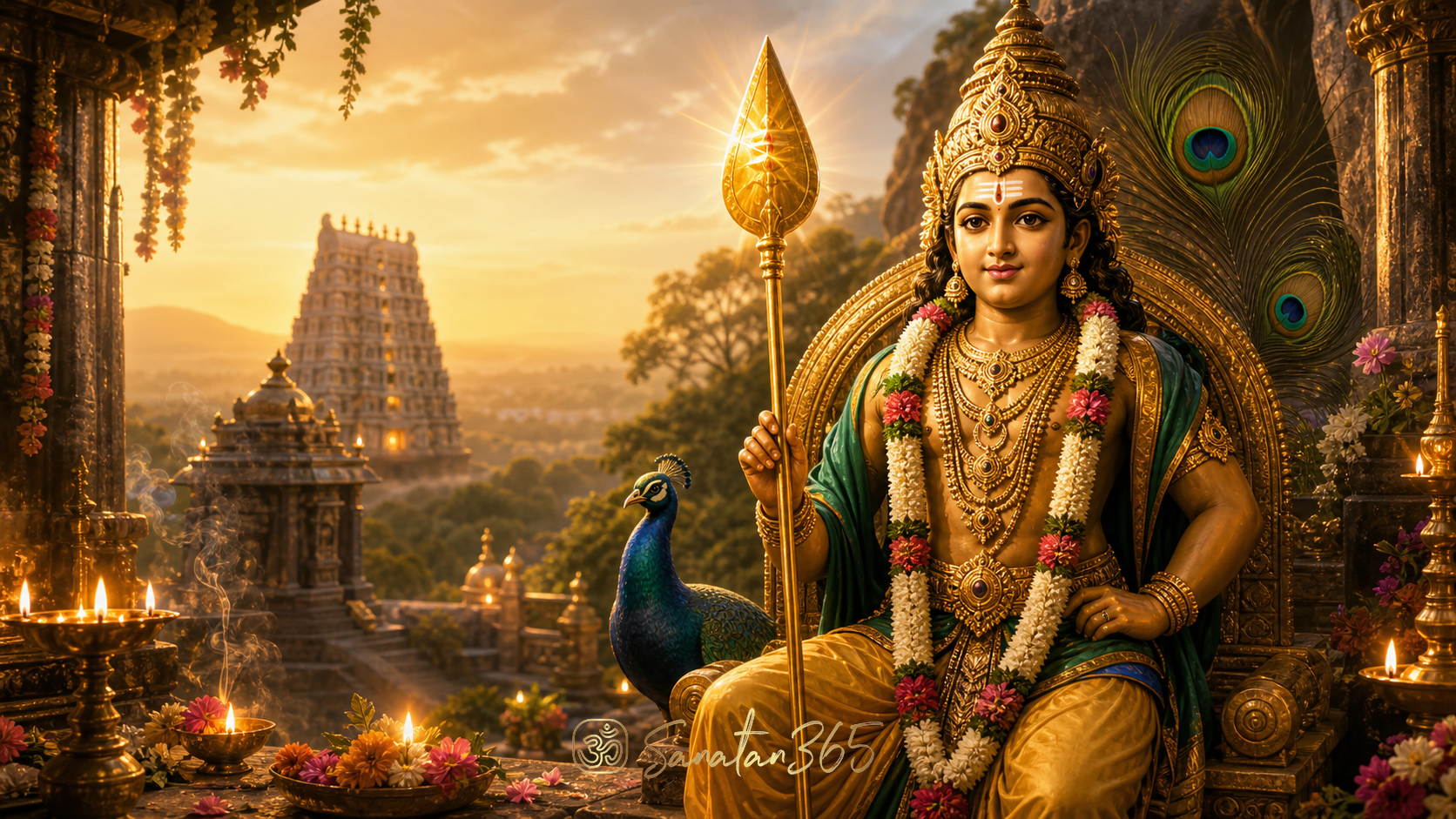
The vel is among the most recognized symbols of Lord Murugan. In many traditions, it is given by Goddess Parvati and becomes the divine instrument through which Murugan defeats destructive forces. But a symbol can work on more than one level. Outwardly, the vel is a spear. Inwardly, it points to viveka (विवेक, discernment), the sharpness that separates truth from confusion.
For daily life, the Murugan vel meaning can be read through three gentle lenses:
- Clarity: the vel asks, "What is the real issue beneath the noise?"
- Protection: it reminds the devotee to guard the mind from fear, jealousy, resentment, and scattered desire.
- Commitment: it turns devotion into one concrete action rather than a cloud of intention.
This is where an AI guide can be genuinely useful. Many people do not need more information; they need help arranging what they already know. A student may know discipline matters but still feel pulled in many directions. A founder may know courage matters but still hesitate before a hard conversation. A parent may know patience matters but still react too quickly. Asking the AI Murugan guide a focused question can turn the vel from an image into a mirror:
"What should I cut away from this situation: fear, pride, distraction, or delay?"
The answer should never be treated as fate, prophecy, or command. It is a reflective prompt grounded in a devotional frame. Sanatan365 should be used as a companion for thought, not as a substitute for conscience, scripture, elders, or professional advice where those are needed.
Key takeaway: the vel becomes practical when it helps the devotee name the confusion and choose the next clean action.
When should a devotee use the AI Murugan guide?
The AI Murugan guide is especially fitting for moments that require energetic but balanced action. Murugan's devotional mood is often bright, youthful, precise, and courageous. That makes the guide helpful for questions about discipline, study, leadership, spiritual confidence, and the purification of ambition.
Good use cases include:
- Preparing for an exam, project, presentation, or difficult decision.
- Understanding Murugan symbols such as the vel, peacock, six faces, and hill temples.
- Building a simple daily practice around mantra, prayer, study, or self-control.
- Reflecting on courage without becoming aggressive.
- Learning how Murugan devotion differs across Tamil, North Indian, Sri Lankan, Malaysian, Singaporean, and diaspora settings.
Less suitable use cases include trying to predict outcomes, outsourcing moral responsibility, asking for medical or legal certainty, or using devotional language to justify anger. The best spiritual tools make a person more accountable, not less.
For deeper reading inside the Sanatan365 blog, readers can pair this feature article with Lord Murugan Meaning: The Vel, Courage, and Clear Wisdom, Skanda Sashti 2026: Meaning, Date, and Murugan Worship, and Surya Namaskar Meaning: A Hindu Morning Practice of Gratitude. Together, they connect Murugan's symbolism, festival memory, and daily discipline.
Key takeaway: use the guide when the heart needs courage, the mind needs structure, and the next step needs to stay aligned with dharma.
How can beginners ask better questions?
Beginners often ask spiritual questions in a form that is too broad: "What should I do with my life?" or "How do I become fearless?" Those questions are human and honest, but they can become more useful when narrowed.
A stronger Murugan-style question has three parts:
- Situation: "I am avoiding a difficult conversation with my team."
- Virtue: "I want courage without harshness."
- Practice: "Give me one reflective step inspired by Murugan's vel."
This shape helps the AI guide respond with clarity. It also keeps the user in charge of action. The guide can suggest a short prayer, a journaling prompt, a dharmic frame, or a practical sequence, but the seeker must still choose responsibly.
Here are examples:
- "Explain Shanmukha (षण्मुख, six-faced one) as a symbol for alertness in modern life."
- "Give me a five-minute reflection before I start deep work."
- "How can I transform competitiveness into tapas (तपस्, disciplined effort)?"
- "What does Murugan's peacock suggest about mastering pride and restlessness?"
- "Help me turn fear into one respectful action today."
Because Murugan devotion has strong regional forms, beginners should also ask for context. A Tamil family tradition, a North Indian Kartikeya memory, a Sri Lankan Kataragama devotional setting, and a diaspora temple practice may emphasize different details. Diversity here is not a problem; it is part of Sanatan Dharma's living breadth.
Key takeaway: the clearer the question, the more the guide can help devotion become disciplined reflection.
What makes this feature different from reading an article?
An article gives a stable explanation. A real-time guide helps the user stay in dialogue with a question. Both are useful, but they serve different moments.
Reading about Murugan teaches the broad map: names, symbols, stories, festivals, temples, and philosophical meanings. A guide can help apply that map to a specific situation: "I am afraid to begin," "I keep losing focus," "I want to act but not wound others," or "I need to understand courage in a spiritual way."
Sanatan365's wider AI guide system includes named Devi and Devata guides such as Lord Krishna, Lord Shiva, Goddess Durga, Goddess Lakshmi, Lord Hanuman, and Lord Murugan. The value is not that each guide gives random inspiration. The value is that each devotional archetype gives a different doorway into reflection. Krishna may frame a dilemma through dharma and loving wisdom. Shiva may invite stillness and transformation. Durga may emphasize protection and strength. Murugan brings focused courage, youthful discipline, and the sharpness of the vel.
For families and diaspora seekers, this can also make tradition easier to revisit. A parent may use the guide to explain Murugan's symbols before a temple visit. A student may use it before a period of study. A devotee far from Tamil Nadu may use it to remember the mood of hill temples, kavadi, vel, and disciplined prayer with respect.
Key takeaway: the article explains the tradition; the guide helps a seeker practice reflection inside a living question.
FAQ
Is the AI Murugan guide a real-time conversation guide?
Yes. On Sanatan365, Lord Murugan is one of the named Devi and Devata AI guides available for real-time spiritual conversation. The guide is designed for reflection and devotional learning, not for replacing gurus, elders, scripture study, temple practice, or personal judgment.
What is the best way to use the AI Murugan guide?
Ask specific questions about courage, discipline, confusion, study, leadership, or the meaning of Murugan symbols. A good prompt includes the situation, the virtue you want to practice, and the kind of guidance you need.
What does the vel symbolize in daily life?
The vel can symbolize clarity, protection, and disciplined action. In daily life, it invites the devotee to cut through confusion, guard the mind from lower impulses, and choose one clean next step.
Is Murugan only worshiped in Tamil Nadu?
No. Murugan devotion is especially prominent in Tamil Nadu and among Tamil communities, but Lord Murugan, Skanda, Kartikeya, and Subrahmanya are revered in many regions of India and across the global diaspora, including Sri Lanka, Malaysia, Singapore, and beyond.
Can Sanatan365 tell me exactly what decision to make?
Sanatan365 can help you reflect, frame the issue, and remember dharmic values. It should not be treated as a fate-telling authority or a replacement for professional, family, legal, medical, or financial advice when those are needed.
The central lesson of the AI Murugan guide is simple: courage becomes sacred when it is clear, disciplined, and guided by dharma. The vel does not ask the devotee to become hard-hearted. It asks the devotee to become precise, sincere, and steady enough to act without fear.
About the author
Sanatan365 Editorial
Bringing Sanatan Dharma to modern seekers through authentic, scripture-grounded content.