Surya Namaskar Meaning: A Hindu Morning Practice of Gratitude
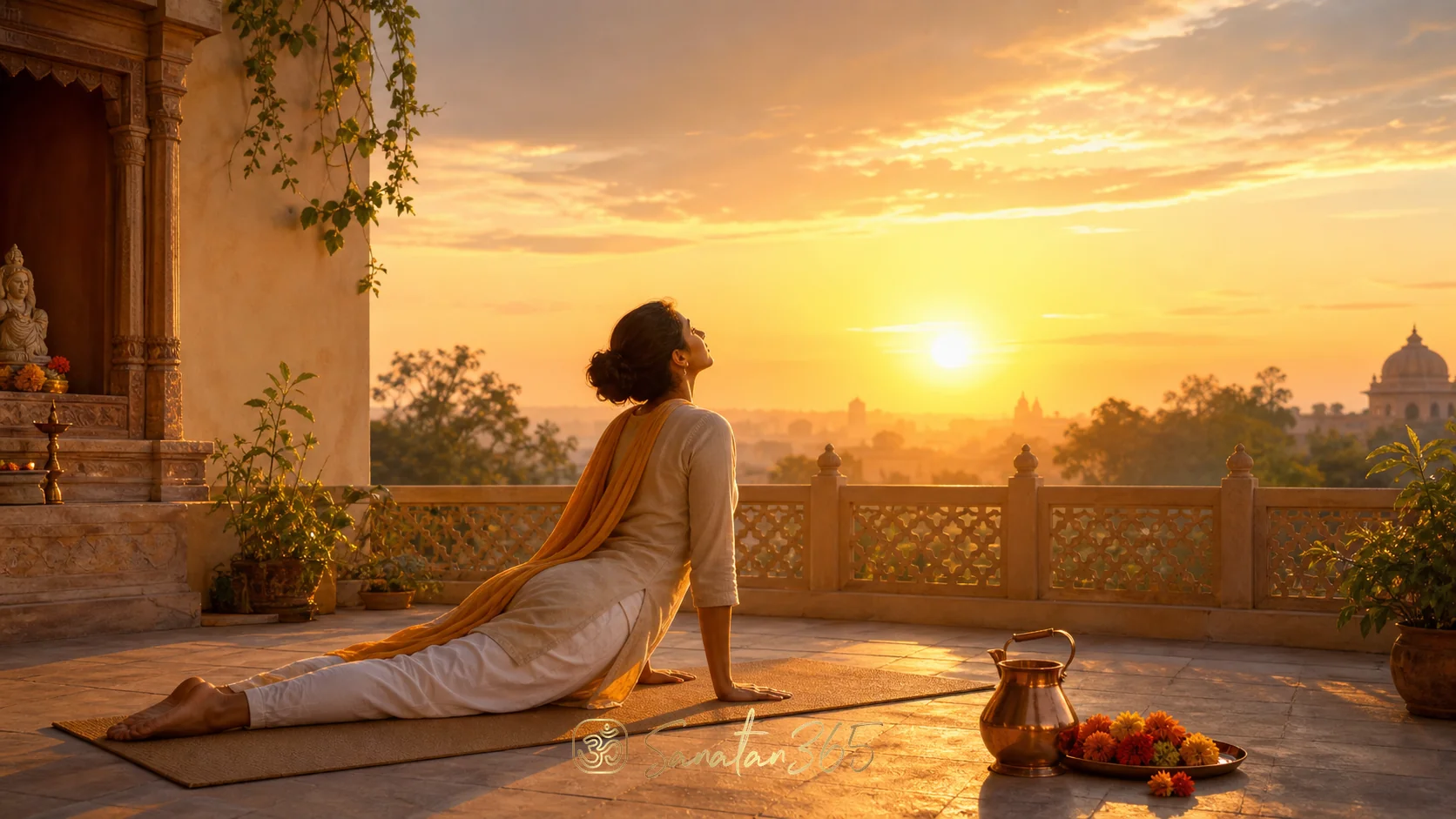
Surya Namaskar means salutation to the Sun, a flowing yoga practice that joins movement, breath, mantra, and gratitude to Surya.
Surya Namaskar begins with a simple human act: turning toward light before the day becomes crowded.
Surya Namaskar meaning is "salutation to the Sun." In Sanskrit, Surya (सूर्य, the Sun as divine light and life-giver) and namaskara (नमस्कार, reverent greeting or bowing) come together as a practice of movement, breath, mantra, and gratitude. It is often known in English as Sun Salutation, but in Hindu practice it is more than a warm-up. It trains the body while teaching the mind to begin the day with humility, rhythm, and awareness.
What Is Surya Namaskar Meaning in Hindu Practice?
Surya Namaskar is a flowing sequence of asanas (आसन, steady bodily postures) offered with breath and attention toward Surya. A widely used form has 12 postures and 24 movements in one full round, as noted in a peer-reviewed review of Surya Namaskar practice published by the National Library of Medicine (NLM). The exact sequence varies across yoga lineages, but the inner idea remains consistent: the practitioner bows, rises, stretches, grounds, and returns.
The English phrase "Sun Salutation" is useful, but it can flatten the devotional meaning. In a Hindu context, Surya is not only a physical star in the sky. Surya is also honored as visible divinity, a source of prana (प्राण, life-force), sight, time, warmth, and order. The Hindu American Foundation describes Surya Namaskar as a way of connecting body, mind, and spirit in gratitude to the sun and to the natural order that sustains life (HAF).
This does not mean every person who practices Surya Namaskar must perform it as a formal ritual. Some approach it as exercise, some as meditation, some as a devotional offering, and many as all three. Hindu practice often holds these layers together without forcing a narrow definition.
Key takeaway: Surya Namaskar means reverent salutation to the Sun, expressed through the whole body rather than only through words.
Why Does Surya Matter in Sanatan Dharma?
Surya worship is deeply woven into Hindu time, ritual, and daily life. Sunrise and sunset are natural thresholds, and many Hindu practices treat these moments as especially suitable for prayer, mantra, and self-discipline. In traditions such as Sandhya Vandana (सन्ध्या वन्दन, twilight prayer), the Sun's movement frames the seeker's movement from sleep to action, from activity to reflection, and from outer light toward inner clarity.
The Rig Veda contains hymns to solar divinities such as Surya and Savitr, and the Gayatri Mantra is addressed to Savitr, the divine solar radiance that illumines the intellect. Later practice traditions connect morning discipline with gratitude, purity, and attentiveness. This is why many families pair simple offerings of water, mantra, or folded hands with the first light of the day.
Surya Namaskar belongs to this broader sensibility. It does not replace puja (पूजा, worship), japa (जप, mantra repetition), or meditation. It can sit beside them. A person may begin with a short prayer, perform a few rounds of Surya Namaskar, and then continue into Nitya Puja or Sandhya Vandana depending on family tradition and capacity.
Modern readers should also be careful with historical claims. The exact modern sequence of Sun Salutation became widely systematized in the twentieth century, while reverence to Surya and morning bodily disciplines are much older. That distinction matters. It allows the practice to be honored without pretending that every modern movement pattern is unchanged from Vedic times.
Key takeaway: Surya Namaskar is best understood as a modern yoga sequence rooted in an older Hindu reverence for light, time, and disciplined morning practice.
How Do the 12 Steps of Surya Namaskar Work?
Most familiar versions of Surya Namaskar move through 12 positions, though names and transitions vary by school. The sequence commonly includes standing prayer, raised arms, forward fold, lunge, plank-like position, eight-point prostration or related transition, cobra or upward-facing expansion, downward-facing stretch, and a return to standing.
A simple beginner-friendly pattern looks like this:
- Pranamasana (प्रणामासन, prayer pose): stand with palms joined.
- Hasta Uttanasana (हस्त उत्तानासन, raised arms pose): lift and open the chest.
- Padahastasana (पादहस्तासन, hand-to-foot pose): fold forward with softness.
- Ashwa Sanchalanasana (अश्व संचलनासन, equestrian pose): step one leg back.
- Dandasana or Phalakasana (दण्डासन / फलकासन, staff or plank-like pose): lengthen the body.
- Ashtanga Namaskara (अष्टाङ्ग नमस्कार, eight-limbed salutation): lower with humility and control.
- Bhujangasana (भुजङ्गासन, cobra pose): lift the heart gently.
- Adho Mukha Svanasana (अधो मुख श्वानासन, downward-facing dog pose): stretch and ground.
- Ashwa Sanchalanasana: step forward with the opposite leg.
- Padahastasana: fold again.
- Hasta Uttanasana: rise with breath.
- Pranamasana: return to stillness.
The physical movement is only one layer. Traditionally, breath is coordinated with each posture. Inhale while opening, exhale while folding or grounding, and keep transitions steady rather than rushed. Some lineages also add 12 names of Surya, such as Om Mitraya Namah and Om Ravaye Namah, as mantras of reverence. A beginner may start without mantra and add it later with guidance.
The aim is not performance. A stiff body can practice sincerely. A person with limited mobility can modify the sequence with a chair, wall, or reduced range of motion. People with injuries, pregnancy, dizziness, blood pressure concerns, or medical conditions should learn from a qualified teacher or clinician before attempting dynamic rounds. Spiritual discipline should not become physical harm.
Key takeaway: The 12 steps train coordination, breath, humility, and steadiness; they are not a competition of flexibility.
How Can Beginners Practice Surya Namaskar Safely?
Beginners should start smaller than their enthusiasm. One to three slow rounds are enough for many people. The point is not to force a dramatic morning routine, but to create a rhythm the body can trust.
A balanced beginner approach:
- Practice on an empty or light stomach, preferably after washing and before heavy food.
- Begin with joint loosening, especially wrists, shoulders, hips, and ankles.
- Move slowly for the first few rounds.
- Keep the breath smooth, not held.
- Bend the knees in forward folds if the hamstrings are tight.
- Step back and forward rather than jumping.
- Rest in standing or child's pose when needed.
- Stop if there is sharp pain, breathlessness, chest discomfort, or dizziness.
In Hindu practice, discipline is not harshness. Tapas (तपस्, disciplined effort or inner heat) is meaningful when it clarifies, not when it injures. A person who does three careful rounds with gratitude may receive more from the practice than someone who forces twenty rounds while distracted.
Timing also matters. Brahma Muhurta (ब्रह्म मुहूर्त, the pre-dawn period traditionally valued for spiritual practice) is praised in many traditions, but not everyone can practice before sunrise. A working parent, student, or night-shift worker may choose a realistic morning window and still keep the spirit of the practice alive. For more on pre-dawn discipline, see Brahma Muhurta.
Key takeaway: Begin with a few mindful rounds, modify generously, and let consistency matter more than intensity.
What Is the Link Between Surya Namaskar and International Yoga Day 2026?
International Yoga Day is observed on June 21 every year after the United Nations proclaimed it in 2014. The UN describes yoga as a practice connected with health, harmony, and well-being, and lists the 2026 theme as "Yoga for Healthy Ageing" (United Nations). In 2026, June 21 falls on a Sunday, making Yoga Week a natural time for families, schools, temples, community centers, and diaspora groups to revisit simple practices such as Surya Namaskar.
For Hindu readers, this global observance is not only about public events. It is also an opportunity to remember that yoga is not merely stretching. Yoga, from the Sanskrit root yuj (युज्, to join or yoke), points toward integration. Body, breath, attention, ethics, devotion, and self-knowledge are not separate compartments. Surya Namaskar can become a doorway into that larger vision when practiced with awareness.
This matters especially for children and beginners. A family Yoga Day practice does not need to be complex. It can be as simple as lighting a lamp, offering gratitude to Surya, doing three slow rounds together, and speaking about one value for the day: patience, truthfulness, compassion, or steadiness. The posture sequence then becomes part of character education, not only physical exercise.
Diaspora families may also find Surya Namaskar useful because it travels well. It needs little space, no elaborate equipment, and can be adapted across ages. A small apartment, a community hall, a school lawn, or a temple courtyard can all hold the practice when the intention is clear.
Key takeaway: International Yoga Day 2026 is a timely moment to recover Surya Namaskar as a simple, embodied practice of gratitude, steadiness, and Hindu cultural memory.
How Does Surya Namaskar Become a Daily Spiritual Habit?
A daily habit becomes spiritual when it changes the quality of attention. Surya Namaskar can begin as movement, but over time it asks a deeper question: how does one greet the day?
One practical home rhythm:
- Stand quietly and take three natural breaths.
- Offer a simple intention, such as "May this day be guided by clarity and kindness."
- Perform one to six slow rounds of Surya Namaskar.
- Sit for one minute with the breath.
- Close with gratitude to Surya and to the life supported by sunlight.
This structure is intentionally modest. It leaves room for students, workers, elders, and parents. It can also be expanded. A devotee of Surya may add the Aditya Hridayam, Gayatri Mantra, or 12 Surya mantras with guidance. A yoga practitioner may use it before asana or meditation. A family may make Sunday sunrise practice a weekly ritual.
The deeper fruit is not visible in a photograph. It appears in steadier mornings, less scattered energy, and a more respectful relationship with the body. Hindu practice often teaches through repetition. By bowing, rising, stretching, and returning, the seeker quietly rehearses a complete philosophy: receive light, offer effort, bow the ego, and begin again.
Key takeaway: Surya Namaskar becomes spiritual when movement, breath, gratitude, and daily conduct begin to support one another.
Conclusion
Surya Namaskar is a bridge between physical yoga and devotional awareness. Its Sanskrit name means salutation to the Sun, but its lived meaning is wider: gratitude for light, discipline for the body, steadiness for the mind, and reverence for the order that sustains life.
Single key takeaway: practice Surya Namaskar as a humble morning greeting to Surya, not as a display of fitness, and it can turn an ordinary day into a more conscious one.
FAQ
What is the simple Surya Namaskar meaning?
Surya Namaskar means "salutation to the Sun." Surya means the Sun and namaskara means reverent greeting or bowing. In practice, it is a sequence of yoga postures done with breath and attention.
Is Surya Namaskar a Hindu practice or just exercise?
It can be practiced as exercise, but its name, symbolism, and devotional roots are closely connected with Hindu reverence for Surya. Many people practice it as movement, meditation, and gratitude together.
How many steps are in Surya Namaskar?
Many common forms use 12 postures and 24 movements in one full round, though the sequence varies across yoga schools. Beginners should learn a simple version slowly before adding speed or mantra.
Can beginners do Surya Namaskar every day?
Many beginners can practice a few gentle rounds daily, but the sequence should be modified for age, strength, mobility, and health. Anyone with medical concerns should learn from a qualified teacher or clinician.
Why is Surya Namaskar useful during International Yoga Day 2026?
International Yoga Day 2026 falls on June 21 with the theme "Yoga for Healthy Ageing." Surya Namaskar is a simple, adaptable practice that helps people connect Yoga Day with gratitude, breath, movement, and Hindu cultural memory.
About the author
Sanatan365 Editorial
Bringing Sanatan Dharma to modern seekers through authentic, scripture-grounded content.
Related in Practices
 Practices
Parayana Meaning: Giving Sacred Reading a Steady Place
Understand parayana as sustained devotional reading or recitation, with distinctions from study and mantra repetition and a respectful way…
 Practices
Smarana Meaning: Remembering the Divine Between Daily Tasks
Smarana is devotional remembrance. Explore its scriptural context, its relationship with chanting, and gentle ways to remember the Divine d…
 Practices
Upasana Meaning: Why Worship Is a Practice of Drawing Near
Upasana means drawing near to the Divine through sustained attention. Explore how sacred symbols, daily worship and inward recollection bel…