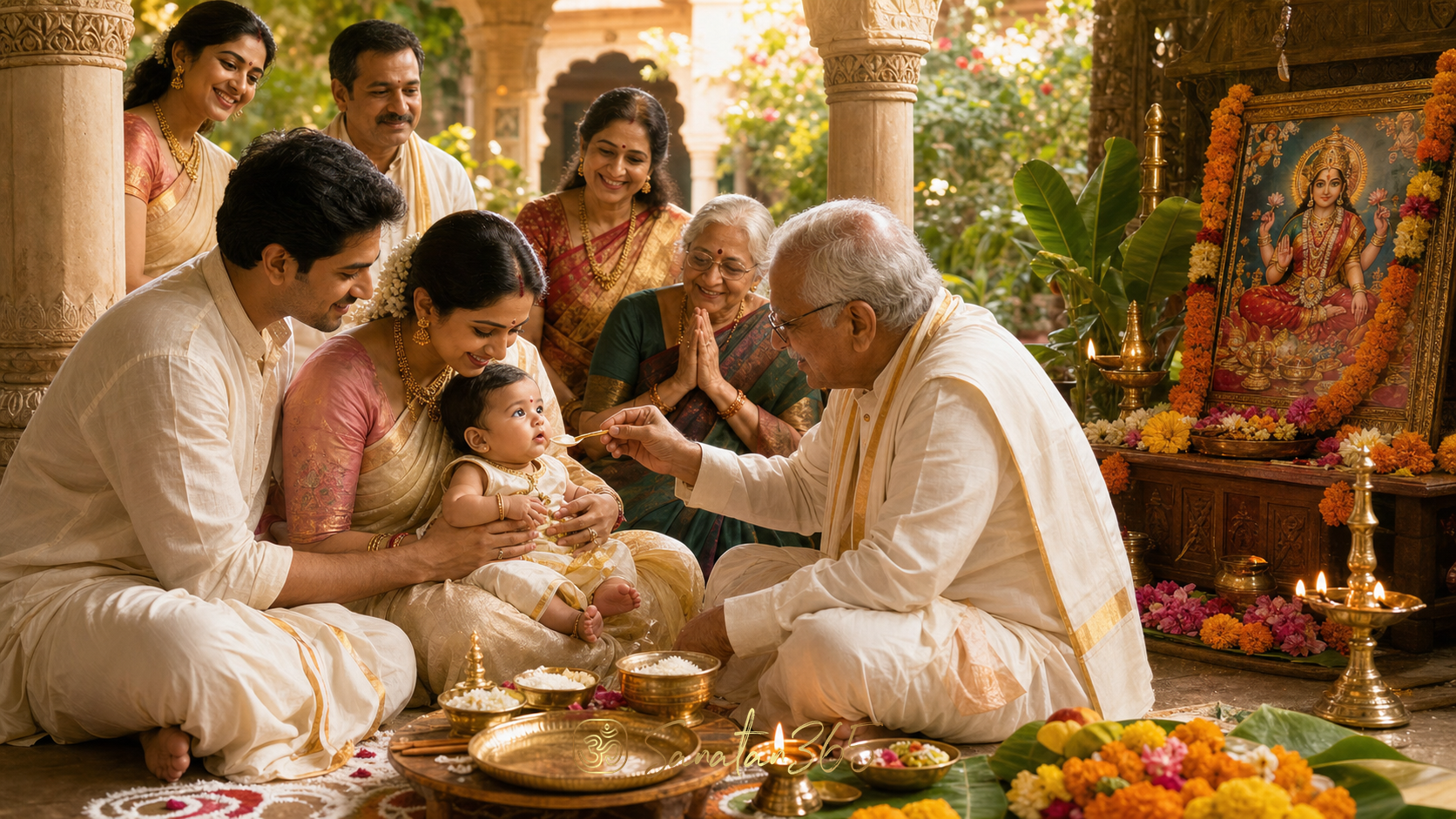
Annaprashana Meaning: A Baby's First Food Ceremony
Annaprashana is the Hindu samskara that welcomes a baby to solid food with prayer, family blessing, gratitude, and careful attention to the child's readiness.
A baby's first taste of grain can become a family's first shared prayer over the child's lifelong relationship with food. Annaprashana meaning comes from anna (अन्न, food or grain) and prashana (प्राशन, feeding or tasting): it is the Hindu samskara (संस्कार, a rite that marks and refines a life transition) in which an infant is ceremonially introduced to solid food.
The ceremony does not replace ordinary feeding guidance or decide when a baby is developmentally ready. Its spiritual purpose is to receive nourishment with gratitude, ask for the child's health and character, and remind the family that food is never merely private consumption. Food links soil, rain, labour, hospitality, the Divine, and the responsibility to share.
Key takeaway: Annaprashana welcomes a baby to food through blessing and gratitude while the child's readiness and safety remain the first practical priority.
What Is the Annaprashana Meaning in Hindu Tradition?
Annaprashana is commonly counted among the traditional Hindu life-cycle rites. Classical domestic-ritual texts known as the Grihya Sutras describe ceremonies associated with birth, naming, first feeding, education, marriage, and other transitions. Practices differ across texts, communities, regions, and family lineages, so there is no single universal script that every Hindu household must reproduce.
At its heart, the ceremony recognizes a change in dependence. Until this stage, the infant has received nourishment through milk. The first ceremonial food signals entry into a wider household ecology: grain grown by farmers, cooked with care, offered in prayer, and shared among relatives. The child is not simply given calories. The family publicly accepts a duty to nourish body, mind, and values.
The rite also carries a theology of food. The Taittiriya Upanishad teaches, “Do not despise food” and “Produce food in abundance,” joining reverence with responsibility. The Taittiriya Upanishad translation at Wisdom Library preserves this larger teaching in which food sustains beings and should be honoured. The Bhagavad Gita 3.14 similarly connects living beings, food, rain, and action in a cycle of mutual dependence.
Some families invoke Annapurna Devi, the Divine Mother associated with nourishment. Others pray to Ganesha, a family ishta-devata (इष्टदेवता, personally cherished form of the Divine), or the deities honoured in their household tradition. The sacred focus may vary; the underlying bhava (भाव, devotional feeling) is thankfulness rather than display.
This makes Annaprashana distinct from a birthday party or food-themed photo session, although celebration and photographs may accompany it. The rite asks adults to pause before feeding and remember: this child will learn the meaning of abundance from how the family cooks, eats, wastes, offers, and shares.
Key takeaway: The deeper Annaprashana meaning is the family's vow to nourish a child with food, gratitude, discipline, and generosity.
When Is Annaprashana Usually Performed?
Many traditions observe Annaprashana around the sixth month, though customary timing can differ for boys and girls, by region, and by family practice. Some families consult a priest or panchanga (पञ्चाङ्ग, Hindu almanac) for a suitable muhurta (मुहूर्त, a fitting time for an undertaking). Others choose a practical day when the child is well, close relatives can gather, and the baby's healthcare professional agrees that complementary feeding can begin.
Religious timing should never overrule developmental readiness. The World Health Organization's infant and young child feeding guidance recommends introducing nutritionally adequate and safe complementary foods at about six months while breastfeeding continues where possible. The American Academy of Pediatrics advises looking for readiness signs such as good head control, the ability to sit with support, interest in food, and reduced tongue-thrust behaviour.
Premature infants, babies with swallowing concerns, poor head control, allergies, medical conditions, or feeding difficulties may need individualized professional advice. Postponing the ceremonial taste is not a spiritual failure. Protecting the child is itself dharma (धर्म, responsible order and right conduct).
A family can separate symbolic and nutritional beginnings when needed. For example, a priest may conduct prayers on an auspicious family date while the actual taste is omitted or delayed under medical guidance. Alternatively, a tiny taste of an already tolerated, age-appropriate food can be used rather than introducing an unfamiliar recipe in a crowded setting.
The infant's rhythm also matters. A rested, calm baby is more important than a perfect clock time. If the child is ill, distressed, sleepy, or unwilling, the ceremony can pause. Annaprashana should welcome the child, not force a performance.
Key takeaway: Family custom may guide the date, but health, developmental readiness, and the baby's comfort decide whether feeding should occur.
What Happens During an Annaprashana Ceremony?
Annaprashana can be elaborate in a temple or very simple at home. A family priest may lead Vedic or regional prayers, but households without a priest can still create a reverent ceremony through cleanliness, a clear altar, prayer, blessing, and a safe first taste.
A common sequence includes:
- Prepare the prayer space. Clean the home or chosen venue. Place a respectful image or murti of the family's chosen deity, or Annapurna Devi, as the worship focal point. Add a diya, flowers, and a small bowl of the ceremonial food.
- Begin with prayer. The family may invoke Ganesha, offer gratitude to the Divine, remember ancestors, and state a sankalpa (संकल्प, clear sacred intention) for the child's well-being and wise relationship with food.
- Bless the food. A small portion of soft, suitable food is placed before the deity as naivedya (नैवेद्य, a food offering). Families should distinguish the sacred act from the practical safety of what the infant can eat.
- Seat the baby securely. The child sits upright with stable head and neck support, usually on a parent's lap or in an appropriate feeding seat. The parent remains responsible for the feeding even when an elder performs the symbolic gesture.
- Offer a tiny taste. A clean spoon carries a very small amount of smooth, soft food. One taste is enough for the ritual; no one should insist that the baby finish a bowl.
- Receive family blessings. Grandparents and relatives may offer flowers, gifts, prayers, or affectionate words. Multiple people should not repeatedly feed the baby merely for photographs.
- Share a meal and give. The family eats together and may practise dana (दान, generous giving) by feeding guests, supporting a food charity, or helping a family in need.
Ceremonial foods vary. Soft rice, rice pudding, payasam, kheer, or other family foods may appear. For an infant, recipes containing added sugar, excessive salt, whole nuts, hard pieces, unpasteurized ingredients, or honey require caution. The AAP advises avoiding honey before twelve months because of infant botulism risk. Cow's milk should not replace breast milk or infant formula as the main drink before twelve months, even when dairy is used appropriately in small amounts in foods under professional guidance.
Food used as an offering must still meet feeding safety. Sacred intention does not neutralize choking hazards or allergies. The best ceremonial recipe is one suited to the child, offered in a tiny amount, and approved by the parent.
Key takeaway: A meaningful Annaprashana needs prayer, a secure feeding posture, one safe symbolic taste, blessings, and gratitude—not complexity.
How Do Annaprashana Traditions Vary Across India?
The rite's names and expressions reveal Hindu tradition's regional richness. In Bengal, the ceremony is widely called mukhe bhaat (মুখে ভাত, rice in the mouth). Kerala families may call it choroonu (ചോറൂണ്, first rice feeding), with Guruvayur Temple especially associated with the practice for some devotees. In parts of Tamil Nadu it may be known as annaprasanam or connected with the child's first rice. Telugu and Kannada households have their own family names, songs, foods, and priestly customs.
Regional diversity can affect who gives the first taste, where the baby sits, which deity is invoked, what the child wears, and whether the event happens at home, in a temple, or in the maternal family household. Some families include a playful choice ritual in which objects representing learning, wealth, craft, or service are placed before the baby. That custom may be meaningful family folklore, but it should not be treated as a guaranteed prediction of profession or destiny.
Diaspora families often adapt the ceremony to apartment living, mixed-language relatives, temple schedules, and local food guidance. A grandparent may join by video call. A priest may explain mantras in English. A family may use a familiar puree rather than a traditional sweet dish. Such adaptations can preserve the rite's essential values when made with respect.
No regional form should be presented as more authentic than another. Hindu samskaras have always lived through sampradaya (सम्प्रदाय, transmitted tradition), family memory, local language, and practical circumstance. Families can honour elders by asking what was done in their childhood, while still applying current safety knowledge.
The Namakarana ceremony similarly shows how a shared samskara can take different regional forms without losing its central purpose. Ritual continuity is strongest when families understand the meaning behind an action, not only its outer sequence.
Key takeaway: Annaprashana is one shared rite with many regional languages, foods, and family forms; diversity is part of the tradition.
How Can Families Plan a Safe and Meaningful First Food Ceremony?
Good planning protects both devotion and the baby. Begin with the parents and child's healthcare professional, then coordinate the priest, elders, photographer, and guests around that decision. The child is not a prop, and ceremonial authority never transfers feeding responsibility away from the caregiver.
Use this practical checklist:
- Confirm readiness and any allergy or swallowing concerns with the baby's healthcare professional.
- Choose one smooth, age-appropriate food, ideally already discussed or previously tolerated.
- Keep the baby upright, awake, calm, and continuously supervised.
- Use clean hands, bowl, and spoon; prevent guests from sharing used utensils.
- Offer only a tiny amount and stop if the baby turns away, coughs, gags persistently, becomes distressed, or shows any concerning reaction.
- Keep whole nuts, hard sweets, grapes, raw chunks, coins, jewellery, flowers, and small ritual objects out of reach.
- Avoid honey before twelve months and avoid added salt or sugar for the ceremonial taste.
- Ask one designated adult to control the feeding while others offer verbal blessings.
- Keep emergency contacts available and know the difference between gagging and choking; caregivers may consider an infant first-aid course.
- Schedule photographs around the baby rather than prolonging the feeding for the camera.
Allergy reactions can include hives, swelling, repeated vomiting, breathing difficulty, sudden lethargy, or other alarming symptoms. Families should seek emergency medical help for severe reactions. A ritual article cannot replace advice from a paediatrician or feeding specialist.
Emotional safety matters too. Parents should be free to decline a customary ingredient, postpone the event, limit guest feeding, or hold a shorter prayer. Elders deserve explanation and respect, but the baby's welfare is not negotiable. A gentle phrase can help: “We are preserving the blessing while following the child's medical guidance.”
Waste can also be reduced. Prepare a small ritual portion and serve guests thoughtfully. Compost where appropriate, donate usable surplus through safe channels, and avoid creating a large display solely for photographs. Reverence for food includes not wasting it.
Key takeaway: The safest Annaprashana is parent-led, medically informed, hygienic, unhurried, and small enough to keep attention on the child.
What Does Annaprashana Teach About Food, Family, and Gratitude?
The first taste lasts seconds; the family lesson can last a lifetime. Annaprashana frames eating as relationship. A grain of rice depends on seed, soil, water, sunlight, human labour, transport, cooking, and care. Prayer makes that dependence visible.
The rite can inspire five household commitments:
- Receive food with gratitude. A short prayer or moment of silence before meals interrupts entitlement.
- Feed without shame. Children need guidance, not fear, comparison, or moral judgment about appetite and body size.
- Waste less. Serve manageable portions and honour leftovers safely.
- Share abundance. Let celebrations include hospitality and support for those facing hunger.
- Teach discernment. Nourishment involves tradition, science, moderation, pleasure, and attention to individual needs.
These commitments prevent the ceremony from becoming a one-day spectacle. They also connect Annaprashana with the meaning of Naivedya and prasad: offering transforms the eater's attitude from possession toward gratitude. The lesson is not that every meal must be ritualized elaborately, but that no meal is isolated from the world that made it possible.
For the child, love will eventually be communicated through thousands of ordinary acts: washing fruit, packing lunch, respecting hunger cues, eating together, learning family recipes, and feeding a guest. Annaprashana blesses that long work before it begins.
Key takeaway: Annaprashana is fulfilled over years when a family treats food with gratitude, safety, moderation, hospitality, and care.
Conclusion
Annaprashana marks a quiet threshold: the infant begins to receive nourishment from the family's wider table. Its prayers honour food, its blessings surround the child with community, and its practical discipline reminds adults that sacred care must also be safe care.
Families may follow Bengali, Tamil, Telugu, Kannada, Malayalam, North Indian, temple, or household customs. They may choose a priest-led ceremony or a simple prayer at home. What matters is the unity of shraddha (श्रद्धा, sincere faith), informed caregiving, and gratitude.
Key takeaway: Annaprashana gives one tiny taste a lifelong meaning—the promise to nourish a child wisely and share food reverently.
FAQ
What is Annaprashana meaning in simple words?
Annaprashana is the Hindu first-food ceremony. The name means feeding or tasting food, especially grain. It welcomes a baby to complementary food through prayer, family blessing, and gratitude.
At what age is Annaprashana performed?
Many families observe it around six months, but customs vary. The actual feeding should happen only when the baby shows developmental readiness and the child's healthcare professional considers complementary food appropriate.
What food is given during Annaprashana?
Soft rice, kheer, payasam, or another family food may be traditional. The ceremonial taste should be smooth, age-appropriate, and free from choking hazards. Honey should not be given before twelve months, and parents should control all ingredients.
Can Annaprashana be performed at home?
Yes. A family can clean a prayer space, worship its chosen deity, bless a safe food, offer one tiny taste with the baby seated securely, invite elder blessings, and share a meal or charitable gift.
Is a muhurta more important than the baby's readiness?
No. A muhurta may guide the family's ceremonial timing, but it should never override health, developmental readiness, illness, allergies, or the baby's comfort. Protecting the child is part of dharma.
About the author
Sanatan365 Editorial
Bringing Sanatan Dharma to modern seekers through authentic, scripture-grounded content.
Related in Rituals
 Rituals
Vastra Offering Meaning: Why Clothing Is Offered in Puja
The offering of cloth turns ordinary care into sacred hospitality. Understand vastra in Hindu worship without confusing expense with devoti…
 Rituals
Madhuparka Meaning: Sweetness and Sacred Hospitality
Read madhuparka as a ceremonial honey mixture of welcome, exploring textual recipes, guest reception and its distinction from panchamrita.
 Rituals
Samavartana Meaning: Returning Home After Sacred Study
Samavartana marks the completion of traditional study through a ceremonial bath and return. Its lasting question is how learning becomes re…