Namakarana Samskara: Meaning of the Hindu Naming Ceremony
Namakarana Samskara gives a child a name while welcoming them into family, community, memory, and dharma. Here is its meaning, sequence, and regional variety.
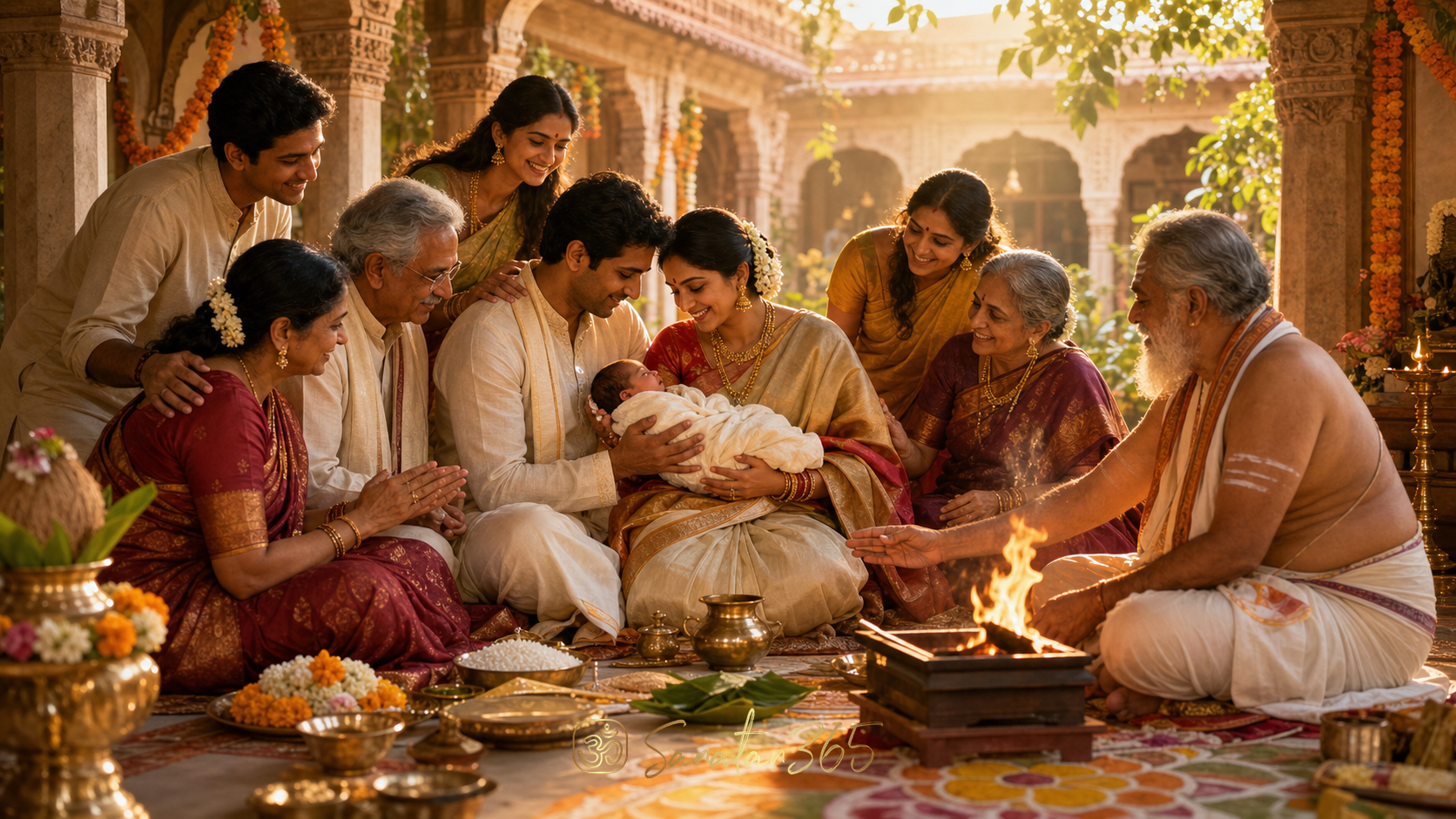
A name is often the first gift a family gives a child that the child will carry into every room of life. Namakarana Samskara is the Hindu naming ceremony in which that gift becomes a sacred welcome: the newborn is named before family, community, and the Divine.
The Sanskrit expression nāmakaraṇa saṃskāra (नामकरण संस्कार, “the rite of making or giving a name”) refers to a traditional Hindu rite of passage performed after birth. Its purpose is larger than choosing an attractive name. Namakarana gives the child a recognized social identity, connects the child with family memory and sacred values, and invites elders to bless the life that is beginning. Customs differ widely, but the heart of the ceremony is consistent: a person is welcomed not as an possession, but as a new bearer of dignity, relationship, and possibility.
What Is the Meaning of Namakarana Samskara?
The word nāma (नाम) means “name,” while karaṇa (करण) means “making” or “doing.” Saṃskāra (संस्कार) is a refining rite, formative impression, or life-cycle observance. A samskara marks a transition and asks that an ordinary biological or social event be met with attention, responsibility, and prayer.
Birth has already happened when Namakarana is performed. The ceremony does not create the child’s worth; that worth is inherent. It creates a shared moment of recognition. The family says, in effect: this life has arrived among us, this is how we shall call this person, and we accept the duty to nurture them.
Classical discussions of Hindu life-cycle rites appear across the Gṛhya Sūtras (गृह्यसूत्र, “domestic ritual manuals”), whose instructions vary by Vedic school and region. That variety matters. There has never been only one uniform script followed by every Hindu household. Some traditions emphasize a fire offering; others centre prayer, the family deity, the child’s horoscope, the whispering of the name, or the blessings of elders. Standard reference summaries of Namakarana describe it as the formal naming and social welcome of the newborn.
The ceremony holds several meanings at once:
- Identity: the child receives a name by which society can recognize and address them.
- Belonging: the child is welcomed into a family, lineage, locality, language, and community.
- Memory: a name may recall a deity, saint, ancestor, virtue, river, sacred place, or family story.
- Responsibility: parents and elders publicly accept the work of care, education, and moral example.
- Blessing: the community offers prayers for a life of health, wisdom, courage, compassion, and dharma.
Key takeaway: Namakarana is not merely a naming event; it is a family’s public promise to receive a new person with reverence and responsibility.
When Is the Hindu Naming Ceremony Performed?
There is no single date that governs every Hindu family. Traditional sources and living customs commonly place the ceremony after the first days following birth, often around the tenth, eleventh, or twelfth day. Other households perform it on a later auspicious day, after a period of maternal and infant rest, or at a time recommended by a family priest. Some communities combine naming with another early-childhood observance.
This flexibility should not be mistaken for carelessness. It reflects the fact that Hindu ritual life is shaped by deśa-kāla-pātra (देश-काल-पात्र, “place, time, and the people concerned”). The well-being of the mother and baby, medical guidance, travel, household circumstances, and regional custom all matter. A family living far from grandparents may wait until relatives can gather. A diaspora family may hold a simple home prayer first and a wider celebration later.
Some families consult a pañcāṅga (पञ्चाङ्ग, Hindu almanac) or the child’s birth nakṣatra (नक्षत्र, lunar mansion) when selecting the date or the opening sound of the name. This is customary in many communities, but not universal. It should be approached as a tradition of sacred timing, not a guaranteed prediction of personality or destiny. Readers who want the broader context can explore how the five limbs of the Panchang describe Hindu time and what Nakshatras mean in Hindu astrology.
The most responsible modern principle is simple: choose a time that respects family tradition without compromising maternal recovery, infant safety, or medical advice. A ceremony meant to welcome life should never become a source of avoidable strain.
Key takeaway: Namakarana timing varies; family custom and sacred calendars can guide the date, while the mother’s and child’s well-being comes first.
How Is a Namkaran Ceremony Traditionally Performed?
The exact sequence changes across regions and sampradayas, but many ceremonies follow a recognizable progression. The details below describe a broad pattern rather than a compulsory universal rule.
1. Preparing a clean and welcoming space
The household prepares the puja area, often with flowers, lamps, rice, water, and images or symbols sacred to the family. Cleanliness here is both practical and symbolic: the family makes room for a new beginning. The ceremony may be held at home, in a temple, or in a community venue.
2. Invoking auspiciousness
The family may begin with prayers to Ganesha, the family deity, or the chosen form of the Divine. A priest may guide a saṅkalpa (संकल्प, “solemn intention”), identifying the family, time, place, and purpose of the observance. The deeper logic of this step is explained in why Hindu puja begins with Sankalpa.
Depending on custom, the rite may include mantra recitation, a small homa (होम, sacred fire offering), or a simple lamp and prayer. A fire ritual is not mandatory in every household tradition.
3. Presenting and announcing the child
The parents bring the baby into the gathered circle. In many traditions, the chosen name is whispered into the child’s ear, often several times, before being announced to the family. Some families write the name or its first syllable in a tray of rice. Others place the child on the lap of a parent, grandparent, or maternal uncle according to local custom.
The whisper carries a beautiful symbolism. Before a name becomes public, it is offered intimately. Sound reaches the child before social explanation does. The act reminds everyone that speech should be used to protect dignity, not merely to label.
4. Blessings from elders and community
Elders bless the newborn and parents. Gifts, flowers, sacred rice, or affectionate words may accompany the blessings. The gathering then shares food. This communal meal is not incidental: hospitality turns the family’s joy into shared gratitude.
Families should adapt every physical action to infant safety. Smoke, loud sound, strong fragrance, crowded handling, and long ceremonies may be unsuitable for a newborn. Ventilation, hygiene, a quiet room, feeding breaks, and the parents’ comfort are more important than performance. Ritual precision without care would contradict the ceremony’s purpose.
Key takeaway: The traditional sequence moves from intention to name-giving to collective blessing, but it should always be adapted with tenderness and safety.
How Is a Hindu Baby’s Name Chosen?
A Hindu name can carry several layers of meaning. Families may choose a name because of its sound, Sanskrit or regional-language meaning, relationship to a deity, remembrance of an ancestor, or connection to a virtue they hope to honour. A name may also draw from sacred rivers, flowers, music, philosophy, or literature.
Common approaches include:
- Devotional names: names associated with Krishna, Shiva, Devi, Rama, Ganesha, Vishnu, Murugan, or another revered form.
- Virtue names: words suggesting compassion, truth, courage, light, wisdom, joy, or peace.
- Ancestral names: names that preserve family memory, sometimes adapted for the new generation.
- Nakshatra-based sounds: initial syllables suggested by the child’s lunar mansion in Jyotisha custom.
- Regional and linguistic heritage: names chosen from Tamil, Telugu, Kannada, Bengali, Marathi, Gujarati, Nepali, Hindi, Sanskrit, or another family language.
- Everyday usability: a name whose pronunciation and spelling can travel across the child’s likely social worlds.
Astrological guidance is one input, not the child’s prison. A name should never be used to burden a baby with a prediction or to rank one birth as more fortunate than another. Nor should adults treat the child as an extension of their own status. The name belongs to a person who will gradually develop preferences, convictions, and a life beyond the ceremony.
Families may also keep more than one form of the name: a formal name, a household name, and sometimes a ritual or astrological name. Bengal’s distinction between bhalo nām and ḍāk nām, for example, reflects the wider Indian familiarity with public and affectionate home names. Practices differ, and no one arrangement is inherently more spiritual.
Before finalizing a Sanskrit-derived name, families should verify its grammar, pronunciation, gender usage where relevant, and meaning with a reliable scholar or speaker. Internet lists frequently repeat attractive but inaccurate etymologies. Careful verification is itself a form of respect.
Key takeaway: A good name can carry devotion, virtue, ancestry, and language, but it should be chosen for the child’s dignity rather than adult display or fatalistic expectation.
How Does Namakarana Vary Across India and the Diaspora?
Namakarana is known by several everyday names, including Namkaran, Naamkaran, Namakaranam, and naming ceremony. The Sanskrit concept remains recognizable, while ritual form follows local culture.
In parts of North and West India, families may combine Vedic prayers, horoscope consultation, whispering the name, and a feast. Maharashtrian families may call the ceremony bārse, while Gujarati households have their own family and community conventions. Bengali families often distinguish the formal name from the affectionate call-name. In Tamil, Telugu, and Kannada contexts, naming may include specific roles for maternal relatives, temple blessings, or the writing and recitation of the name. Nepali Hindu families likewise preserve distinctive domestic and calendrical customs.
Diaspora practice often becomes deliberately bilingual. A family might explain each step in English while reciting Sanskrit mantras, include relatives by video, or choose a name that keeps its sacred meaning while remaining pronounceable in the child’s country of residence. This is not necessarily a dilution. Translation can help younger relatives understand why the rite matters.
What should remain stable is not every accessory but the ethical centre:
- welcome the child without exclusion;
- honour both sides of the family with fairness;
- avoid turning astrology into fear;
- respect the mother’s recovery and agency;
- keep the baby safe and the ritual proportionate;
- explain the name truthfully;
- let blessings express hope rather than control.
The wider meaning resembles the insight behind Namaste as a gesture of recognition and respect: another person is not an object in one’s world but a presence worthy of reverence. Namakarana applies that recognition at the threshold of social life.
Key takeaway: Regional variety is a strength of the tradition when the ceremony preserves welcome, truth, safety, and shared responsibility.
How Can a Modern Family Plan a Meaningful Namakarana?
A meaningful ceremony does not require extravagance. It requires clarity about what the family wants to honour. The following plan can help:
- Agree on the purpose. Decide whether the gathering will be a brief home puja, a temple rite, a larger family celebration, or a simple blessing followed by a later reception.
- Put recovery and safety first. Ask what timing, duration, crowd size, smoke level, and travel are genuinely suitable for the mother and newborn.
- Verify the name. Confirm meaning, spelling, pronunciation, and any scriptural or linguistic claim.
- Consult tradition without fear. A trusted priest or knowledgeable elder can explain the family’s custom. Ask for meaning, not only instructions.
- Give relatives clear roles. One person can welcome guests, another can manage food, and another can protect a quiet space for feeding and rest.
- Explain the rite. A short printed or spoken explanation helps children, guests from other backgrounds, and diaspora relatives participate respectfully.
- Keep a record for the child. Save the meaning of the name, who chose it, the blessings offered, and the story of the day. This may become more valuable than elaborate decoration.
- Practise the promise afterward. The deepest Namakarana continues in how adults speak the child’s name: with patience, truthfulness, affection, and respect.
The final point is the most demanding. A sacred name does not guarantee a sacred life. What shapes a child is the atmosphere built around that name: the examples adults set, the stories they tell, the apologies they make, and the freedom they allow the child to mature.
A name is given in one ceremony, but its dignity is protected through years of relationship.
Key takeaway: The best modern Namakarana is understandable, safe, culturally honest, and followed by daily conduct worthy of the blessing.
Conclusion
Namakarana Samskara transforms naming from a private preference into a shared act of welcome. Through prayer, sound, memory, and blessing, a family recognizes a newborn as a person entering a web of relationships. Its forms may differ across scriptures, regions, and households, but its enduring wisdom is clear: identity should be given with care, belonging should come with responsibility, and every child should be received with dignity.
Key takeaway: Namakarana is the sacred beginning of calling a child by name and the lifelong beginning of learning to honour the person who answers.
FAQ
What is Namakarana Samskara?
Namakarana Samskara is the traditional Hindu naming ceremony performed after a child’s birth. The Sanskrit phrase means the “rite of giving a name.” It formally welcomes the child into family and community while inviting blessings for their life.
On which day is the Hindu naming ceremony held?
Many traditions hold it around the tenth, eleventh, or twelfth day after birth, but customs vary considerably. Some families choose a later auspicious date or wait for the mother and baby to be ready. Family tradition, medical guidance, and practical well-being should all inform the decision.
Is astrology required for a Namkaran ceremony?
No single practice is universal. Many families consult the child’s nakshatra or a Panchang to choose a syllable or date, while others select a meaningful name without astrological guidance. Astrology should be treated as a family tradition, not a guarantee of fate.
What happens during Namakarana?
The ceremony often includes an auspicious prayer, a family intention, whispering or announcing the chosen name, blessings from elders, and a shared meal. Some traditions include a homa, horoscope reference, or writing the name in rice. The sequence varies by region and lineage.
Can Namakarana be simple or performed in the diaspora?
Yes. A short home prayer, temple blessing, bilingual ceremony, or gathering with relatives joining online can all preserve the rite’s meaning. The essentials are a truthful name, a loving welcome, responsible blessings, and respect for the mother’s and child’s well-being.
About the author
Sanatan365 Editorial
Bringing Sanatan Dharma to modern seekers through authentic, scripture-grounded content.
Related in Rituals
 Rituals
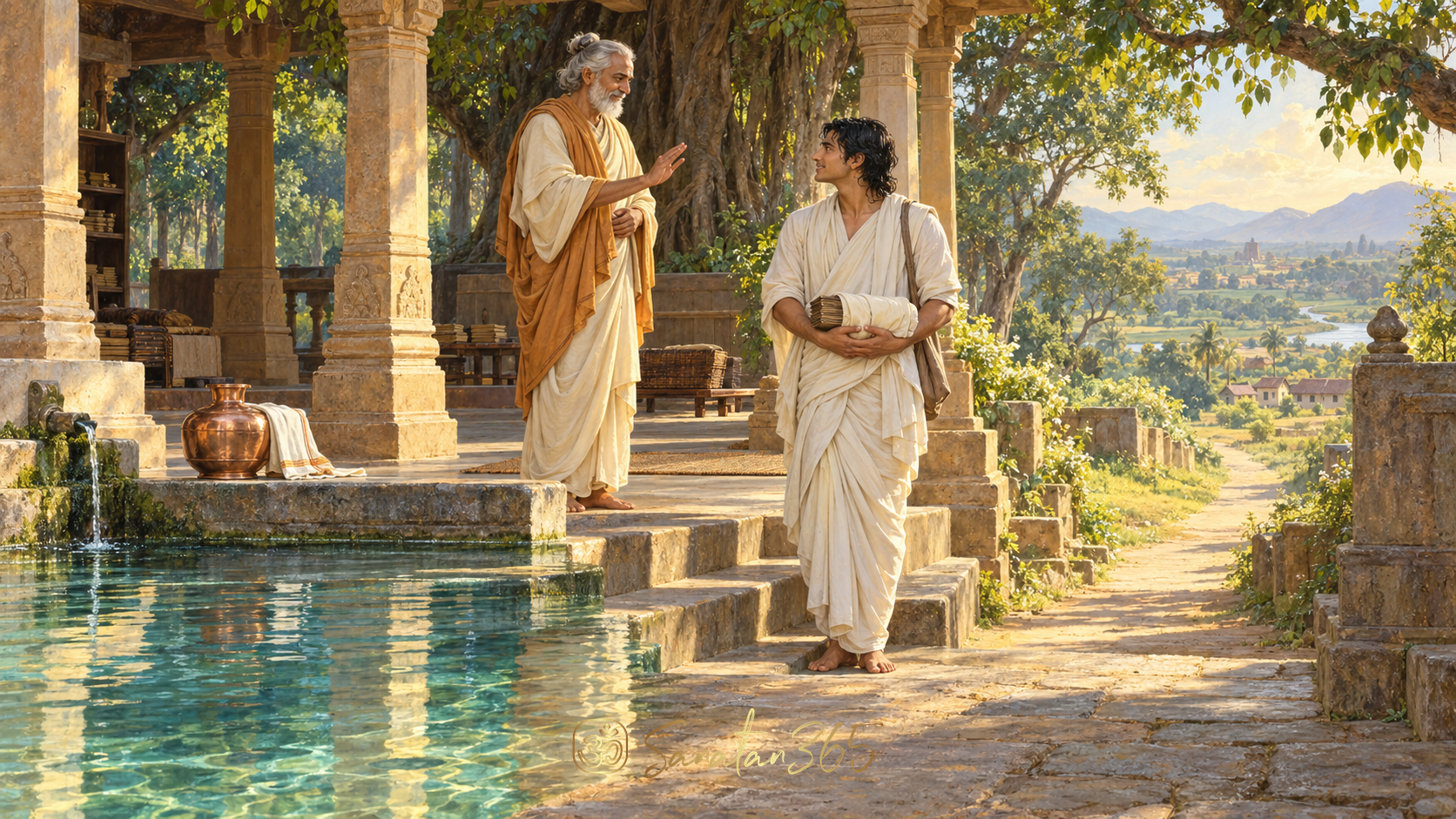
Samavartana Meaning: Returning Home After Sacred Study
Samavartana marks the completion of traditional study through a ceremonial bath and return. Its lasting question is how learning becomes re…
 Rituals
Vidyarambham Meaning: First Letters, Learning, and Reverence
Explore Kerala’s ceremony of beginning letters, its Vijayadashami setting, rice-writing customs, and the meaning of a gentle first step int…
 Rituals
Ganga Aarti Meaning: Why Lamps Are Offered to the River
Why devotees offer light to the Ganga, what the public ceremony in Varanasi expresses, and how visitors can participate with care.